
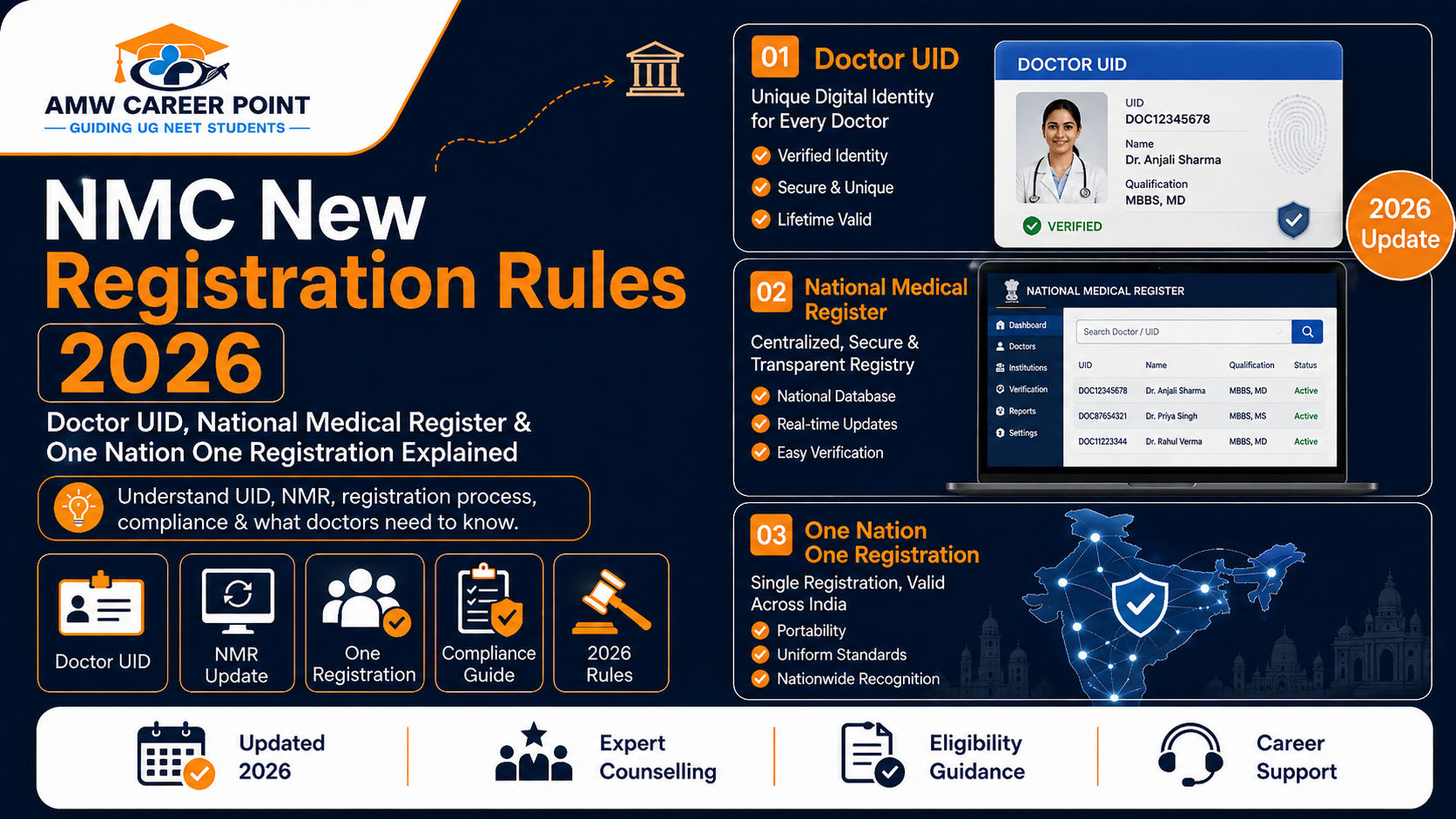
On 11 August 2026, the National Medical Commission notified the draft Registration of Medical Practitioners and License to Practice Medicine (Amendment) Regulations, 2026, a proposed amendment to the existing 2023 Registration of Medical Practitioners and License to Practice Medicine Regulations, not a standalone new law. The same notification withdrew an earlier draft published on 7 April 2026, which had proposed narrower amendments (to Regulations 2, 6, 7, 8, 9, plus a new 10A) and had included separate, since-withdrawn provisions specifically for Armed Forces Medical Services doctors.
The August draft opens a 30-day stakeholder consultation window, counted from the date the gazette notification is made available to the public. Objections and suggestions can be submitted to NMC before the Commission considers finalizing the amendments.
2026 Update: Read This Before Anything Else in This Guide The August 2026 document is a draft amendment, open for public comment. It is not yet a final, operational rule. Nothing in this guide should be read as implying that the new UID/One Nation One Registration framework is already mandatory; we'll flag clearly throughout which parts of this article describe something already in force versus something currently proposed. We'll update this page if and when NMC publishes a final notification. |
NMC 2026 Registration Rules: Current Rules vs Proposed Changes
Area | Current Framework (Already in Force) | August 2026 Proposal |
State registration | Registration via the relevant State Medical Council (SMC) | Continues; SMCs remain the registration/licensing authority |
National Medical Register (NMR) | Already exists; pilot launched 2024, registration began September 2024 | Strengthened role as central repository, with electronic synchronization to State Registers |
NMR ID / UID | Existing NMR ID system, application described as voluntary as of 2025 government statements | A centrally-generated UID, incorporating state/UT code + SMR registration number, tied to State Medical Register entry |
State-to-state practice | Existing transfer/fresh-registration requirements when relocating states | Nationwide practice eligibility once UID is allotted, without fresh state registration |
NMR–SMR synchronization | Existing NMR portal, linked to Aadhaar for identity verification | Proposed electronic synchronization: a change in either register reflected in the other |
Disciplinary records | Handled through existing SMC/NMC regulatory mechanisms | NMR proposed as a central repository for registration particulars and disciplinary orders (suspension, removal, restoration) |
Licence validity | Existing registration/licensing system | 5-year validity proposed, with an inactive-status mechanism if not renewed within a prescribed post-expiry window |
Appeals | Existing regulatory/legal mechanisms | A specific EMRB appeal route proposed for registration/licence rejections |
Foreign Medical Graduates | Existing FMGL 2021 pathway | Explicitly incorporated into the registration/UID framework, alongside OCIs, once FMGE/NExT is cleared. |
Existing registered doctors | Existing state/IMR registration | One-time UID update proposed, with no EMRB/NMC fee for the update |
Why This Table Matters More Than a News Summary Almost every serious question a doctor, FMG, or MBBS-abroad student has about this reform can be reduced to one of these rows. Bookmark this table; the rest of this blog is based on this. | ||
What Is the National Medical Register (NMR)?
The National Medical Register is a centralized database of registered modern-medicine practitioners, maintained by NMC under Section 31 of the NMC Act, 2019. It is not a new proposal; it already exists, with a pilot launched in 2024 and doctor registration beginning in September 2024, inaugurated for eligible MBBS doctors.
Established under: Section 31, NMC Act 2019
Maintained by: the Ethics and Medical Registration Board (EMRB) of NMC
Who is included: licensed and registered medical practitioners enrolled in State Medical Registers
Information maintained: name, UID/registration details, qualifications, place of work, specialty, and the institute/university of qualification, among other particulars
Purpose: eliminate duplication and administrative red tape, and give the public a way to verify a practitioner's credentials
Relationship to State Medical Registers: intended to interoperate with, not replace, each state's own register, with the August 2026 draft proposing tighter, electronic synchronization between the two
Public verification: part of the NMR is designed to be publicly accessible so that patients can check a doctor's registration and qualifications.
The NMR is also explicitly linked to each doctor's Aadhaar for identity verification during registration. This point should be clearly distinguished from the question of whether Aadhaar itself constitutes a medical license.
NMR vs Indian Medical Register (IMR): What's the Difference?
Feature | IMR (Legacy) | NMR (Current) |
Authority | Earlier MCI/NMC-era system | NMC, via EMRB |
Format | Legacy, largely paper/state-fragmented register | Digital, centralized electronic register |
Verification | Historical, manual-heavy system | Integrated digital verification process |
Unique identifier | State registration number only | NMR ID / UID, tied to state registration |
Updates | Limited, slow to reflect changes | Designed for more dynamic, ongoing updates |
Public verification | Available, but fragmented by state | Designed for centralized, single-portal verification |
A Transition, Not an Overnight Switch NMC has stated that data from the roughly 14 lakh doctors registered under IMR would be transferred to NMR without requiring doctors to re-register from scratch. NMC continues to maintain IMR-related verification resources alongside the newer NMR system during this transition; the IMR didn't simply vanish the day NMR launched. | ||
What Is the NMC Unique Identification Number (UID) for doctors?
What Is the UID?
Under the August 2026 draft, the UID (Unique Identification Number) is a centrally generated identifier for each registered medical practitioner, incorporating the code of the relevant state/UT and the practitioner's State Medical Register registration number.
Who Generates and Assigns It?
The Ethics and Medical Registration Board (EMRB) of NMC centrally, once a person (including a foreign medical graduate, where applicable) is registered in the concerned State Medical Register.
When Is It Generated?
Per the draft, after State Medical Register registration is complete, the UID is generated as the next step, not as a parallel or independent process.
Is UID the Same as Aadhaar, NMR ID, State Registration Number, or ABHA?
No, these are four different identifiers and have four different purposes These are commonly confused, and the confusion matters; see the comparison table in Section 6 below for exactly how each differs. |
NMC UID vs NMR ID vs State Registration Number vs Aadhaar vs ABHA
Identifier | Purpose | Issued/Maintained By |
Aadhaar | General individual identity verification | UIDAI |
ABHA | Digital health identity (for health records generally, not medical licensing) | Ayushman Bharat Digital Mission (ABDM) |
State Medical Registration Number | Professional medical registration within a specific state | State Medical Council |
NMR ID | National medical register identification | NMC / EMRB |
Proposed UID (August 2026 draft) | National professional identifier under the proposed framework, incorporating state code + SMR number | EMRB / NMC |
Important Nuance The NMR portal already uses Aadhaar-linked authentication for identity verification during registration, but Aadhaar itself is not, and does not become, a medical license. It verifies who someone is; it says nothing about whether they're a registered, licensed medical practitioner. Don't conflate the two. | ||
How Does the NMC UID Registration Process Work?
Medical qualification: Complete an MBBS (or NMC-recognised equivalent) degree
State Medical Council registration: Register with the relevant SMC
Verification: SMC and NMR-side verification of credentials
NMR/EMRB processing: Application processed centrally
UID generation: EMRB generates the UID, tied to the SMR entry
National registration/practice framework: Under the August 2026 proposal, this would confer nationwide practice eligibility without fresh state-by-state registration
For the existing NMR portal (already operational and separate from the August draft), applications are submitted and verified by the State Medical Council before the NMC issues the NMR ID. A dated snapshot from an April 2026 record showed 175,041 applications received and 5,489 pending as of 29 April 2026, useful as an indicator of processing scale, not a current, live figure.
Who Will Get the New NMC UID?
Indian MBBS graduates: generated upon State Medical Register registration, as the standard pathway
Existing registered doctors: a one-time UID update is proposed for those already on IMR/SMR, with no EMRB/NMC fee for this update
Foreign Medical Graduates: explicitly incorporated into the registration pathway under the August draft, once FMGE/NExT (as applicable) is cleared and provisional/permanent registration follows
Indian citizens with foreign medical degrees: covered under the same FMG pathway as above
OCI applicants: the draft specifically streamlines processes for Overseas Citizens of India pursuing this route
Other eligible practitioners: covered as specified under the applicable regulations, including special provisions discussed for categories such as Armed Forces Medical Services doctors in the earlier (now withdrawn) April draft
What Is ‘One Nation, One Registration’ for doctors?
The informal name for the broader reform this blog covers is a system in which a single, centrally recognized UID (following State Medical Council registration) allows a doctor to practice anywhere in India without needing a fresh registration or license each time they move between states.
Proposed Pathway
State Medical Council registration → UID generated by EMRB → registration recorded in NMR → eligibility to practice medicine anywhere in India, per the August 2026 draft's stated intent.
The draft specifically states that once a practitioner is registered and licensed by an SMC and allotted a UID in the NMR, they would be eligible to practice in any State/UT without a fresh registration or license there.
Can a Doctor Practice in Any State with One NMC UID?
Can an MBBS doctor practice anywhere in India? Under the proposed framework, yes, once registered, licensed by an SMC, and allotted a UID
Is separate State Medical Council registration still required to move states? Under the proposal, no fresh registration would be needed once the UID exists, though the SMC of the destination state would be notified and given a prescribed processing period
Does UID automatically allow practice? Only after the underlying SMC registration and licensing step is complete is UID generated as a consequence of that registration, not a substitute for it
What role does the State Medical Council retain? A substantial one
Does the proposal eliminate State Medical Councils?
No, This Is a Common Misreading The proposal does not abolish State Medical Councils. SMCs retain their core role in granting registration and licensing, and in handling disciplinary matters arising within their own jurisdiction. The actual proposed change is central synchronization and nationwide practice validity after UID allotment, not the removal of SMCs from the system. |
Role of State Medical Councils Under the New NMC Framework
Registration: SMCs remain the entry point for a practitioner's registration
Licensing: SMCs continue to grant the license to practice
Verification: SMCs verify credentials as part of registration
Fees: existing SMC fee structures are not described as being eliminated by the draft
Disciplinary role: complaints and misconduct allegations are investigated by the SMC where the incident occurred, with findings shared with both the state registration council and the national database
Synchronization with NMR: proposed to happen electronically, rather than through manual reporting
Interaction with EMRB: EMRB centrally generates the UID and maintains the NMR, working alongside and not replacing SMC functions
NMR–State Medical Register Electronic Synchronization
The August draft proposes electronic synchronization between the NMR and each State Medical Register, so that a change recorded in one a disciplinary action, a qualification update, a status change is automatically reflected in the other, rather than relying on manual cross-reporting between systems. The draft also proposes a new Regulation 9A to determine which State Medical Council has jurisdiction in cases involving a practitioner registered in one state but practicing in, or facing a complaint in, another.
What Information Will the National Medical Register Contain?
Name and registration details
Qualifications and additional qualifications
Speciality
Registration status and license status
Institution/university of qualification
Disciplinary information: suspension, removal, restoration, and other regulatory orders (proposed as a central repository function under the August draft)
Can Patients Verify a Doctor Through NMR?
Yes, the NMR portal is specifically designed to let the public check a practitioner's registration status, qualifications, and (per the current proposal) certain disciplinary information, addressing a real, documented gap: cases like the widely reported fake-cardiologist incident in Madhya Pradesh exposed how difficult it previously was to track a doctor's professional history across state lines. That said, treat publicly visible information as what NMC chooses to disclose through the portal, not a complete regulatory file; some information remains visible only to EMRB, SMCs, NBE, and medical institutions rather than the general public.
Will Disciplinary Records Be Added to the NMR?
This is one of the more significant proposed changes in the August 2026 draft. The proposal makes NMR a central repository for:
1. Professional misconduct findings
2. Suspension orders
3. Removal orders
4. Restoration orders
5. Orders issued by SMCs and by EMRB/NMC
The explicit intent, per NMC's own framing, is to prevent a doctor with a disciplinary record in one state from practicing elsewhere without that history being visible or traceable, directly responding to the kind of cross-state accountability gap highlighted by recent, high-profile cases.
What Happens if a Doctor's Registration or License Is Rejected?
The August draft proposes a structured appeal pathway:
SMC decision → appeal to EMRB (within a stated window) → EMRB decision → SMC action.
Current reporting on the draft describes this appeal mechanism as being specifically written into the proposed regulations, giving practitioners a defined route to challenge a rejection rather than an ad hoc process.
NMC Medical License Validity: What Does the 5-Year Rule Mean?
Proposed, Not Yet in Force The August draft proposes a 5-year license validity period. If renewal isn't completed within the prescribed post-expiry window, as reported by some current coverage, of roughly three months, the practitioner could be marked inactive and unable to practice until reactivated. We're presenting this clearly as a proposal under consultation, not an existing universal rule; confirm the final, notified figure once NMC finalizes the amendment. |
NMC License Renewal Under the Proposed 2026 Rules
When renewal would be required: at the end of each 5-year validity period, per the proposal
Post-expiry period: a prescribed window (reportedly around 3 months in current coverage) before inactive status applies
Inactive status: a practitioner who doesn't renew within that window could be marked inactive and barred from practicing
Reactivation: presumably possible through a renewal process, though exact mechanics should be confirmed once the rule is finalized
Practical implication: once finalized, doctors would need an active reminder system for their own 5-year renewal cycle; treat this as a planning consideration for the future, not an immediate action item while the rule remains a draft
What Happens to Existing Doctors Who Don't Have an NMR UID?
The August draft proposes that existing practitioners already enrolled in IMR/SMR without a UID would receive one as a one-time measure, with no fee charged by EMRB/NMC for that specific update intended to bring the roughly 14 lakh already-registered doctors into the new framework without requiring them to re-register from scratch.
Is NMR ID Currently Mandatory?
This is worth a precise timeline, because conflicting claims circulate online.
Year | Status |
2024 | NMR portal pilot launched; registration for eligible MBBS doctors began, inaugurated by the Union Health Minister in September 2024 |
2025 | Government statements described application for an NMR ID as voluntary at that stage. |
2026 | The August draft proposes a more integrated, UID-centred framework but remains a draft, open for stakeholder comment, as of this guide's writing. |
What We Will Not Write We will not state that ‘NMR UID is already mandatory for every doctor’ anywhere in this guide, because that isn't accurate as of a final notification. If and when NMC finalizes the August draft into an operational rule, this section will be the first thing we update. | |
NMC 2026 Rules and Foreign Medical Graduates
Shifting now to the audience AMW Career Point works with most directly: NEET aspirants and families considering, or already pursuing, MBBS abroad.
Foreign medical degree → FMGL 2021 compliance → FMGE/NExT as applicable → provisional registration/internship → permanent registration → NMR/UID.
The August 2026 draft's contribution to this chain is at the very end; it explicitly incorporates FMGs (and OCIs) into the registration/UID framework once they've already cleared the qualifying exam and completed the required internship steps. It does not change anything earlier in this chain.
What Does the New NMC UID Mean for MBBS Abroad Students?
Students planning MBBS abroad: the UID reform doesn't change your admission planning, NEET requirement, or FMGE 2021 compliance checks; those remain governed by existing rules covered in our other guides
Current foreign medical students: unaffected in terms of your ongoing coursework or clinical training requirements
Students graduating abroad: the UID becomes relevant only after you clear FMGE/NExT and complete provisional registration/internship steps; it's the final link in the chain, not an earlier one
FMGs returning to India: once permanently registered with an SMC post-FMGE/CRMI, you'd be brought into the same UID/NMR framework as Indian graduates, per the proposal
The Single Most Important Sentence in This Section A UID does not make an overseas medical degree NMC-recognised. It is a registration/licensing identifier generated after a foreign medical graduate has already satisfied FMGL 2021, cleared FMGE/NExT as applicable, and completed the required registration steps. It does not replace, shortcut, or substitute for any of those foreign medical qualification eligibility requirements; see our MBBS in India vs Russia guide and our Uzbekistan/Georgia/Kyrgyzstan guides for what those requirements actually entail. |
Does NMC UID Replace FMGE?
No A foreign medical degree, an NMC UID, and FMGE/NExT are three separate things. FMGE remains the operative screening examination for eligible foreign medical graduates under the existing regulatory framework, as it has throughout 2026 (see our MBBS in India vs Russia guide for FMGE's current status and schedule). The UID is generated later, as part of registration; it has no bearing on whether FMGE is required. |
Does NMC UID Replace NExT?
No. NExT remains a separate examination/regulatory framework under the NExT Regulations 2023, and its rollout is not yet operational for foreign medical graduates as of 2026 (see our MBBS in India vs Russia guide's dedicated section on this). A registration identifier and a licensing examination framework serve entirely different functions; don't confuse the two.
FMGE vs NExT vs NMC UID: Complete Difference
Feature | FMGE | NExT | NMC UID |
Type | Examination | Examination/licensing framework | Registration identifier |
Main purpose | FMG screening | National exit/licensing pathway (once operationalized) | National medical registration |
Applies to | Eligible FMGs | As operationalized, when implemented | Registered practitioners generally |
Conducting/governing authority | NBEMS | NMC/NBEMS framework | EMRB/NMC |
Replaces registration? | No | No | It IS the registration identifier and not a replacement for the exam requirement. |
Is it an exam? | Yes | Yes | No |
What Are the 2026 NMC Requirements for MBBS Abroad Students?
A brief recap, connecting to our fuller treatment elsewhere on the site, the registration reform this guide covers sits downstream of all of these:
NEET requirement: Indian citizens/OCIs intending to obtain a primary medical qualification abroad must qualify NEET-UG for the India-return pathway to remain open
FMGL 2021 compliance: minimum 54-month course duration, English medium of instruction, curriculum commensurate with Indian MBBS, and a 12-month internship at the same foreign institution covered in full in our MBBS in India vs Russia guide
FMGE/NExT: FMGE remains operative; NExT not yet implemented for FMGs
CRMI: a further 12-month India-side internship required for most current students, per CRMI Regulations 2021
Registration and UID: the final step this guide has focused on occurring only after all of the above are satisfied
Timeline: From Foreign Medical Degree to NMC UID
Complete FMGL-compliant foreign medical degree + internship at the same institution
Clear FMGE (or NExT, once implemented for FMGs)
Complete provisional registration and CRMI (12 months) in India
Obtain permanent registration with the relevant State Medical Council
Receive UID, generated by EMRB and recorded in the NMR under the August 2026 proposal, once finalized
Where This Fits Relative to Everything Else in an FMG's Journey The UID sits at the very end of a multi-year process. If you're still at the university selection or admission stage, the registration reform covered in this guide is not something to factor into your near-term decisions; focus on FMGL 2021 compliance and clinical training quality first, using the checklists in our country-specific guides. |
Who Is Affected, and How
Stakeholder | Current Reality | Proposed Change |
Recent MBBS graduate | Register with one SMC | Same first step; UID generated after, per proposal |
Existing doctor | Multiple-registration friction when relocating states | Potential nationwide practice eligibility via UID, once finalized |
Foreign Medical Graduate | FMGL compliance + FMGE/NExT + CRMI + SMC registration | UID generated after qualifying registration is complete; no change to the underlying FMGL/FMGE/CRMI requirements |
Doctor changing states | Fresh transfer/registration requirements | Potentially easier mobility, once finalized |
Patient | Fragmented, state-by-state credential verification | Better centralized records, including disciplinary history, once finalized |
State Medical Council | Full registration/licensing/disciplinary authority | Continues, with added electronic synchronization to NMR |
NMC/EMRB | National oversight role | Greater centralized role in UID generation and NMR maintenance |
Three Things This Guide Deliberately Gets Right
Common Errors We're Correcting 1. This is not a final regulation. As of 20 August 2026, it is a draft, with stakeholder comments invited for 30 days from gazette publication. Don't act as though the UID/NMR framework is already legally binding. 2. NMR/UID does not replace FMGE or NExT. A registration identifier and a licensing examination are not the same thing. FMGE remains the relevant screening pathway for eligible FMGs under the existing framework, independent of this registration reform. 3. State Medical Councils are not being eliminated. The proposed system keeps SMCs central to registration, licensing, and jurisdiction-level disciplinary handling. The actual proposed change is central synchronization and nationwide validity after UID allotment, not SMC abolition. |
Conclusion
The NMC's new registration rules for 2026 propose a Doctor UID (Unique Identification Number) and a National Medical Register, which comes under the “One Nation, One Registration” policy, which represents a reform direction that is simple and helps centralize practitioners to verify their details, disciplinary record portability across states, and simpler multi-state practice for doctors. But as of this blog's writing, all of it remains a draft under public consultation, not operational law, and State Medical Councils are not being removed from the system despite how some coverage has framed it.
For AMW's core audience, NEET aspirants and MBBS-abroad families, this reform sits at the very end of a much longer journey that starts with NEET, runs through FMGL 2021 compliance and university verification, and passes through FMGE/NExT and CRMI before UID and NMR registration become relevant at all. Don't let headlines about this reform distract from the university selection and FMGL compliance work that actually determines whether a foreign medical degree is usable in India in the first place.
Frequently Asked Questions
What are the new NMC registration rules for 2026?
A draft amendment to the Registration of Medical Practitioners and License to Practice Medicine (Amendment) Regulations, 2026, notified on 11 August 2026, proposes a centrally generated UID tied to State Medical Register registration, nationwide practice eligibility once allotted, NMR as a central disciplinary records repository, and a 5-year license validity. It remains under 30-day public consultation.
What is the NMC Unique Identification Number?
A proposed identifier, generated by EMRB after State Medical Register registration, incorporating the state/UT code and SMR registration number, intended to grant NMR registration and nationwide practice eligibility.
What is NMR ID?
The existing National Medical Register identification number, issued by NMC/EMRB, a system already operational since the 2024 pilot, distinct from the newly proposed UID framework, though closely related.
Is NMR ID the same as UID?
Closely related but not identical in current usage, NMR ID refers to the existing register identifier; UID, under the August 2026 draft, is the proposed centrally generated identifier that would grant NMR registration and nationwide practice eligibility.
Is NMR ID mandatory in 2026?
Government statements as of 2025 described NMR ID application as voluntary. The August 2026 draft proposes a more integrated, mandatory-leaning UID framework, but this remains a draft, not a final notified rule, as of this guide's writing.
What is the National Medical Register?
A centralized database of registered medical practitioners, maintained by NMC's EMRB under Section 31 of the NMC Act, 2019, already operational, not a new 2026 creation, though the August draft proposes strengthening its role.
What is One Nation One Registration?
The informal name for the reform, proposed under the August 2026 draft, allowing a doctor, once registered with an SMC and allotted a UID, to practice anywhere in India without fresh state-by-state registration.
Can doctors practice anywhere in India with one registration?
Under the proposal, yes, once a UID is allotted following SMC registration. This is not yet an operational rule as of this guide's writing.
Will State Medical Councils be abolished?
No. SMCs retain their core registration, licensing, and jurisdiction-level disciplinary role under the proposal.
Who will issue the UID?
The Ethics and Medical Registration Board (EMRB) of NMC, centrally, once State Medical Register registration is complete.
What is the role of EMRB?
NMC's Ethics and Medical Registration Board maintains the NMR, generates the proposed UID, and would handle the proposed appeal mechanism for registration/licence rejections.
How can doctors register on NMR?
Through the existing NMR portal, via their State Medical Council, using their degree certificate, SMC/MCI registration certificate, and Aadhaar-linked verification.
What documents are required for NMR registration?
Digital copies of the medical degree certificate and State Medical Council (or legacy MCI) registration certificate, alongside Aadhaar-based identity verification.
Is NMR registration currently voluntary?
Described as voluntary in 2025 government statements; the August 2026 draft proposes a more integrated framework, but this remains under consultation, not yet final.
What happens to existing doctors without an NMR UID?
The August draft proposes a one-time UID update for existing IMR/SMR-registered practitioners, at no fee.