There is a detail about BPKIHS that most guides mention in passing but never actually explain. This university was founded through a bilateral agreement signed between the Health Ministers of India and Nepal on Mahashivaratri, 10 March 1994. It is not just built on a hill in eastern Nepal; it is, formally and structurally, a product of Indo-Nepali cooperation. That origin matters because it shaped everything about BPKIHS's design: the curriculum, the clinical training model, the community health mandate, and the degree recognition framework. When the NMC India recognised BPKIHS's MBBS from the very first year, 1994, it was no coincidence. It was the direct consequence of India being one of the founding partners.
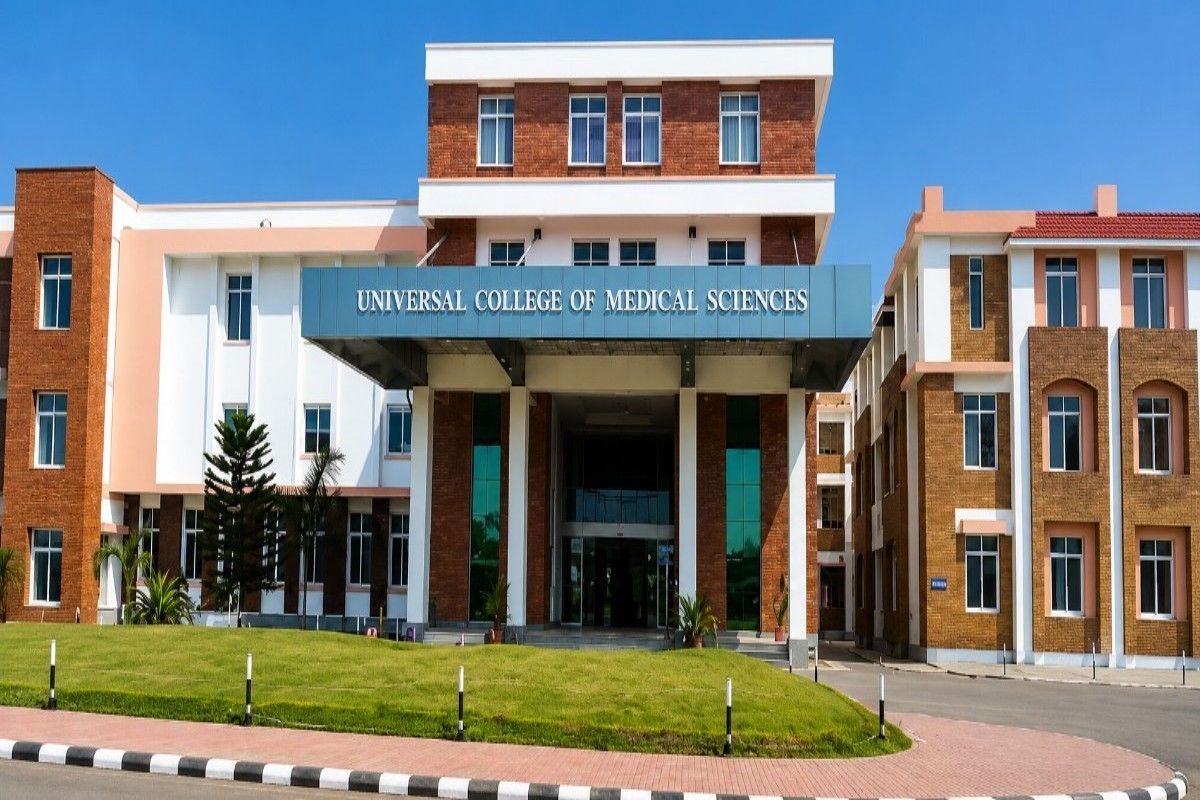
BPKIHS was established on 18 January 1993 and subsequently upgraded to a fully autonomous Health Sciences University on 28 October 1998. It sits on a 700-acre campus in Dharan, Sunsari District, a clean, green sub-metropolitan city in the foothills of eastern Nepal, consistently described as one of the country's least polluted cities. The campus is not a collection of buildings in a city; it is a self-contained medical university town with 24/7 electricity, an uninterrupted water supply, its own sports facilities, hostel blocks, a 14,000-volume library, and a 700-bed teaching hospital at its centre.
That teaching hospital, the BPKIHS Central Teaching Hospital, is what makes this institution clinically serious in a way that most overseas MBBS destinations are not. Over 1,000 patients arrive at the OPD every single day. The emergency department handles nearly 40,000 patients per year and operates round the clock, with emergency operating theatres, emergency X-ray, emergency CT scan, and 24/7 USG. When a student in Year 3 walks into their first clinical posting at BPKIHS, they are not entering a teaching ward with curated cases. They are entering a working tertiary hospital that serves the entire eastern belt of Nepal and the cross-border population from Bihar and West Bengal.
The Teaching District Concept is the feature that competitor pages mention but fail to explain. Since 2000, BPKIHS has operated a network of eight districts across eastern Nepal, primary health centres, district hospitals, and zonal hospitals where students are posted during community and internship rotations. This is not a one-week rural camp. It is a structured, faculty-supervised placement system through which BPKIHS extends real clinical services to eight districts while simultaneously training students in the epidemiology, pathology, and healthcare delivery challenges of under-resourced settings. For a student considering a public health MD, community medicine, or a global health career, this component of the BPKIHS curriculum is genuinely irreplaceable.
For Indian students, the practical proposition at BPKIHS is clean and honest. English is the medium of instruction throughout. No language test is required. The flight to the nearest major airport, Biratnagar, takes under two hours from Delhi or Kolkata, and Biratnagar is 20 kilometres from Dharan. Students from Bihar, Jharkhand, West Bengal, and the Northeast find the cultural transition minimal: the food, the festivals, the social norms, and much of the language overlap. The campus is fully residential, with well-maintained hostel blocks, and the annual hostel fee of approximately $280 is among the lowest of any recognised MBBS institution in Nepal the region.
The cost reality needs to be stated clearly because different sources quote widely varying figures. Annual tuition at BPKIHS is approximately INR 14 lakh. Total 5.5-year all-inclusive costs, tuition, hostel, food, insurance, and personal expenses typically range from INR 45 to 70 lakh, depending on lifestyle. That range sits higher than Central Asian options and lower than Indian private colleges. What you get for that cost is a government autonomous institution with a 30-year track record, an NMC recognition going back to 1994, a 700-bed live teaching hospital, and a community clinical network covering eight districts. No private college in Kyrgyzstan or Uzbekistan offers that combination.
Finally, BPKIHS is a no-management-quota institution. Every seat is allocated on merit through the Medical Education Commission's MECEE-BL entrance examination. There is no back-door admission. That matters for two reasons: it means the peer cohort is genuinely academically selected, and it means the degree does not carry the institutional baggage that management-quota seats sometimes create when graduates compete for residency placements in India.