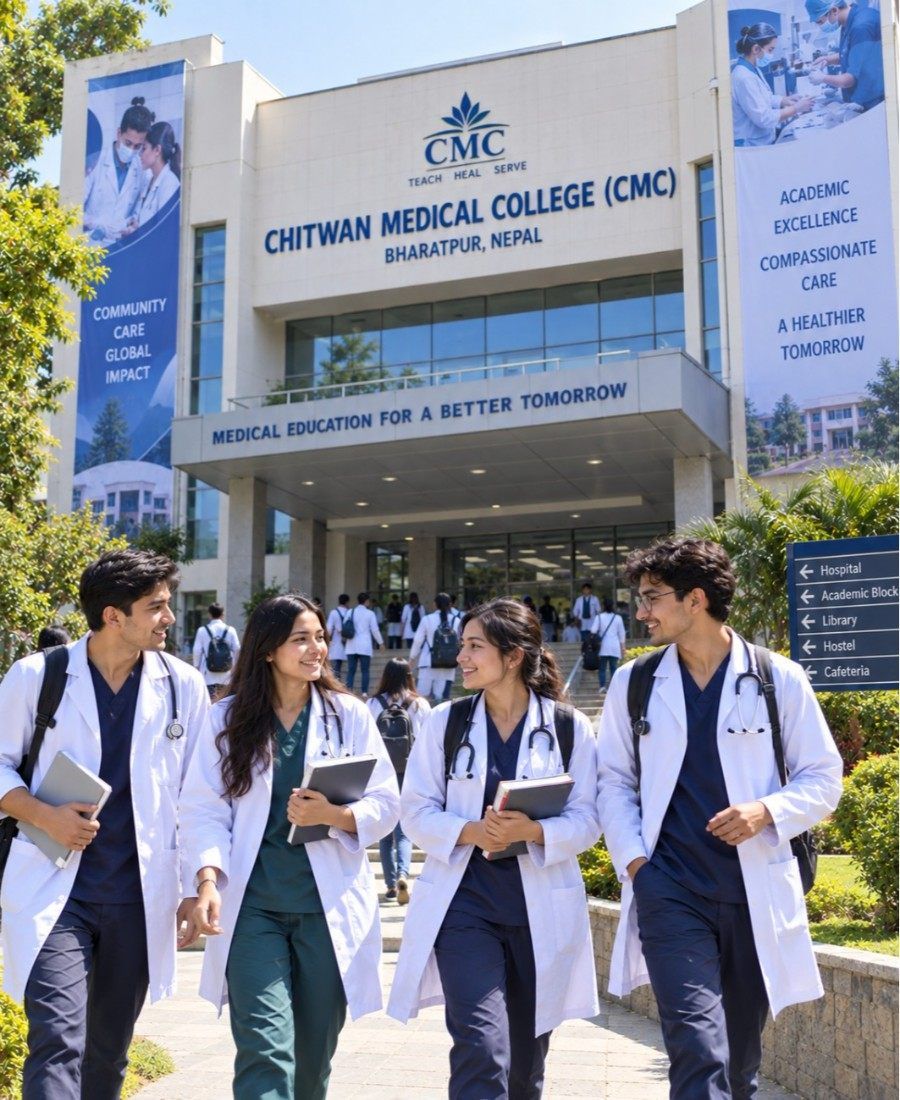
Bharatpur is not Kathmandu. That matters more than most MBBS guides acknowledge. Chitwan Medical College sits in southern-central Nepal, in a mid-sized city that has grown steadily, where the cost of living, the pace of daily life, and access to natural surroundings are meaningfully different from those in the capital. Students who settle well at CMC typically mention that Bharatpur is quieter, and that this quietness leads to more productive study hours in the evenings, particularly during the high-stakes pre-clinical years.
CMC was founded in 2006 by the International Society for Medical Education Private Limited, and the MBBS programme started in 2009 with an initial intake of 80 students. Since then, the college has grown into one of the five most recognised private medical colleges in Nepal. It now admits 100 MBBS students per year and offers postgraduate programmes, MD and MS, alongside BDS, BSc Nursing, Pharmacy, MPH, and allied health sciences. However, MBBS remains the core of what CMC does, and the 750-bed teaching hospital on campus is built around the entire programme.
CMC Teaching Hospital is not an affiliated government facility and is located some distance from the campus. It is on-site. Modern ICUs, emergency units, a fully operational surgical department, obstetrics wards, paediatric units, orthopaedic facilities, and a diagnostic wing are all within walking distance of the academic buildings. The hospital draws patients from the Chitwan district and the surrounding Tarai belt, which means agricultural trauma, infectious disease, obstetric emergencies, and the growing chronic disease burden of a rapidly urbanising population. For FMGE and NExT preparation, the variety of cases matters directly.
The recognition portfolio at CMC is wider than most guides mention. Beyond the standard WHO and NMC approvals, CMC holds recognition from the General Medical Council of the United Kingdom, the Medical Council of Sri Lanka, and ECFMG USA. That combination means four distinct international licensing pathways are open from graduation: FMGE/NExT for India, PLAB for the UK, USMLE for the USA, and the Sri Lanka pathway for SAARC-region practice. Very few Nepali private colleges hold all four simultaneously, but competing pages on CMC consistently skip this detail.
For Indian students, the geographic logic is unusually clean. Bharatpur is reachable from Gorakhpur on the UP-Nepal border by direct bus in roughly four to five hours. The Delhi-to-Bharatpur air journey via Kathmandu takes under two hours. Students from UP, Bihar, Uttarakhand, and Jharkhand are, in practice, closer to CMC than to many South Indian MBBS colleges. Hindi is widely spoken in Bharatpur, and across the Chitwan Tarai belt, the cultural distance is genuinely negligible.
The fee structure is MEC-regulated and transparent. The Medical Education Commission of Nepal sets the total tuition fee for international students at USD 75,000 for the full 5.5-year programme, payable in three equal instalments. There is no donation, no capitation fee, and no renegotiation. The total all-inclusive cost of tuition, hostel, food, insurance, and local expenses typically comes to INR 62–70 lakh for the full course. That is the number families should compare against Indian private college fees, not just the annual tuition headline.