
Q1. Can I study Medicine at Ghent University in English?
+No. Ghent's own Faculty page confirms that dentistry and medicine are Dutch-only and not offered in English.

 Belgium | Est. 1993
Belgium | A recognised public Belgian university, one of Flanders' largest, with 11 faculties in total. | Dutch for Medicine and Dentistry; English for the Biomedical Sciences and Global Health master's, plus roughly 69 other medium
Expert will call you within 2 hours
Ghent University was founded in 1817 by King William I of the Netherlands. It's now one of the largest universities in Flanders. Its Faculty of Medicine and Health Sciences is one of 11 faculties across the city, and it works closely with Ghent University Hospital, known locally as UZ Gent. Because of this close tie, teaching and clinical care sit right next to each other on the same campus.
Here's the thing most agent-style pages skip: this Faculty runs two separate tracks. One is a Dutch-medium Medicine and Dentistry program that trains real physicians for Belgian practice. The other is a small set of English-taught master's, built for research careers, not clinical licensure. Mixing the two up is the single biggest mistake international applicants make.
The medical campus centres on UZ Gent, one of the largest hospitals in Flanders. It holds more than 1,000 beds, employs around 6,500 staff, and treats roughly 75,000 inpatients plus 400,000 outpatients a year. Also worth knowing: the hospital is midway through a major redevelopment, aiming to become a fully modern health campus by 2029. Ghent itself is a compact, historic port city of about 270,000 people, the capital of East Flanders.
World Directory of Medical Schools administers medicine and dentistry admissions through a single national entrance exam, organised by the government rather than by individual universities. In Flanders, that includes Ghent, this exam is offered only in Dutch. So, you need strong, certified Dutch before you even think about applying. Ghent University states this plainly on its website: dentistry and medicine are offered only in Dutch, not in English.
What about English, then? The Faculty offers two real options: the Master of Science in Biomedical Sciences (2 years, 120 credits) and the Master of Science in Global Health (2 years, 120 credits, run jointly with four other Flemish universities). Both stay genuinely open to international students. Neither leads to a medical licence.
Fees also vary by programme, not just nationality. One comparison sheet for non-EU applicants lists Biomedical Sciences at roughly EUR 6,672 per year. So don't assume one "Ghent Medicine" fee applies across the board; check the specific programme first.
Search results for "Ghent University Faculty of Medicine and Health Sciences" are full of generic study-abroad pages. Several list a program called "Master of Surgery" here as if it were a real English degree. It isn't; no such English-taught programme appears on Ghent's own official study guide. That single error should make you double-check everything else these pages say.
The Dutch-Only Entrance Exam Isn't a Small Detail — Ghent's own Faculty page states outright that dentistry and medicine are Dutch-only. This isn't a rumour or a technicality. It's a direct admission from the university itself.
Ranking Numbers Conflict Across Sources — QS lists Ghent around the 162nd position for 2026, but another QS-linked directory lists 150th for 2027. THE, meanwhile, shows figures from 112th to 115th. Always check the ranking body and year before quoting a number.
Subject-Specific Rankings Tell a More Useful Story — By research output, Ghent ranks 2nd in Belgium and 179th globally in Medicine. That's more honest than a vague, institution-wide number.
Invented Programme Names Undermine Otherwise Decent Pages — Beyond "Master of Surgery," some pages list a generic "Medicine (Bachelor's Degree)" as an English option, without ever flagging the entrance exam.
Be clear about what you're signing up for. Practising as a doctor requires near-native Dutch before the entrance exam, plus a place in a heavily competitive national quota. Biomedical or global health research, though, remains genuinely open through the English-taught master's program.
So, who fits here? Students aiming at a research career in the life sciences or public health, comfortable with Belgium's cost of living, and clear on which track they're entering. Anyone assuming a full English-medium medical degree should double-check that first.
City-level safety — Ghent scores around 74.6 out of 100 on independent safety indices, with a comparatively low crime index of around 28. That puts it among the safer university cities in Belgium.
Areas to be mindful of — Locals commonly advise extra caution at night around Brugse Poort, Nieuw Gent, and Citadel Park. This isn't unique to Ghent; most cities have a few areas best avoided after dark.
Campus and hospital access — UZ Gent runs full emergency services around the clock, so students get access to a major hospital's emergency department close to campus.
Consular support — Indian students should register with the Indian Embassy in Brussels after arrival, standard practice across Belgium.
Expense Head | Approx. Monthly (EUR) | Notes |
Housing (student room) | 400-670 | Cheaper than Brussels or Antwerp; Numbeo/Qogent estimates |
Food | 250-350 | Discount supermarkets cut this noticeably |
Transport | 20-30 | Student discount rates apply to public transport |
Health Insurance | 25-45 | Mandatory in Belgium for all residents |
Miscellaneous | 100-150 | Books, phone, leisure, personal expenses |
Estimated Total | 800-1,200 | Matches multiple independent student-budget estimates |
• Dutch-language certification for anyone attempting the entrance exam route
• Mandatory Belgian health insurance, sometimes quoted separately from tuition
• Student visa and residence permit fees for non-EEA applicants
• Housing deposit, typically one to two months' rent
• Document translation and legalisation for non-EU transcripts
• Proof-of-funds requirement for the Belgian student visa
• Return airfare, since most non-EU students fly rather than commute regionally
• Lab or fieldwork costs tied to specific Biomedical Sciences majors
Deadlines differ by programme, so confirm the current one directly. Several aggregator pages quote a blanket 15 January deadline, but Ghent's own English-taught master's pages list their own separate timelines each year. The national medicine and dentistry entrance exam schedule is set by the Flemish government, not Ghent University, so check that timetable on the official exam site.
Belgium's numerus clausus system for medicine and dentistry continues to cap national intake. Because this cap applies across all Flemish universities, seat numbers can shift slightly year to year based on national policy rather than university-level decisions.
Ghent combines a well-preserved medieval centre with a large student population; roughly 15% of residents aren't Belgian nationals, many of whom are students. The city is compact, bike-friendly, and well-connected by train to Brussels, Antwerp, and Bruges. The cost of living is lower here than in Brussels or Antwerp, which is one reason students often prefer it.
Teaching blends lectures, seminars, and lab work, with a strong translational-research culture linking basic science to clinical practice. UZ Gent and the Faculty jointly prioritise four research areas: oncology, genetics, immunology, and neuroscience. That focus feeds directly into teaching content.
Dutch-medium Medicine students complete clinical rotations through UZ Gent's 1,000-plus beds. Biomedical Sciences students, by contrast, mostly train through lab research placements and thesis projects instead.
Myth | Reality |
You can study Medicine at Ghent University in English. | Ghent's own Faculty page states that dentistry and medicine are offered only in Dutch and not in English. |
"Master of Surgery" is a real English programme here | No such standalone English-taught programme exists in Ghent's official study guide |
Ghent's global ranking is a fixed, single number. | QS and THE figures vary by year and by source, from 112th to 162nd, depending on which page you check |
A high overall ranking means Medicine is highly ranked, too | By research output, Medicine ranks 2nd in Belgium and 179th globally, a more specific and more useful figure |
Any medicine-related program at Ghent accepts international applicants directly. | Only two English-taught master's, Biomedical Sciences and Global Health, are genuinely open this way. |
1. Determine which programme is suitable for you, i.e., Biomedical Sciences or Global Health, depending on your academic background.
2. Consult the present deadline for programme-specific applications on Ghent’s official study guide.
3. Collect all necessary documents like transcripts, recommendation letters and motivation letter if you want to write one.
4. Fill in the application form on the website of Ghent University.
5. Wait for the announcement from the faculty regarding successful applications (this takes around two months).
6. Locate your location and begin the steps for payment and registration.
7. Get started on the application process for your student visa 6 months in advance of arriving in Ghent.
8. Fulfil all financial and medical requirements to apply.
9. Get to Ghent and go to the Student Registrar's Office to register. Register with the Indian Embassy in Brussels after arrival.
• Valid passport
• Certified, translated academic transcripts and diplomas
• Dutch language certificate for the Dutch-medium entrance exam route
• English proficiency certificate (IELTS/TOEFL) for English-taught programmes
• Motivational statement and references (for applicable master's programmes)
• Proof of sufficient funds for the student visa
• Belgian student visa application and supporting documents
• Mandatory health insurance proof
• Passport-size photographs
Ghent University offers general scholarships for international students, as well as interuniversity funding tied to programmes such as Global Health. Funding stays competitive and programme-specific, so check the scholarships database directly rather than assume automatic eligibility.
Set aside generic "study in Europe" marketing, and three factual reasons stand out—first, direct integration with a 1,000-plus-bed teaching hospital. Second, a research-led culture focused on oncology, genetics, immunology, and neuroscience; third, a lower cost of living than in Brussels or Antwerp.
Institution | Language of the MD Track | Approx. Non-EU Master's Fee | Notable Feature |
Ghent University Faculty of Medicine and Health Sciences | Dutch (MD); English (research master's) | ~EUR 6,672/yr (Biomedical Sciences) | UZ Gent's 1,000+ bed teaching hospital |
Dutch (MD); English (research master's) | EUR 1,181-9,494/yr (programme-dependent) | UZ Leuven's ~1,995-bed hospital system | |
Charles University, Prague | English (dedicated international MD track) | EUR 11,000-14,000/yr | Established English-medium MD pathway |
On the facts alone, Ghent's Faculty of Medicine and Health Sciences suits students aiming to pursue biomedical or global health research in English, backed by a research-led hospital system. However, in practice, it isn't an accessible route to a clinical medical degree without near-native Dutch, no matter how the faculty's name appears in search results.
Parameter | Details |
Founded | 1817, by King William I of the Netherlands |
Institution Type | Public, state-funded research university |
Location | Ghent, Belgium (East Flanders' capital city) |
Clinical MD Track | Dutch-medium only; national entrance exam; numerus fixus quota |
Track 1 Duration — Dutch MD (becoming a doctor) | Belgium's standard 3-year Bachelor + 3-year Master model, plus 4-6 years specialisation |
Track 2 Duration — English Master's (research, not a medical licence) | 2 years full-time (120 credits) for both Biomedical Sciences and Global Health |
English-Taught Options | Master of Science in Biomedical Sciences; Master of Science in Global Health |
Teaching Hospital | UZ Gent, 1,000+ beds, ~6,500 staff |
Global Rankings | QS ~150th-162nd; THE ~112th-115th (varies by source/year) |
Medicine Subject Ranking | 2nd in Belgium, 179th globally, by research output |
Programme | Approx. Annual Fee | Notes |
Master of Science in Biomedical Sciences (non-EU) | EUR 6,672 | Per one official comparison sheet, confirm the current rate |
Master of Science in Global Health | Varies by home institution | Jointly run across 5 Flemish universities |
Dutch-Medium Bachelor/Master of Medicine | Regulated Flemish rate (~EUR 1,000-1,200/yr) | Realistically inaccessible without certified Dutch and exam clearance |
Housing & Living Costs | EUR 800-1,200/month | Per multiple independent student-budget estimates |
No hidden charges, no donation. The full picture of costs at MBBS in Ghent University Faculty of Medicine and Health Sciences.
Tuition Fee
(Dutch-medium, EEA) Roughly EUR 1,000-1,200/year for regulated Flemish-rate programmes. (Biomedical Sciences, non-EU) Around EUR 6,672/year,
EUR 1,000-1,200/year for regulated Flemish-rate programmes.
Hostel Fee
EUR 400-670/month depending on room type and distance from the centre.
EUR 400-670/month depending on room type and distance from the centre.
Food & Meals
EUR 250 to 350
A full monthly food and grocery budget
Insurance
Roughly EUR 25-45
per month for students.
Donation
No donation
No Capitation Fees
Total Estimated Cost
EUR 15,000-22,000
per year cost, including tuition and living costs for the English-taught master'
25–35%
Average FMGE first-attempt pass rates for students from many overseas medical universities. Students from structured programs consistently score higher.
Students returning to India need to clear the FMGE/NExT exam. MBBS in Ghent University Faculty of Medicine and Health Sciences integrates exam-oriented coaching into the regular curriculum so students are prepared from day one.
A structured program that takes you from foundational sciences to clinical mastery.
• Early introduction to patient communication and the medical profession.
• Core subjects: Anatomy, Physiology, and Biochemistry
• First structured clinical-skills sessions begin.
• Study of disease mechanisms across major body systems.
• The completion of the BA degree program is necessary before commencing Master's studies.
• Combines basic pre-clinical knowledge with initial clinical involvement.
• Studies continue in diagnostics and clinical reasoning.
• Internships supervised across the various clinical units at UZ Gent.
• Clinical responsibility grows under faculty and hospital supervision.
• The students rotate through multiple areas of specialisation, including surgery, gastroenterology, etc.
• Graduation as a qualified physician; further specialisation follows separately.
• Final internships and completion of the master's thesis.

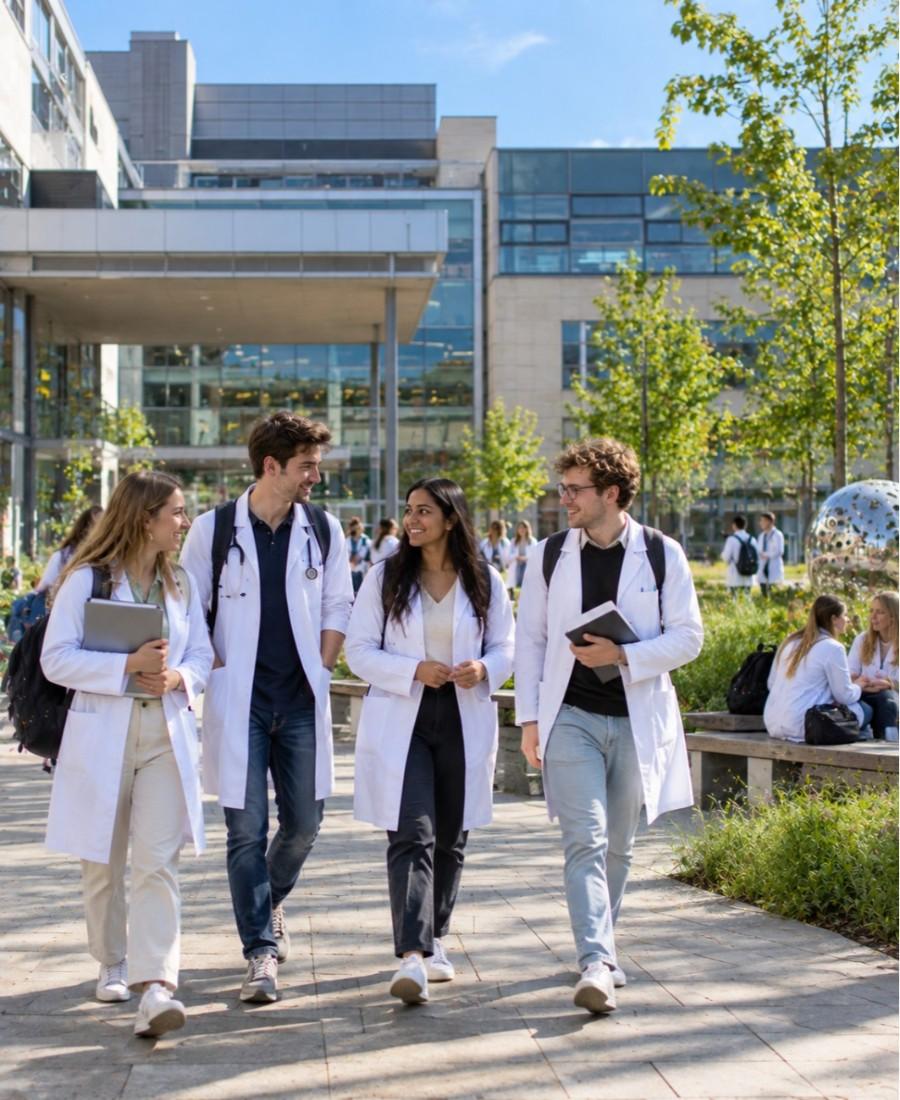
Furnished hostel rooms with Wi-Fi, laundry, 24/7 security, and Indian mess on or near campus.
Indian restaurants and mess facilities serving vegetarian and non-vegetarian home-style food daily.
Strong Indian community with cultural events, festival celebrations, and peer support groups.
Students get hands-on clinical training in government and private hospitals affiliated with the university.
Practical information for students planning to study at MBBS in Ghent University Faculty of Medicine and Health Sciences.
Prepare for all seasons. Thermal wear for winters, light clothing for summers. University provides heating in hostels.
Student visa processed with university invitation letter. Direct and connecting flights from major Indian cities.
Health insurance included in fees. Medical facility on campus plus city hospitals easily accessible.
Local SIM cards available. WhatsApp and video calls keep you connected with family back home.
Average monthly expenses of $150–$250 covering food, transport, and personal needs.
University library, online databases, and study groups. Seniors mentor juniors through academic challenges.
Our team guides you through every step — from application to arriving on campus.
Our team assesses Dutch or French readiness and determines the KU Leuven/Ghent (Dutch) or ULB/Liège (French) pathway.
Our team connects you with NT2 (Dutch) or DELF (French) certified instructors. Begin at least 12–18 months before intake.
Full Belgian application and visa document set, including language certificates and translated academic transcripts.
Our team submits to KU Leuven, ULB, Ghent, or Liège following the international admissions process.
University admission confirmation received. Begin CROUS-equivalent housing application.
Full documentation submitted to the Belgian Embassy in New Delhi. Begin 3 months before departure.
City-specific orientation Leuven, Brussels, or Ghent logistics, cycling culture, banking, SIM card.
Our team advises on routing to Brussels Zaventem (BRU) or Liège (LGG). Confirms arrival with the local team.
Our local team meets you and immediately initiates commune registration, which is mandatory within 8 days.
Residence card (E/A card) issued after commune registration. University enrolment and campus orientation proceed after that.
Admission Helpline — Contact our counsellors for step-by-step assistance.
“The faculty here is incredibly supportive. The clinical training during hospital rotations has given me real confidence in patient care.”
“Affordable fees without compromising on quality. The campus facilities and hostel life made my transition abroad very smooth.”
“English medium instruction and WHO-recognized curriculum were the deciding factors for me. No regrets so far — excellent experience overall.”
“The university helped with everything from visa to accommodation. Hospital exposure from year three has been invaluable for my FMGE prep.”
“Just cleared my licensing exam on the first attempt. The structured coaching and mock exams during final year were a game-changer.”
“Safe campus, good food options, and a strong Indian student community. The teaching methodology is very practical and hands-on.”
No. Ghent's own Faculty page confirms that dentistry and medicine are Dutch-only and not offered in English.
The Master of Science in Biomedical Sciences and the Master of Science in Global Health are both 2-year, 120-credit programmes.
No. It doesn't appear on Ghent's official study guide as a standalone English-taught degree, despite some agent pages listing it.
Depends on the year and source. Approximately 150th-162nd in QS and 112th-115th in THE.
It ranks 2nd in Belgium and 179th globally, based on its publications and citations.
Ghent scores around 74.6 on independent safety indices, among the safer Belgian university cities, though normal night-time caution applies in a few areas.
UZ Gent, with more than 1,000 beds and around 6,500 staff.
No, though basic Dutch helps with daily life and part-time work options.
A national exam organised by the Flemish government, taken in Dutch, is separate from Ghent University's own admissions process.
Yes, general and programme-specific funding exists, including interuniversity support for Global Health, though it's competitive.
The monthly cost of living in Ghent is approximately EUR 800-1,200.
Yes, as an EU/EEA-recognised degree from a major Belgian public research university.


Our expert counsellors will guide you through the complete admission process — from documents to airport pickup.