
Let us start with the number that actually determines your fate, not your NEET score, but the gap between your score and what a government MBBS seat actually costs. In NEET 2025, the qualifying cutoff for the General category was 144 marks. The last seat allotted under the All India Quota (AIQ) for government MBBS went to a student ranked AIR 26,178, which corresponds to approximately 534 marks. That is a 390-mark gap between "you passed NEET" and "you got a government MBBS seat." Every year, thousands of students who have qualified for NEET sit confused about why they are not getting admission. This is why.
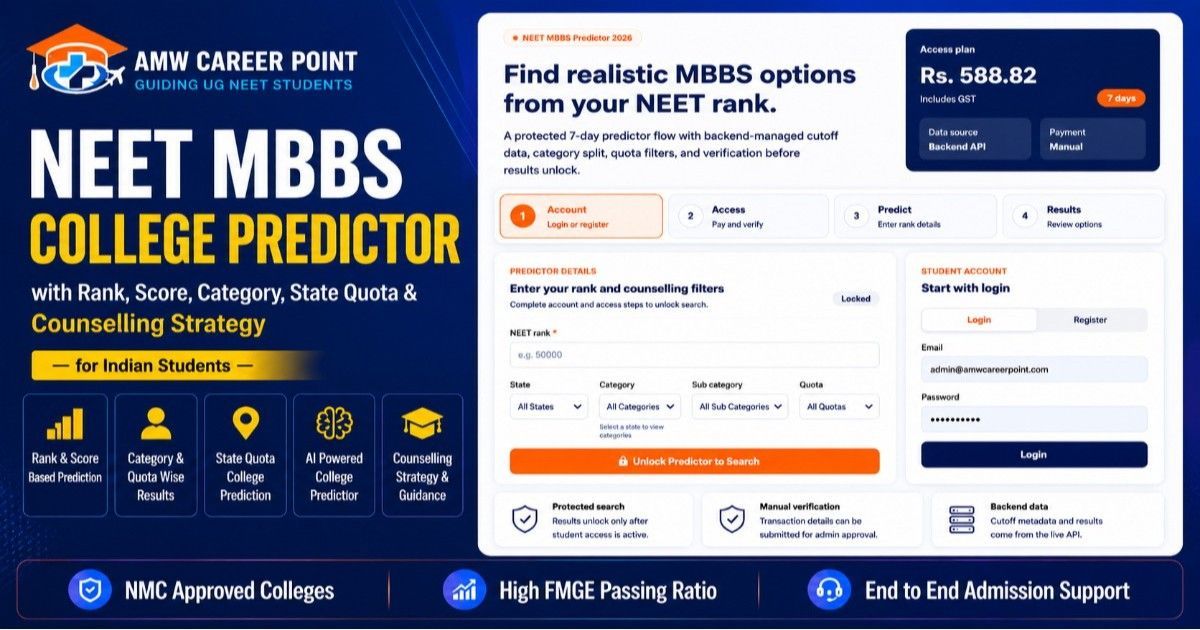
A NEET college predictor does not change the physics of that gap. What it does is give students an honest, data-based picture of where they actually stand, not where they hope they stand. It uses NEET score, expected AIR, category, domicile state, and previous counselling data to show realistic college possibilities across AIQ, state quota, private, and deemed university routes.
This guide covers what the AMW predictor actually does, the real NEET 2025 cutoff data you need to calibrate your 2026 expectations, the counselling strategy mistakes that cost students their seats even when their scores were good enough, and the one strategy move Freeze / Float / Slide.
NEET 2025 Reality Check: 22,09,318 students appeared. 12.36 lakh qualified. 58,583 government MBBS seats are available under AIQ. General category final AIQ closing rank: AIR 26,178. General qualifying cutoff: 144 marks. The gap between qualifying and getting a government MBBS seat is real, large, and non-negotiable. |
The Most Important Thing About NEET Cutoffs That No One Explains Clearly
There are two completely different cutoffs in NEET, and students often get them confused. Understanding the difference is the single most important thing you can do before counselling.
Cutoff Type 1: The Qualifying Cutoff
This is the minimum mark you need to be eligible for counselling. Declared by NTA with results. It does not guarantee admission to any college. It just means you can participate in the counselling process.
Category | NEET 2025 Qualifying Cutoff Marks | Percentile |
General / EWS | 686 – 144 | 50th percentile |
OBC / SC / ST | 143 – 113 | 40th percentile |
General PwBD | 143 – 127 | 45th percentile |
OBC/SC/ST PwBD | 126 – 113 | 40th percentile |
Cutoff Type 2: The Admission Cutoff (What Actually Gets You a Seat)
This is the rank at which the last seat was filled in a specific college, quota, and category. It is released during counselling, not with results. This is what matters. In 2025, under AIQ, the last General category MBBS seat went at AIR 26,178. That is the number of students needed to calibrate against, not 144.
Category | AIQ Round 1 Closing Rank | AIQ Round 3 Final Closing Rank | Approx. Score at Round 3 Cutoff |
General / Open | AIR 21,190 | AIR 26,178 | ~528–534 |
OBC | AIR 21,452 | AIR 26,231 | ~528–534 |
EWS | AIR 25,599 | AIR ~28,000–30,000 est. | ~525–530 |
SC | AIR 1,10,389 | AIR 1,36,445 | ~455–460 |
ST | AIR 1,45,625 | AIR 1,62,975 | ~435–442 |
The cutoff data above is from the MCC NEET UG 2025 AIQ Round 1 and Round 3 final seat allotment results. Round 3 final closing ranks are higher than Round 1 because more students match in later rounds. For 2026, use this as a calibration; actual numbers will depend on paper difficulty, topper density, and seat matrix. |
NEET 2026 Expected Score vs Rank: Calibrated Against 2025 Data
The most-searched question after NEET results is "How much rank will I get at my score?" The honest answer is: it depends on the paper's difficulty and the competition's density, which change every year. The table below uses 2025 as the baseline and projects 2026 ranges. These are directional estimates, not guarantees.
NEET 2026 Score (Expected) | Expected AIR Range | 2025 Comparable Score | What This Gets You (AIQ Government) |
700–720 | Under 100 | 700–720 → Under 100 | AIIMS Delhi, AIIMS top campuses. Extremely competitive. |
680–699 | 100 – 1,000 | 680+ → Under 500 in 2025 | Top AIIMS campuses, JIPMER, MAMC Delhi, and elite institutes. |
660–679 | 1,000 – 4,000 | 660–679 → ~2,500–7,000 | AIIMS newer campuses, top state government colleges, and AIQ. |
640–659 | 4,000 – 10,000 | 640–650 → ~7,000–15,000 | Strong state government colleges, AIQ closes here for premium colleges. |
620–639 | 10,000 – 18,000 | 620 → ~15,000–22,000 | Good AIQ government MBBS realistic. Strong state quota options. |
600–619 | 18,000 – 28,000 | 600 → ~22,000–32,000 | AIQ government MBBS possible — at the edge. Strong state quota focus. |
580–599 | 28,000 – 40,000 | 580 → ~32,000–45,000 | AIQ largely closed. State quota, private MBBS becomes the primary route. |
550–579 | 40,000 – 70,000 | 550 → ~50,000–75,000 | Some state quota government colleges. Private MBBS realistic. |
500–549 | 70,000 – 1,00,000+ | 500 → ~95,000+ | Reserved categories may still access government seats. Private, deemed universities. |
450–499 | 1,00,000 – 1,50,000+ | - | Private MBBS, deemed. Some states have a quota for SC/ST. |
Below 450 | 1,50,000+ | - | Private counselling, management quota, and abroad MBBS. MBBS In Russia, Avicenna International Medical University |
⚠ Important: These are estimates based on NEET 2025 trends. NEET 2026 paper difficulty, number of toppers, and the normalisation method can shift ranks significantly even for identical scores. A student who scored 580 and got AIR 32,000 in 2025 might get AIR 40,000 or AIR 25,000 in 2026, depending on the competition's density that year. Rank matters more than marks. Use this table for planning direction only. |
NEET 2026 Government MBBS Safe Score: By Category and Quota
Safe score means the score at which your chances of getting a government MBBS in that category are reasonably strong, not guaranteed. The numbers below are calibrated against NEET 2025 AIQ final-round data and standard state-quota trends. State quota safe scores are lower than AIQ because competition is limited to domicile candidates.
Safe Score for Government MBBS — AIQ and State Quota
Category | Safe Score for AIQ Govt MBBS | Safe Score for State Quota Govt MBBS (Most States) | Notes |
General | 620+ | 580+ | AIQ is very competitive. The state quota offers more room at this score. |
OBC | 610+ | 560+ | OBC AIQ and state quota are both competitive. Domicile state matters. |
EWS | 615+ | 570+ | EWS is treated similarly to the general cutoff in AIQ. Verify state EWS rules. |
SC | 480+ | 450+ | The SC category opens significantly more opportunities across states. |
ST | 450+ | 420+ | ST cutoff is among the most accessible in most states for government seats. |
PwBD (General) | 500+ | 460+ | Horizontal reservation verifies the college-wise availability of PwBD seats. |
AIIMS MBBS Cutoff 2025 Actual Data Across Campuses
AIIMS admissions are part of AIQ counselling under MCC. AIIMS Delhi remains in a category entirely its own. The General closing rank in 2025 Round 1 was AIR 48. Newer AIIMS campuses are significantly more accessible. If you are targeting AIIMS and scoring below 660, newer campuses are realistic. AIIMS Delhi and Jodhpur at that score are not.
AIIMS Campus | General Closing (Round 1 2025) | OBC Closing | EWS Closing | SC Closing | ST Closing |
AIIMS New Delhi | AIR 48 | AIR 186 | AIR 214 | AIR 1,56,816 | AIR 1,41,178 |
JIPMER Puducherry | AIR 258 | ~AIR 700–900 est. | ~AIR 800–1 000 est. | ~AIR 2,00,000+ est. | ~AIR 1,80,000+ est. |
AIIMS Jodhpur | AIR ~200–400 est. | ~AIR 1,000–1,500 est. | ~AIR 1,200–1,500 est. | ~AIR 1,50,000+ est. | ~AIR 1,20,000+ est. |
AIIMS Bhopal / Rishikesh | AIR ~500–1 500 est. | ~AIR 2,000–4,000 est. | ~AIR 2,000–4,000 est. | ~AIR 1,60,000+ est. | ~AIR 1,40,000+ est. |
Newer AIIMS (Patna, Raipur, Gorakhpur, etc.) | AIR 2,000–8,000 est. | AIR 8,000–20,000 est. | AIR 10,000–22,000 est. | AIR 1,20,000+ est. | AIR 80 000+ est. |
AIIMS New Delhi closing rank data is from MCC Round 1 2025 official allotment. JIPMER and other campus data are trend estimates from published 2025 counselling sources. Always verify on mcc.nic.in for official round-wise data. |
State-Wise Government MBBS Cutoff 2025: Expected 2026 Trends
This is where most students make their biggest planning error. They assume cutoffs are uniform across India. They are not. A student who scores 570 and comes from Karnataka has meaningfully different options than a student with the same score from Delhi. The cutoffs below are based on 2025 counselling data and typical state quota trends for the General category.
High Competition States: General Category State Quota
State | Approx. General Score for Govt MBBS State Quota | Approx. OBC | Approx. SC | Why High |
Delhi | 660+ | 630+ | 560+ | Fewer colleges, highest topper concentration, no domicile relaxation for AIQ |
Uttar Pradesh | 550–580 (top colleges 580+) | 520–550 | 410–510 | Large applicant pool; KGMU, RMLIMS close early at 550–580 |
Bihar | 580–610 | 550–580 | 480–520 | High topper density relative to seat count |
Rajasthan | 590–620 | 570–595 | 480–520 | Strong coaching ecosystem, competitive state pool |
Tamil Nadu | 570–610 | 555–590 | 480–510 | Highly competitive; state formula differs (marks + 12th weightage) |
West Bengal | 580–610 | 560–585 | 480–510 | High NEET scorers are concentrated in the state |
Moderate Competition States: Better Opportunity at 550–590 Range
State | Approx. General Score for Govt MBBS State Quota | Approx. OBC | Approx. SC | Notes |
Maharashtra | 540–580 | 520–560 | 450–490 | Large seat count helps. Private MBBS is very strong here. |
Gujarat | 505–540 | 490–525 | 420–470 | GMERS colleges accessible at 505–540; strong state medical system. |
Karnataka | 540–580 | 520–555 | 430–470 | BMC, MMCRI close at 600+ (AIR 5,000 range); mid-tier opens at 540. |
Madhya Pradesh | 500–540 | 480–515 | 400–450 | MP is among the more accessible state quotas for moderate scorers. |
Andhra Pradesh | 540–570 | 515–545 | 440–480 | Fees slightly higher at some govt colleges; strong clinical training. |
Telangana | 545–575 | 520–550 | 440–480 | Hyderabad government colleges are competitive; district colleges are accessible. |
Lower Cutoff Zones: Opportunity States for 500–560 Scorers
State | Approx. General Cutoff (State Quota) | Key Advantage | Practical Note |
Chhattisgarh | 480–530 | Lower applicant density; decent seat count | Domicile mandatory. New colleges have been added recently. |
Jharkhand | 480–525 | Lower topper concentration | State quota is strictly domicile-based. |
Himachal Pradesh | 500–540 | Hill state quota advantages | Small state; few government seats, but lower cutoff for HP domicile. |
Jammu & Kashmir | 480–530 | UT quota system; lower competition | The separate UT quota under MCC applies here. |
Northeastern States | 450–510 (varies by state) | Government promotion of medical education; lower applicant density | Check the individual state counselling rules — each state has distinct domicile verification requirements. |
Uttarakhand | 490–535 | Mid-size pool; state quota accessible | Some domicile flexibility for students from UP border areas — verify rules. |
⚠ Important: State quota admission requires a verified domicile. A student who has scored 580 but applies to a state where they have no valid domicile will be blocked at the document verification stage after the counselling round is complete. Verify domicile eligibility before registering for state counselling. This mistake happens every year, and it is entirely avoidable. |
AIQ vs State Quota — Which Should You Focus On?
This question does not have a universal answer because the right answer depends on your score, state, and category. Here is the honest breakdown.
Factor | All India Quota (AIQ) | State Quota |
Seat Share | 15% of government MBBS seats | 85% of government MBBS seats |
Who Conducts | MCC (Medical Counselling Committee) | Individual state counselling authorities |
Eligibility | Open to candidates from all states | Domicile candidates of that state only |
Competition Level | Highest, all toppers compete nationally | Lower, limited to the state domicile pool |
General Closing (2025) | AIR 26,178 (Round 3 final) | Varies: AIR 30,000–80,000+, depending on state |
When to Focus | Scores of 620+ for strong chances; 600–620 at the edge | Primary route for 500–600 range students |
Private Colleges | 15% seats under AIQ for NRI, management quota varies | 50% state quota, 35% management, 15% NRI for private |
Registration Deadline | Separate MCC registration required | Separate state portal registration is required |
The practical takeaway: If you score 600+ General, register for both AIQ and your state counselling. Do not depend on only one. If you score 540–600 General, your realistic opportunity is the state quota, and the state counselling strategy matters far more than AIQ obsession. If you score below 520, General, private MBBS counselling and deemed university options need serious attention alongside the state quota.
How the AMW NEET MBBS College Predictor Works
The predictor is a structured counselling analysis tool, not a random college list generator. It takes multiple inputs together and outputs a realistic range of college possibilities across all applicable quotas.
What the Predictor Analyses
Input Variable | What It Determines |
NEET Score | First layer of rank estimation based on score-to-rank mapping from the previous year's data. |
Expected AIR | Rank-adjusted prediction, since marks alone shift year-to-year based on paper difficulty |
Category (Gen/OBC/EWS/SC/ST/PwBD) | Changes to the cutoff entirely, SC/ST cutoffs are categorically different from General AIQ. |
Domicile State | Determines eligibility for the state quota and which state counselling to register for |
Quota Preference (AIQ / State / Private / Deemed) | Filters predictions to the relevant counselling stream |
Previous Year Cutoff Trends (2023–2025) | Uses 3-year trend data to model the expected 2026 range, not a single year snapshot |
Round Preference | Round 1 vs Mop-Up behaves differently; later rounds open more colleges at lower cutoffs. |
The output is not a single college name. It is a realistic range of possibilities categorised into high-probability, moderate-probability, and stretch options across government, private, and deemed routes. The goal is clarity before counselling, not false confidence.
Freeze, Float, Slide: The Counselling Strategy Every Student Must Understand
This is the section most online guides skip entirely.
During MCC counselling, after seat allotment, you are given three options. Most students do not know what these options mean and therefore pick one at random. The wrong choice costs students seat upgrades in subsequent rounds.
Option | What It Means | When to Choose It |
Freeze | Accept the allotted seat and exit all future rounds. You are done with counselling. Your seat is confirmed. | When you are fully satisfied with the allotted college and do not want any further changes. |
Float | Keep the allotted seat, but participate in the next round. If a better college becomes available, your seat automatically upgrades. If not, you retain the current seat. | When you are reasonably happy with the allotted college but want to try for a better one in the next round. |
Slide | Keep the allotted seat and participate in the next round, but only for upgrades within the same college (different course or round)—narrow upgrade window. | When you are happy with the college but want to upgrade to a specific course within the same institution. |
Most students who miss a seat upgrade do so because they chose Freeze when Float was the right option, or because they exited counselling after Round 1 without checking what opened in Round 2 and Mop-Up. If you are not fully satisfied with your allotted college, always choose Float — it costs nothing and keeps your current seat secure while you try for a better one. |
The round-wise expansion in 2025 is a useful reference: General AIQ Round 1 closed at AIR 21,190. Round 3 closed at AIR 26,178. That is nearly 5,000 more students who got seats between Round 1 and the final round. In a practical sense, students with AIR 22,000–26,000 who had not got a seat in Round 1 were allotted one by Round 3. Students who exited after Round 1 missed this.
What MBBS Options Are Realistic at Your Score: 2026 Guide
These are realistic possibilities based on 2025 actual data and expected 2026 trends. State, category, and domicile significantly affect these.
680+ Marks
The top bracket. Students here are competing for AIIMS Delhi (closed at AIR 48 in 2025), JIPMER (AIR 258), and other elite central institutes. If you are in this range, the AIQ government college strategy is the primary focus, and accuracy in filling choices matters enormously; you are not going to miss a seat. Still, you can miss the right college due to poor ordering.
640–679 Marks
Strong government MBBS territory. AIQ government colleges are realistic, and the state quota gives you the most competitive options in your state. This score range requires a careful split among AIIMS newer campuses, top state government colleges through AIQ, and premium state-quota colleges. Do not ignore state counselling at this range just because AIQ looks strong.
600–639 Marks
This is where counselling strategy matters as much as the score itself. AIQ is possible, but at the edge for government MBBS. State quota is your primary arena. The quality of your state, your domicile status, and your category all significantly determine the outcome. A General student from Delhi at 620 faces very different odds than a General student from Karnataka at 620.
Register for both AIQ and state counselling. Do not skip either.
550–599 Marks
The State quota becomes the primary route for government MBBS admissions. AIQ General closes well above this range in most years. But state quota in lower-cutoff states. Karnataka, MP, Chhattisgarh, and some northeastern states can still yield government seats in the General category. For OBC, SC, and ST, the picture is significantly more positive. Choice-filling strategy and participation in mop-up rounds are critical here.
500–549 Marks
Reserved-category students still have realistic chances of securing government seats, depending on the state and category. General category students in this range should focus on: state-quota lower-cutoff states, private MBBS counselling, deemed universities, and, if fees are a constraint, MBBS options abroad (NMC-approved universities in Georgia, Kazakhstan, and Kyrgyzstan, where total 6-year costs run ₹22–38 Lakhs).
Below 500 Marks
Private MBBS, management quota, deemed universities, and abroad MBBS. At this range, the honest assessment is that qualifying for NEET does not translate to a government MBBS seat. Private MBBS in India costs ₹60 Lakhs to ₹1.2 Crores. Abroad MBBS at NMC-approved universities in Kazakhstan or Kyrgyzstan costs ₹18–38 Lakhs all-in for 6 years. For families where private Indian fees are not viable, MBBS abroad is worth serious consideration, not as a backup option, but as a financially rational primary choice.
Counselling Mistakes That Cost Students Seats Every Year
These are the actual reasons students with adequate scores end up without MBBS seats. They are not the marks' problems. They are strategy and process problems.
Mistake | Why It Happens | What to Do Instead |
Filling only dream colleges in the choice list | Students rank their top 3 preferences and stop | Fill a minimum of 20–30 choices across safe, realistic, and stretch categories. Include lower-cutoff states. |
Not registering for state counselling. | Assuming AIQ is sufficient | Register for AIQ AND state counselling simultaneously. Both have different deadlines. |
Wrong domicile state registration | Using an expired domicile certificate or applying to a state you're not eligible for | Verify domicile documentation before registration. Rejection at the document stage loses the round. |
Choosing Freeze after Round 1 unnecessarily | Not understanding the float option. | Choose Float if not fully satisfied. You keep the current seat and try for better simultaneously. |
Skipping Mop-Up and Stray Vacancy rounds | Assuming all good seats are gone | 2025 data show that General AIQ extended by 5,000 ranks from Round 1 to Round 3. Mop-Up opens new colleges. |
Believing the rank estimator YouTube videos | Panic-driven, unverified predictions post-NEET | Use official MCC data and verified previous-year cutoffs. AMW's predictor uses 3-year trend data. |
Ignoring deemed university options | Perceived as expensive or low-quality | Some deemed universities have strong hospital affiliations and reasonable fees. Compare by infrastructure, not by category alone. |
Comparing cutoffs from different years without context | Assuming 2023 cutoff = 2026 cutoff | Cutoffs shift based on paper difficulty and competition. Use 3-year averages, not single-year snapshots. |
NEET 2026 Counselling Step-by-Step Strategy
1. Calculate estimated marks accurately. Use multiple official answer keys (NTA, coaching institutes). Take the median across 2–3 reliable keys. Do not rely on WhatsApp-circulated answer keys, as they have been wrong before.
2. Map score to expected rank range. Use the marks vs rank table above. Remember, it is a range, not a fixed number. Plan for both the optimistic and conservative ends of your rank range.
3. Use the AMW predictor. Input score, category, state, and quota preference. Review realistic college possibilities, not just the top colleges, but the safe and backup options too.
4. Register for both AIQ and state counselling. Both have separate portals and separate deadlines. AIQ is at mcc.nic.in. State counselling is through the respective state authority. Both require document upload. Do this the week results are declared, not after.
5. Prepare documents before results. 10th/12th marksheets, NEET scorecard, category certificate, domicile certificate, medical certificate, passport photos, ID proof. Document errors at the verification stage are a round-killer.
6. Create a tiered choice list. Stretch (top 20% of realistic range), realistic (middle 60%), and safe (bottom 20%). Fill at least 25–30 choices. More is better. Less is risky.
7. Understand Freeze/Float/Slide before allotment. Decide in advance what your threshold is for Freeze vs Float. A college you would definitely attend → Freeze. A college you would attend but want to try for better → Float.
8. Participate in every round — including Mop-Up. Never assume all seats are gone after Round 1 or Round 2. Mop-Up and stray vacancy rounds have filled thousands of seats annually. Show up for all of them.
NEET 2026 MBBS Seat Matrix: How Many Seats Are Available
India has been expanding MBBS seats significantly over the past five years. For 2026, the total seat count is expected to exceed 1.29 lakh, driven by new medical college approvals and expanded intake at existing institutions.
Seat Type | Approx. 2025 Count | Expected 2026 Trend | Notes |
Government MBBS (Total) | 58,583 (AIQ-eligible) | Increasing the number of new colleges approved | AIQ covers 15% of this. State quota covers 85%. |
AIIMS MBBS | 2,200+ | A stable new AIIMS was added recently | All through MCC AIQ counselling. |
JIPMER | 200 | Stable | Puducherry & Karaikal campuses. |
Private MBBS | 60,000+ | Expanding | Multiple counselling rounds. AIQ 15%, Management 35%, State Quota 50%. |
Deemed University MBBS | 10,000+ | Expanding | Independent counselling. Higher fees typically. |
Total (Est.) | ~1,18,000–1,25,000 | ~1,25,000–1,29,000+ est. | Expansion helps, but competition is still intense. |
More seats reduce the pressure at the margin; a student who would have missed a government MBBS seat two years ago might now get one. But the increase in qualified candidates has been proportionally significant too: 12.36 lakh qualified in 2025. Competition remains genuinely intense at the 580+ range.
Key Takeaways
Qualifying cutoff ≠ admission cutoff: NEET 2025 qualifying mark for General: 144. Last government AIQ seat: ~534 marks (AIR 26,178). The 390-mark gap is the real NEET reality most students misunderstand.
Rank matters more than marks: The same score can produce different ranks in different years based on paper difficulty and topper density. Use rank, not marks, as your counselling calibration.
Round-wise rank extension: General AIQ moved from AIR 21,190 (Round 1) to AIR 26,178 (Round 3 final) in 2025, nearly 5,000 ranks. Participate in every round. Do not exit early.
Freeze/Float/Slide: Float keeps your current seat and tries for better simultaneously. Most students should choose Float over Freeze until they are fully satisfied. This is the most underused and least-explained counselling strategy available.
State quota over AIQ for 550–600 scorers: AIQ General closes at 600–620+ effectively. State quota in lower-cutoff states is the more realistic route for this score range. Register for both, but plan primarily around the state quota.
Domicile verification is not optional: an incorrect state registration or an expired domicile certificate is a seat-losing mistake. Verify before registering, not after allotment.
Below 500, private or abroad: Government MBBS is unlikely for the General category in most states. Private Indian MBBS costs ₹60 Lakhs to ₹1.2 Crores. Abroad MBBS at NMC-approved universities costs ₹18–38 Lakhs all-in. The financial comparison is not marginal.
Use AMW's predictor as a planning tool: Not a guarantee, not a crystal ball—a realistic, data-based picture of where you stand before counselling registration deadlines close.
Frequently Asked Questions
Q1. What is the difference between the NEET qualifying cutoff and the MBBS admission cutoff?
The qualifying cutoff (144 marks for General in 2025) is the minimum to appear for counselling. The admission cutoff is the rank at which the last seat was actually filled. In 2025, the last AIQ government MBBS General seat went at AIR 26,178, approximately 534 marks. Simply qualifying for NEET does not guarantee an MBBS seat.
Q2. What NEET score is safe for government MBBS in 2026?
For the AIQ General category, 620+ is the safer zone based on 2025 data. For the state quota, the range varies from 480 to 610, depending on the state and category. SC/ST students have meaningfully lower cutoffs in both AIQ and state quota. See the category-wise safe score table above.
Q3. How accurate is a NEET college predictor?
No predictor can guarantee admission because cutoffs shift annually based on paper difficulty, competition density, and changes to the seat matrix. A good predictor gives you a realistic range of possibilities to plan from, not a fixed answer. AMW's predictor uses 5-year trend data (2020 to 2025) to give a range rather than a point estimate.
Q4. What are Freeze, Float, and Slide in NEET counselling?
These are options given after seat allotment. Freeze = accept the seat and exit all rounds. Float = keep the current seat but try for a better one in the next round (seat auto-upgrades if available). Slide: keep the seat; try for a course upgrade within the same college. Most students should choose Float unless they are fully satisfied with their allotted college.
Q5. Can I get a government MBBS with 550 marks in NEET 2026?
Yes, depending on the category, domicile state, and counselling round. General category at 550 is challenging for AIQ but possible in state quota in lower-cutoff states (Karnataka, MP, Chhattisgarh, northeastern states). For OBC, EWS, SC, and ST categories, the same score opens significantly more options. Mop-Up and stray vacancy rounds have historically yielded seats at this score range.
Q6. What if I get below 450 in NEET 2026?
Government MBBS is not realistic in this range for most categories. Options include: private MBBS in India (₹60 Lakhs–₹1.2 Crores), management quota, deemed universities, or abroad MBBS at NMC-approved universities. Abroad MBBS in Kazakhstan, Georgia, or Kyrgyzstan costs ₹18–38 Lakhs all-in for 6 years, less than most private Indian options, with comparable or better FMGE outcomes at the right institutions.
Q7. Should I register for AIQ and state counselling separately?
Yes, both are mandatory and have different registration portals and deadlines. AIQ through mcc.nic.in. State counselling through your respective state authority. Registering for only one and missing the other is an avoidable mistake that happens every cycle.
Q8. What states have the lowest government MBBS cutoffs?
Based on 2025 trends: Karnataka (mid-range private and government options accessible at 540+), Madhya Pradesh (state quota accessible at 500–540 General), Chhattisgarh, Jharkhand, Himachal Pradesh, and some northeastern states show lower cutoffs for domicile candidates. Cutoffs change yearly; use these as directional guidance, not as fixed numbers.