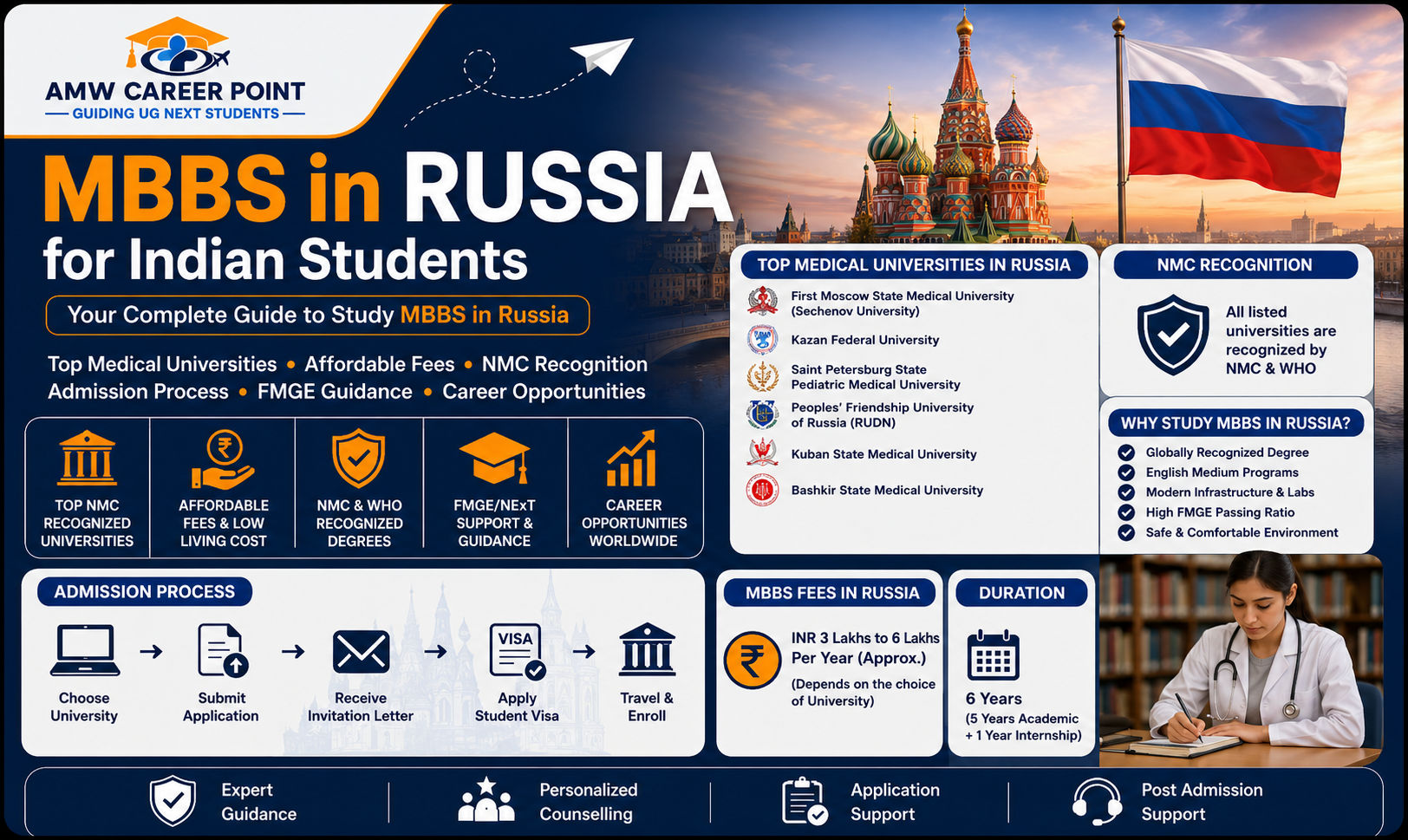
Russia has been one of the best destinations for Indian Medical students for over a decade now. With more than 50 government medical universities verified by the National Medical Commission (NMC) and the World Health Organisation (WHO), Russia offers a structured path to an MBBS degree that is globally recognised. Furthermore, the annual tuition fees can start from as low as Rs. 2.5 lakh. Thus, making Russia far more affordable than any private medical college in India. These programs are offered in English medium and require no donation fees. Moreover, a large community of Indian students makes the transition smoother for students who are moving abroad for the first time. Furthermore, the major appeal lies in its affordability, subsidizing tuition fees, lack of donation requirement and degrees that are globally recognized and comply with the National Medical Commission (NMC) guidelines
Top Medical Universities in Russia for Indian Students
Choosing the right university is one of the key decisions in your MBBS journey. Russia has over 90 medical universities, but only around 50 of them offer a
MBBS programs in English for international students. Among these, a smaller group of universities stands out for their recognition, clinical training quality
and support for students. Furthermore, there are three universities in particular that stand out among the competition that are widely trusted by Indian students and education counsellors alike
The Most Reputable Universities in Big Cities
1. I.M Sechnov First Moscow State Medical University
2. Pavlov First Saint Petersburg State Medical University
Most Popular for Indian Communities
2. Orenburg State Medical University
3. Bashkir State Medical University
The Bang for Your Buck Universities
2. Siberian State Medical University
Kazan Federal University
Kazan Federal University (KFU), established in 1804, is one of Russia's oldest and most respected academic institutions. It ranks among the top five medical universities in Russia. Furthermore, it attracts thousands of international students every year. The university is recognised by
NMC (National Medical Commission)
WHO World Health Organization
WDOMS World Directory of Medical Schools
ECFMG Educational Commission for Foreign Medical Graduates
FAIMER Foundation for Advancement of International Medical Education and Research
This makes it a reliable choice for Indian students who plan to practice medicine in India after their graduation
Moscow State University of Medicine and Dentistry
Moscow State University is also referred to as the "Third Medical" in Moscow. Closely following Sechenov and Pirogov, Moscow State Medical and Dental University (MSMSU), also known as the Yevdokimov University, is the upper echelon of institutions in Russia for dentistry, but can also offer a highly regarded General Medicine (MBBS) program.
Overview of MSMSU
Established: 1804
Location: Kazan, Republic of Tatarstan, Russia
Course Duration: 6 years (5 academic + 1 year of internship)
Annual Tuition Fee: $5,000 to $6,000 (approx. Rs. 4.5 lakh to
Total Course Cost: 6 years Rs. 37 lakhs to Rs 40 lakh (tuition + hostel
Medium of Instruction: English
Recognition: NMC Entrance Exam
University Hospital Beds: 800 beds for clinical training
Key Highlight of KFU
1 - Over 52000 enrolled students, which also includes 11000+ international students from more than 100 countries
2 - A separate wing for the accommodation of Indian students on campus for welfare and cultural support
3 - An Indian food mess is available on campus and within walking distance of the hostels
4 - The library houses over 5 million printed resources, which also include 15000 manuscripts
5 - Hostel facilities including Wi-Fi, Kitchen, laundry, and round-the-clock security
6 - Graduates are eligible for FMGE/NExt (India), USMLE (USA), and PLAB (UK)
7 - KFU is regarded as the first choice among Indian students for its transparent structure of fees, with a strong academic reputation
Pavlov First Saint Petersburg State Medical University
Pavlov First Saint Petersburg State Medical University, commonly known as Pavlov University, is one of the oldest medical institutions in Europe. Founded in 1897, it was one of the first institutions in Russia and Europe to offer women access to higher medical education, which wasn't the norm at the time. Today, it ranks among the top 10 medical schools in Europe and is recognized for its clinical training and research output
Quick Overview
Established: 1897
Location: Saint Petersburg, Russia
Course Duration: 6 years (Pre clinical: year 1-3, year 4-6)
Medium of instruction: English
Recognition: NMC, WHO, WDOMS
Annual Tuition: Fee Rs. 4.5 lakh to 7 lakh (approx.)
Total Course Cost: (6 years) Rs 27 Lakh to Rs 42 Lakh (tuition and hostel)
Indian Students in the Region: Approx 14,000 Indians in Saint Petersburg and Moscow
Key highlights of Pavlov University
The only higher medical school in Saint Petersburg with a polyclinic attached to the university campus
Collaboration with internation university in Sweden, Berlin, the USA, and Finland for research and exchange programs
Focus on research in Oncology, transplantation, cardiology, molecular genetics, and nephrology
The campus is located in a 40,000 sq meter park area in the heart of Saint Petersburg
The batch size is small, so make sure students get attention from the faculty
No donation fee is required at any stage of admission
Key Factors to Consider for MBBS College in Russia
Once you have explored your options of top universities, the next step is to evaluate them against the right criteria. Not all universities that appear at the top of Google's search results are always suitable for Indian students. Moreover, key factors students should consider when choosing a suitable university for their MBBS include recognition status, clinical exposure, quality of education, and fee structure, which can impact their career after graduation. Furthermore, understanding these critical factors before finalizing a university based on gut feeling can save students from mistakes and can help them make informed decisions that can align with their future goals of students
NMC and WHO Recognition
An MBBS degree from a non-recognized university does not qualify you to practice medicine in India. Before applying to any university in Russia, students must verify that it meets the following demands:
Recognition Body | What It Confirms | Where to Verify |
NMC (India) | The degree is valid for FMGE/NExT eligibility in India | nmc.org.in (official list) |
WHO | Global credibility of a medical degree | |
WDOMS | University is listed in the World Directory of Medical Schools | |
ECFMG | Degree is valid for USMLE (USA practice) | |
FAIMER | Validates international medical education quality |
Critical points to keep in mind:
Always verify on the NMC's official website, not on a consultancy's website
Some universities may hold WHO recognition but do not hold NMC recognition; both are needed to practice in India
Degrees from universities not listed on WDOMS are not valid for licensing in most countries
Periodic review conducted by NMC confirms the recognition is current for 2026, not from an outdated list
Students who study at non-recognized universities are not eligible to appear for FMGE or NExT in India
Spending some time on research to verify the recognition on the NMC website can save six years of your life and career.
Clinical Exposure and Internship Opportunities
Clinical exposure is one of the biggest factors in producing a competent doctor. Russia's medical education
system follows a clear clinical training model, and the quality can vary across different universities.
Here are some key steps students should look for
Year 4 to year 6 - Dedicated to clinical rotation in surgery, Internal Medicine, Gynecology, Pediatrics, Dermatology and Emergency Medicine
Universities affiliated with multi-speciality teaching hospitals give richer exposure than those with smaller facilities
Kazan Federal University operates a university clinic with 800+ beds
Pavlov University has a polyclinic located on campus
Moscow State University of Medicine and Dentistry provides training using robotic surgery technology
Clinical Internship (year 6), in some cases, can be completed in India at NMC-approved hospitals, based on NMC guidelines at the time of completion
Additionally, students must verify
Whether the university internship is counted in the 6-year course duration or as an additional part
Whether the clinical rotation is conducted in-house or outsourced to distant partner hospitals
If senior Indian students or alumni have confirmed the quality of ward rounds and exposure to the case
Strong clinical training can directly improve FMGE/NExt preparation and your readiness to practice medicine after graduation
Tuition Fees and Scholarships
Understanding the complete fee structure, not just the advertised annual tuition, is essential for realistic financial planning. Here is a side-by-side fee
Comparison of the three universities that are featured
University | Annual Tuition Fee (Approx.) | Total 6-Year Cost (Tuition + Hostel) |
Kazan Federal University | Rs. 4.5 lakh – Rs. 5.4 lakh | Rs. 37 lakh – Rs. 40 |
Moscow State Univ. of Medicine and Dentistry | Rs. 5 lakh – Rs. 8 lakh | Rs. 30 lakh – Rs. 48 lakh |
Pavlov First St. Petersburg State Med. Univ. | Rs. 4.5 lakh – Rs. 7 lakh | Rs. 27 lakh – Rs. 42 lakh |
Scholarship options available at these universities:
Russian Government Scholarship - Over 15,000 grants annually cover tuition and maintenance, awarded based on merit and country quotas
KFU Merit-Based Scholarship - For students with strong academic performance
Presidential Scholarship (Russia) - Awarded to outstanding international students by the Russian President
KFU Social Support Scholarship - Partial tuition waiver or living expense support for financially weaker students
University Research Scholarships - For students who participate in active research projects
Always ask the university directly about scholarship availability before finalising your admission. Many students do not apply simply because they are unaware of these options.
The Admission Process for Indian Students
A clear understanding of the admission process can remove unnecessary anxiety and help students prepare on time. The positive side is that MBBS admission in Russia does not require a separate entrance exam beyond NEET. Furthermore, this process is direct and based on documentation. However, a few universities, like Kazan Federal, do not conduct their own online entrance screening. Moreover, to know each step
From eligibility to verification to visa issuance and arrival, it can help students plan a timeline and avoid common delays.
Eligibility Criteria for Indian Students
Before applying, students must always confirm to meet the NMC mandated eligibility requirements
These are the same across all NMC-recognized universities in Russia.
Eligibility Requirements for MBBS in Russia 2026
Criteria | General Category | Reserved Category (SC/ST/OBC) |
Minimum Age | 17 years by 31st December 2026 | Same |
10+2 Subjects Required | Physics, Chemistry, Biology, English | Same |
Minimum Marks in PCB | 50% aggregate | 40% aggregate |
40% aggregate | Mandatory | Mandatory |
NEET Score Validity | 3 years (2024/2025/2026 valid) | 3 years |
Maximum Age | No upper limit (approval may be required above 25) | Same |
Passport Validity | Minimum 18 months | Same |
Additional eligibility notes:
KFU specifically requires students to pass an online entrance exam in Biology, Chemistry, and English (50 marks required per subject; no negative marking)
MSUMD requires an online entrance exam in Chemistry and English
Pavlov University uses a direct application process without a university-level entrance test
Students must obtain an NMC Eligibility Certificate before enrolling in any foreign medical university
Entrance Exams and Admission Process
Here is a step-by-step guide to the full admission process for Indian students applying to MBBS in Russia for the 2026 session:
1 | Qualify NEET UG | May 2026 result |
2 | Research and shortlist NMC-approved universities | May – June 2026 |
3 | Submit online application and documents | June – August 2026 |
4 | Clear university entrance exam (if applicable) | June – August 2026 |
5 | Receive official Admission/Invitation Letter | Within 5–10 working days |
6 | Obtain NMC Eligibility Certificate | After receiving invite letter |
7 | Apply for Russian Student Visa | July – August 2026 |
8 | first-year tuition fee | Before departure |
9 | Travel to Russia and report to the university | September 2026 |
Documents required for admission and visa:
10th and 12th mark sheets and certificates
NEET scorecard (current year or within 3-year validity)
Valid passport (minimum 18 months validity)
Birth certificate
Passport-size photographs (6–8 copies)
Medical fitness certificate (HIV test included)
Police clearance certificate
NMC Eligibility Certificate
Bank statement (proof of funds for Russian Ministry requirement)
Official invitation letter from the university
Cost of Studying MBBS in Russia
Financial clarity is one of the most important things a student and their family need before committing to MBBS abroad. Beyond the advertised tuition fee, there are hostel charges, food costs, travel, insurance, and personal expenses that add up over six years. The positive side is that Russia remains one of the most affordable destinations globally for medical education, especially when compared to private medical colleges in India, where fees exceed Rs. 70 lakhs to Rs. 1 crore.
S.No. | Name Of The University | Total Fees (INR) | Medium & Duration |
1 | ₹ 28,29,000 | English Medium (6 years) | |
2 | ₹ 26,65,000 | English Medium (6 years) | |
3 | ₹ 30,62,000 | English Medium (6 years) | |
4 | ₹ 18,45,000 | English Medium (6 years) | |
5 | ₹ 22,00,000 | English Medium (6 years) | |
6 | ₹ 59,70,000 | English Medium (6 years) | |
7 | ₹ 27,42,000 | English Medium (6 years) | |
8 | ₹ 28,11,114 | English Medium (6 years) | |
9 | ₹ 24,82,500 | English Medium (6 years) | |
10 | ₹ 23,85,000 | English Medium (6 years) | |
11 | ₹ 25,12,500 | English Medium (6 years) | |
12 | ₹ 18,39,000 | English Medium (6 years) | |
13 | ₹ 24,75,000 | English Medium (6 years) | |
14 | ₹ 42,75,000 | English Medium (6 years) | |
15 | ₹ 19,12,500 | English Medium (6 years) | |
16 | ₹ 20,77,500 | English Medium (6 years) | |
17 | ₹ 27,45,000 | English Medium (6 years) | |
18 | ₹ 15,00,000 | English Medium (6 years) | |
19 | Pirogov Russian National Research Medical University (RNRMU) | ₹ 37,20,000 | English Medium (6 years) |
Tuition Fees Breakdown
University | Annual Tuition Fee | Annual Hostel Fee | Total Annual Cost | Total 6-Year Cost |
Kazan Federal University | Rs. 4.5 lakh – Rs. 5.4 lakh | Rs. 60,000 – Rs. 80,000 | Rs. 5.1 lakh – Rs. 6.2 lakh | Rs. 37 lakh – Rs. 40 lakhs |
Moscow State Univ. of Medicine and Dentistry | Rs. 5 lakh – Rs. 8 lakhs | Rs. 80,000 – Rs. 1.2 lakh | Rs. 5.8 lakh – Rs. 9.2 lakh | Rs. 30 lakh – Rs. 48 lakhs |
Pavlov First St. Petersburg | Rs. 4.5 lakh – Rs. 7 lakhs | Rs. 70,000 – Rs. 1 lakh | Rs. 5.2 lakh – Rs. 8 lakhs | Rs. 27 lakh – Rs. 42 lakhs |
One-time costs at the time of joining:
- Flight ticket (India to Russia): Rs. 25,000 to Rs. 40,000 (one way)
- Visa fee: Rs. 8,000 to Rs. 12,000
- Medical insurance (annual): $100 to $300 (approx. Rs. 8,500 to Rs. 25,000)
- Document notarization and attestation: Rs. 5,000 to Rs. 15,000
- Initial setup costs (bedding, winter clothing, kitchenware): Rs. 10,000 to Rs. 20,000
Note: Fees may vary slightly with currency exchange rates. Always confirm the latest fee structure directly with the university or its authorized representative.
Key Takeaways
Russia remains one of the most practical, affordable, and academically sound options for Indian students pursuing MBBS abroad in 2026. Before making your final decision, here is a concise summary of the most important points from this guide:
- Kazan Federal University, Moscow State University of Medicine and Dentistry, and Pavlov First Saint Petersburg State Medical University are three of the most trusted choices for Indian students, each offering NMC and WHO recognition, English-medium instruction, and strong clinical training
- Annual tuition fees across these universities range from Rs. 4.5 lakh to Rs. 8 lakhs, making the total 6-year course cost fall between Rs. 27 lakh and Rs. 48 lakhs, which is a fraction of Indian private college fees
- NMC and WDOMS recognition must be verified on official websites at nmc.org.in and wdoms.org before any payment or commitment
- NEET qualification is mandatory: qualifying marks (around 137/720 for the general category) are sufficient; a high rank is not required
- Clinical exposure quality varies; always check hospital bed count, type of affiliated hospitals, and how clinical rotations are structured at your chosen university
- The admission process is straightforward: apply online, clear any university entrance screening, receive an invitation letter, obtain an NMC Eligibility Certificate, apply for a student visa, and report to campus in September
- Monthly living costs range from approximately Rs. 9,100 in Kazan to Rs. 24,500 in Moscow, which can be managed with proper budgeting and hostel accommodation
Scholarships are real and accessible. The Russian Government offers over 15,000 grants annually; KFU provides merit-based, presidential, and social support scholarships
- Education loans from SBI, PNB, HDFC Credila, and other lenders that are accessible for MBBS in Russia, given the NMC recognition and strong global rankings of the featured universities
Q1. Which is the best medical college for MBBS in Russia for Indian students?
There is no single "best" university — the right choice depends on your budget, city preference, and career goals. That said, three universities consistently top the list for Indian students:
Kazan Federal University — Best overall for recognition, Indian student support, and transparent fee structure. Annual tuition starts at approximately Rs. 4.5 lakh.
Pavlov First Saint Petersburg State Medical University — Best for clinical training quality and research exposure. Ranked among the top 10 medical schools in Europe.
Moscow State University of Medicine and Dentistry — Best for students who want to study in Russia's capital with access to advanced hospital infrastructure and robotic surgery training.
All three are NMC and WHO recognized. Before making a final choice, verify the university's current recognition status on the official NMC website at nmc.org.in and cross-check it on the World Directory of Medical Schools at wdoms.org.
Q2. Is MBBS from Russia valid in India? Can I practice medicine after returning?
Yes — but only if you follow the correct steps after graduation. An MBBS degree from a Russian university that is listed on the NMC approved list and on the World Directory of Medical Schools (WDOMS) is fully valid in India. However, having the degree alone is not enough to practice. After returning to India, you must:
Clear the FMGE (Foreign Medical Graduate Examination), conducted by the National Board of Examinations (NBE) twice a year
Once FMGE is replaced by NExT (National Exit Test), you will need to clear that instead
Register with your State Medical Council using your NExT or FMGE clearance certificate
The key is to choose only NMC-recognized universities and to prepare seriously for FMGE from Year 1 of your MBBS — not just in the final year.
Q3. What is the FMGE pass rate for students returning from Russia?
FMGE pass rates vary by university and by how well-prepared individual students are. Here is a general picture based on available data:
University / Country | Reported FMGE Pass Rate (Approx.) |
|---|---|
Kazan Federal University (Russia) | 40% – 55% |
Pavlov First St. Petersburg (Russia) | 45% – 60% |
Russia (Overall Average) | 35% – 50% |
Georgia (Overall Average) | 50% – 65% |
Philippines (Overall Average) | 55% – 65% |
These figures reflect the importance of consistent academic preparation throughout the 6-year program. Students who:
Study regularly and do not rely on last-minute preparation
Attend all clinical rotations seriously
Enroll in dedicated FMGE coaching in their final year
To clear FMGE in their first or second attempt. FMGE can be taken an unlimited number of times, so a failed first attempt is not the end of the road, but early and consistent preparation is strongly recommended.
Q4. Is Russian the language of instruction? Do I need to learn Russian?
No, all three universities featured in this guide (KFU, MSUMD, and Pavlov University) offer MBBS programs fully in English. You do not need Russian language skills to complete your academics or pass your exams.
However, learning basic Russian is practically useful for the following reasons:
Clinical rotations (Years 4–6) involve direct interaction with Russian patients, who typically speak only Russian. Knowing conversational Russian helps you take patient history and understand symptoms more effectively.
Daily life — shopping, commuting, navigating hospitals, and interacting with local staff becomes easier with basic Russian
Most universities offer a short Russian language course in the first semester to help international students adapt
Think of Russian as a helpful life skill rather than an academic requirement. You will not fail your MBBS because you do not speak Russian fluently, but knowing the basics will significantly improve your clinical experience and day-to-day comfort.
Q5. What are the hostel and food arrangements for Indian students in Russia?
Hostel and food arrangements at all major NMC-approved Russian universities are well-organized for Indian students. Here is a summary:
Feature | Kazan Federal University | MSUMD (Moscow) | Pavlov Univ. (St. Petersburg) |
|---|---|---|---|
Hostel Type | University campus hostel | 5 hostel buildings on/near campus | Campus hostel in a 40,000 sq. meter park |
Room Type | 2–3-seater rooms | 2–3-seater rooms | 2–3-seater rooms |
Annual Hostel Fee | Rs. 60,000 – Rs. 80,000 | Rs. 80,000 – Rs. 1.2 lakh | Rs. 70,000 – Rs. 1 lakh |
Central Heating | Yes | Yes | Yes |
Wi-Fi | Yes | Yes | Yes |
Indian Food | Available on campus and nearby | Available in the canteen and nearby | Available in the surrounding area |
Kitchen Access | Shared kitchen on every floor | Canteen + common kitchen | Common kitchen available |
Security | 24/7 security and warden | 24/7 security | 24/7 security |
Additional points worth knowing:
Indian student associations at all three universities help new students settle in during the first weeks
Most universities have a warden system specifically for international students
Students are advised to carry essential Indian spices and dry foods from home for the first few weeks until they find local Indian grocery shops, which are available in Kazan, Moscow, and Saint Petersburg
Frequently asked questions (FAQ’S)
Q1. Which is the best medical college in Russia for Indian MBBS students?
There is no single "best" university, The right choice depends on your budget, city preference, and career goals. That said, three universities consistently top the list for Indian students:
Kazan Federal University — Best overall for recognition, Indian student support, and transparent fee structure. Annual tuition starts at approximately Rs. 4.5 lakh.
Pavlov First Saint Petersburg State Medical University — Best for clinical training quality and research exposure. Ranked among the top 10 medical schools in Europe.
Moscow State University of Medicine and Dentistry — Best for students who want to study in Russia's capital with access to advanced hospital infrastructure and robotic surgery training.
All three are NMC and WHO-recognised. Before making a final choice, verify the university's current recognition status on the official NMC website at nmc.org.in and cross-check it on the World Directory of Medical Schools at wdoms.org.
Q2. Is an MBBS from Russia valid in India? Can I practice medicine after returning?
Yes, but only if you follow the correct steps after graduation. An MBBS degree from a Russian university listed on the NMC-approved list and the World Directory of Medical Schools (WDOMS) is fully valid in India. However, having the degree alone is not enough to practice. After returning to India, you must:
Clear the FMGE (Foreign Medical Graduate Examination), conducted by the National Board of Examinations (NBE) twice a year
Once FMGE is replaced by NExT (National Exit Test), you will need to clear that instead
Register with your State Medical Council using your NExT or FMGE clearance certificate
The key is to choose only NMC-recognized universities and to prepare seriously for FMGE from Year 1 of your MBBS — not just in the final year.
Q3. What is the FMGE pass rate for students who have returned from Russia?
FMGE pass rates vary by university and by the level of preparation of individual students. Here is a general picture based on available data:
University / Country | Reported FMGE Pass Rate (Approx.) |
|---|---|
Kazan Federal University (Russia) | 40% – 55% |
Pavlov First St. Petersburg (Russia) | 45% – 60% |
Russia (Overall Average) | 35% – 50% |
Georgia (Overall Average) | 50% – 65% |
Philippines (Overall Average) | 55% – 65% |
|
|
These figures reflect the importance of consistent academic preparation throughout the 6-year program. Students who:
Study regularly and do not rely on last-minute preparation
Attend all clinical rotations seriously
Enrol in dedicated FMGE coaching in their final year
tend to clear the FMGE in their first or second attempt. FMGE can be taken an unlimited number of times, so a failed first attempt is not the end of the road — but early and consistent preparation is strongly recommended.
Q4. Is Russian the language of instruction? Do I need to learn Russian?
Not all three universities featured in this guide (KFU, MSUMD, and Pavlov University) offer MBBS programs fully in English. You do not need Russian language skills to complete your academics or pass your exams.
However, learning basic Russian is practically useful for the following reasons:
Clinical rotations (Years 4–6) involve direct interaction with Russian patients, who typically speak only Russian. Knowing conversational Russian helps you take patient history and understand symptoms more effectively.
Daily life — shopping, commuting, navigating hospitals, and interacting with local staff becomes easier with basic Russian
Most universities offer a short Russian language course in the first semester to help international students adapt
Think of Russian as a helpful life skill rather than an academic requirement. You will not fail your MBBS because you do not speak Russian fluently, but knowing the basics will significantly improve your clinical experience and day-to-day comfort.
Q5. What are the hostel and food arrangements for Indian students in Russia?
Hostel and food arrangements at all major NMC-approved Russian universities are well-organized for Indian students. Here is a summary:
Feature | Kazan Federal University | MSUMD (Moscow) | Pavlov Univ. (St. Petersburg) |
|---|---|---|---|
Hostel Type | University campus hostel | 5 hostel buildings on/near campus | Campus hostel in a 40,000 sq. meter park |
Room Type | 2–3-seater rooms | 3-seater rooms | 2–3-seater rooms |
Annual Hostel Fee | Rs. 60,000 – Rs. 80,000 | Rs. 80,000 – Rs. 1.2 lakh | Rs. 70,000 – Rs. 1 lakh |
Central Heating | Yes | Yes | Yes |
Wi-Fi | Yes | Yes | Yes |
Indian Food | Available on campus and nearby | Available in the canteen and nearby | Available in the surrounding area |
Kitchen Access | Shared kitchen on every floor | Canteen + common kitchen | Common kitchen available |
Security | 24/7 security and warden | 24/7 security | 24/7 security |
Additional points worth knowing:
Indian student associations at all three universities help new students settle in during the first weeks
Most universities have a warden system specifically for international students
Students are advised to carry essential Indian spices and dry foods from home for the first few weeks until they find local Indian grocery shops, which are available in Kazan, Moscow, and Saint Petersburg
Q6. How do I avoid fraud and fake consultancies when applying for MBBS in Russia?
Unfortunately, the MBBS abroad space is rife with fraudulent consultancies that mislead students and charge inflated fees. Here is a clear checklist to protect yourself:
Red flags to watch out for:
Consultancy promises guaranteed admission without NEET
Claims of "free MBBS" with no conditions attached
Asks you to deposit fees into a personal bank account rather than the university's official account
Cannot provide the university's NMC approval letter or WDOMS listing on request
Pressures you to pay immediately with no time to verify
Offers a suspiciously low fee not matching the university's officially published rates
Steps to verify safety:
Check the university directly on nmc.org.in under the list of recognized foreign medical universities
Search the university name on wdoms.org and confirm it is listed
Look for real alumni reviews on LinkedIn — not just testimonials on a consultancy's website
Cross-check the university's fee structure on its official .ru or .edu domain website
Call or email the university's international admissions office directly to confirm the consultancy is authorized
Never pay more than a nominal registration fee before receiving your official invitation letter