Factor | Germany Medicine 2026 |
Formal degree | Human Medicine (Humanmedizin) / Staatsexamen pathway, and it is not literally called "MBBS" |
Typical duration | Approximately 6 years of academic study + licensing stages |
Main teaching language | German |
English-taught public medicine | Extremely limited, not the standard route (see dedicated section below) |
Indian applicants | Possible, subject to qualification recognition and university-specific admission rules |
NEET | A separate Indian regulatory requirement not part of German admission (see dedicated section) |
TMS (Test für medizinische Studiengänge) | Generally, not part of the process for non-EU applicants with a non-German university entrance qualification |
Studienkolleg | May be required depending on your specific qualification; not automatic for every Indian Class 12 student |
Medicine Studienkolleg course | M-Kurs |
German language level required | High proficiency, typically is for C1 for direct university admission; B1–B2 for Studienkolleg entry |
Tuition at most public universities | Usually no standard tuition fee, but real exceptions apply (Baden-Württemberg and Bavaria in some cases) |
Semester contribution | Applicable at every public university, typically €150–€350 per semester. |
Visa financial proof (2026) | €11,904/year (€992/month) |
NMC consideration for return to India | Must be checked against current FMGL Regulations, 2021 before enrolment |
Is an MBBS in Germany Available to Indian Students?
Can Indian Students Study Human Medicine in Germany?
Yes, in principle, Indian students are admitted to German medical universities every year. But "available" and "straightforward" are different things: admission depends on recognition of qualifications, competitive Numerus Clausus (NC) selection, German-language proficiency, and university-specific international-applicant procedures that vary considerably.
Is Germany a Realistic Option Straight After Class 12 in India?
It can be, but rarely without an intermediate step. Because Germany's school system runs for 13 years, compared with India's 12, most Indian Class 12 qualifications don't independently satisfy Germany's Hochschulzugangsberechtigung (HZB university entrance qualification) for medicine, and a preparatory pathway (Studienkolleg, or, in some cases, a partially completed Indian degree) is commonly required. Whether this applies to you specifically depends on your board, marks, and university-specific rules and is never a blanket assumption (see the eligibility and Studienkolleg sections below).
What Makes German Medical Admission Different to Other European Countries?
Unlike Italy's single IMAT exam or several CIS countries' grade-based admission, Germany combines qualification recognition (HZB), a possible preparatory year (Studienkolleg), a high German-language bar, and a competitive Numerus Clausus selection process with no single, unified "take one test and you're in" pathway. This makes Germany structurally more complex to plan for, not necessarily more difficult academically.
Is Germany Suitable for Students Who Want an English-Medium Medical Degree?
Public medical education in Germany is taught in German, including virtually all clinical training. This is covered in greater depth later in this guide ("Can Indian Students Study Medicine in Germany in English?"), but it needs to be said up front, since a large amount of existing online content overstates the availability of English-medium medicine programs in Germany specifically.
Why Study Medicine in Germany?
Public medical universities: Germany's public university system includes some of Europe's oldest and most research-intensive medical faculties.
German healthcare system: training happens inside a well-funded, technologically advanced clinical infrastructure.
Clinical exposure: structured, hospital-based training from the clinical stage onward, including the compulsory Practical Year (Praktisches Jahr).
Research opportunities: many German medical faculties run active research programs students can engage with alongside coursework.
European medical education: a degree grounded in the EU/Bologna-adjacent academic tradition, though Germany's Staatsexamen system has its own distinct structure.
Lower tuition at many public universities: most public universities charge no standard tuition fee for a first degree; real exceptions are covered honestly below.
Career possibilities in Germany: a persistent physician shortage in parts of Germany has kept demand for qualified doctors strong.
Specialist training (Facharztausbildung): structured, well-established postgraduate specialization pathways.
Long-term opportunities: for students genuinely interested in building a career within Germany or the wider EU, not just returning to India immediately after graduation.
Advantages for Indian Students
Genuine EU medical qualification with strong international academic reputation
No standard tuition fee at most public universities (semester contributions still apply)
Structured, hospital-integrated clinical training
A realistic long-term pathway to practicing in Germany or elsewhere in the EU
Challenges Indian Students Should Know Before Applying
A high German-language bar that takes most students 12–18 months of dedicated study to reach
A genuinely competitive, multi-stage admission process and not a single entrance exam
Qualification recognition (HZB) that is genuinely case-by-case, not a blanket yes/no for Indian Class 12
A possible additional Studienkolleg year before you can even apply to medical school
Not a fast or simple route compared to several other MBBS-abroad destinations
MBBS vs Human Medicine in Germany
What Is Humanmedizin?
Humanmedizin ("Human Medicine") is the German name for the medical degree program. It is not formally called "MBBS"; that's an Indian/Commonwealth term. Search engines and Indian students use "MBBS in Germany" as shorthand, but German universities, application portals, and official documentation will all refer to Humanmedizin or Medizin.
What Is the German Staatsexamen?
The Staatsexamen ("state examination") is Germany's medical licensing examination structure, taken in stages throughout the degree rather than as a single final exam: the first state examination after the pre-clinical stage, and the second state examination after the clinical stage and Practical Year. Passing all stages is required before Approbation (full medical licensure) can be granted.
How Long Does German Medical Education Take?
Approximately 6 years and 3 months of academic study (12–13 semesters), covering pre-clinical study, clinical study, and the compulsory Practical Year before Approbation. This does not include any Studienkolleg year that may be required beforehand, or subsequent specialist (Facharzt) training.
Is the German Medical Degree Equivalent to MBBS?
Functionally, yes, both lead to a first professional medical qualification and licensed practice. Structurally, they differ meaningfully: Germany's Staatsexamen system, subject sequencing, and Approbation process don't map directly onto India's MBBS year-by-year structure. Treat them as comparable outcomes achieved through different systems, not as identical programs with different names.
What Happens After the Medical Degree?
University study → Ärztliche Prüfung (state medical examinations) → Approbation → medical practice/specialisation. Approbation is the full, unrestricted license to practice medicine in Germany — the functional equivalent of permanent medical registration.
Eligibility for Medicine in Germany After Class 12
This is one of the most important sections in this guide, and the one most existing articles oversimplify. There is no single blanket answer to "is my Class 12 enough?" It depends on your board, your marks, and how German authorities and universities currently assess that specific qualification.
Academic Requirements
Strong performance in Physics, Chemistry, and Biology at Class 12 (Mathematics is relevant for some Studienkolleg tracks)
Overall Class 12 percentage: Competitive applications typically need high overall marks, given medicine's Numerus Clausus selection
Subject-specific grades in the sciences, assessed alongside your overall result
Academic equivalence: How your specific board and result convert against German standards, verified through official channels (see below)
Does CBSE Class 12 Qualify for Direct Admission?
What About ISC?
What About Indian State Boards?
There is no single universal answer that applies identically across CBSE, ISC, and every state board. Outcomes depend on the specific board, your results, and critically the specific German university and course you're applying to.
What If the Indian School Certificate Is Not Considered Equivalent to the German Abitur?
Get this right: Do not accept a blanket "yes" or "no" answer from an agent or a generic article. The correct starting point is DAAD's own admission database (commonly referenced alongside "anabin"), which applicants are directed to specifically to check whether their foreign school-leaving certificate constitutes a German higher-education entrance qualification — and DAAD is explicit that the final admission decision always rests with the individual university, not with the database itself.
If your Class 12 certificate alone doesn't provide direct access, the realistic pathways are: completing a recognized period of prior university study in India, which may upgrade your qualification status; or completing a Studienkolleg preparatory year, followed by the Feststellungsprüfung, covered in full in the next two sections.
German University Entrance Qualification: HZB Explained
What is Hochschulzugangsberechtigung (HZB)?
HZB is Germany's formal term for "university entrance qualification," the recognized academic credential that permits admission to a German degree program. For German students, this is the Abitur. For international students, whether your existing qualification counts as an HZB, a restricted HZB, or neither depends on your specific country, board, and result.
Abitur vs fachgebundene Hochschulzugangsberechtigung
The Abitur is Germany's general HZB, granting broad access to most degree subjects. A Fachgebundene Hochschulzugangsberechtigung is a restricted/subject-specific entrance qualification, valid only for certain fields of study — an important distinction if your evaluated Indian qualification falls into this narrower category rather than a general HZB.
How Are Foreign School Qualifications Assessed?
How Does an Indian Student's Qualification Get Evaluated?
DAAD, anabin and University Verification
This is where this guide becomes genuinely useful rather than generic. DAAD's admission database is specifically structured to distinguish subject areas, including medicine, from general degree access. It provides qualification-specific admission outcomes rather than a single blanket statement for all subjects. In practice:
Check your specific board and result against DAAD's database/anabin as your starting point, not a generic online claim.
Understand that medicine is very often assessed more strictly than other subjects within the same database, given its Numerus Clausus status.
Treat the database result as guidance, not a guarantee. DAAD itself states that the final admission decision lies with the individual university.
Re-verify with your specific shortlisted universities directly, since interpretation can vary at the margins even where the database gives a general indication.
Do Indian Students Need Studienkolleg for Medicine in Germany?
What Is Studienkolleg?
Studienkolleg is a preparatory institution for students who are academically qualified to study in their home country but whose qualifications do not, on their own, meet Germany's HZB standard. It bridges that gap through a structured, subject-track preparatory year taught largely in German, ending in the Feststellungsprüfung (FSP), the exam that then grants a subject-specific university entrance qualification.
When Is Studienkolleg Required?
Can You Skip Studienkolleg?
Can Previous University Study Replace Studienkolleg?
Does Every Indian Class 12 Student Need Studienkolleg?
Be precise here: The answer must not be a blanket yes or no. DAAD's own guidance states that students whose foreign qualification does not provide direct university access may need either comparable prior study at a recognized institution or a Studienkolleg. The exact outcome depends on the specific qualification being assessed, with the starting point being a check in DAAD's database.
In practice, for most Indian Class 12 students applying directly, Studienkolleg (specifically the M-Kurs for medicine) is the common outcome, given the 12-year vs. 13-year school-system gap. But a genuine alternative exists for some applicants: students who have already completed a defined period of recognized university study in India (for instance, a year of an MBBS or a relevant science bachelor's program) may, in some cases, be assessed as having already met an equivalent standard, bypassing Studienkolleg entirely. This is evaluated on a case-by-case and university-by-university basis and should never be assumed without direct verification
M-Kurs for Medicine in Germany
What Is the M-Kurs?
The M-Kurs is the Studienkolleg track specifically for students targeting Medicine, Biology, Pharmacy, and related life-science degrees and is one of several subject-specific Studienkolleg tracks (alongside the T-Kurs for engineering/technical subjects, the W-Kurs for business/economics, and the G/S-Kurs for humanities/languages).
Subjects Taught in M-Kurs
Biology
Chemistry
Physics
Mathematics
German (intensive, ongoing throughout the course)
Other institution-specific components, varying by Studienkolleg
How Long Is the M-Kurs?
Typically, within one year (two semesters), which is consistent with Studienkolleg's standard preparatory-phase duration across all subject tracks.
M-Kurs Entrance Examination
Admission to the M-Kurs itself requires passing an entrance test (the Aufnahmeprüfung), typically covering German and Mathematics. Seats are genuinely limited; most Studienkollegs run only around 20–40 seats per intake specifically for the medicine track, and competition among international applicants for these seats is real. A strong Aufnahmeprüfung performance (typically around 70% or higher) is generally required to secure a place, though exact thresholds vary by institution and intake.
German Language Requirement for M-Kurs
Most Studienkollegs require roughly B1-B2-level German to sit the Aufnahmeprüfung and begin the M-Kurs; this is a real, non-negotiable prerequisite, not a nice-to-have.
What Happens After M-Kurs?
Students who complete the M-Kurs sit the Feststellungsprüfung, which is covered in full in the next section and determines eligibility to apply for medical school places.
Feststellungsprüfung (FSP) for Medicine
What Is the Feststellungsprüfung?
The FSP is the formal exit examination at the end of Studienkolleg, assessing the subjects studied during the M-Kurs. Passing it grants a subject-specific Hochschulzugangsberechtigung for medicine-track programs.
FSP Subjects for M-Kurs
Typically covers Biology, Chemistry, Physics, Mathematics, and German, which mirrors the M-Kurs curriculum, with the exact weighting and format varying by Studienkolleg.
How Difficult Is the FSP?
Genuinely demanding; it's assessed in German, on content taught over just one year to bridge a real academic-system gap, and your FSP result becomes part of the competitive academic profile used in the subsequent Numerus Clausus medical-school selection process, so a passing grade alone is not the goal; a strong grade materially affects your actual medical-school admission odds afterward.
What Happens If You Fail?
Policies on resits vary by Studienkolleg and are limited, typically to one resit opportunity, sometimes with conditions. Confirm the specific resit policy with your Studienkolleg directly, since failing without a viable resit path can mean a significant setback to your entire timeline.
Can You Apply for Medicine After Passing FSP?
Does FSP Guarantee a Medical University Place?
Reality check: Passing the Studienkolleg and the FSP establishes eligibility for admission to medicine; it does not automatically secure a seat at a medical school. Your FSP grade, combined with your other academic results, feeds into Germany's competitive Numerus Clausus (NC) selection process for medicine, one of the most oversubscribed subject areas in the entire German university system. A pass is the ticket to apply; it is not the seat itself.
German Language Requirements for Medicine in Germany
What German Level Is Required for Medicine?
As a practical target: B1–B2 for Studienkolleg entry, and C1 (often specifically "C1 Hochschule" or equivalent) for direct university admission to a medical program, medicine sits at the higher end of language demand among German degree subjects, given the density of technical vocabulary and the centrality of patient communication from the clinical stage onward.
B1 vs B2 vs C1
Level | What It Means | Where It Applies |
B1 | Intermediate everyday communication, some structured academic contexts | Minimum for most Studienkolleg entrance exams |
B2 | Upper-intermediate: can follow complex arguments and academic material with effort. | Preferred/required level for stronger Studienkolleg applications |
C1 | Advanced to near-fluent comprehension and production, including specialised/technical material | Typical requirement for direct medical university admission |
German Requirement for University Admission
Most medical faculties require proof of C1-equivalent German (via TestDaF, DSH, or telc C1 Hochschule; see the exam comparison below) as part of the application itself, separate from any Studienkolleg-stage language requirement.
German Requirement During Clinical Training
Do not underestimate this. From the clinical stage onward, functional, confident German is required for ward rounds, patient history-taking, documentation, and direct patient communication. University-entry C1 German is a starting point, not the finish line. Many students continue actively building medical-specific German vocabulary throughout their clinical years.
Why Medical Students Need More Than Conversational German
Conversational fluency doesn't automatically transfer to reading a patient's history, following a consultant's ward-round explanation at speed, or writing accurate clinical documentation. Medical German is its own register, layered on top of general C1 proficiency addressed specifically in the "Medical German" section below.
German Language Exams Accepted for University Admission
Exam | Level | Where Used | Medicine Relevance | Notes |
TestDaF | TDN 4–5 (broadly C1-equivalent) | Widely used for university admission generally | Commonly accepted for medicine; verify per university | Can be taken in India through Goethe-Institut and partner centers |
DSH | DSH-2/DSH-3 (broadly C1-equivalent) | German-administered, often taken in-country | Commonly accepted for medicine verification per university | Often taken after arrival in Germany, sometimes pre-course |
telc C1 Hochschule | C1 | Designed specifically for university admission purposes | Accepted at many universities; verify per university | Available through telc-licensed centers |
Goethe-Zertifikat (C1/C2) | C1/C2 | General-purpose proficiency certification | Accepted at some universities as an alternative; please verify per university. | Widely available, including in India |
Other university-specific certificates | Varies | Institution-specific recognition lists | Verify individually; please do not assume interchangeability | Check each shortlisted university's own accepted-certificate list |
Medical German: The Language Students Actually Need
German for lectures: dense, fast-paced technical content delivered in German from the pre-clinical stage onward.
German for hospitals: ward-round communication, handovers, and interprofessional discussion.
Patient communication: taking a history, explaining a diagnosis or procedure, and responding to patient concerns, which is arguably the single highest-stakes language skill in the entire program.
Medical terminology: a substantial, largely Latin/Greek-rooted vocabulary layer specific to German clinical usage.
Clinical documentation: writing accurate, professionally structured patient notes in German.
How Long Does It Take to Reach Medical-Level German?
Reaching a workable clinical-communication standard is a multi-year process that continues well into your degree — C1 at admission is a strong foundation, not a finish line—budget ongoing, active language development throughout your pre-clinical years specifically to prepare for the clinical stage.
Entrance Exams for Medicine in Germany
TMS-Test für medizinische Studiengänge
The TMS is a standardized aptitude test used in Germany's medical admissions selection process, but its relevance is narrower than most existing online content suggests.
Is TMS Required for Indian Students?
Generally, no. The official TMS authority's own site explicitly states that the test is not part of the medical admission process for non-EU citizens holding a non-German university entrance qualification, which describes the vast majority of Indian applicants. If this description applies to you, do not spend time or money preparing for the TMS on the assumption that it's mandatory.
Why TMS Information Online Can Be Misleading for Non-EU Applicants
A great deal of existing "MBBS in Germany" content, written primarily for a German or EU domestic audience, treats TMS as a near-universal requirement, without clarifying that this applies specifically to the domestic/EU applicant pool and pathway, and not to the separate international-applicant quota and process most Indian students go through.
University-Specific Admission Procedures
International applicant selection for medicine is generally handled through a separate quota (commonly cited as roughly 5% of total medical school seats), assessed based on your academic results (including your FSP grade, where applicable), and, at some universities, by additional criteria such as motivation letters or interviews. These procedures are university-specific; there is no single, unified international-applicant test that replaces TMS across all institutions.
Studienkolleg Entrance Examination vs Medical University Admission
Studienkolleg entrance test ≠ TMS ≠ university medical admission. Keep these three things distinct — conflating them is a common, costly mistake: the Studienkolleg entrance test (Aufnahmeprüfung) only gets you into the M-Kurs itself; TMS is a domestic/EU-pathway aptitude test that is generally not relevant to your non-EU, non-German-HZB application; and actual medical university admission is a separate, later step assessed primarily on your academic record (including FSP grade, where applicable) through each university's own international-quota process.
Is NEET Required for MBBS in Germany?
NEET and German University Admission
No, NEET plays no role in German university admission itself. It is not part of HZB assessment, Studienkolleg entry, the FSP, or medical-school selection in Germany.
NEET and Indian Regulatory Requirements
NEET-UG qualification is relevant separately as an Indian regulatory requirement under the NMC's FMGL Regulations, 2021, for any Indian student intending to return to and practice medicine in India after a foreign medical degree, including those from Germany. This is a completely different system from Germany's own admission process, evaluated by a different authority for a different purpose.
Can NEET Replace the German Admission Process?
Can You Study Medicine in Germany Without NEET?
Reality check: German admission rules and Indian licensing rules are two separate systems, evaluated by two separate authorities. NEET cannot substitute for any part of German qualification recognition, Studienkolleg, or medical-school admission, and conversely, completing German admission successfully does not remove the separate NEET-qualification requirement if you intend to return and practice in India. You can technically study medicine in Germany without ever having taken NEET, but doing so would jeopardize your ability to register and practice in India afterward under current NMC rules; plan for NEET regardless of your German admission route if returning to India is even a possibility.
Can Indian Students Study Medicine in Germany in English?
Are German Public Medical Degrees Taught in English?
Set this expectation clearly: No, not as a standard route. Public Humanmedizin programs in Germany are taught in German; this is the honest, unambiguous answer, and it should shape your entire planning process from the outset.
Are There English-Taught Medical Programs?
A small number of private institutions and specific programs may offer partial or full English-medium instruction, but this is not the standard German public-university medicine pathway and comes with its own separate cost, recognition, and eligibility considerations that must be verified individually and in depth before treating it as a realistic primary plan.
Can You Complete Clinical Training Without German?
No, realistically. Clinical training is embedded in German hospital settings with German-speaking patients, staff, and documentation systems. Meaningful clinical training without functional German is not a realistic path in the German public system.
Why "English-Taught Medicine in Germany" Needs Careful Verification
High-intent warning: Agents and marketing content frequently oversell "English MBBS in Germany." Treat any such claim with real skepticism, and verify directly with the specific institution, including exactly which years/stages are genuinely English-taught, if any, and what the recognition and cost implications are, before accepting it as your plan.
Medicine Admission Process in Germany for Indian Students
Step | Details |
1. Check your HZB | Determine whether your Indian qualification provides direct, restricted, or no direct university access, using DAAD's database (anabin) as your starting point. |
2. Determine whether Studienkolleg is required | Based on Step 1's outcome and, where relevant, direct university confirmation. |
3. Learn German | Build toward B1–B2 for Studienkolleg, ultimately C1 for university admission — realistically budget 12–18 months. |
4. Complete M-Kurs/FSP if required | One year, ending in the Feststellungsprüfung. |
5. Identify universities and admission routes | Shortlist based on your qualification status, language readiness, and each university's specific international-applicant process. |
6. Prepare documents | See the full documents checklist below. |
7. Submit application | Via uni-assist, Hochschulstart, or a direct application to the university, depending on the specific program. |
8. Wait for admission decision | Timelines vary by university and intake. |
9. Arrange finances and insurance | Proof of funds, blocked account or equivalent, and compulsory health insurance. |
10. Apply for visa | German national (long-stay) student visa, through your local German consulate/embassy. |
11. Enroll and begin medical studies | Complete local registration on arrival and begin your program or Studienkolleg year. |
How to Apply to German Medical Universities
Uni-Assist Applications
Uni-assist is a centralized application-processing service used by many German universities (including for some Studienkolleg applications) to pre-check international applicants' documents before forwarding them to the university itself.
Direct University Applications
Some universities process international applications directly rather than through uni-assist; please confirm which route your specific shortlisted institution uses.
Hochschulstart and Who Uses It
Hochschulstart is Germany's central admissions portal specifically for Numerus Clausus subjects including medicine. Domestic and, at many universities, the international-quota selection for medicine runs through this portal, though the exact process and quota mechanics vary by university.
International Applicant Routes
Why Application Routes Differ by Applicant Category
Germany operates separate quotas and, in places, separate procedural routes for domestic/EU applicants versus non-EU international applicants, which is part of why generic "how to apply to German medical school" content aimed at a domestic audience can mislead Indian applicants about which steps actually apply to them.
Application Deadlines
Intake | Typical Application Period |
Winter semester (main intake, typically starts October) | Commonly around 15 July, but verify per university and program |
Summer semester (limited availability for medicine) | Commonly around 15 January, but verify per university and program |
Documents Required for Indian Students
Academic documents: Class 10 and Class 12 certificates, marksheets, transcripts, school-leaving certificate, and any university transcripts if applicable.
Language documents: your German-language certificate (TestDaF/DSH/telc C1 Hochschule/Goethe, per your target university's accepted list).
Entrance examination documents: Aufnahmeprüfung and/or FSP results, where applicable.
Identity documents: valid passport and passport-style photographs meeting German requirements.
Qualification-equivalence documents: your DAAD/anabin assessment outcome or equivalent evaluation, where required by the university.
Certified translations and legalization: German or English translations of your Indian documents, certified/apostilled as required.
University-specific documents: motivation letters, CVs, or additional forms as required by your specific target institution.
MBBS in Germany Fees 2026
Is MBBS in Germany Free?
Do not market this as "free MBBS": No, and this claim should never be published without immediate qualification. "Free MBBS in Germany" is a significant oversimplification.
Most German public universities do not charge a standard tuition fee for a first degree, including medicine; this part of the claim is broadly accurate. But real costs still apply, and real exceptions exist:
Tuition Fees at Public Universities
Generally, there is no standard tuition fee at most public universities for a first-degree program, per DAAD's own confirmation, but this is not universal across all states and institutions (see below).
Semester Contribution
Every public university charges a Semesterbeitrag (semester contribution) regardless of tuition status, typically €150–€350 per semester, which covers student services, administration, and often a regional public transport pass. This is compulsory and applies to every enrolled student, domestic and international alike.
Baden-Württemberg Tuition for Non-EU Students
Named exception #1: Baden-Württemberg specifically charges non-EU international students a tuition fee of €1,500 per semester, as confirmed directly by the DAAD. If you're targeting a university in this state (which includes several well-regarded medical faculties), factor this into your budget from the outset; it is not covered by the general "no tuition" claim.
Bavaria and Tuition for International Students
Named exception #2: Bavaria can also impose tuition fees on non-EU international students, depending on the specific university and program; this is not applied uniformly across every Bavarian institution, so verify directly with each specific university (including flagship medical faculties like LMU Munich and TUM) rather than assuming either a blanket fee or a blanket exemption.
Private Medical University Tuition
Private medical universities in Germany charge substantial tuition, typically tens of thousands of euros per year, and follow a fundamentally different cost model from the public-university "no standard tuition, but real exceptions and a semester contribution" picture described above. Always treat private-university costs separately and verify current fee schedules directly.
Cost of Living in Germany for Indian Medical Students
Expense | Monthly Estimate (€) |
Accommodation | €300 – €600 (student dormitory generally cheaper; private shared housing more in major cities) |
Food | €200 – €300 |
Transport | €30 – €80 (often partly covered by the semester ticket bundled into your Semesterbeitrag) |
Health insurance | €120 – €150 (compulsory for all students) |
Study materials | €30 – €60 |
Personal expenses | €100 – €200 |
City-Wise Differences
City | Relative Cost of Living |
Munich | Highest among the most expensive German cities for accommodation specifically |
Berlin | High, though more moderate than Munich; Charité is here. |
Heidelberg | Moderate-high, smaller city with strong student demand |
Hamburg | High |
Cologne | Moderate |
Freiburg | Moderate |
Leipzig | More affordable relative to western/southern German cities |
Göttingen | More affordable, established university town |
Münster | Moderate, established student city |
Total Cost of Studying Medicine in Germany
Scenario | Monthly Cost Range | Estimated Total (incl. Studienkolleg year where relevant) |
Low-budget scenario (affordable city, no Studienkolleg tuition, no state-level non-EU tuition) | ≈ €700–€900/month living + €150–€250/semester contribution | ≈ €55,000–€75,000 across ~6.5 years |
Average scenario (moderate-cost city, standard public university, no additional non-EU tuition) | ≈ €900–€1,200/month living + €250–€350/semester contribution | ≈ €75,000–€100,000 across ~6.5–7 years (including a Studienkolleg year) |
High-cost city scenario (Munich/Hamburg-tier city, and/or Baden-Württemberg/Bavaria non-EU tuition applies) | ≈ €1,200–€1,600+/month living + tuition + semester contribution | ≈ €110,000–€150,000+ across ~6.5–7 years |
Scholarships for Medicine in Germany
DAAD scholarships: DAAD funds a wide range of postgraduate, research, and exchange opportunities but
Reality check: Do not imply that DAAD automatically funds undergraduate medical study. DAAD's scholarship portfolio is overwhelmingly weighted toward postgraduate, doctoral, and research-focused funding; undergraduate Humanmedizin study is not a typical DAAD-funded category, and applicants should not plan their financing around this assumption.
University scholarships: some universities offer limited merit-based support for international students generally, rarely medicine-specific or covering the bulk of living costs.
Foundation scholarships: various German foundations (e.g., political-party-affiliated and other independent foundations) fund students, generally on merit and often civic-engagement criteria competitive and not medicine-specific.
Scholarships for international students generally: exist but are limited relative to the real cost of a multi-year medical program.
Can Undergraduate Medical Students Get Full Scholarships?
Rarely, and this should not be the basis of your financial plan. Plan around self-funding (savings, family support, or an education loan) as your primary source of financing, treating any scholarship as a genuine bonus rather than a core funding pillar.
Education Loans for Indian Students
Can You Get an Education Loan for Medicine in Germany?
Yes, Indian banks and NBFCs offer education loans for medical study in Germany, similar to loans for other MBBS-abroad destinations, subject to standard lending criteria.
What Can the Loan Cover?
Typically, tuition/fees (where applicable), living expenses, travel, and sometimes visa-related costs, up to the lender's specific coverage limits and policies.
Collateral and Co-Applicant
Requirements vary by lender and loan amount, and the larger loans commonly require collateral and a co-applicant (typically a parent/guardian), consistent with standard Indian education-loan practice for overseas study.
Public University vs Private University Loan Requirements
Given Germany's public-university "largely no tuition, but real exceptions" cost structure, which differs sharply from private-university tuition-driven costs, loan amounts and lenders' risk assessment differ accordingly to the living costs typically dominate a public-university applicant's loan need. In contrast, a private-university applicant's need is dominated by tuition itself.
Germany Student Visa for Indian Medical Students
Student Visa Requirements
Confirmed university (or Studienkolleg) admission/offer
Valid passport
Proof of financial resources (see below)
Health insurance
Completed visa application and supporting documents per your local German consulate/embassy's current checklist
Visa for Studienkolleg
Studienkolleg applicants apply for a student visa on a broadly similar basis to direct university applicants, since Studienkolleg is itself a recognized preparatory study program. Please confirm the specific visa category and documentation with your local German consulate.
Proof of Funds
Current 2026 figure: The official government guidance sets the required proof-of-funds figure at €11,904 per year, or €992 per month. This is the correct figure to use, replacing older, lower figures still circulating in outdated articles.
Blocked Account (Sperrkonto)
A blocked account is the most common way to demonstrate proof of funds with a German bank account that holds the required annual amount, has monthly withdrawal limits, and is set up specifically for visa purposes before you travel.
Scholarship as Financial Proof
A sufficient, confirmed scholarship covering living costs can substitute for a blocked account as financial proof, subject to the consulate's assessment of the scholarship's coverage and reliability.
Declaration of Commitment (Verpflichtungserklärung)
A formal sponsor declaration from a Germany-based individual or entity, committing to cover your costs, can be an alternative route to demonstrating financial capacity, where applicable.
Health Insurance
Compulsory for all students, from visa application through your entire period of study, public statutory health insurance is standard and required for enrolment at most public universities.
Visa Application Process
Apply through your local German consulate/embassy in India, well ahead of your intended start date; processing timelines vary and should be checked directly with the consulate handling your region, since embassy processing capacity and current wait times are not something a general guide can reliably state.
Medical Curriculum in Germany
Germany's medical curriculum has its own defined structure and doesn't force the Indian "MBBS Year 1–5" framework onto it:
Pre-clinical stage: foundational sciences, ending in the first state examination (Physikum).
Clinical stage: clinical subject teaching and hospital-based learning.
Practical Year (Praktisches Jahr, PJ): a substantial, structured, hospital-based final-year clinical placement.
State examinations: staged throughout the program, culminating in the second state examination after the Practical Year.
Approbation: granted after completing all stages with full medical licensure.
Clinical Training and Medical Internship in Germany
Hospital-based clinical education: structured rotations through university-affiliated teaching hospitals.
Patient interaction: increasing responsibility and direct patient contact through the clinical stage and Practical Year.
Practical Year (PJ): the capstone clinical placement immediately before final state examinations.
Importance of German during clinical training: reiterated deliberately here, and this is not optional at any stage of clinical training.
Clinical communication for international students: international students are held to the same clinical-communication standard as domestic students, with no reduced language expectation existing for the clinical stage.
Medical Licensing in Germany After Graduation
What is Approbation? Germany's full, unrestricted medical license, granted after completing all academic and examination stages.
Temporary medical permission and other routes: limited, specific alternative permissions exist in some circumstances but are not the standard route for a student who completed their full degree in Germany.
Language requirements for doctors: beyond admission-stage German, working doctors are expected to demonstrate ongoing, medically fluent German competence.
Medical knowledge assessment where applicable: relevant primarily to foreign-qualified doctors seeking German recognition of an existing degree is a different pathway from a student who trained in Germany from the start (see next section).
Working as a doctor in Germany: requires Approbation, and in most cases, functional integration into the German healthcare employment system (hospital or practice-based).
Can Indian Medical Graduates Practice in Germany?
Reality check: These are two genuinely different pathways, and conflating them leads to bad planning.
An Indian student who graduates from a German medical school completes German training and German state examinations from the outset, and pursues Approbation through the standard German route described above.
An Indian doctor who already holds a medical degree from India and wants German recognition follows an entirely separate foreign-qualification-recognition process which assesses an already completed Indian degree against German standards, often involving a knowledge assessment and additional requirements, and is fundamentally different (and generally more complex) than the first pathway.
Can You Pursue a Medical Specialization in Germany?
Residency/Facharzt training: Structured postgraduate specialist training, typically 5–6 years depending on the specialty.
How medical specialization works: Built around defined specialty-training programs within hospital departments, under a supervising Facharzt.
German language requirements: Full working-level German remains essential throughout specialist training.
Employment during specialist training: Facharzt trainees are salaried hospital employees, not students, during this stage.
Career prospects after specialization: Specialist doctors are generally in strong demand in Germany, with earnings that increase substantially compared to the training stage.
Returning to India After Studying Medicine in Germany
Does NMC Recognize a German Medical Qualification?
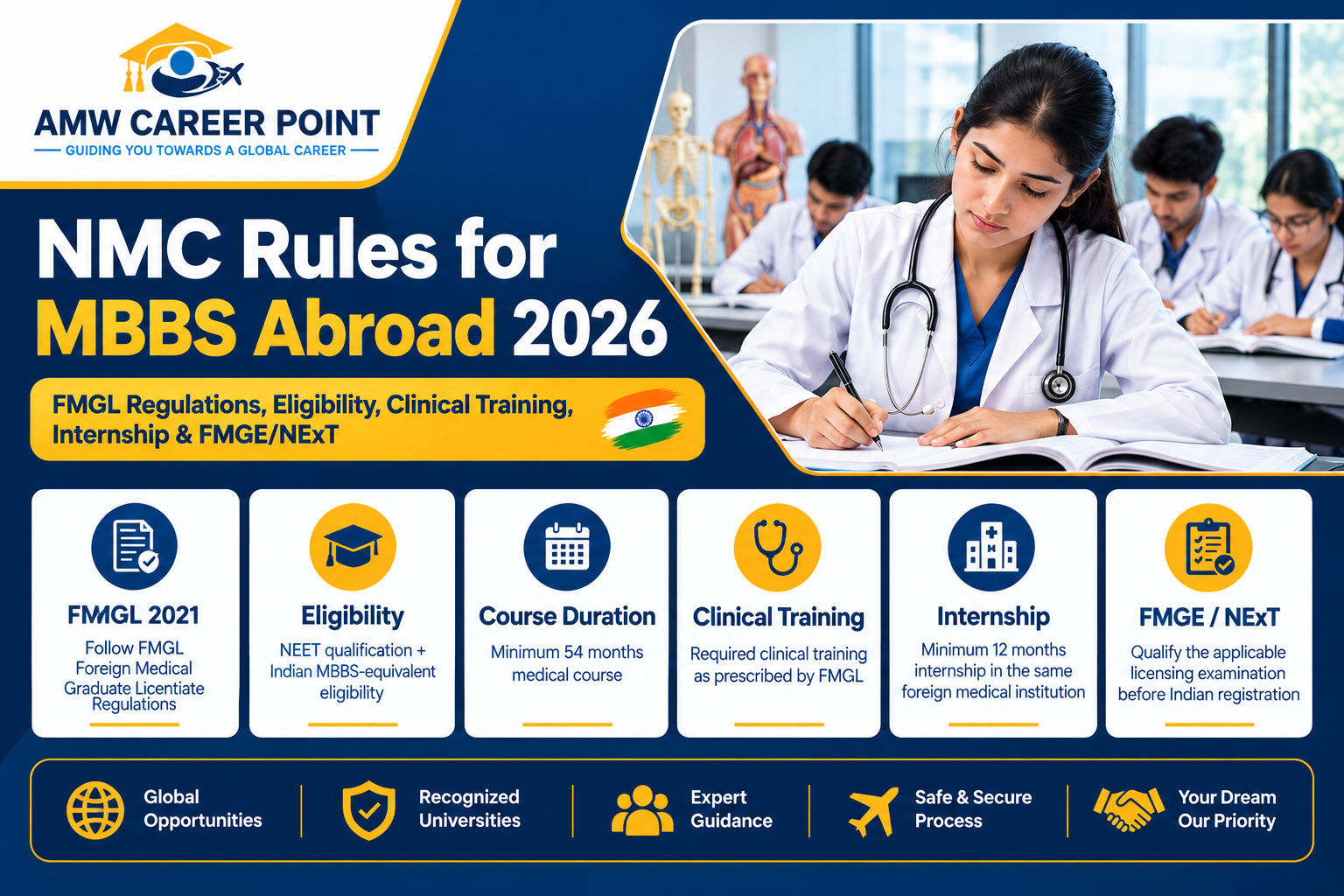
Recognition is governed by the Foreign Medical Graduate Licentiate (FMGL) Regulations, 2021, which are assessed on a course-by-course basis against specific criteria, not by a blanket "Germany is approved" status. The NMC does not publish a countrywide approved list for any destination, including Germany.
Current FMGL Regulations, 2021
Minimum duration: your course must meet FMGL's minimum duration and structure requirements, inclusive of a 12-month internship at the same foreign institution.
English-medium requirement: this is where German medical education needs particularly careful attention. FMGL 2021 expects English-medium instruction, and Germany's programs are taught in German. Students planning to return to India after completing German medical training must verify precisely how their program's medium of instruction is treated under the current NMC assessment, rather than assuming automatic compliance.
Verify this specifically before enrolling: This is one of the most important and most commonly overlooked compliance questions for Germany specifically, compared to English-medium-dominant destinations elsewhere in Europe or the CIS. Given FMGL 2021's English-medium expectation, verify directly and explicitly with the NMC and your specific target German university how a German-taught program is treated for FMGL compliance purposes before committing to this pathway if returning to India is part of your plan.
2026 NMC Updates Relevant to Foreign Medical Graduates
The NMC's current regulations page lists the FMGL Regulations, 2021, alongside a Frequently Asked Questions document dated 8 June 2026, issued specifically to clarify the implementation of an earlier public notice (18 March 2026) concerning compensatory physical training requirements for foreign medical graduates affected by COVID-19-era and Ukraine-Russia war-era online classes. This June 2026 FAQ does not create new eligibility categories or additional relief beyond what earlier notices already permitted; it clarifies implementation. Always check the NMC's current regulations page directly for the latest version before relying on any secondhand summary, including this one.
Course Duration and Clinical-Training Requirements
Germany's roughly 6-year-plus structure, including its compulsory Practical Year, generally aligns with FMGL 2021's duration expectations in principle but exact compliance still needs to be verified against your specific university's documented course structure, not assumed from the country's general reputation.
Medium-of-Instruction Requirements
As flagged above, this is Germany's single biggest FMGL compliance question, given the program's German-medium nature, as it treats it as a mandatory, specific verification step rather than a formality.
Registration/Licensing in the Country of Study
Approbation (or an equivalent recognized licensing status) in Germany is a separate step from NMC/FMGE registration in India; it may be relevant depending on your career plans, but neither automatically confers the other.
Indian Licensing Examination Pathway
After confirming FMGE 2021 compliance, returning graduates must clear the FMGE (Foreign Medical Graduate Examination) as of 2026; NExT has not yet replaced FMGE for foreign medical graduates; the transition remains pending further NMC direction, so students should plan around the examination and transition rules actually in force at the time they become eligible to register, not around outdated FMGE-only or NExT-only assumptions.
Why Students Must Verify NMC Compliance Before Enrolment
Reality check: Given Germany's German-medium instruction and its structurally different Staatsexamen system, verifying FMGE 2021 compliance before enrolling, not after graduating, is significantly more important for Germany specifically than for many other MBBS-abroad destinations. Do not treat this as a formality to check later.
FMGE or NExT After Medicine in Germany?
Current Position in 2026
FMGE remains the operative licensing examination for foreign medical graduates as of 2026. NExT has been notified as a future framework, but its rollout affecting foreign medical graduates has been deferred pending further NMC direction.
FMGE vs NExT
FMGE is the current, single-stage screening examination foreign medical graduates must clear before Indian registration. NExT, once implemented, is designed as a broader licensing and postgraduate-merit framework with theory and clinical/practical components, but its applicability to foreign medical graduates specifically remains pending clearer NMC direction as of this writing.
What Applies to a Future German Medical Graduate?
A student beginning German medical education now, who will graduate several years from now, should expect to follow whichever framework (FMGE, NExT, or a transitional arrangement) is in force when they become eligible to register, and should not assume today's rules will necessarily be identical years from now.
Why Students Should Not Rely on Outdated FMGE Articles
Reality check: This section should be treated as current only as of this guide's publication date and rechecked against the NMC's official site before you rely on it. Foreign medical graduate licensing rules have changed materially in recent years and may change again.
Germany vs Italy for Indian Medical Students
Factor | Germany | Italy |
Main language | German (near-universal for public medicine) | English at several public universities; Italian at others |
Admission exam | No single national exam; HZB assessment + Studienkolleg/FSP where required + university NC selection | IMAT (single national/university-specific entrance exam) |
NEET | Separate Indian regulatory requirement, not part of German admission | Separate Indian regulatory requirement, not part of Italian admission |
Tuition | Usually none at public universities, with real state-specific exceptions (Baden-Württemberg, parts of Bavaria) | Income-assessed (ISEE) at public universities can be very low for eligible students. |
Scholarships | Limited for undergraduate medicine; DAAD is not a realistic undergraduate-medicine funding source. | Strong. DSU regional scholarships can cover tuition, housing, and a stipend for eligible students. |
Living cost | Moderate to high, city-dependent | Moderate, generally lower than Germany's higher-cost cities |
International admission route | Complex HZB, possible Studienkolleg, then university-specific international quota | Single defined pathway via IMAT with a set international-student quota |
Difficulty | High with no language, qualification recognition, and Studienkolleg/FSP compound the challenge. | High as IMAT is competitive, but the pathway itself is more linear. |
NMC considerations | The medium of instruction (German) is a specific FMGL compliance question to verify directly. | English-medium instruction generally aligns more straightforwardly with FMGL 2021 expectations. |
Germany vs Portugal
Portugal, like Italy, generally offers a more linear admissions pathway and, depending on the specific program, greater availability of English-medium programs than Germany's overwhelmingly German-medium public system. Germany's advantage is its larger number of public medical faculties and generally lower or no standard tuition (state exceptions aside); Portugal's advantage is a simpler, more predictable admission and language pathway for students who don't want to commit to German-language study. Compare language requirements, admission routes, entrance exams, fees, medical universities, clinical training structure, international accessibility, and overall suitability for Indian students directly against our dedicated MBBS in Portugal guide before deciding between the two.
Germany vs Hungary, Poland & Other European Destinations
Germany vs Hungary
Hungary offers well-established, genuinely English-medium medical universities (Semmelweis, Debrecen, Pécs, Szeged) with decades of international-student teaching experience a fundamentally more accessible language pathway than Germany's German-medium system, at broadly comparable or higher tuition cost.
Germany vs Poland
Poland similarly offers established English-medium programs with a defined entrance-exam-based admission process, again structurally simpler for an Indian applicant than Germany's HZB/Studienkolleg/German-language pathway, though generally at higher direct tuition cost than Germany's typical "no standard tuition" public-university position.
Germany vs Czech Republic
The Czech Republic offers a small number of well-regarded English-medium medical programs (e.g., at Charles University) with real tuition costs, again with a more linear international-applicant pathway than Germany's system.
Germany vs Romania
Romania's longer-established English-medium MBBS tradition offers a more accessible language route than Germany, at a moderate tuition cost, with EU degree value in both cases.
Germany vs Georgia
Georgia offers a lower total cost and genuinely English-medium instruction (at established universities), but without Germany's EU-degree status specifically, and with its own distinct FMGE track record, a fundamentally different trade-off than Germany's language-intensive, typically lower direct tuition pathway.
Germany vs CIS Countries
CIS destinations (Russia, Kazakhstan, Uzbekistan, Kyrgyzstan) generally offer substantially lower total cost and grade-based or simpler admission, but with English-medium claims that often don't hold up fully through the clinical years, a different risk profile than Germany's upfront, explicit German-language requirement, which at least sets clear expectations from the outset even though it demands more preparation before you can even apply.
Advantages and Disadvantages of Medicine in Germany
Major Advantages
Strong medical education and research infrastructure
Public universities with usually no standard tuition fee
Well-developed healthcare system for clinical training
Active research opportunities
Long-term EU/German career opportunities
Major Disadvantages
The German-language requirement which is a genuine, non-negotiable barrier for most Indian applicants
Highly competitive Numerus Clausus admission process for medicine specifically
Complex, case-by-case qualification recognition (HZB) rather than a simple universal rule
Studienkolleg may be necessary, adding a full year to your timeline
Limited international-applicant access relative to total seats (roughly a 5% international quota at many universities)
Real cost of living, and state-specific tuition exceptions that complicate simple "free MBBS" cost planning
Genuinely complicated, multi-step application routes compared to several other MBBS-abroad destinations
Who Should Choose Medicine in Germany?
Germany is potentially suitable for a student who:
Is academically strong, with competitive Class 12 results
Is prepared to learn German seriously, realistically 12–18 months of dedicated study, minimum
Can handle a genuinely competitive, multi-stage admission process
Is willing to complete Studienkolleg if that turns out to be their required route
Has a long-term interest in building a career in Germany or the wider EU, not just returning to India immediately
Understands clearly that this is not simply "low-cost MBBS abroad"; it's a more demanding, longer-horizon pathway with a genuinely different value proposition
Who Should NOT Choose Medicine in Germany?
Germany is not ideal for a student who:
Only wants an English-medium medical degree
Doesn't want to commit real time and effort to learning German
Expects guaranteed or fast admission
Wants a simple, agent-led admission process with minimal personal verification
Expects NEET, or any single Indian qualification, to secure a German medical seat on its own
Cannot commit to a potentially lengthy, multi-stage preparation pathway (German language, possible Studienkolleg, then competitive selection)
Is looking for the fastest possible route to a foreign MBBS
Common Mistakes Indian Students Make
Assuming TMS is mandatory for every applicant
Assuming every Indian Class 12 student needs Studienkolleg
Assuming every Indian Class 12 student can directly enter Medicine
Treating NEET as a German entrance examination
Assuming B1 German is enough for medical school admission
Confusing the Studienkolleg entrance exam with actual medical-school admission
Assuming passing FSP guarantees a medical-school place
Applying to universities without first checking their specific international-applicant rules
Believing "free education" means zero cost overall
Ignoring NMC/FMGL compliance verification, particularly the German medium-of-instruction question
Step-by-Step Germany Medicine Roadmap for an Indian Student
Route A — Direct University Admission
Class 12 → HZB confirmed as direct access → German language study → Application → Admission → Visa.
Realistic only for a minority of Indian applicants whose specific qualification is assessed as providing direct HZB access; please verify this specifically before planning around it.
Route B — Studienkolleg Route
Class 12 → HZB assessment (indicates Studienkolleg needed) → M-Kurs → FSP → Medicine application → Admission → Visa.
The realistic default route for most Indian Class 12 applicants, given the 12-year vs. 13-year gap in the school system.
Route C — Student With Previous University Study
Students who have already completed a defined period of recognized university study in India (for example, part of an MBBS or a relevant science bachelor's degree) may, in some cases, have their qualification assessed differently, potentially bypassing Studienkolleg. This must be evaluated against the specific qualifications and university rules involved, rather than assumed generally.
Germany Medicine Admission Checklist 2026
Class 12 completed
PCB requirements checked
Qualification evaluated via DAAD database/anabin
HZB status confirmed
Studienkolleg requirement checked
M-Kurs identified (if applicable)
German language plan created
Language exam selected (TestDaF/DSH/telc C1 Hochschule/Goethe)
FSP requirement checked (if applicable)
University shortlist created
Application route confirmed (uni-assist/Hochschulstart/direct)
Deadlines checked directly with each university
Documents prepared
Financial plan created
Scholarship options checked realistically
Visa funds arranged (€11,904/year confirmed)
Health insurance arranged
NMC/FMGL compliance verified, including the German medium-of-instruction question
Is MBBS in Germany Worth It for Indian Students in 2026?
Academically
Genuinely strong, as Germany's medical education system is well-regarded, research-active, and clinically rigorous. This is not in question.
Financially
Potentially favorable if you're admitted to a public university outside the state-specific tuition exceptions, but the real total cost (living expenses, semester contributions, a possible Studienkolleg year, and state-specific tuition) is meaningfully higher than the "free MBBS" headline suggests.
For Students Willing to Learn German
This is the deciding factor more than any other single variable in this entire guide. Students genuinely willing to invest 12–18 months in serious German-language study before even applying are the ones for whom this pathway realistically works.
For Students Planning to Return to India
Workable, but requires specific, upfront verification of FMGL 2021 medium-of-instruction compliance; please do not assume automatic compliance given Germany's German-medium instruction.
For Students Planning to Build a Career in Germany
This is where Germany's proposition is strongest: a genuine, long-term EU medical career pathway with robust postgraduate specialization infrastructure and sustained demand for qualified doctors.
Best For / Not Best For
| Assessment |
Best for | Academically strong students genuinely willing to commit to German-language study, who are open to a longer, more complex admission pathway, and who see real long-term value in a German or EU medical career. |
Not best for | Students who want the fastest, simplest, or lowest-total-effort route to a foreign medical degree, who want English-medium instruction, or who are treating "MBBS in Germany" as a low-cost shortcut rather than a genuinely different, more demanding pathway. |
University Overview
Reality check: This is a structured comparison, not a "best university" ranking — no defensible single-methodology ranking is offered here. All 24 public universities listed in this guide's research scope teach Humanmedizin in German as the standard medium; international admission routes and any state-specific tuition exceptions should always be verified directly and kept up to date with each institution.
Selected Public Medical Universities
Heidelberg University: Heidelberg, Baden-Württemberg
Germany's oldest university (founded in 1386) with a highly regarded medical faculty; Baden-Württemberg's € 1,500-per-semester non-EU tuition applies here.
LMU Munich: Munich, Bavaria
One of Germany's most research-intensive medical faculties; Bavaria's non-EU tuition policy should be verified directly for current status.
Technical University of Munich (TUM): Munich, Bavaria
Strong integration of medical technology and research; the same Bavarian tuition-verification point applies.
Charité: Universitätsmedizin Berlin: Berlin
One of Europe's largest and most prestigious university hospitals/medical faculties, jointly run by Humboldt and Freie Universität Berlin.
Table 1: German Medical Universities (Full List)
University | Medicine Programme | Tuition Fee for Indian Students | Semester Contribution — WS 2026/27 | Approx. University Cost/Year |
Human Medicine, State Examination | €0 | €363.07/semester | €726.14 | |
Human Medicine, State Examination | €0 | €182.10/semester | €364.20 | |
Human Medicine, State Examination | €0 | €371.15/semester | €742.30 | |
Human Medicine, State Examination | €0 | €412.30/semester | €824.60 | |
Human Medicine, State Examination | €0 | ~€424.80/semester | ~€849.60 | |
University of Cologne | Human Medicine, State Examination | €0 | €355.65/semester | €711.30 |
University of Hamburg | Human Medicine, State Examination | €0 | €402/semester | €804 |
University of Münster | Human Medicine, State Examination | €0 | €369.50/semester | €739 |
University of Leipzig | Human Medicine, State Examination | €0 | €332.30/semester | €664.60 |
University of Jena | Human Medicine, State Examination | €0 | €333.05/semester | €666.10 |
FAU Erlangen-Nürnberg | Human Medicine, State Examination | €0* | €82/semester | €164 |
Ulm University | Human Medicine, State Examination | €1,500/semester | €192/semester | €3,384 |
University of Regensburg | Human Medicine, State Examination | €0 | €208/semester | €416 |
University of Rostock | Human Medicine, State Examination | €0 | €352/semester | €704 |
University of Greifswald | Human Medicine, State Examination | €0 | €127/semester† | €254 |
University of Magdeburg (OVGU) | Human Medicine, State Examination | €0 | €329.30/semester | €658.60 |
Johannes Gutenberg University Mainz | Human Medicine, State Examination | €0 | €366.90/semester | €733.80 |
Private Medical Universities
A smaller number of private medical universities and institutes also operate in Germany, charging substantial tuition (commonly tens of thousands of euros per year) and a fundamentally different cost model from the public system described above. Private institutions are deliberately covered separately here, since mixing them into the public-university comparison misrepresents Germany's dominant "largely no standard tuition" public pathway. Verify accreditation, NMC/FMGL implications, and current fees independently and in depth before considering a private route.
Table 2: Indian Qualification Pathway
Indian Qualification | Direct HZB? | Studienkolleg Likely Needed? | Medicine Eligibility | Verification Required |
CBSE Class 12 (high aggregate + strong PCB) | Case-by-case, please verify via DAAD/anabin | Likely, for most applicants | Subject to HZB and Studienkolleg/FSP outcome | Yes, also verify individually |
ISC Class 12 | Case-by-case; please verify via DAAD/anabin | Likely, for most applicants | Subject to HZB and Studienkolleg/FSP outcome | Yes, also verify individually |
State Board Class 12 | Case-by-case; please verify via DAAD/anabin | Likely, for most applicants | Subject to HZB and Studienkolleg/FSP outcome | Yes, also verify individually |
Completed 1+ year of recognized Indian university study (e.g., partial MBBS or relevant BSc) | Potentially improved status; please case-by-case | Possibly bypassed | Subject to specific university assessment | Yes, also verify individually |
Table 3: German Language Exams (Summary)
See the full comparison table earlier in this guide ("German Language Exams Accepted for University Admission") for exam-by-exam detail on TestDaF, DSH, telc C1 Hochschule, Goethe-Zertifikat, and university-specific certificates.
Table 4: Studienkolleg Pathway
Stage | What Happens |
1. Qualification Assessment | Check HZB status via DAAD database/anabin |
2. Studienkolleg (M-Kurs) | One-year preparatory course, entry via Aufnahmeprüfung |
3. Feststellungsprüfung (FSP) | Exit exam, determines subject-specific university entrance qualification |
4. University Application | Via uni-assist, Hochschulstart, or direct application, using your FSP result within the international medicine quota |
Table 5: Medicine Admission Exams: Explicitly Separated
Exam/Assessment | Who Takes It | Purpose | Indian Student Relevance | Required? |
TMS (Test für medizinische Studiengänge) | Primarily domestic/EU applicants | Aptitude assessment for the domestic/EU medicine-admission pathway | Generally, not relevant for non-EU applicants with a non-German HZB | Generally, no for most Indian applicants |
Studienkolleg Entrance Test (Aufnahmeprüfung) | Studienkolleg applicants | Determines entry into the M-Kurs specifically | Directly relevant if Studienkolleg is required | Yes, if Studienkolleg applies to you |
Feststellungsprüfung (FSP) | Studienkolleg completers | Exit exam determining university entrance qualification and feeding into NC selection. | Directly relevant if Studienkolleg is required | Yes, if Studienkolleg applies to you |
University-specific assessments (motivation letters, interviews, etc.) | International-quota applicants generally | Supplementary selection criteria at some universities | Relevant — university-specific | Verify per university |
Table 6: 2026 Fees (Summary)
University Type | Tuition | Semester Contribution | Other Mandatory Charges | Notes |
Most public universities (outside named exceptions) | None (standard) | ≈ €150–€350/semester | None beyond semester contribution | Verify current status directly |
Public universities in Baden-Württemberg (Heidelberg, Freiburg, Tübingen, Ulm, etc.) | €1,500/semester for non-EU students | ≈ €150–€350/semester | Confirmed exception — factor into budget | Applies specifically to non-EU international students |
Bavaria public universities (LMU Munich, TUM, Würzburg, Erlangen-Nuremberg, Regensburg, etc.) | Possible, institution-dependent | ≈ €150–€350/semester | Verify current status per specific university | Not applied uniformly — check individually |
Private medical universities | Substantial commonly tens of thousands of euros/year | Varies by institution | Verify current fee schedule directly | Fundamentally different cost model from public universities |
Table 7: Cost of Living (Summary)
See the full "Cost of Living in Germany for Indian Medical Students" section above for the detailed monthly breakdown and city-wise comparison across Munich, Berlin, Heidelberg, Hamburg, Cologne, Freiburg, Leipzig, Göttingen, and Münster.
Table 8: Germany vs Italy vs Portugal
Factor | Germany | Italy | Portugal |
Admission | HZB + possible Studienkolleg/FSP + university NC selection | IMAT (single exam) | Generally more linear, program-specific admission |
Language | German (near-universal) | English at several public universities; Italian at others | English at several programs; Portuguese in clinical years at most |
Entrance exam | No single national exam | IMAT | Program-specific, generally simpler than Germany's multi-stage process |
Tuition | Usually none, with real state-specific exceptions | Income-assessed (ISEE) can be very low | Moderate, program-dependent |
Living cost | Moderate to high, city-dependent | Moderate | Generally moderate |
Scholarships | Limited for undergraduate medicine | Strong (DSU regional scholarships) | Limited to moderate, verify per program |
International access | Roughly 5% international quota at many universities, plus qualification-recognition complexity | Defined international-student quota via IMAT | Generally accessible international routes, program-dependent |
Indian student suitability | Best for students committed to German language and a long-term EU/Germany career | Best for academically strong students wanting EU degree value with more admission clarity | Best for students wanting a simpler EU pathway with more English-medium availability |
Frequently Asked Questions
Q: Can Indian students study MBBS in Germany after Class 12?
A: Yes, but not always directly; whether your Class 12 qualification gives direct university access (HZB) or requires a Studienkolleg year first depends on your specific board and results, checked via DAAD's database/anabin as the starting point.
Q: Is NEET required for studying Medicine in Germany?
A: NEET plays no role in German university admission itself, but a qualifying NEET-UG score is a separate Indian regulatory requirement under FMGL 2021 if you intend to return and practice in India.
Q: Is MBBS in Germany free for Indian students?
A: Not entirely, as most public universities charge no standard tuition fee for a first degree, but a compulsory semester contribution always applies, and Baden-Württemberg (€1,500/semester) and, in some cases, Bavaria do charge non-EU international students a tuition fee. "Free MBBS in Germany" is an oversimplification.
Q: Do Indian students need Studienkolleg for Medicine in Germany?
A: Often, but not universally, as it depends on whether your specific Indian qualification is assessed as providing direct HZB access. Most Indian Class 12 applicants do end up needing the Studienkolleg (specifically the M-Kurs), but this should be verified on an individual basis rather than assumed.
Q: What is M-Kurs in Germany?
A: The Studienkolleg preparatory track specifically for students targeting Medicine, Biology, and related life-science degrees with a one-year course ending in the Feststellungsprüfung (FSP).
Q: What German language level is required for Medicine?
A: Roughly B1–B2 for Studienkolleg entry, and C1 (often "C1 Hochschule" or equivalent) for direct medical university admission, with ongoing, active language development needed well into the clinical years.
Q: Is TMS required for Indian students applying to German medical universities?
A: Generally no, as the official TMS authority states the test is not part of the medical admission process for non-EU citizens with a non-German university entrance qualification, which describes most Indian applicants.
Q: Can I study Medicine in Germany in English?
A: Not through the standard public-university pathway; German public Humanmedizin programs are taught in German, including virtually all clinical training. Treat any "English MBBS in Germany" claim with skepticism and verify directly.
Q: What are the medical universities in Germany for international students?
A: Germany has a large number of public medical faculties (including Heidelberg, LMU Munich, TUM, Charité Berlin, Freiburg, Tübingen, Göttingen, Bonn, Cologne, Hamburg, Münster, Leipzig, Jena, Würzburg, Erlangen-Nuremberg, Düsseldorf, Ulm, Regensburg, Rostock, Greifswald, Saarland, Magdeburg, Marburg, and Mainz, among others) plus a smaller number of private institutions
Q: How much does it cost to study Medicine in Germany?
A: Realistically ₹50 lakh to ₹1.3+ Crore across the full program (including a possible Studienkolleg year), depending heavily on the specific state, city, and whether any non-EU tuition exception applies; see the Total Cost section above for scenario-based estimates.
Q: What entrance exam is required for Medicine in Germany?
A: There is no single national entrance exam. The relevant assessments are the Studienkolleg Aufnahmeprüfung (if Studienkolleg is required) and the Feststellungsprüfung (FSP); afterward, TMS generally does not apply to most Indian applicants, as explained above.
Q: Can Indian Class 12 students directly enter German medical universities?
A: Some can, if their specific qualification is assessed as providing direct HZB access, but most Indian Class 12 applicants require the Studienkolleg route first, given the 12-year vs. 13-year school-system gap.
Q: Can I work as a doctor in Germany after graduating from a German medical university?
A: Yes, after completing all state examinations and receiving Approbation (full German medical licensure), this is the standard route for a student who trained in Germany from the start.
Q: Can I return to India after studying Medicine in Germany?
A: Yes, provided your specific course satisfies FMGL 2021, including careful verification of the German medium-of-instruction question, and you clear the FMGE (or NExT, once implemented) and obtain State Medical Council registration.