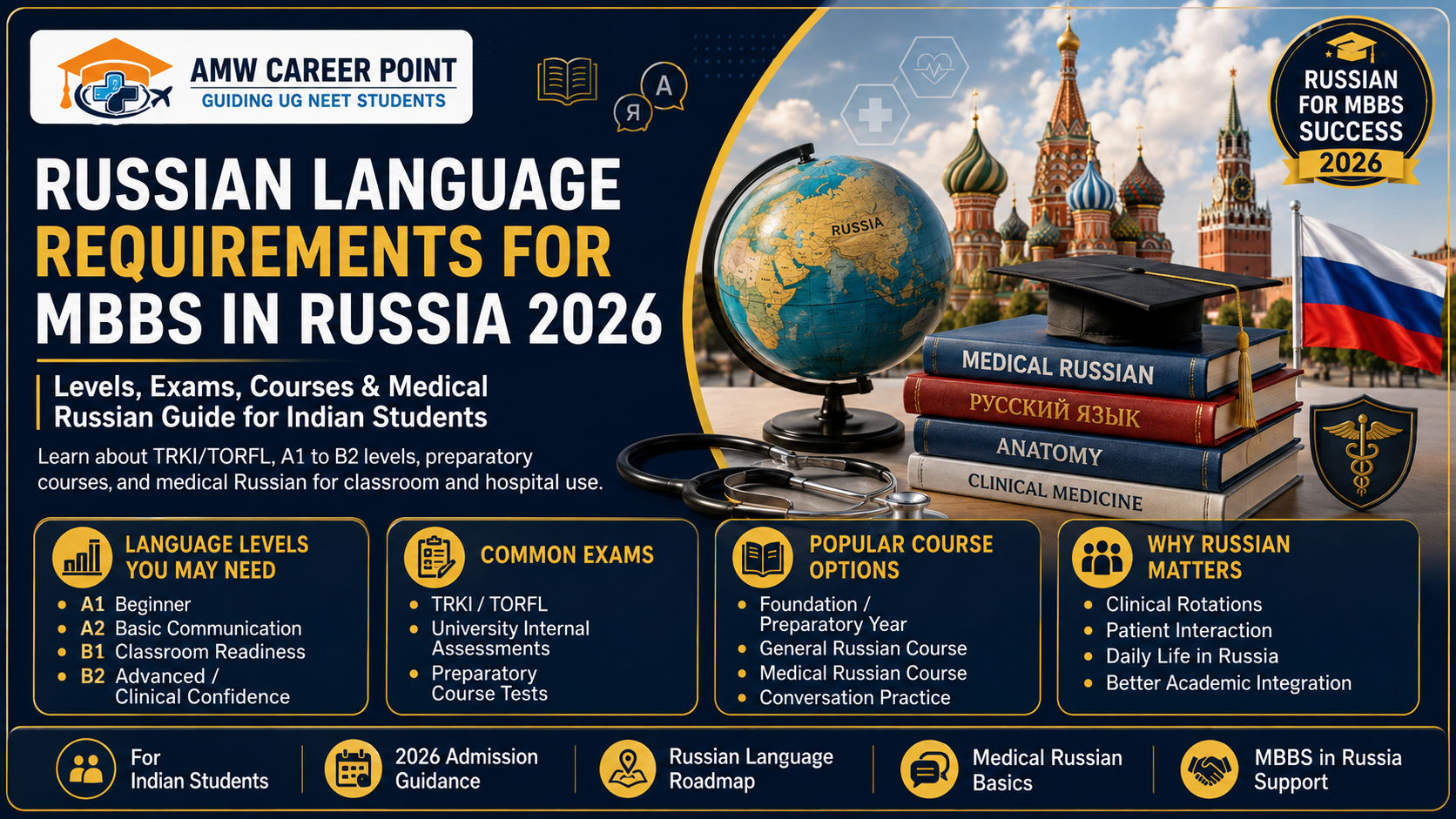
There is no single Russian-language requirement that applies uniformly to all MBBS/General Medicine programs for MBBS in Russia. The requirement depends on the specific university, the program's medium of instruction, and the admission route. Sechenov University, for example, offers General Medicine in both Russian and English and requires a Russian-language entrance exam for both tracks. Kazan State Medical University separately lists Russian-medium and English-medium General Medicine programs with different entrance requirements, yet still includes a compulsory Russian-language discipline in its English-medium curriculum.
Question | Short Answer |
Is Russian compulsory? | Depends on the university and track; not universal |
Does it depend on the university? | Yes, significantly |
Does it depend on medium of instruction? | Yes, but English-medium ≠ zero Russian |
Is Russian required for admission? | At several universities, yes, even for English-medium tracks |
Is Russian required during clinical training? | Practically, yes, at almost every university |
Is IELTS a substitute for Russian? | No, they test different things and serve different purposes. |
Is TRKI/TORFL compulsory? | University-specific; verify per institution |
What level should Indian students target? | B1 as a practical foundation, B2 as a strong clinical-communication target |
Do Indian Students Need Russian to Study MBBS in Russia in 2026?
Is Russian compulsory for all MBBS students?
No, not universally. Requirements are set at the university and program level, not by a single national rule that applies to every medical student in Russia.
Is Russian compulsory for Russian-medium MBBS?
Yes, both academically and practically. A student in a Russian-medium program needs sufficient Russian to follow lectures, take exams, and function in clinical settings from an early stage.
Is Russian required for English-medium MBBS?
This is where the distinction matters most. Separate these five things, because they are not the same question:
Academic instruction: Conducted in English at English-medium universities/tracks
Entrance examination: Several universities, including Sechenov, require a Russian-language exam even for English-medium applicants
University requirements: Some universities fold a compulsory Russian-language discipline into the English-medium curriculum itself (Kazan does this)
Clinical communication: Patients, nurses and hospital staff generally do not speak English
Patient interaction: Becomes increasingly Russian-dependent from the clinical years onward
Can I study MBBS in Russia without knowing Russian?
Possible at some English-medium programs at the point of admission, but this is not the same as "Russian is unnecessary." Even where a university doesn't mandate a Russian entrance exam, real clinical training in a Russian hospital will demand functional Russian well before graduation.
Why Russian Language Matters Even for English-Medium MBBS
Classroom vs Hospital
Studying medical theory in English does not mean the hospital operates in English. In practice:
Patients speak Russian, not English
Nurses and hospital support staff generally speak Russian
Case histories are conducted with the patient in Russian
Everyday communication on the ward is in Russian
Emergencies don't wait for a translator
Russian During Clinical Rotations
From the point a student enters a hospital ward, Russian becomes directly relevant to:
Taking patient history
Understanding reported symptoms
Obtaining informed consent
Giving basic instructions to a patient
Conducting a physical examination with verbal guidance
Ward communication with nurses and attending doctors
Reading prescriptions and medical terminology
General interaction with hospital staff
Why Medical Russian Is Different from General Russian
Conversational fluency and clinical fluency are not the same skill. A student who can navigate a Moscow metro conversation may still struggle to take a structured patient history in Russian. Medical Russian requires its own vocabulary, phrasing conventions, and listening practice specific to a clinical setting, covered in a later section of this guide.
Russian Language Levels Explained: A1, A2, B1, B2, C1 & C2
Level | What a Student Can Generally Do | Relevance to MBBS |
A1 | Basic phrases | Too low for medical study |
A2 | Basic everyday communication | Limited, daily life only |
B1 | Intermediate communication | Useful foundation; minimum for most Russian university admission (TRKI-I) |
B2 | Upper-intermediate | Strong target for academic and clinical communication (TRKI-II) |
C1 | Advanced | Excellent for clinical communication; not typically required |
C2 | Near-native | Usually unnecessary for MBBS purposes |
Important Editorial Note
Do not treat B2 as a universal legal requirement for MBBS in Russia; it isn't. B1/B2 are practical targets to aim for, but the actual admission requirements must be verified on a university-by-university and program-by-program basis. Treating B2 as mandatory everywhere is exactly the kind of generic claim that misleads students, and this guide deliberately avoids it.
What Is TRKI/TORFL? Russian Language Proficiency Exam Explained
TRKI (Тест по русскому языку как иностранному) and TORFL (Test of Russian as a Foreign Language) are the same exam. TRKI is the Russian-language name; TORFL is the English name used internationally. It is Russia's closest equivalent to a single, government-linked national Russian proficiency standard, administered under Russian federal legislation by thirteen nominated lead institutions, including the Pushkin Institute in Moscow and Kazan's own testing center.
TRKI vs TORFL: Are They the Same?
Yes. They refer to identical six-level testing systems; which name you see depends on whether the source is Russian-language or English-language material.
Level | CEFR Equivalent | What It Enables |
Elementary (ТЭУ) | A1 | Basic vocabulary, greetings, simple requests |
Basic (ТБУ) | A2 | Basic communication, shopping, public transport |
TRKI-I / TORFL-I | B1 | Satisfies main everyday, cultural and educational communicative needs; the minimum level generally needed to apply to a Russian university. |
TRKI-II / TORFL-II | B2 | High competence across cultural, educational and professional situations; generally the level needed to be awarded a bachelor's, master's or PhD degree from a Russian university (except certain philology-related programs) |
TRKI-III / TORFL-III | C1 | Advanced fluent communication, understanding of lectures and media |
TRKI-IV / TORFL-IV | C2 | Near-native not required for MBBS purposes |
What Does the TRKI Exam Test?
The exam covers five components: grammar/vocabulary (a multiple-choice section), reading, writing, listening, and speaking. Passing generally requires scoring at least 66% on each subtest, not just an overall average.
Where Can Students Take TRKI?
At the Pushkin Institute in Moscow, at any of the thirteen authorized lead testing universities inside Russia (including Kazan, Moscow State University, and St Petersburg State University), and at select partner centers abroad. International test-center availability has fluctuated since 2022 and varies by country; confirm current availability directly with the Pushkin Institute or a listed partner center rather than relying on older lists.
How Long Is TRKI Valid?
TORFL/TRKI certificates do not carry a printed expiry date from the testing body itself. However, individual universities may still apply their own currency requirements for admission; verify this directly with the specific university's admissions office rather than assuming it is valid indefinitely.
What Russian Language Level Is Required for MBBS in Russia?
This is the highest-value section of this blog because a single blanket answer would be inaccurate. The table below shows the currently available 2026 admission information. Moreover, always cross-check directly with the university before you apply, as entrance exam policies are reviewed on a yearly basis.
University/Program | Medium | Russian Required? | Russian Entrance Exam? | Recommended Level |
Sechenov, English-medium General Medicine | English | Yes, for the entrance exam | Yes — mandatory, even for English-track applicants | B1 at entry; university's own Preparatory Department builds this up |
Sechenov, Russian-medium General Medicine | Russian | Yes | Yes | B1–B2 recommended before enrolling |
Kazan State Medical University, English-medium | English | Compulsory Russian discipline built into the curriculum | Not for admission at the English track | Not mandatory pre-admission; picked up through the compulsory in-course Russian classes |
Kazan State Medical University, Russian-medium | Russian | Yes | Yes | B1–B2 before enrolling |
Saratov State Medical University | English/Russian tracks available | Track-dependent | Track-dependent | Verify per track at application |
This is a materially more useful answer than a blanket "B2 is required everywhere" claim, because it simply isn't true. Kazan's English-medium track, for instance, does not require a Russian entrance exam at all, even though Russian remains a compulsory subject once enrolled.
Russian Language Requirement at Top Russian Medical Universities
Sechenov University
Sechenov offers a six-year General Medicine program with tuition set at RUB 1,300,000/year for 2026/27. Applicants to both the Russian- and English-language tracks sit internal entrance exams, and the examination language can be chosen as either Russian or English for specialist-level programs. Still, a Russian-language exam is listed as mandatory even for students entering the English-taught track. No external certificate such as IELTS is required in its place.
Sechenov runs its own Preparatory Department, combining Russian-language training with subject preparation (chemistry, biology, physics) in Russian. For students with no or very limited Russian, the university's preparatory route commonly runs around 11 months; students who already have functional Russian can take a shorter track.
Why Sechenov Is a Strong Case Study Sechenov demonstrates precisely why "English-medium" does not automatically mean "Russian not required." The academic instruction is genuinely in English, but the entrance exam, the compulsory clinical communication requirement, and the university's own guidance for preparing to interact with "doctors, nurses, and patients in Russian hospitals" all make Russian practically unavoidable. |
Kazan State Medical University
Kazan runs six-year General Medicine programs in both Russian and English. For the English-medium track, all lectures, practicals, laboratory work, seminars, and examinations are conducted in English. Still, Russian is included as a compulsory discipline within the English-medium curriculum, specifically to prepare students for clinical communication. International students on the Russian-medium track are required to complete preparatory Russian-language courses before or alongside their first year.
Kazan's entrance process for the English-medium General Medicine track consists of an online exam in Biology, Chemistry, and English; a separate Russian-language proficiency test is generally not required for admission to that track, though this should be confirmed for the current admission cycle before applying, as policies are reviewed annually.
Saratov State Medical University
Saratov offers General Medicine as a six-year program with both Russian and English listed as languages of instruction, and its current information on foreign admissions distinguishes between Russian-language and bilingual program tracks. As with the other universities in this guide, the exact Russian-language entrance requirement depends on which specific track a student applies to; verify directly with Saratov's international admissions office for the applicable 2026 requirements before applying.
Bashkir State Medical University, Pirogov RNRMU, Pavlov SPbSMU & Volgograd SMU
These four universities also run English- and Russian-medium General Medicine tracks with preparatory faculty options, broadly following the same pattern described above: English-medium academic instruction paired with a Russian-language expectation that grows over the clinical years. Because published entrance-exam requirements for these institutions vary by admission cycle and were not independently verified against a current 2026 official source at the time of writing, prospective applicants should confirm the specific Russian-language and entrance-exam policy directly with each university's international admissions office before applying, rather than relying on aggregator listings.
English-Medium MBBS in Russia: Do You Still Need Russian?
English-medium academics: yes, theory is genuinely taught in English
Russian-language admission requirements can vary; Sechenov requires it, Kazan's English track generally does not
Russian during clinical years practically essential at nearly every university, English-medium or not
Russian for patient communication essential; patients are Russian-speaking
Russian for daily life highly useful for shopping, transport, medical appointments, and basic administration
Russian for internships: the final-year internship is conducted inside a Russian hospital system, where Russian is the working language
Verdict: English-medium ≠ zero Russian requirement. |
Is IELTS Required for MBBS in Russia?
Is IELTS mandatory?
University-specific. Several Russian medical universities, including Sechenov, explicitly state that no external English-language certificate, such as IELTS, is required; English proficiency is instead assessed through the university's internal entrance examination, conducted in the applicant's chosen language.
IELTS vs Russian Language Requirement
These serve entirely different purposes and are not interchangeable. IELTS (where required at all) assesses English proficiency for an English-medium academic track; a Russian-language requirement, whether an entrance exam or a compulsory in-course discipline, exists for admission and clinical communication purposes, independent of English proficiency.
Can IELTS Replace TRKI?
Generally, no. Where a university specifically requires a Russian-language entrance exam or TRKI-level proficiency, an IELTS score does not substitute for it; the two exams test entirely different languages.
Is TOEFL Required for MBBS in Russia?
Treatment is broadly the same as for IELTS above: most Russian medical universities assess English proficiency through their own internal entrance exam rather than requiring an external certificate such as TOEFL. Confirm the specific university's current policy rather than assuming TOEFL is either required or unnecessary as a blanket rule.
Russian Language Entrance Exam for MBBS in Russia
What Is Tested?
Grammar
Vocabulary
Reading
Listening
Writing
Speaking
University-Specific Entrance Tests
Sechenov's internal entrance exams allow applicants to choose Russian or English as the examination language for specialist programs, but require a Russian-language component for General Medicine regardless of track. Kazan's English-medium entrance exam covers Biology, Chemistry, and English, without a separate Russian-language paper for that track.
Minimum Scores
Sechenov's entrance exams are scored out of 100 points per subject, with minimum passing scores set by the university for each admission campaign. These are published and updated annually, so treat any specific cutoff figure as needing reconfirmation for the exact year of application.
Online vs Offline Testing
Both formats are in active use across Russian medical universities. Exam dates and formats are typically communicated through each applicant's personal admissions portal account after document submission; confirm the format directly rather than assuming either is standard.
Russian Preparatory Course for MBBS Students
Russia's official Study in Russia portal confirms that international students can take university preparatory programs which typically last about one academic year to learn Russian and build subject knowledge before beginning their degree.
What Is a Preparatory Faculty?
Known in Russian as the Подготовительный факультет (Preparatory Faculty/Department), this is a dedicated one-year (approximately) program combining Russian-language instruction with foundational coursework in the sciences relevant to the student's intended degree.
Who Should Take It?
Complete beginners in Russian
Students at A1/A2 level who need to reach a functional level before starting medical coursework
Students entering a Russian-medium program
Students who feel underprepared for a university's entrance examination
What Do Students Study?
Russian language (general and, at some universities, introductory medical Russian)
Chemistry
Biology
Physics
Mathematics where applicable
Introduction to Russian culture and the education system
How Long Is the Course?
Duration varies by university; there is no single universal figure. Sechenov currently offers an 11-month preparatory track for students with little or no prior Russian, and a shorter route for those who are already functionally fluent. Kazan's preparatory department runs a 10-month course beginning 1 September, and explicitly states that completing it does not exempt a student from the university's regular entrance examinations; the preparatory course and the entrance exam remain two separate steps.
Editorial Note Do not present preparatory-course duration as a fixed, universal figure such as "one year everywhere." Durations reported across universities range from roughly 7 to 12 months, depending on the institution and the student's starting level of Russian; confirm the specific figure with the chosen university before budgeting. |
How Much Does a Russian Language Course Cost in Russia?
Costs vary by route. University preparatory programs are typically billed as a package alongside or as a precursor to the main tuition fee; standalone TRKI/TORFL examination fees at the Pushkin Institute currently run roughly RUB 5,000–6,500 (approximately ₹4,500–5,900) per sitting depending on level, with partner centers abroad setting their own local pricing. Private language institutes and online courses vary widely by provider and are not standardized; get a specific quote before budgeting rather than relying on a generic figure.
Learning Route | Best For |
University preparatory faculty | Students starting from zero or A1/A2, who also need subject (science) preparation alongside language |
Private language institute (in India or Russia) | Structured group learning with a fixed schedule before or after departure |
Online course | Flexible, self-paced early foundation-building before departure |
One-on-one tutor | Fast progress on specific weak areas, especially speaking practice |
Dedicated TRKI/medical Russian preparation | Students specifically targeting a TRKI certificate or clinical-year readiness. |
Can Indian Students Learn Russian Before Going to Russia?
Yes, and doing so genuinely eases the transition. The main options:
Learn in India: Through a private institute or tutor before departure
Online course: Self-paced foundation building, useful pre-departure
Russian university preparatory faculty: Combines language with subject prep, done in Russia
Private institute in Russia: Supplementary or intensive study alongside the academic program
Hybrid: Foundational learning in India followed by the university's preparatory faculty for depth
How Long Does It Take to Learn Russian for MBBS?
Starting Level | Approximate Goal | Focus |
Beginner | A1 | Basic communication |
A1 | A2 | Daily life |
A2 | B1 | University interaction, meeting most entrance-exam thresholds |
B1 | B2 | Strong academic and clinical communication |
B2 | Medical Russian | Clinical-environment readiness |
Avoid promising fluency in an unrealistically short window. Progress genuinely depends on hours of structured study, immersion, and most importantly regular speaking practice, not calendar time alone. A student studying intensively with daily speaking practice will progress faster than one studying the same total hours spread thinly with no conversation practice.
Medical Russian for MBBS Students
This is where general Russian courses and clinical readiness genuinely diverge, and where this guide aims to go beyond a generic language overview.
Common Medical Russian Vocabulary Categories
Body parts
Symptoms
Diseases
Medicines
Hospital departments
Emergency terminology
Patient history questions
Physical examination instructions
Instructions to patients
Medical documentation terms
Essential Russian Words Every MBBS Student Should Know
A working starter vocabulary built on this list with structured medical Russian coursework rather than treating it as complete.
Russian | English |
врач | doctor |
пациент | patient |
больница | hospital |
лекарство | medicine |
боль | pain |
температура | temperature/fever |
кровь | blood |
сердце | heart |
лёгкие | lungs |
голова | head |
живот | stomach/abdomen |
горло | throat |
рецепт | prescription |
укол | injection |
анализ | test/analysis |
операция | surgery/operation |
медсестра | nurse |
скорая помощь | ambulance/emergency services |
давление | blood pressure |
кашель | cough |
Russian Phrases Doctors Need in Clinical Practice
Russian | English | Clinical Use |
Где болит? | Where does it hurt? | History-taking |
Как давно? | Since when? | History-taking |
Есть ли температура? | Do you have a fever? | Symptom check |
Вам больно? | Does it hurt? | Physical examination |
Принимали ли вы лекарства? | Have you taken any medication? | Medication history |
Откройте рот | Open your mouth | Physical examination |
Дышите глубоко | Breathe deeply | Physical examination |
Есть ли аллергия? | Do you have any allergies? | History-taking |
Do Indian MBBS Students Need Russian for Clinical Training?
Year | Russian Language Demand |
Year 1–2 | Basic communication, settling in, daily life, early coursework |
Year 3–4 | Growing need for clinical terminology as hospital exposure begins |
Year 5–6 | Patient communication becomes increasingly important as clinical rotations intensify. |
The exact curriculum structure and degree of language exposure vary by university and program; this progression is a general pattern, not a fixed syllabus applicable to every institution.
Russian Language and Patient Communication
Taking a structured medical history
Explaining a procedure in plain terms
Obtaining information from an anxious or unwell patient
Communicating with nursing staff during rounds
Managing emergencies without a translator available
Understanding a patient's reported complaints accurately
General bedside communication and reassurance
Russian Language and FMGE/NExT: Does Russian Affect Eligibility in India?
This section needs precise wording, because it's an area where informal claims frequently get it wrong.
NMC's FMGL Requirement: Medium of Instruction Under the NMC's FMGL Regulations 2021, the medical program's medium of instruction must be English. This is a distinct, separate requirement from any Russian-language ability a student may or may not have. |
Does learning Russian satisfy NMC's medium-of-instruction requirement?
No. Russian is an additional practical and academic skill relevant to clinical training and daily life in Russia; it is not, and cannot be, presented as a substitute for the NMC's English-medium-of-instruction requirement. A degree earned through a genuinely Russian-medium program does not meet this specific FMGL condition, regardless of how proficient the student becomes in Russian.
Does NMC require Russian?
Not as a universal medium-of-instruction requirement, no. NMC's requirement concerns English as the degree's instructional language.
Why is Russian still important, then?
Clinical communication, functioning within a hospital environment, interacting with patients, and daily life in Russia are practical necessities that exist independently of what NMC's FMGL regulations require for degree recognition. A degree can satisfy FMGL's English-medium condition and still leave a graduate underprepared for the Russian-language clinical environment in which they were actually trained, which is precisely why this guide treats the two as separate questions.
Does Russian improve preparation for FMGE/NExT?
Only indirectly, through better clinical exposure and comprehension during training. There is no evidence that Russian proficiency directly improves FMGE or NExT exam scores, and this guide does not claim otherwise.
Russian Language vs NMC Requirements: What Indian Students Must Understand
Three Separate Questions Do Not Conflate Them 1. What language does the university teach in? (Determines the medium-of-instruction status relevant to NMC's FMGL requirement. 2. What language does the university require for admission? (A separate, university-specific policy may or may not include a Russian entrance exam even for English-medium tracks, as Sechenov's example shows.) 3. What language is relevant to NMC eligibility? (English, specifically as the medium of instruction of the academic program.) These are three genuinely different questions. Confusing them is the single most common source of misinformation about Russian and MBBS in Russia. |
Can You Study MBBS in Russia Without Russian?
Scenario 1: English-medium university, no Russian entrance exam
Possible at admission, depending on the specific university (Kazan's English track is an example). Russian will still become practically important during clinical years.
Scenario 2: Russian-medium university
Russian is essential from day one both for admission and for following the entire academic program.
Scenario 3: English-medium academics with a mandatory Russian entrance exam or in-course discipline
Russian becomes highly important both for admission (where required, as at Sechenov) and, separately, for the clinical environment.
Scenario 4: Preparatory route
Students entering with little or no Russian typically use a university's preparatory faculty to build a foundation in the language (and often the subject) before formally starting the medical program.
Russian Language Requirement for MBBS in Russia vs Other Countries
Country | Local Language | English-Medium MBBS | Local Language for Clinical Work |
Russian | Available at several universities | Important practically unavoidable | |
German | Limited availability | Essential | |
Italian | Some English-medium public programs (ISEE-based) | Important | |
French | Limited availability | Essential | |
Georgian | Widely available English programs | Useful | |
Kazakh/Russian | English programs available | Useful | |
Uzbek/Russian | University-specific | Useful |
This pattern an English-medium academic track sitting atop a non-English clinical environment is common across most MBBS-abroad destinations, not unique to Russia. See AMW's broader language requirements guide for the full comparison across all destinations.
Can Learning Russian Help Indian Students Get Admission?
Direct admission advantage
Depends on the university. Where a Russian-language entrance exam exists, stronger Russian directly improves admission prospects for that specific track.
Preparatory faculty
Provides structured pathway preparation for students who aren't yet ready for direct admission through the entrance exam.
Russian-medium programs
Russian proficiency is a necessary precondition, not just an advantage, for these tracks.
Scholarship/quota routes
Russian-language preparation may be practically relevant to competitive selection under some government quota routes, discussed below.
Can Russian Language Help Students Get Scholarships?
This deserves careful handling. Russia's official study portal describes government quota admissions for foreign citizens as a competitive process, with individual universities potentially applying their own additional procedures in addition to the central quota system.
Government quota (Rossotrudnichestvo route)
University-specific scholarships
Preparatory-program pathways that feed into quota eligibility
Russian-language preparation as one factor in a broader, competitive selection process
Important Russian proficiency does not automatically guarantee a scholarship. Scholarship and quota outcomes depend on the specific scheme's selection criteria as a whole, not language ability alone. Treat any claim that fluency guarantees funding with skepticism. |
Russian Government Scholarship/Quota and Medical Education
Russian government quota (administered via Rossotrudnichestvo) is a competitive, limited-seat route for foreign applicants
Selection is based on the specific scheme's published criteria, not on Russian fluency alone
Where awarded, coverage can include tuition, and in some cases a stipend and accommodation support, depending on the specific scheme
Preparatory language training is commonly built into quota pathways for students who need it
Not every medical student or even every quota applicant receives a full scholarship; treat this as a competitive, limited route rather than a default expectation
Russian Language Certifications Indian Students Can Consider
Certificate | CEFR Level | Purpose | Useful for MBBS? |
TRKI-I / TORFL-I | B1 | Admission-level intermediate proficiency | University-specific; often the minimum for Russian-medium admission |
TRKI-II / TORFL-II | B2 | Degree-award-level upper-intermediate proficiency | Stronger academic and clinical readiness |
TRKI-III / TORFL-III | C1 | Advanced proficiency | Excellent for clinical communication, though not typically required |
Pushkin Institute proprietary testing (adult, business, tourism tracks) | A1–C2 depending on track | General or specialized proficiency assessment | Depends on the specific university's recognized certificate list |
Where Can Indian Students Take Russian Language Exams?
Pushkin Institute: Moscow (the primary national testing body)
Authorized TORFL/TRKI centers inside Russia: Including Kazan, Moscow State University, St Petersburg State University, and other lead institutions
University-run testing centers at the student's own institution, where available
Select partner centers abroad: Availability varies by country and has changed since 2022; confirm current status directly rather than relying on older lists
Online/remote sittings: Offered by some centers, subject to current availability
Always verify a testing center's current authorization for the 2026 cycle directly with the Pushkin Institute or the university in question before booking, rather than relying on older aggregator listings.
Russian Language Course in India vs Russia
Factor | In India | In Russia |
Cost | Generally lower for group/online courses | Bundled into preparatory-faculty fees; varies by university |
Immersion | Limited outside the classroom | Full daily immersion |
Speaking practice | Depends on class size and instructor availability | Constant, real-world practice |
Medical Russian | Rarely offered as a dedicated track | Some universities integrate it into preparatory coursework |
Visa | Not required | Requires a student visa for the preparatory program itself |
Duration flexibility | Flexible, start anytime | Fixed intake dates (commonly September) |
University integration | None, purely preparatory | Directly feeds into the university's own entrance process |
Best for | Building an early foundation before departure | Reaching genuine functional/academic fluency |
Best Way for an Indian Student to Learn Russian Before MBBS
Beginner: A1 → A2 (in India, pre-departure) ↓ Pre-departure: A2 → B1 (continued study, ideally with speaking practice) ↓ Preparatory year (in Russia): B1 → B2 ↓ Medical college: Medical Russian + clinical communication (ongoing through the clinical years) |
6-Month Russian Learning Plan for MBBS Aspirants
Month | Focus |
Month 1 | Alphabet, pronunciation, basic grammar |
Month 2 | Basic conversation |
Month 3 | Everyday Russian |
Month 4 | Academic vocabulary |
Month 5 | Medical vocabulary |
Month 6 | Clinical conversation and listening practice |
12-Month Russian Learning Plan Before MBBS
A more realistic pathway for students starting from zero, broken into structured stages:
A1: Foundational alphabet, pronunciation, basic grammar and vocabulary
A2: Everyday communication and simple structures
B1: Intermediate communication, sufficient for most university entrance thresholds
B1+: Consolidation and expanded academic vocabulary
Medical Russian: Clinical vocabulary and structured phrase practice
TRKI preparation: Targeted exam-format practice for the specific level required
Common Mistakes Indian Students Make About Russian Requirements
Mistake 1: "English-medium means I don't need Russian."
False; see the dedicated section above. Clinical years and, at several universities, the entrance exam itself, still require Russian.
Mistake 2: "TRKI B2 is compulsory everywhere."
False: Requirements are university- and track-specific, not a universal national rule.
Mistake 3: "IELTS replaces Russian."
False: They assess different languages for different purposes and are not interchangeable.
Mistake 4: "Russian is only needed during admission."
False: Clinical-year demand for Russian is typically greater than admission-stage demand.
Mistake 5: "I can learn medical Russian after reaching Russia."
Risky: Starting from zero during the clinical years leaves little runway; earlier preparation substantially reduces stress.
Mistake 6: "Any Russian certificate is accepted everywhere."
False: Confirm which specific certificate and level a given university actually recognizes.
Mistake 7: "An agent's language claim is enough."
Insufficient: Verify directly against the university's own official admissions page.
Mistake 8: "Russian language satisfies NMC's medium-of-instruction requirement."
False: NMC's FMGL requirement specifically concerns English as the medium of instruction; Russian proficiency is a separate, practical skill.
How to Check the Russian Language Requirement Before Applying
Open the official university admission page directly, not an aggregator or agent summary.
Check the exact General Medicine program and track you're applying to.
Check the language of instruction for that specific track.
Check the required entrance examinations, including whether a Russian-language component applies.
Check any Russian-language requirements built into the curriculum itself, even if not required at admission.
Ask the admissions office for written confirmation of the current-cycle requirement.
Verify NMC/FMGL compatibility separately; medium of instruction, course duration, and internship structure are distinct questions from Russian-language policy.
Russian Language Requirements at Russian Medical Universities Comparison Table
University | Duration | Medium | Russian Entrance Exam | Preparatory Course | Clinical Russian Importance |
6 yrs | Russian/English | Yes, it is mandatory for General Medicine, both tracks | Yes (~11 months for beginners) | Important | |
6 yrs | Russian/English | Track-specific not required for English-medium admission | Yes (10 months, from 1 Sept) | Important compulsory in-course Russian discipline | |
6 yrs | Russian/English | Track-specific verify per program | Available | Important | |
Bashkir SMU / Pirogov RNRMU / Pavlov SPbSMU / Volgograd SMU | 6 yrs (typical) | Russian/English tracks generally available | Verify directly with each university | Generally available | Important: verify specifics per institution |
Confirm every cell directly against the specific university's official 2026 admission page before applying; this table reflects the general pattern, not a substitute for institution-specific confirmation.
Cost of MBBS in Russia with and Without a Preparatory Russian Year
Scenario | Total Duration | Additional Cost vs No-Prep Route |
Without preparatory year (direct entry, English-medium) | 6 years | Baseline: for more info see AMW's MBBS Abroad Cost guide for full Russia tuition/hostel/living breakdown |
With a preparatory year (Russian-medium or beginner-level entry) | 7 years total (1 prep + 6 medical) | Adds roughly one year's tuition-equivalent cost (Sechenov's preparatory track, for example, is billed separately from the main program) plus an additional year of hostel, food, insurance, and living expenses |
A preparatory year is a genuine additional cost, not a free add-on: a full extra year of hostel, food, insurance, and travel is included in the budget alongside the preparatory course fee itself. For the detailed line-by-line six-year cost framework, see AMW's MBBS Abroad Cost 2026 guide.
Is Learning Russian Cheaper Than Studying MBBS in India?
This should not be treated as a blanket claim either way; the honest comparison depends heavily on which specific Indian college and which specific Russian university and track are being compared.
Comparison | What to Weigh |
Private MBBS in India | Tuition ₹50 lakh–₹1.5 crore+ depending on college and quota; no additional language-learning cost or time |
English-medium Russian MBBS (no preparatory year) | Lower tuition than most Indian private colleges, but adds living/travel costs in a foreign currency and ongoing FMGE/NExT preparation |
Russian-medium MBBS + preparatory year | Adds a full extra year of cost and time on top of the above, in exchange for stronger clinical-language readiness |
Affordability depends heavily on the specific Indian college option a student would otherwise be considering, and on the specific Russian university and track chosen; this is a comparison to run with real numbers for a student's actual shortlist, not a general rule.
Advantages of Learning Russian Before MBBS
Academic: Smoother transition into coursework and, where applicable, entrance exams
Clinical: Meaningfully better patient and staff communication from the clinical years onward
Social: Easier day-to-day integration and reduced early culture shock
Daily life: Navigating shopping, transport, banking and administration independently
Patient interaction: Stronger history-taking and bedside communication
Part-time/non-medical communication: Broader ability to interact outside the university environment
Long-term: A practical skill that outlasts the degree itself, useful in Russian-speaking healthcare or research settings
Disadvantages / Challenges
Time: A genuine investment, particularly for students starting from zero
Cost: Course fees, whether in India, online, or through a preparatory faculty
Cyrillic alphabet: An initial hurdle distinct from Latin-script languages
Grammar: Russian's case system requires sustained, structured practice
Medical vocabulary: A distinct additional layer beyond conversational Russian
Pronunciation: Meaningfully different from English or Hindi phonetics
Need for continuous practice: Proficiency can lapse without regular use
Is Russian Difficult for Indian Students?
Practically speaking, most Indian students find three areas the steepest: the Cyrillic alphabet at the very start (a genuine but short-lived hurdle), Russian's six-case grammatical system (which has no direct equivalent in English and requires sustained practice), and pronunciation patterns that differ meaningfully from both English and Hindi. Vocabulary building is comparatively straightforward with consistent exposure. None of this makes Russian uniquely difficult among foreign languages; it simply requires structured, sustained study rather than casual exposure, as with any language with a different script and grammatical structure.
Career Benefits of Russian for Indian Medical Graduates
Worth stating plainly, without overselling: Russian proficiency can support communication in Russian-speaking healthcare settings, participation in research collaborations, broader international exposure, and, where legally available, residency or work opportunities in Russian-speaking environments. But licensing to practice medicine in India or elsewhere is governed entirely by the relevant regulatory body's own requirements, not by language proficiency. Treat Russian fluency as a genuinely useful professional skill, not as a substitute for meeting FMGE/NExT or any other licensing requirement.
Frequently Asked Questions
Is B1 enough for MBBS in Russia?
B1 satisfies many universities' baseline entrance-level expectations, but clinical-year communication generally benefits from progressing toward B2.
Is B2 required for MBBS in Russia?
Not as a universal rule; B2 is a strong practical target, not a documented blanket legal requirement across every university.
Is TRKI compulsory for MBBS?
University-specific. Some universities require a Russian entrance exam (which may follow TRKI-aligned levels); others, like Kazan's English-medium track, generally do not require it for admission.
What is TRKI?
TRKI (Тест по русскому языку как иностранному) is Russia's standardized Russian-language proficiency testing system, with six levels aligned to the CEFR scale from A1 to C2.
Is TORFL the same as TRKI?
Yes, TORFL is the English name for the same six-level testing system known as TRKI in Russian.
Can I study MBBS in Russia without Russian?
Possible at some English-medium tracks at the point of admission, but Russian typically becomes practically necessary during clinical years regardless.
Can I study MBBS in Russia in English?
Yes, at several universities' English-medium General Medicine tracks; Sechenov and Kazan both offer this, among others.
Is IELTS required for MBBS in Russia?
Not universally; many Russian medical universities assess English through their own internal entrance exam rather than requiring an external certificate.
Is TOEFL required for MBBS in Russia?
Same pattern as IELTS generally not required as a blanket rule; internal university exams are more common.
Can IELTS replace Russian?
No, they test different languages for different purposes and are not interchangeable where a university specifically requires Russian.
Do English-medium medical students need Russian?
Often yes, in practice for the entrance exam at some universities, and for clinical communication at nearly all of them.
Do I need Russian for clinical rotations?
Practically, yes, at almost every Russian medical university, regardless of the academic medium of instruction.
Do I need Russian to communicate with patients?
Yes, patients in Russian hospitals are generally Russian-speaking, regardless of the program's academic language.
Can I take TRKI from India?
Availability at partner centers has varied since 2022; confirm current in-country availability directly with the Pushkin Institute rather than assuming a fixed list.
What is TRKI Level 1?
TRKI-I / TORFL-I, equivalent to CEFR B1, an intermediate level generally sufficient to apply to a Russian university.
What is TRKI Level 2?
TRKI-II / TORFL-II, equivalent to CEFR B2, a higher competence level generally required to be awarded a bachelor's, master's or PhD degree at most Russian universities.
Is B2 Russian enough for clinical practice?
B2 provides strong clinical communication skills; C1 offers additional fluency, though it is not typically required for MBBS purposes.