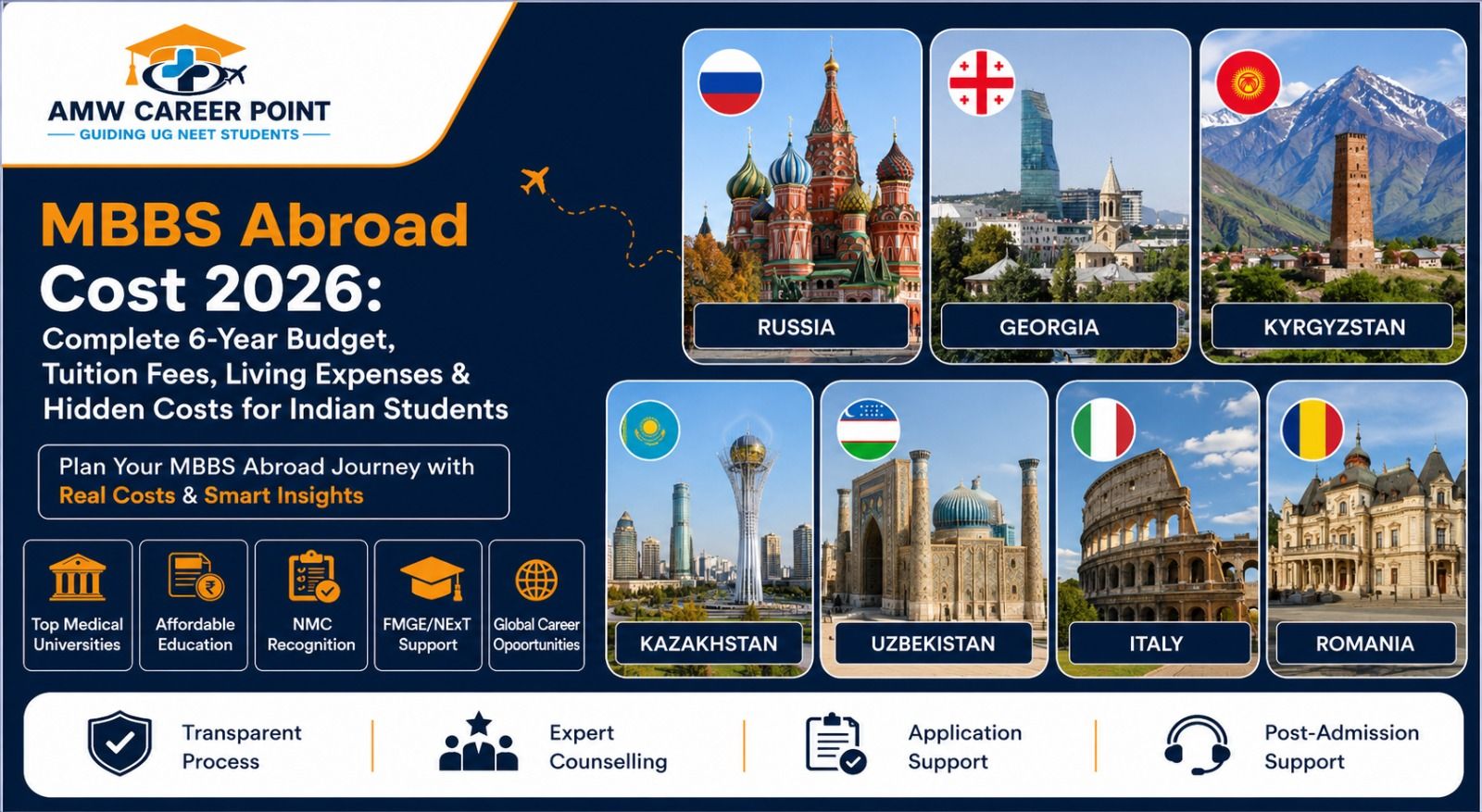
If you've qualified NEET and are confused about which country you should choose for MBBS abroad, the question your family actually needs answered isn't "what is the tuition fee"; it's "how much money will we need for the entire six years, all-in." This blog walks through exactly that: verified 2026 tuition figures from official university sources, the full list of costs that agents rarely mention upfront, and real six-year totals for the destinations AMW Career Point works with directly: Georgia, Kyrgyzstan, Kazakhstan, Uzbekistan, Romania, Italy, and Nepal.
Important for Indian Students
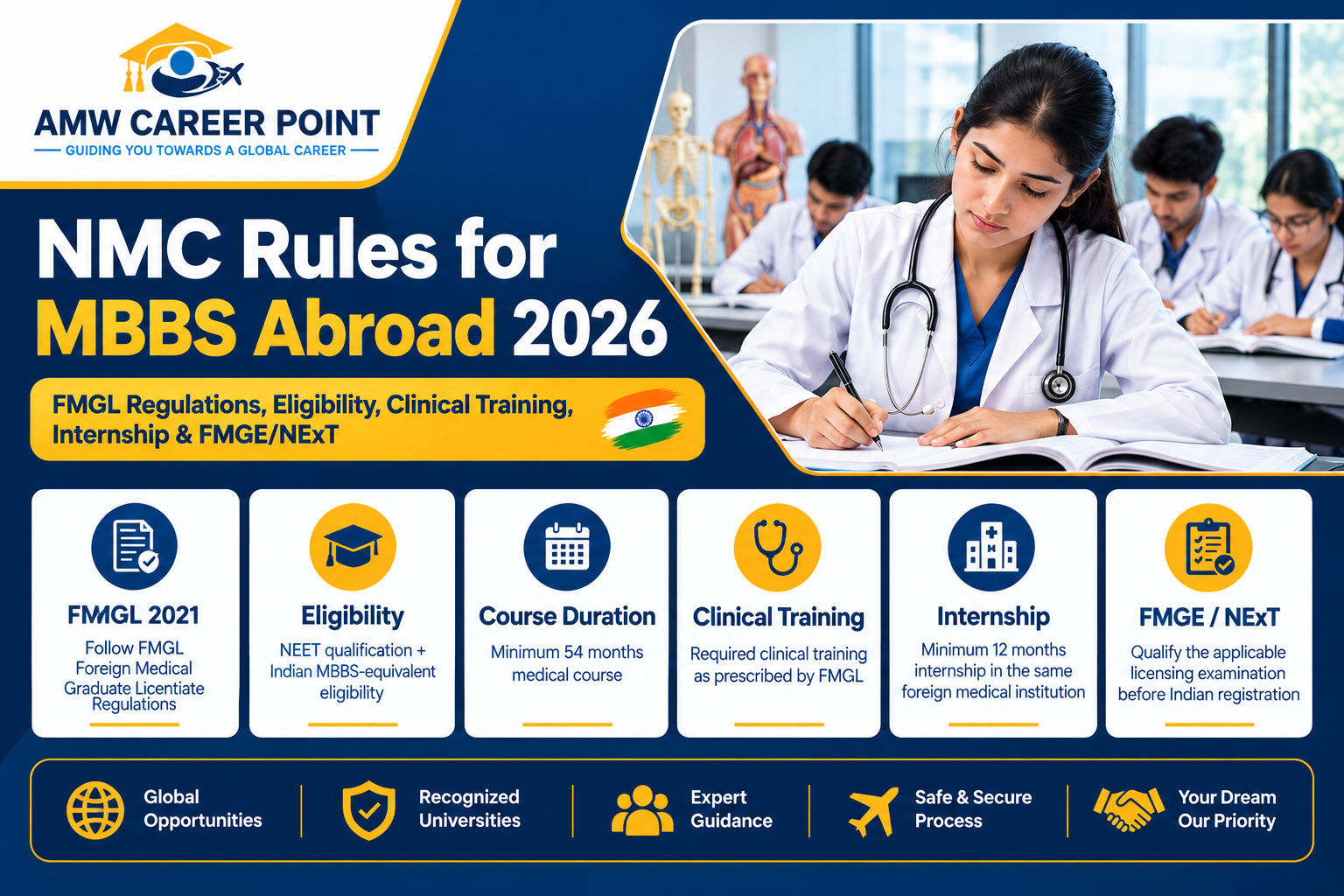
Before comparing fees, verify that the specific foreign medical program satisfies the NMC's applicable FMGL requirements. NMC's current 2026 materials specify eligibility conditions, including a minimum 54-month medical course, a 12-month internship at the same foreign medical institution, English as the medium of instruction, and defined clinical training requirements. Cost cannot be separated from eligibility; the cheapest option is worthless if the degree does not qualify you to practice in India.
MBBS Abroad Cost in 2026 At a Glance
The figures below are annual tuition ranges from the currently published 2026 university fee schedules, converted at ₹97/USD and ₹108/EUR. Hostel, food, insurance, and other recurring costs are added separately in the country sections below; treat this table as a tuition-only starting point, not the full budget.
Country | Tuition/Year | Duration | 6-Yr Tuition Only | Typical All-In 6-Yr Total |
Georgia (TSMU) | ₹6.9–7.8 lakh | 6 years | ₹41–47 lakh | ₹48–56 lakh |
₹2.8–6.8 lakh | 5–6 years* | ₹14–34 lakh | ₹18–30 lakh | |
₹3–5.5 lakh | 6 years | ₹18–33 lakh | ₹22–36 lakh | |
₹2.2–4.4 lakh | 6 years | ₹13–26 lakh | ₹19–35 lakh | |
₹0–5.4 lakh (ISEE-based) | 6 years | ₹0–32 lakh | ₹35–90 lakh (ISEE-dependent) | |
₹7–14 lakh | 5.5 years | ₹38–56 lakh | ₹45–75 lakh | |
Romania | ₹6.5–10.8 lakh | 6 years | ₹39–65 lakh | ₹45–75 lakh |
Duration in Kyrgyzstan varies by university and medium of instruction; verify before calculating a total (see the Kyrgyzstan section below).
What Does "MBBS Abroad Cost" Include?
The number an agent quotes first is almost always tuition fee alone. That is one line item out of roughly fifteen. Before you compare any two universities, make sure you're comparing the same basket of costs:
Tuition Fee: The university's academic charge, usually billed annually
Hostel/Accommodation: University dorm or private rental, billed separately from tuition at most universities
Food: Mess facility, Indian mess (where available), or self-catering
Health Insurance: Usually mandatory and billed annually by the university or a local insurer
Visa: Student visa application and processing fees
Residence Permit/Registration: Annual or one-time registration with local migration authorities
Flight Tickets: 1–2 round trips per year in practice, even if students plan to stay put
Airport Transfers: Often bundled into a consultancy package, sometimes billed separately
Books and Study Materials
Medical Examination: Pre-departure fitness certificates and, in some countries, on-arrival tests
Translation/Notarisation: Academic documents, passport, and medical records
Local Transportation
Communication/Internet
Personal Expenses
Emergency Fund
Currency Exchange Costs: Spread and transfer charges on every remittance
Tuition Fee vs Total Cost: Why Students Get the Wrong Number
This is the single most common financial mistake families make when comparing MBBS abroad options.
Example University A: ₹4 lakh/year tuition, in an expensive capital city with compulsory hostel at ₹1.5 lakh/year and no Indian mess. University B: ₹5 lakh/year tuition, in a smaller city with hostel + Indian mess bundled at ₹1 lakh/year. On tuition alone, A looks ₹1 lakh cheaper every year. Once hostel, food, and city cost of living are added, B can come out ahead over six years. |
Before treating a lower tuition figure as the cheaper option, compare the following: hostel, food, insurance, program duration, city, billing currency, whether a preparatory year is required, local transportation, and any additional annual university charges beyond tuition.
How Much Does MBBS Abroad Cost Per Year?
A representative annual budget for a mid-range destination (using Uzbekistan/Kyrgyzstan-type costs as an illustration) looks like this:
Expense | Annual Estimate (INR) |
Tuition | ₹2.5–4 lakh |
Hostel | ₹40,000–90,000 |
Food (where not bundled) | ₹60,000–1.2 lakh |
Insurance | ₹15,000–30,000 |
Visa/registration | ₹15,000–35,000 |
Local transport | ₹15,000–25,000 |
Personal expenses | ₹40,000–70,000 |
Miscellaneous | ₹20,000–40,000 |
Total/year | ₹4.7–7.9 lakh |
The first year is almost always the most expensive because it includes costs that don't recur: admission processing, visa fees, flights, medical tests, document attestation, and hostel or caution deposits. Families should budget the first year at roughly 1.3–1.5× a normal year.
How Much Does 6-Year MBBS Abroad Actually Cost?
The formula is straightforward; the discipline is in not skipping a line item:
The Real Six-Year Formula 6-year tuition + 6-year accommodation + 6-year food + insurance (6 yrs) + visa/registration (6 yrs) + travel (6 yrs, minimum 1 round trip/year) + personal expenses (6 yrs) = Estimated Total Cost |
Applied country by country, this produces very different pictures even when headline tuition looks similar, which is exactly why the country-wise section below calculates it out rather than stopping at tuition alone.
MBBS Abroad Cost Country-Wise in 2026
The following breakdowns use currently published 2026 fee data from official or verified university sources. Where sources disagree, which happens often in this space, a range is shown rather than a single flattering number.
MBBS in Georgia Cost 2026
Tbilisi State Medical University (TSMU), Georgia's most-recognized destination for Indian students, currently lists its English-medium MD (Medical Doctor) program tuition at USD 8,000/year for the 2026 intake, approximately ₹8.6 lakh/year at ₹108/EUR-equivalent rates (using current USD conversion of ~₹97, this is closer to ₹7.8 lakh/year). Hostel fees are billed separately and reported in the ₹1.1–3.4 lakh/year range, depending on the source and room type; a realistic mid-point is ₹1.5 lakh/year. On-campus hostel availability is limited, and many students end up in private apartments.
Item | Annual Cost | 6-Year Cost |
Tuition (USD 8,000/yr) | ₹7.76 lakh | ₹46.6 lakh |
Hostel/accommodation | ₹1.2–3.4 lakh | ₹7.2–20.4 lakh |
Food (self-catering) | ₹1.2–1.8 lakh | ₹7.2–10.8 lakh |
Insurance + visa/TRC | ₹40,000–60,000 | ₹2.4–3.6 lakh |
Flights (2 round trips/yr avg) | ₹60,000–90,000 | ₹3.6–5.4 lakh |
Estimated 6-year total | — | ₹48–56 lakh |
First-year out-of-pocket costs, including admission processing, document translation, visa, insurance, and TRC (Temporary Residence Card), commonly reach USD 10,000–10,500 in agency-packaged estimates noticeably above the recurring annual cost.
MBBS in Kyrgyzstan Cost 2026
Kyrgyzstan remains one of the lowest-cost MBBS destinations, but it also has the widest genuine variation of any country on this list, both in tuition and in program duration.
Important Distinction: Verify Duration Before Calculating
Some Kyrgyz universities run different tracks for different mediums. Kyrgyz State Medical Academy's international admissions structure, for instance, distinguishes a 5-year English-medium General Medicine track from a 6-year Russian-medium track and expects applicants already to know the relevant language for the Russian track. A one-year difference materially affects total cost; confirm the exact duration and medium for the specific program before comparing it with those of any other country.
Kyrgyzstan also introduced a moratorium on new medical education licenses (July 2025–December 2027) and set a fixed minimum tuition floor of USD 3,000/year for international students; factor this into any "under $3,000" claims you see in older marketing material.
City/University Type | Tuition/Year | Living/Year | Approx. 6-Yr Total |
Bishkek (KSMA and similar) | $3,000–6,000 (₹2.9–5.8 lakh) | ₹1.7–2.8 lakh | ₹22–30 lakh |
Osh / Jalal-Abad / smaller cities | $3,000–4,500 (₹2.9–4.4 lakh) | ₹1.2–2 lakh | ₹18–24 lakh |
Most current university-wise breakdowns place the full 5–6-year MBBS cost in Kyrgyzstan between ₹14 lakh and ₹30 lakh, including tuition, hostel, and mess, with Bishkek at the higher end and Osh, Kant, and Jalal-Abad consistently cheaper. Note that Indian mess is frequently billed as a compulsory additional charge (commonly USD 900–1,200) in the first year at several universities.
MBBS in Kazakhstan Cost 2026
Kazakhstan sits between Central Asia's cheapest options and Russia/Georgia's mid-tier pricing, with meaningful variation by city and university.
University | Tuition/Year | 6-Yr Tuition | Notes |
Astana Medical University | $5,500 (₹5.3 lakh) | ₹31.8 lakh | Total 6-yr incl. hostel ~₹36 lakh per current published estimates |
Semey Medical University | $4,500–5,000 (₹4.4–4.9 lakh) | ₹26–29 lakh | Mid-tier pricing |
South Kazakhstan Medical Academy (Shymkent) | ~₹2–3 lakh | ₹12–18 lakh | Widely cited as Kazakhstan's most budget-friendly NMC-recognised option; warmer climate. |
Karaganda State Medical University | $4,000–5,000 (₹3.9–4.9 lakh) | ₹23–29 lakh | — |
All-in six-year cost across Kazakhstan's universities generally falls between ₹22 lakh and ₹36 lakh, including tuition, hostel and living expenses, with Shymkent (SKMA) at the lower end and Astana at the higher end.
MBBS in Uzbekistan Cost 2026
NMC Advisory April 2026 NMC's advisory dated 1 April 2026 specifically flags Tashkent State Medical University (TSMU), Samarkand State Medical University (SSMU), Bukhara State Medical Institute (BSMI), and TIT Institute of Medical Sciences, Bangalore, cautioning Indian students seeking undergraduate medical admission in Uzbekistan to verify duration, medium of instruction, curriculum, clinical training and internship arrangements before enrolling. AMW Career Point does not facilitate admissions to the flagged institutions. Do not treat "cheap" and "NMC-safe" as the same thing when shortlisting a university in Uzbekistan. |
Outside the flagged institutions, Uzbekistan continues to offer some of the lowest all-in costs among NMC-recognised destinations. Published 2026 tuition at several NMC-compliant universities runs USD 2,300–4,500/year, with hostel typically an additional USD 600–800/year.
City | Tuition (Yr 1 / Yr 2–6) | 6-Yr Tuition Total |
Bukhara (compliant institution) | $3,200 / $3,200 | $19,200 (₹18.6 lakh) |
Fergana | $4,000 / $3,400 | $21,000 (₹20.4 lakh) |
Andijan | $4,000 / $3,400 | $21,000 (₹20.4 lakh) |
Adding hostel, Indian mess, insurance, and travel, the most recently published estimates place the full six-year cost of MBBS at NMC-compliant universities in Uzbekistan between ₹19 lakh and ₹35 lakh. Living costs are among the lowest of any destination on this list. Tashkent runs ₹18,000–28,000/month, while Bukhara and Andijan run ₹10,000–16,000/month. Treat any agency quote under roughly ₹20 lakh with skepticism unless it is broken down line by line.
MBBS in Romania Cost 2026
Romania is the only EU/Schengen option in AMW's active portfolio, and it prices accordingly meaningfully above Central Asia, broadly comparable to or below Georgia depending on the university.
University Tier | Tuition/Year | 6-Yr Tuition | Living/Month |
Premium (Cluj-Napoca, Bucharest) | €9,000–10,000 (₹9.7–10.8 lakh) | ₹58–65 lakh | €300–700 |
Mid-tier (Iasi, Timisoara, Oradea) | €6,000–8,500 (₹6.5–9.2 lakh) | ₹39–55 lakh | €300–500 |
Adding six years of living costs (roughly €300–700/month, or ₹32,000–75,000/month) brings the realistic all-in six-year total to approximately ₹45–75 lakh positioning Romania closer to a mid-tier private Indian medical college than to Central Asia's budget destinations, in exchange for EU-standard infrastructure, Schengen-area mobility, and a curriculum aligned with UNESCO/FAIMER/WHO recognition frameworks.
MBBS in Italy Cost 2026
Italy needs a fundamentally different cost framework from every other country in this guide because public university tuition is not a fixed amount; it is calculated based on family income (the ISEE system).
Scenario | Annual Tuition | 6-Yr Tuition |
ISEE below regional threshold (DSU-qualified) | €156 regional tax only | ~₹1 lakh |
No ISEE declaration filed (most Indian students by default) | €2,500–5,000 | ₹16–32 lakh |
Standard published range across public universities | €200–4,500 | ₹1.3–29 lakh |
Two things make Italy an outlier worth understanding rather than skipping: first, students who successfully file for and qualify under the DSU (Diritto allo Studio Universitario) scholarship and a need-based regional grant, not a merit award, can have tuition waived to the €156 regional tax, and receive an annual stipend commonly cited in the €2,000–7,000 range, alongside subsidized or free hostel accommodation. Second, admission is based on the IMAT entrance exam rather than a tuition-fee competition, so a student's NEET score only establishes basic eligibility; the IMAT score determines the actual seat and university.
Living costs vary sharply by city: Milan and Rome run €800–1,200/month, while southern cities such as Catania, Messina and Bari run €450–750/month. A realistic all-in six-year estimate, without DSU support, is roughly €60,000–90,000 (₹65–97 lakh); with a qualifying DSU award, the effective family outlay can fall to a fraction of that. Because eligibility hinges on documented family income, this is one destination where the "cheap" and "expensive" outcomes for two similar students can differ by tens of lakhs. Plan the ISEE/DSU question early rather than assuming either outcome.
MBBS in Nepal Cost 2026
Nepal occupies a distinct position in this list: it is the only MBBS-abroad destination Indian students can enter without a visa, and its curriculum and entrance framework are closely aligned with India's own, but it is not a budget destination. Total costs are closer to those of a mid-tier private Indian medical college than to Central Asia.
Seat Category | Tuition/Year | 5.5-Yr All-In Total |
Government/deemed (IOM, BPKIHS, PAHS — highly competitive) | ₹6–8 lakh | ₹35–50 lakh |
Private (Kathmandu, Pokhara) | ₹7–14 lakh | ₹45–75 lakh |
Border-city private (Birgunj, Bhairahawa, Janakpur) | ₹6–9 lakh | ₹38–50 lakh |
Hostel and mess typically run ₹1–1.5 lakh/year and are often bundled with tuition into a single headline fee; always ask for the unbundled breakdown, since exam fees, uniforms, a refundable caution deposit, and books typically add another ₹2–4 lakh over the course. Unlike Georgia or Uzbekistan, admission requires clearing Nepal's own MECEE-BL entrance exam in addition to NEET, a step some agents omit when quoting fees.
Why Nepal Costs More Than Central Asia Nepal is not being marketed honestly if it's positioned as a "cheap" MBBS-abroad option. Its genuine advantages are proximity, no visa requirement, familiarity with the curriculum, and consistently strong FMGE outcomes, not low cost. Choose Nepal for those reasons, not because a quote looked low; a low Nepal quote is usually missing hostel, mess, or exam fees. |
Cheapest Countries for MBBS Abroad in 2026
Ranking by tuition alone produces a misleading list. The table below ranks the seven destinations AMW College Predictor Tool works with by realistic six-year all-in cost, while flagging the other factors that should influence, not just follow, the budget decision
Rank | Country | 6-Yr Total (approx.) | NMC Checks Needed | Best For |
1 | ₹19–35 lakh | Verify against Apr 2026 advisory list | Lowest realistic all-in cost among compliant options | |
2 | ₹18–30 lakh | Confirm duration/medium per university | Budget-conscious families, flexible on city | |
3 | ₹22–36 lakh | Confirm current-cycle fees, not archived figures | Better infrastructure at moderate cost | |
4 | ₹48–56 lakh | Generally straightforward FMGL compliance | English-only track, no local-language pressure | |
5 | ₹45–75 lakh | MECEE-BL entrance + NMC checks | No visa, curriculum familiarity, strong FMGE outcomes | |
6 | ₹45–75 lakh | EU-standard recognition, generally lower risk | Families prioritizing EU/Schengen credentials | |
7 | ₹1–97 lakh (ISEE-dependent) | IMAT-based; DSU eligibility case-by-case | High-scoring IMAT candidates with genuine low-income documentation |
MBBS Abroad Under ₹20 Lakh Is It Realistic in 2026?
For the six countries in this guide, ₹20 lakh is realistic only at the lower end in Uzbekistan (NMC-compliant universities such as Bukhara-based options, roughly ₹19–24 lakh all-in) and in the cheapest cities in Kyrgyzstan (Osh, Jalal-Abad, roughly ₹18–24 lakh). It is not realistic for premium universities in Kazakhstan, Georgia, Romania, Nepal, or Italy without a DSU scholarship. Any quote under ₹20 lakh for those destinations should be treated as tuition-only; ask specifically what it excludes.
MBBS Abroad Under ₹25 Lakh
This band comfortably includes most options in Uzbekistan and Kyrgyzstan, as well as the lower-cost universities in Kazakhstan (such as South Kazakhstan Medical Academy in Shymkent). It does not include Georgia, Romania, Nepal, or non-DSU Italy, which consistently land above ₹40 lakh once hostel, food, and travel are added.
MBBS Abroad Under ₹30 Lakh
Adds most of Kazakhstan's mid-tier universities to the ₹25 lakh list, and covers the upper end of Kyrgyzstan and Uzbekistan comfortably. This is the most useful band for families comparing Central Asia against a mid-tier Indian private medical college, where ₹30 lakh often barely covers a single year.
MBBS Abroad Under ₹40 Lakh
Brings in Astana Medical University and other premium Kazakhstan options, plus the lower end of Georgia's realistic range if hostel and food are kept modest. Romania and Nepal still generally sit above this band once living costs are included.
MBBS Abroad Under ₹50 Lakh
Covers Georgia comfortably, the lower end of Nepal's private-college range, and the lower end of Romania's mid-tier universities. This band becomes directly comparable to a moderate private MBBS seat in India; see the comparison below.
MBBS Abroad vs Private MBBS in India: Which Is More Expensive?
Private MBBS seats in India vary enormously by state, college, and quota; there is no single "Indian private MBBS cost" to quote, and any article that gives you one fixed number is oversimplifying. What can be compared fairly is the range.
Scenario | Approx. Total Cost (5.5 yrs India / 6 yrs abroad) |
Indian private college management quota, lower-tier state college | ₹50–70 lakh |
Indian private college reputed private university | ₹70 lakh–₹1 crore |
Indian private college top-tier deemed university, NRI/management quota | ₹1–1.5 crore+ |
MBBS abroad Uzbekistan/Kyrgyzstan (lower end) | ₹18–30 lakh |
MBBS abroad Kazakhstan/Georgia (mid-range) | ₹22–56 lakh |
MBBS abroad Romania/Nepal (upper end) | ₹45–75 lakh |
MBBS abroad Italy with DSU scholarship | ₹1–15 lakh (income-dependent) |
On a purely cost basis, most destinations in this guide are cheaper than a management-quota private seat in India, often by a wide margin. What this comparison cannot tell you is FMGE/NExT pass-rate outcomes, which vary sharply by university and are a separate, equally important part of the decision.
MBBS Abroad Cost vs Government MBBS in India
For NEET-qualified students who can realistically compete for a government seat, the comparison changes entirely.
Government MBBS in India
Tuition typically ₹50,000–₹1.5 lakh for the entire course at most government colleges
Extremely competitive availability is almost entirely NEET rank-dependent
By far the lowest total cost of any pathway to an Indian medical license
MBBS Abroad
Wider seat availability, not rank-dependent in the same way
International cost structures as detailed throughout this guide
Requires clearing FMGE/NExT and meeting NMC's FMGL conditions before practicing in India
If a government MBBS seat is genuinely within reach based on NEET rank and category, it remains the lowest-cost, lowest-friction pathway. MBBS abroad becomes the relevant comparison once a government seat is off the table and the real choice is between a private Indian seat and a foreign one.
Hidden Costs of MBBS Abroad
These are the costs that rarely appear in an initial agent quote but show up on the ground:
Currency Exchange spread: Banks and exchangers routinely charge 1–3% above the interbank rate on every remittance
Bank Transfer Charges: SWIFT and correspondent-bank fees on international wires, typically ₹1,500–3,500 per transfer
Visa Renewal: Annual, in most destinations
Residence Registration: Annual re-registration with local migration authorities
Insurance Renewal: Annual, and premiums can rise after the first year
Medical Tests: Required on arrival in several countries, in addition to pre-departure tests
Document Translation: For every academic year's paperwork, not just the initial application
Notarisation
Flights: Realistically 1–2 round trips per year, not zero
Winter Clothing: A genuine first-year cost in Russia, Kazakhstan, Kyrgyzstan and Georgia
Laptop/Equipment
Local Transportation
Emergency Medical Expenses beyond what insurance covers
Annual University Charges beyond tuition, including library, lab, and exam fees
Re-examination/Backlog Costs: Supplementary exams are frequently charged separately
Internship/Clinical Expenses where applicable
First-Year MBBS Abroad Cost vs Later Years
First Year
Usually 30–50% higher than a typical recurring year because of admission processing, visa, flights, deposits, medical examination, documentation, and initial purchases (winter clothing, basic furnishings, a laptop).
Years 2 to 5/6
Recurring costs: tuition, hostel, food, insurance, and routine living expenses with comparatively few one-time additions.
Final Year
Often carries its own bump: internship-related costs where applicable, travel for licensing exam registration or coaching, and final documentation for return to India.
How Much Money Should Parents Keep as an Emergency Fund?
There is no honest universal figure here; anyone quoting a fixed number is guessing. Instead, calculate it as:
3–6 months of living expenses at the student's actual city cost of living
Emergency travel with an unplanned return trip
A medical emergency not fully covered by student insurance
A currency fluctuation buffer of roughly 8–10% on annual remittances
Currency Exchange Rate and MBBS Abroad Cost
Every country in this guide bills fees in a currency other than rupees: USD, EUR, GEL, KGS, KZT, or UZS. Indian families pay in rupees, so the rupee amount moves even when the university has not changed its fee.
Example If tuition is fixed at USD 6,000/year: At ₹83/$ → ₹4.98 lakh At ₹88/$ → ₹5.28 lakh At ₹95/$ → ₹5.70 lakh Same university, same fee in dollars, with a ₹72,000 difference over one year, purely due to currency fluctuations. |
This is exactly why an emergency fund with a currency buffer, discussed above, matters as much as the headline tuition number.
Fixed Tuition vs Variable Tuition
Universities differ in how they structure tuition over six years:
Fixed-fee contract with the same fee, in the billing currency, for the entire program
Annual revision: The university can revise the fee each year, independent of currency movement
Currency-linked fee: The fee itself may be indexed to a reference currency
A Question Worth Asking Every University "Is my tuition fixed for all six years, or is it revised annually?" Get the answer in writing before paying an admission fee; this single question prevents the most common source of budget overruns in MBBS abroad. |
How to Calculate the Real Cost of MBBS Abroad
Step 1: Annual tuition
Step 2: Multiply by the actual program duration (verify this per university, not per country)
Step 3: Add hostel
Step 4: Add food
Step 5: Add insurance
Step 6: Add visa/registration
Step 7: Add flights
Step 8: Add personal expenses
Step 9: Add a currency buffer (8–10%)
Step 10: Add an emergency fund (3–6 months living costs)
Estimated Cost of MBBS Abroad.
Does a Preparatory Year Increase MBBS Abroad Cost?
Yes, directly, a preparatory year adds a full extra year of tuition and living costs before the medical program even begins. Tbilisi State Medical University, for instance, currently lists a preparatory course at USD 2,000/year, separate from the main MD program tuition. Where a preparatory year is required by language or academic policy, add it explicitly: preparatory year cost + main program cost + one additional year of living expenses = the real total, not the six-year total alone.
Does Learning the Local Language Increase or Reduce the Cost?
Neither automatically. A local-language track (Russian-medium in Kyrgyzstan or Kazakhstan, for example) is sometimes priced lower than the English-medium equivalent. Still, it adds the cost of language coaching, a longer effective preparation timeline, and translation/interpretation costs during clinical years. English-medium tracks avoid the cost of language courses but may entail a tuition premium and, in some countries, weaker preparation for clinical communication. Neither path is cheaper in every case; evaluate it on a program-by-program basis, not as a blanket rule. This connects directly to language-requirement planning, which matters as much for clinical-year readiness as for cost.
Scholarships for MBBS Abroad
Scholarship availability varies sharply by country and is generally the exception rather than the rule outside Italy's ISEE-linked DSU system. Categories worth investigating for any specific university:
Government Scholarships
University Scholarships
Merit Scholarships
Need-Based Scholarships
Tuition Waivers
Regional/State Support
Scholarships for International Students
What Scholarships Actually Cover?
Always confirm exactly what's included before treating a scholarship as reducing your total budget:
Tuition only
Tuition + stipend
Hostel
Living allowance
Travel
Education Loan for MBBS Abroad
Can Indian students get education loans?
Yes, most nationalized and several private banks offer education loans for NMC-recognised MBBS programs abroad, commonly covering up to 100% of the total fees, with higher loan amounts.
Secured vs Unsecured Loan
Loans above roughly ₹20–30 lakh typically require collateral; smaller amounts may be available without it, depending on the bank and applicant profile.
Collateral
Interest (commonly 9–12% depending on bank and loan type)
Moratorium (usually course duration + 6–12 months)
Processing fees
Margin money
Repayment
What expenses the loan can cover, including tuition, hostel, and often living expenses, subject to bank policy
How Much Does MBBS Abroad Cost After Scholarship?
The calculation is Original Total minus Scholarship equals Net Cost but the scholarship figure must be the actual amount confirmed in writing, not an advertised "up to" ceiling. Example: a total of ₹52 lakh in Georgia, with a ₹5 lakh university merit scholarship over six years, brings the net cost to ₹47 lakh. An Italy scenario with a full DSU tuition waiver and a stipend can bring the net family outlay to a small fraction of the sticker cost, but only for students who genuinely qualify under the ISEE income threshold.
Does Low Tuition Mean a Cheap MBBS?
Not necessarily. Three distinct ideas get collapsed into one in most marketing material:
Three Different Things Low tuition as the university's headline fee is small. Low total cost as the all-in six-year number, including hostel, food, travel and insurance, is small. Low-risk cost as the total cost is small, and the degree reliably qualifies the graduate for NMC screening and licensing. |
A university can have genuinely cheap tuition and still produce an expensive or high-risk outcome through an expensive city, costly accommodation, a longer-than-expected duration, a mandatory extra language year, high travel costs, or currency risk on a large annual remittance. Evaluate all three dimensions before deciding, not tuition alone.
Does the Cheapest MBBS Abroad Option Make Sense for Indian Students?
NMC's 2026 advisory materials specifically direct prospective students to verify duration, medium of instruction, syllabus/curriculum, clinical training, and internship/clerkship arrangements before enrolling. The relevant FMGL eligibility conditions include a minimum 54-month medical course at a single institution, a 12-month internship at the same foreign university, English as the medium of instruction, and defined clinical training requirements.
Cheapest is not automatically best. A degree that saves ₹10 lakh upfront but fails to meet FMGL requirements can cost far more in delayed licensing, repeat years, or an unusable degree. |
NMC Requirements That Can Affect the Real Cost of MBBS Abroad
NEET Qualification
54-Month Minimum Medical Course
12-Month Internship at the Same Foreign Institution
English Medium of Instruction
Clinical Training Requirements
Registration in the Country of Qualification
Licensing Examination / NExT Framework
NMC's current FAQ materials specify that foreign medical graduates must complete a minimum 54-month foreign medical course, a 12-month internship at the same foreign institution, and use English as the medium of instruction, among other conditions.
Editorial Note on Terminology This guide deliberately avoids the phrase "NMC-approved university"; the NMC does not "approve" foreign universities in that sense. The accurate, safer framing is: check whether the specific program and university satisfy the NMC's applicable FMGL requirements for the year of admission. Always verify current status directly with NMC's published materials rather than relying on a consultancy's claim. |
Does FMGE/NExT Preparation Add to the Cost?
Yes, and it is routinely left out of "total cost" quotes entirely. Budget separately for:
Coaching
Books and question banks
Mock tests
Travel for exams where applicable
Additional preparation time (an opportunity cost, not just a direct one)
Do not fold FMGE/NExT coaching into a university's advertised cost as it is a separate, post-graduation expense that varies with the amount of preparation a student needs.
The Real 6-Year Cost of MBBS Abroad
Three illustrative students, using currently verified 2026 figures from this guide, show how differently "MBBS abroad" can play out financially even within a single cost band.
Expense | Student A — Budget (Uzbekistan) | Student B — Mid-Range (Kazakhstan) | Student C — Premium (Georgia) |
Tuition (6 yrs) | ₹19.4 lakh | ₹29 lakh | ₹46.6 lakh |
Hostel/Food (6 yrs) | ₹4.5 lakh | ₹6 lakh | ₹9 lakh |
Insurance/Visa (6 yrs) | ₹1.8 lakh | ₹2.4 lakh | ₹3 lakh |
Travel (6 yrs) | ₹2.4 lakh | ₹3 lakh | ₹4.5 lakh |
Personal expenses (6 yrs) | ₹3 lakh | ₹3.6 lakh | ₹4.8 lakh |
Licensing preparation | ₹1.5 lakh | ₹1.5 lakh | ₹1.5 lakh |
Emergency buffer | ₹1.5 lakh | ₹2 lakh | ₹3 lakh |
Total | ₹34.1 lakh | ₹47.5 lakh | ₹72.4 lakh |
Indian Family Budget Before Sending a Student Abroad?
Minimum available funds: Cash the family can access without a loan
Annual cash requirement: The recurring yearly figure calculated above the Emergency reserve
Education loan: Sanctioned amount and moratorium terms
Scholarship: Confirmed, not advertised
Currency buffer
Family income: Relevant both for loan eligibility and for Italy's ISEE system specifically
Repayment ability: Realistic post-FMGE/NExT earning timeline
Questions to Ask a University Before Paying the Admission Fee
What is the tuition fee for 2026?
Is it fixed for the entire course?
What is the exact duration?
Is there a preparatory year?
Is hostel compulsory?
What is the hostel cost?
What is the food cost?
Is insurance mandatory?
What are annual university charges beyond tuition?
What is the medium of instruction?
Where does clinical training take place?
Where is the internship completed?
Is the internship at the same university?
What is the degree awarded?
Is the graduate eligible for registration in the country of study?
What are the university's current admission requirements for Indian students?
What happens if a student fails an examination?
Are supplementary examinations charged separately?
What happens if tuition increases?
What is the refund policy?
Best MBBS Abroad Countries by Budget
Best options for low-budget students
Uzbekistan (NMC-compliant universities) and Kyrgyzstan's smaller cities, with realistic all-in costs of ₹18–28 lakh.
Best options for ₹25–30 lakh
Mid-tier Kazakhstan and the upper end of Kyrgyzstan/Uzbekistan.
Best options for ₹30–40 lakh
Premium Kazakhstan (Astana) and modest-lifestyle Georgia.
Best options for ₹40–50 lakh
Georgia at typical lifestyle levels, and the lower end of Nepal/Romania.
Best options above ₹50 lakh
Romania and Nepal at typical lifestyle levels, and non-DSU Italy.
Budget should be a filter, not the only selection criterion. |
Best MBBS Abroad Countries for Value for Money
A single "best country" label oversimplifies a decision with several independent variables. A more defensible approach weights the factors that actually matter:
Factor | Weight |
Total cost | 25% |
NMC/FMGL compliance | 25% |
University quality | 15% |
Clinical training | 15% |
Language | 10% |
Living environment | 5% |
Travel/accessibility | 5% |
How Much Money Do You Need Before Leaving India?
Pre-departure costs are the ones parents most often underestimate, because they land before the recurring annual budget even begins:
Application fee
Admission fee
Visa fee
Medical examination
Documentation
Translations
Airfare
First-year tuition installment
Hostel deposit
Insurance (first year)
Emergency cash reserve for the first month
Across the seven destinations in this guide, the approximate first-payment requirement and everything needed before the student boards a flight range from roughly ₹3.5–5 lakh for Central Asia to ₹8–11 lakh for Georgia and Romania, and vary by ISEE outcome for Italy.
Is MBBS Abroad Financially Worth It in 2026?
The honest answer depends on comparing several dimensions together, not cost in isolation:
Cost: As detailed throughout this guide
Time: 6–6.5 years of study plus 6–18 months of FMGE/NExT preparation before practicing in India
Licensing: Dependent on choosing a university that satisfies current FMGE requirements
Career: Outcomes vary by university reputation and clinical exposure, not just by country
Risk: Currency movement, tuition revision, and regulatory changes like the April 2026 Uzbekistan advisory
Opportunity cost: Years and money that could otherwise go toward a strong private Indian seat or another career path
The Indian private medical college alternative: Which is often more expensive, sometimes faster to a usable license
When Does MBBS Abroad Make Financial Sense? When a government seat is genuinely out of reach, the chosen university clearly satisfies NMC's FMGL conditions, the six-year all-in cost (not just tuition) has been calculated honestly, and the family has planned for FMGE/NExT preparation as a separate cost and timeline, not silently folded into the "total." |
Who Should Consider MBBS Abroad?
Students who:
Have qualified NEET
Cannot secure an affordable government MBBS seat
Have a clearly defined, realistic budget
Understand foreign licensing requirements before enrolling, not after
Can adapt to living in another country, including language and climate
Are willing to meet NMC's FMGL requirements rather than hope around them
Who Should NOT Choose MBBS Abroad Solely Because It Is Cheap?
Students who:
Haven't independently verified the specific university, only taken an agent's word for it
Are choosing purely on agent promises rather than published fee schedules and NMC materials
Don't understand current NMC rules for their intended country
Haven't calculated the six-year all-in cost, only the tuition figure
Cannot realistically finance the full course, including years 4–6
Are uncomfortable with foreign-language clinical environments
Expect automatic registration in India without clearing FMGE/NExT
MBBS Abroad Cost Calculator Final Formula
Total MBBS Cost = Tuition + Hostel + Food + Insurance + Visa + Travel + Local Expenses + Academic Expenses + Miscellaneous + Emergency Buffer |
From that total, derive:
Annual cost = Total ÷ program duration
Total course cost = the full formula above
First-year cost = annual cost × 1.3–1.5 (to account for one-time costs)
Remaining cost = Total course cost − First-year cost
Scholarship-adjusted cost = Total course cost − confirmed scholarship value
MBBS Abroad Cost Comparison University Level
Country-level averages hide meaningful university-to-university differences. This table anchors the guide's figures to specific, currently verified institutions rather than country averages alone.
Country | University | Medium | Duration | Tuition/Yr | Approx. 6-Yr All-In |
Georgia | Tbilisi State Medical University | English | 6 yrs | $8,000 | ₹48–56 lakh |
Kyrgyzstan | Kyrgyz State Medical Academy | English/Russian tracks* | 5–6 yrs | $3,000–6,000 | ₹22–30 lakh |
Kazakhstan | Astana Medical University | English | 6 yrs | $5,500 | ~₹36 lakh |
Kazakhstan | South Kazakhstan Medical Academy | English | 6 yrs | ~₹2–3 lakh | ₹12–18 lakh |
Uzbekistan | NMC-compliant universities (Bukhara, Fergana, Andijan) | English | 6 yrs | $3,200–4,000 | ₹19–24 lakh |
Romania | Iuliu Hațieganu (Cluj-Napoca) | English | 6 yrs | €9,000–10,000 | ₹58–65 lakh |
Nepal | Private colleges (Kathmandu/Pokhara) | English | 5.5 yrs | ₹7–14 lakh | ₹45–75 lakh |
Confirm the exact program duration and medium for the specific track before finalizing; see the Kyrgyzstan section above.
Frequently Asked Questions
How much does MBBS abroad cost in 2026?
Depending on the country and university, the realistic six-year all-in cost ranges from roughly ₹18 lakh (Uzbekistan/Kyrgyzstan budget options) to ₹75 lakh (Romania/Nepal upper range), with Italy varying by ISEE income status. Tuition alone is only one part of this figure.
What is the cheapest country for MBBS abroad among AMW's destinations?
Uzbekistan and Kyrgyzstan currently offer the lowest realistic all-in six-year costs, provided the specific university satisfies current NMC/FMGL requirements.
Which country offers MBBS under ₹20 lakh?
Only the lower end of Uzbekistan and Kyrgyzstan realistically fits under ₹20 lakh all-in; treat any other country's under-₹20-lakh quote as tuition-only.
Which country offers MBBS under ₹30 lakh?
Uzbekistan, Kyrgyzstan, and most of Kazakhstan fit comfortably under ₹30 lakh all-in.
How much does a hostel cost?
Varies by country from roughly ₹40,000/year (Central Asia) to ₹3+ lakh/year (Georgia, private apartments).
How much does insurance cost?
Typically, ₹15,000–60,000/year, depending on the country and coverage level.
How much does a student spend monthly on personal expenses?
Roughly ₹5,000–15,000/month across most destinations, higher in Georgia and Romania's larger cities.
Does tuition increase every year?
Depends on the university; some offer fixed six-year contracts, while others revise annually. Always confirm this in writing before admission.
Is hostel compulsory?
Varies by university; several Georgian and Kazakh universities do not guarantee on-campus hostel, requiring private rentals instead.
Can students get scholarships?
Yes, though availability varies sharply by country, given Italy's DSU system is the most structured; elsewhere, scholarships are the exception, not the rule.
Can I take an education loan?
Yes, most Indian banks offer education loans for NMC-recognised MBBS programs abroad, subject to collateral requirements of roughly ₹20–30 lakh.
Can I study MBBS abroad under ₹25 lakh?
Yes, in Uzbekistan, Kyrgyzstan, and lower-cost universities in Kazakhstan.
Which country has the lowest living expenses?
Uzbekistan, particularly outside Tashkent (Bukhara, Andijan).
How much does MBBS in Georgia cost?
Roughly ₹48–56 lakh all-in over six years at Tbilisi State Medical University; see the Georgia section above for the full breakdown.
How much does MBBS in Uzbekistan cost?
Roughly ₹19–35 lakh all-in over six years at NMC-compliant universities; see the Uzbekistan section above, including the April 2026 NMC advisory.
How much does MBBS in Kyrgyzstan cost?
Roughly ₹18–30 lakh all-in over five to six years, depending on city and program track; verify duration before calculating.
How much does MBBS in Kazakhstan cost?
Roughly ₹12–36 lakh all-in over six years, depending on university, from South Kazakhstan Medical Academy at the low end to Astana Medical University at the high end.
How much does MBBS in Nepal cost?
Roughly ₹35–75 lakh all-in over 5.5 years, depending on government vs private seat category.
Does NMC recognize foreign medical universities?
NMC does not issue a blanket "approval" list in that sense; the correct approach is to verify whether the specific program satisfies current FMGL requirements before enrolling.