Quick Overview
Parameter | Details |
Country | Uzbekistan (Central Asia) |
Capital | Tashkent |
Medical Course | MD (General Medicine), which is officially equivalent to MBBS |
Typical Duration | 5 years academic study + 1 year internship (6 years total); please verify university-wise |
Medium of Instruction | University- and campus-specific, and do not assume English (see Section on language) |
NEET | Mandatory for any Indian student intending to return and practice in India |
University-specific; varies (see dedicated section) | |
Tuition Fee | Approx. USD 2,300 – 4,500/year, university-specific |
Indian Students | Significant and growing presence across Tashkent, Samarkand, Bukhara, Andijan, Fergana |
NMC Advisory | Issued 1 April 2026; see dedicated section below |
FMGE remains the operative screening test; NExT proposed, not yet implemented with a confirmed schedule | |
Main Medical Cities | Tashkent, Samarkand, Bukhara, Andijan, Fergana, Namangan, Termez, Urgench |
Is MBBS in Uzbekistan Still a Good Option for Indian Students in 2026?
Not a simple yes or no, and any page that gives you one in the first paragraph is trying to sell you something rather than inform you.
Why Indian Students Consider Uzbekistan
Comparatively affordable medical education relative to private colleges in India
Geographical proximity and relatively short, direct flights from India
A cluster of established medical institutions, several with decades of history
A growing international and Indian student population
English-accessible programs at some, not all, universities
Lower living costs than most Western MBBS-abroad destinations
Why 2026 Is Genuinely Different
A specific, named NMC advisory (1 April 2026), the fifth advisory concerning Uzbekistan issued in three years
University-level compliance concerns at named institutions, not the country as a whole
Real variation in admission practices, clinical training quality, and intake capacity between universities
Confirmed instances of the medium of instruction not being English at some campuses, despite marketing claims
Documented agent and intermediary risk, specifically flagged by the Embassy of India in Tashkent
Why Did NMC Issue an Advisory for Uzbekistan?
The advisory followed a communication from the Embassy of India in Tashkent to the NMC's Undergraduate Medical Education Board (UGMEB), raising concerns about the quality and standards of medical education at specific institutions, and about alleged malpractice by admission agents facilitating placements for Indian students. This is the fifth Uzbekistan-related advisory NMC has issued in three years, a frequency that signals an unresolved, ongoing problem rather than an isolated incident.
What Does the NMC Advisory Actually Say?
Dated 1 April 2026, the advisory cautions Indian students and parents against seeking admission at specific named institutions, citing:
Students being admitted beyond a university's approved intake capacity
Insufficient hands-on clinical training at the flagged institutions
The medium of instruction not actually being English, contrary to what was marketed to applicants
Broader non-compliance with the Foreign Medical Graduate Licentiate (FMGL) Regulations, 2021
Does the NMC Advisory Mean MBBS in Uzbekistan Is Banned?
No and We Won't Overstate This The advisory is a caution, not a nationwide ban. It names specific institutions and urges verification before payment; it does not prohibit Indian students from studying medicine in Uzbekistan generally, and does not affect universities not named in the notice. Several Uzbekistan universities not named in the advisory continue to be viable, NMC-compliant options, but 'not named' is not the same as 'formally cleared,' since NMC's current framework doesn't publish a positive approved list at all (see the FMGL section below). |
Which Medical Institutions Were Named in the Advisory?
Institution | Location | Concern Flagged by NMC/Embassy | Student Action |
Tashkent State Medical University (TSMU), specifically its Termez Branch | Termez, Uzbekistan | Intake beyond capacity; clinical training quality; medium of instruction not English | Do not enroll without independently verifying current compliance directly with NMC and the university. |
Samarkand State Medical University (SSMU) | Samarkand, Uzbekistan | FMGL non-compliance concerns flagged in the same advisory | Verify current status before payment; treat with caution for 2026 admissions |
Bukhara State Medical Institute (BSMI) | Bukhara, Uzbekistan | FMGL non-compliance concerns flagged in the same advisory | Verify current status before payment; treat with caution for 2026 admissions |
TIT Institute of Medical Sciences, Bangalore | Bangalore, India | An India-based offshore campus model associated with TSMU's Termez Branch | Avoid as an offshore campus arrangement of this kind does not resolve the underlying compliance concern |
A Naming Trap Worth Being Extremely Careful About ‘Tashkent State Medical University’ is the current name of the historic institution long known as ‘Tashkent Medical Academy’ (TMA); the university's own foreign-admissions portal still runs on the tma. uz domain under the TSMU name. TMA/TSMU operates a main campus in Tashkent plus separate branch campuses in Termez and Urgench. Cross-referencing the NMC advisory against university-branch listings suggests the specific concern is centered on the Termez Branch and its Bangalore-based offshore program, not necessarily every program run under the TSMU/TMA name. We are flagging this as an inference from cross-referenced sources, not a confirmed official clarification, which is exactly why any student considering a Tashkent-branded program in 2026 must ask the university, in writing, precisely which campus and branch their offer relates to, and cross-check that specific branch against NMC's current notices themselves. |
What Should Students Verify Before Paying Any University?
1. The exact legal name of the university
2. The exact campus and branch (main campus vs. Termez/Urgench-type branch arrangements)
3. The exact medical program and its official duration
4. The university's approved intake capacity for that program
5. Whether the admission route is direct with the university or through an intermediary
6. Where and how clinical training is actually delivered
7. The genuine medium of instruction is requested and confirmed in writing, not assumed from marketing material
8. Internship structure and location
9. Whether admission is happening directly through the university's own official channel
10. An official, university-issued fee receipt, as it is never a personal bank account
11. A university-issued (not agent-issued) admission letter
12. Current NMC/FMGL compatibility, checked at the time of payment, not based on last year's information
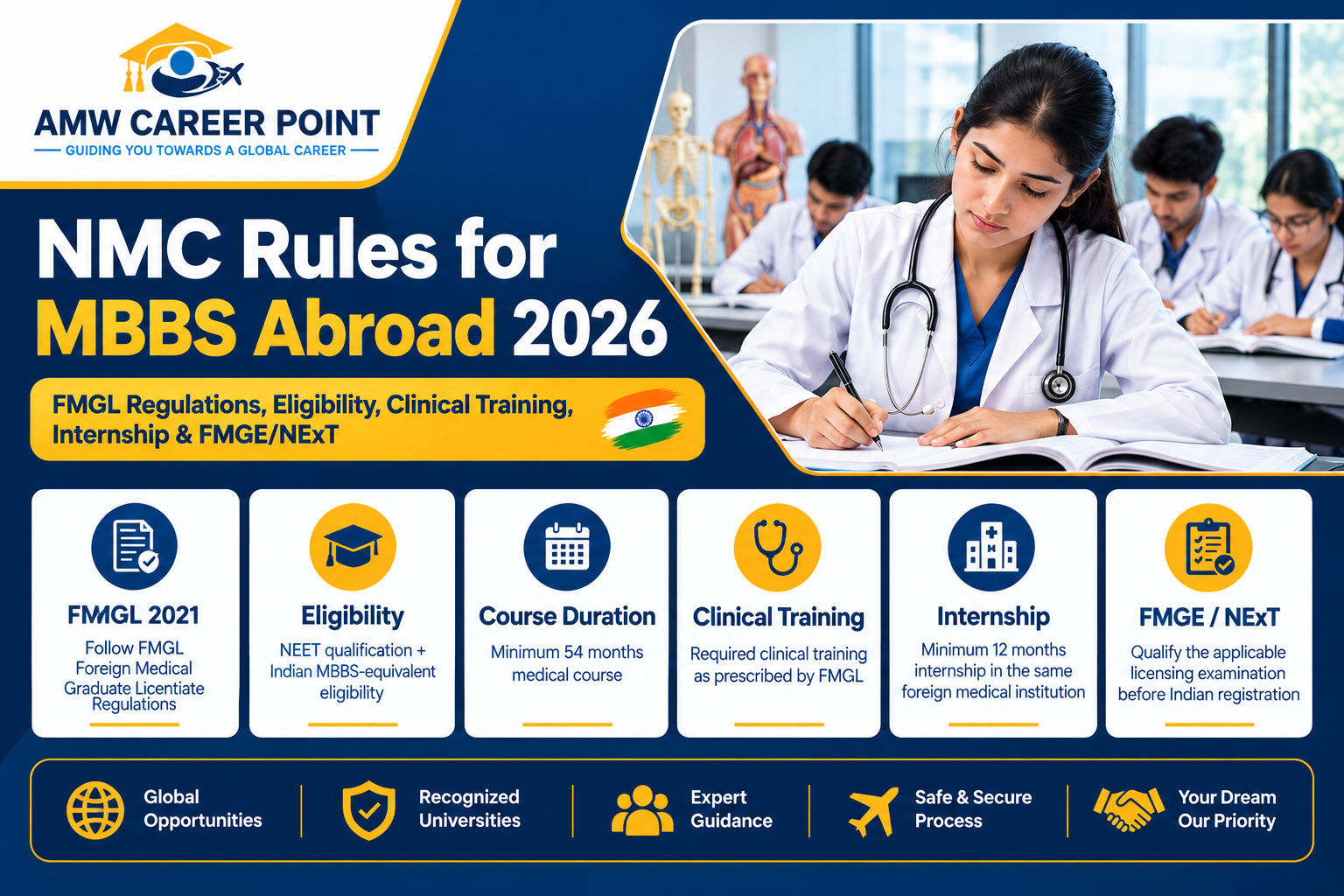
NMC FMGL Regulations 2021: What Indian Students Must Check, Point by Point
Minimum education duration: at least 54 months (4.5 years) of theoretical and clinical training before internship
Single-institution study requirement: the full academic program must be completed at one institution, not split across multiple universities or countries
Medium of instruction: must be English; this is precisely the requirement the April 2026 advisory found some Uzbekistan programs failing to meet
Clinical training requirements: hands-on clinical exposure through recognized teaching hospitals, not simulation-only or severely limited patient contact
Internship requirements: a 12-month internship completed at the same foreign institution where the degree was earned
Internship and registration in India: graduates must additionally be eligible for a license to practice in the country where the degree was awarded before their qualification is considered for Indian registration
What Happens If a University Does Not Meet These Requirements?
The Consequence Is Not Reversible After the Fact A student who completes a degree at a non-compliant institution will not be eligible to appear for FMGE or NExT, regardless of how the degree is otherwise regarded internationally. This cannot be fixed retroactively; it must be verified before enrolment, not after graduation. |
This guide's language requirements are covered in more depth in AMW's dedicated Language Requirements for MBBS Abroad guide, and NEET-linked planning is covered in our What to Do After NEET Results guide, both worth reading alongside this one.
Medical Universities in Uzbekistan: 2026 Admission & Compliance Comparison
We're deliberately not calling this '10 Best NMC-Approved Universities'; that framing is exactly the kind of blanket claim the April 2026 advisory makes irresponsible. Below is a working comparison; treat every cell as a starting point for direct verification, not a final answer.
University | City | Type | Medium (as marketed) | 2026 NMC/FMGL Status |
Tashkent | Government | English (per university) | Not directly named but shares branding/administration with the flagged Termez Branch; verify which campus your offer covers | |
Termez | Government (branch) | Disputed advisory found non-English instruction | Named in the April 2026 NMC advisory | |
Samarkand | Government | English (per university) | Named in the April 2026 NMC advisory | |
Bukhara | Government | English (per university) | Named in the April 2026 NMC advisory | |
Andijan State Medical Institute (now University status, 2025) | Andijan | Government | English (per university) | Not named in the advisory; independently verify current FMGL compliance |
Fergana | Government | English (per university) | Not named in the advisory; independently verify current FMGL compliance | |
Namangan | Government | English (per university) | Not named in the advisory; independently verify current FMGL compliance | |
Fergana | Verify ownership/status directly | Verify directly | Include only after independently confirming a compliant medical-degree pathway for Indian students in 2026 |
Which Uzbekistan Medical University Is Best for Indian Students?
Ranking these 1-to-10 would be dishonest given how differently each fits different students. Categories instead:
Best established medical university (by history): Tashkent State Medical University's main campus and Samarkand State Medical University are among the oldest in the country
Best for clinical exposure claims: Fergana Medical Institute of Public Health, following its April 2026-reported 120-bed multidisciplinary teaching clinic expansion
Best for affordability: Bukhara and Andijan generally carry lower living costs than Tashkent
Best for Tashkent location (largest city, most infrastructure): Tashkent State Medical University's main campus, which is subject to the naming verification above
Best alternative after the NMC advisory (not directly named): Andijan State Medical Institute, Fergana Medical Institute of Public Health, and Namangan State University's Faculty of Medicine
Best for students prioritizing regulatory caution above all else: whichever of the above institutions can provide current, written, verifiable NMC/FMGL compliance documentation at the time of your application and not a fixed name, a live status check
MBBS Fees in Uzbekistan 2026
Annual tuition across Uzbekistan's medical universities generally falls in a fairly narrow band. However, it's worth remembering fees are set and revised by each university, in USD, independent of this guide.
University | Approx. Annual Tuition (USD) | Approx. 6-Year Tuition (INR, at ₹90/USD) | Source Basis |
Tashkent-branded programs (verify branch) | $3,000 – $4,500 | ₹16.2 – ₹24.3 lakh | Confirm with university directly |
Samarkand State Medical University | $3,200 – $4,000 | ₹17.3 – ₹21.6 lakh | Confirm with the university directly |
Bukhara State Medical Institute | $3,000 – $4,000 | ₹16.2 – ₹21.6 lakh | Confirm with the university directly |
Andijan State Medical Institute | $2,500 – $4,000 | ₹13.5 – ₹21.6 lakh | Confirm with university directly |
Fergana Medical Institute of Public Health | $2,300 – $3,500 | ₹12.4 – ₹18.9 lakh | Confirm with university directly |
Namangan State University Faculty of Medicine | ~$3,390 (2026/27, as published by the faculty) | ~₹18.3 lakh | Confirm with the university directly |
Total Cost of MBBS in Uzbekistan for Indian Students
Tuition is only part of the real number. A realistic 6-year, all-in budget looks like this:
Expense | Annual Estimate | 6-Year Estimate |
Tuition | $2,300 – $4,500 (₹2.1 – ₹4.1 lakh) | $13,800 – $27,000 (₹12.4 – ₹24.3 lakh) |
Hostel | $600 – $800 (₹54,000 – ₹72,000) | $3,600 – $4,800 (₹3.2 – ₹4.3 lakh) |
Food (Indian mess, often compulsory in Year 1) | ~$1,200 in Year 1 (₹1.08 lakh); lower thereafter if self-managed | Varies with budget in ₹4–6 lakh across 6 years |
Insurance | $100 – $200 (₹9,000 – ₹18,000) | $600 – $1,200 (₹54,000 – ₹1.08 lakh) |
Visa/residence registration | $100 – $150 annually | $600 – $900 (₹54,000 – ₹81,000) |
Flights (round trips) | ₹30,000 – ₹50,000/trip | ₹2 – ₹4 lakh across 6 years |
Books, personal expenses, miscellaneous | ₹50,000 – ₹1 lakh/year | ₹3 – ₹6 lakh across 6 years |
Realistic 6-year total | — | Approx. ₹22 – ₹35 lakh, all-in |
This aligns with the ₹15–25 lakh to ₹23–35 lakh ranges reported across several sources for the tuition-plus-hostel component alone; once food, insurance, visa, flights, and personal costs are added honestly, ₹22–35 lakh is a more realistic all-in planning figure than the bare tuition number most pages lead with.
MBBS in Uzbekistan Eligibility 2026
Two separate sets of requirements apply, and conflating them is a common, costly mistake.
Indian Eligibility (NMC/FMGL side)
NEET-UG: A qualifying score is a hard requirement for any Indian citizen intending to return and practice in India, regardless of the destination university
Minimum PCB marks: Typically, 50% in Physics, Chemistry, and Biology at 10+2 (40% for reserved categories, per prevailing norms)
Age: Usually17 years by 31 December of the admission year
Academic gap: Most universities accept a reasonable gap, but confirm directly rather than assuming
Passport: Valid Indian passport
Medical fitness: Standard fitness certificate
University Eligibility (institution-specific)
Separate from the above, each Uzbekistan university sets its own admission process, documentation requirements, and in some cases entrance exam or interview expectations. Never assume Indian NMC eligibility automatically satisfies a specific university's own admission criteria, or vice versa.
Can You Study MBBS in Uzbekistan Without NEET?
A Direct Answer For an Indian student who intends to pursue medical education abroad and later practice in India, a qualifying NEET-UG score is a non-negotiable regulatory requirement under applicable Indian rules. This is independent of what any specific Uzbekistan university requires for its own admission. |
Some agents and even university-facing admission pages market 'MBBS without NEET ' technically, a university abroad may not itself check your NEET status at enrolment. That is a completely different statement from 'you can practice in India without NEET,' which is false. Don't let a university's own admission requirement be mistaken for India's separate, non-negotiable registration requirement and be skeptical of any agent who blurs this distinction, deliberately or otherwise.
Does MBBS in Uzbekistan Require an Entrance Exam?
University-specific claims that 'no entrance exam is required in Uzbekistan' are too broad to be reliable.
University | Entrance Exam? | 2026 Status |
Tashkent-branded programs | Interview-based process reported historically | Verify current requirement directly with the specific campus/branch |
Samarkand State Medical University | University-specific screening reported | Verify directly before applying |
Bukhara State Medical Institute | University-specific screening reported | Verify directly before applying |
Andijan / Fergana / Namangan | Documentation-based admission commonly reported, subject to change | Confirm current-cycle requirement directly with each institution |
MBBS Admission Process in Uzbekistan 2026 Step by Step
1. Receive your NEET-UG 2026 result
2. Shortlist universities based on budget, city, and first verify the NMC/FMGL compatibility
3. Check current NMC notices for each shortlisted university, specifically
4. Verify the exact course, campus, and branch you're being offered
5. Confirm the actual medium of instruction in writing
6. Prepare documents (see checklist below)
7. Apply directly with the university, or through a verifiably university-approved route
8. Complete any entrance exam or interview the specific university requires
9. Receive the official admission letter
10. Independently verify the admission letter with the university directly, not just the agent who provided it
11. Pay fees only through the university's official channel and never a personal or intermediary bank account
12. Complete visa and residence registration procedures
13. Travel and complete enrolment
Documents Required for MBBS Admission in Uzbekistan
- Academic
1. Class 10 certificate
2. Class 12 certificate and mark sheets
3. PCB marks documentation
4. NEET-UG scorecard
- Identity
1. Valid passport
2. Passport-size photographs
- Medical
1. Health/medical fitness certificate
2. Standard medical test reports
3. Vaccination documentation, if required by the specific university
- University
1. Completed application form
2. University-issued admission letter
3. Official fee receipt
- Visa
1. University invitation letter
2. Visa application documents
3. Residence registration paperwork on arrival
Language Requirements for MBBS in Uzbekistan
Is MBBS in Uzbekistan Taught in English?
No Country-Wide Answer Exists, and That's the Point Language of instruction varies by institution, and in some cases by branch. Tashkent State Medical University's own current foreign-applicant materials for the 2026/27 intake describe programs delivered in Russian and Uzbek, not English, for at least some tracks, as it is directly contradicting the blanket 'English-medium MBBS' claim that circulates across many consultancy pages. Confirm the medium of instruction for your specific program and campus in writing before applying, every single time. |
Is IELTS or TOEFL Required?
University-specific, and generally uncommon as a strict admission requirement for the medical programs Indian students pursue, but some institutions request a basic English proficiency declaration. Confirm directly with your shortlisted university rather than assuming either way.
Do Indian Students Need to Learn Uzbek or Russian?
Even at universities that market pre-clinical years as English-medium, functional Uzbek or Russian becomes practically necessary during clinical rotations, where the large majority of patients speak neither English. Most universities offer basic local-language coaching, but treat it as a real, ongoing commitment rather than a formality with the same honest disclosure we make for every MBBS-abroad destination with a comparable clinical-language gap.
Why Local Language Matters for NMC Eligibility
FMGL 2021 requires the degree program's medium of instruction to be English, but functional fluency in the clinical setting is a separate, practical necessity for actually learning medicine, independent of what satisfies the regulatory paperwork. AMW's dedicated Language Requirements for MBBS Abroad guide covers this distinction across all destinations in more depth.
MBBS Curriculum in Uzbekistan
+ Pre-Clinical Subjects (Broadly Consistent Across Universities)
Anatomy
Physiology
Biochemistry
Histology
Microbiology
Pathology
Pharmacology
+ Clinical Subjects
Medicine
Surgery
Paediatrics
Obstetrics & Gynaecology
Psychiatry
Community Medicine
Emergency Medicine
The broad subject list above is fairly standard, but sequencing, clinical-hour allocation, and hospital-partnership quality genuinely differ by university, as it is exactly the kind of detail that determines whether an FMGE-preparation-relevant clinical exposure actually happens, and is worth asking about directly rather than assuming from a shared subject list.
Clinical Training and Internship in Uzbekistan
How clinical training works: university-affiliated teaching hospitals host rotations from roughly the third year onward, varying in scale and patient volume by institution.
Teaching hospitals: Quality and patient exposure are different. Fergana Medical Institute of Public Health's government-reported 120-bed multidisciplinary clinic (expanded April 2026) is a concrete, current example of investment in this area worth asking other universities to match with specifics.
Internship: the standard structure is a 12-month internship completed at the same institution, in line with FMGL 2021.
Can clinical training be completed in India instead? No, FMGL 2021's single-institution requirement means splitting clinical training or internship across countries jeopardizes FMGE/NExT eligibility entirely.
Why this matters for NMC eligibility: this is precisely the category of concern the April 2026 advisory raised about specific institutions' insufficient hands-on clinical training being a compliance issue, not just a quality-of-life one.
FMGE/NExT After MBBS in Uzbekistan
Can Uzbekistan Graduates Appear for FMGE?
Yes, provided their specific institution and program meet FMGE 2021 requirements, as this is not automatic or country-wide, which is the entire premise of this guide.
Will NExT Replace the Current Licensing Pathway?
NExT has been proposed as a unified licensing exam for Indian and foreign medical graduates, but as of 2026 it has not been implemented with a confirmed schedule. FMGE remains the operative screening test as it does not defer FMGE preparation on the assumption NExT will arrive first.
Uzbekistan's Country-Wide FMGE Performance (Government-Reported)
Uzbekistan's Ministry of Digital Technologies reported a 40.37% success rate for Uzbekistan-origin candidates in the 2025 FMGE results, ranking Uzbekistan fourth among foreign countries educating international medical students. We're presenting this as a figure reported by Uzbekistan's own government, not as an NMC- or NBEMS-published, university-by-university statistic, as the two are not the same category of source.
University-Wise FMGE Data (December 2025 Session)
University | Appeared | Passed | Pass % |
Fergana Medical Institute of Public Health | 123 | 63 | 51% |
Tashkent-branded program (reported as ‘Tashkent Medical Academy’) | 225 | 106 | 47% |
Bukhara State Medical Institute | 316 | 113 | 36% (down from 48% in 2024) |
Samarkand State Medical University | 68 | 15 | 22% |
Recognition of Medical Degrees from Uzbekistan
WDOMS: university listing in the World Directory of Medical Schools is a baseline check, not a guarantee of Indian recognition.
Uzbekistan's own accreditation: relevant for the degree's validity within Uzbekistan and, separately, for some international bodies; not a substitute for NMC/FMGL compliance.
NMC/FMGL: the operative framework for Indian registration eligibility the filter that actually matters for a student planning to return to India.
ECFMG and other licensing authorities: relevant only if a graduate is separately pursuing licensure outside India (e.g., the USA), a distinct requirement from India's own pathway.
The One Sentence Worth Remembering from This Section WDOMS listing does not equal automatic Indian registration. A university can be correctly listed in WDOMS and still fail the specific, additional FMGL 2021 requirements NMC applies for Indian students. |
Hostel Facilities and Cost of Living in Uzbekistan
University hostels are the default accommodation for most Indian students, typically shared rooms (2–3 students), with heating provided for the winter months, on-site or nearby Indian mess facilities (often compulsory in Year 1, at roughly $1,200 for the year), Wi-Fi, basic laundry facilities, and campus security. Standards vary meaningfully by university and by city; confirm specifics for your shortlisted institution rather than assuming a uniform standard.
City | Est. Monthly Living Cost (Indian Student) | Notes |
Tashkent | ₹18,000 – ₹28,000 | Capital; highest cost but largest infrastructure and student support ecosystem |
Samarkand | ₹12,000 – ₹20,000 | Mid-range; historic city with an established student presence |
Bukhara | ₹10,000 – ₹16,000 | Lower cost tier |
Andijan | ₹10,000 – ₹16,000 | Lower cost tier; Fergana Valley region |
Fergana | ₹10,000 – ₹18,000 | Fergana Valley; growing clinical-training infrastructure |
Namangan | ₹10,000 – ₹16,000 | Lower cost tier; smaller Indian student community than Tashkent |
Student Life and Safety for Indian Students in Uzbekistan
Indian student community: well-established in Tashkent, Samarkand, and Bukhara; smaller but present in Andijan, Fergana, and Namangan
Indian food: widely available through university mess facilities and Indian-run eateries in larger student cities
Festivals and cultural life: active Indian student associations organize Diwali, Holi, and other celebrations at most universities with meaningful Indian enrolment
Accommodation: predominantly university hostels; private accommodation is possible but less common among first-year students
Weather: continental climate cold winters, hot summers; worth factoring in, particularly for students unfamiliar with sub-zero temperatures
Cultural adjustment: generally manageable given the established Indian community, though don't underestimate the adjustment period
Female student considerations: ask specifically about hostel security arrangements, curfew policies, and emergency support structures at your shortlisted university these vary and deserve a direct, specific answer rather than a general reassurance
On safety specifically: don't rely on unsupported blanket statements either way. Ask about city-specific safety records, campus and hostel security measures, transport safety, embassy support availability, and critically what the university's own emergency support structure actually looks like, in writing.
Scholarships for MBBS in Uzbekistan
Government scholarships: limited and generally not the primary route for most Indian medical applicants
University scholarships: some institutions offer merit-based tuition reductions after Year 1, as one widely reported example is a Termez Branch program offering up to an 80% scholarship for merit students from Semester 2 onward, though this should be confirmed directly given the compliance concerns already flagged for that branch
Merit scholarships: Typically, 10–30% fee waivers for top Year 1 performers at several universities; confirm current terms directly
International student scholarships: limited; verify actual eligibility for medical programs specifically, not general university scholarships that may exclude medicine
Education loans: most major Indian banks offer education loans for recognized foreign medical universities; loans above ₹7.5 lakh typically require collateral
List Only What Applies to You Specifically Only treat a scholarship as real for your planning if it's explicitly confirmed as available to international medical students, in writing; for the current admission cycle, general university scholarship pages sometimes list benefits that don't actually extend to the medicine program. |
MBBS in Uzbekistan vs Other Options
Uzbekistan vs MBBS in India
Factor | MBBS in India (Private) | |
Tuition (6-year) | ₹70 lakh – ₹1.5 crore+ | ₹22 – ₹35 lakh, all-in |
NEET | Mandatory for admission | Mandatory for India-return recognition, not necessarily for university admission itself |
Duration | 5.5 years (incl. internship) | 5+1 years, university-specific |
Clinical exposure | Consistent across NMC-regulated Indian colleges | Varies significantly by university; verify directly |
Language | English throughout | Varies per university/branch |
Licensing after graduation | None additional required | FMGE/NExT required |
Uzbekistan vs Kyrgyzstan
Factor | ||
Tuition (annual) | $2,300 – $4,500 | Generally comparable, slightly lower at several institutions |
Recent NMC scrutiny | Yes, April 2026 advisory naming specific institutions | No comparably recent, institution-specific advisory as of this guide's writing |
Language | Varies by university/branch; please verify directly | English-medium more consistently reported, though still verify per university |
Indian student population | Large and growing | Well-established, longer track record |
Best for | Students who complete thorough, per-university verification | Students prioritizing a longer-established, more consistently English-taught option |
Uzbekistan vs Kazakhstan and Uzbekistan vs Russia follow a similar pattern, broadly comparable cost bands, with the deciding factors being institution-specific compliance status, medium of instruction, and clinical-training quality rather than the country label. See AMW's dedicated Kazakhstan vs Uzbekistan comparison for a full breakdown rather than duplicating it here.
Advantages of Studying MBBS in Uzbekistan
1. Established medical institutions, several with decades of operating history
2. Geographic proximity to India and generally short, direct flight connections
3. Comparatively affordable tuition and living costs relative to many other MBBS-abroad destinations
4. A genuine, growing international and Indian student ecosystem
5. Multiple medical universities across several cities, offering some genuine choice
6. Continued government investment in medical education infrastructure at several institutions
Disadvantages and Risks of MBBS in Uzbekistan in 2026
- Regulatory uncertainty: At specific, named institutions following the April 2026 advisory
- The advisory itself: It is a real, current compliance signal, not a historical footnote
- Language differences: Genuine and, at some campuses, more significant than marketed
- Clinical-training variation: Between universities, with real consequences for FMGE/NExT preparedness
- Agent and intermediary risk: Specifically flagged by the Embassy of India as a contributing factor to the current concerns
- Intake and capacity concerns: At flagged institutions
- University-specific admission changes: Application windows and requirements shift year to year and must be reconfirmed each cycle
The need to verify current compliance before every payment: Not just before the first one
Common Scams and Red Flags When Applying to Uzbekistan
Recognize These Before You Pay Anything ‘Guaranteed NMC approval’: No agent or consultancy can guarantee a regulatory outcome that depends on the university's own, ongoing compliance. ‘MBBS without NEET’: Technically possible for university admission, false for India-return eligibility (see the dedicated section above). ‘No entrance exam, guaranteed’: Entrance requirements are university-specific and change; treat blanket guarantees skeptically. Fake or agent-issued admission letters: Always independently verify any admission letter directly with the university's own admissions office. Payment into a personal bank account: Legitimate university fees are paid through official institutional channels, never a named individual's account. Unofficial or unverified agents: Precisely the category of risk the Embassy of India flagged in the communication that triggered the April 2026 advisory. Offshore-campus confusion: The TIT Institute of Medical Sciences, Bangalore situation shows how an India-based offshore arrangement can obscure the underlying compliance status of the actual degree-granting institution. Fake or near-identical university names: Verify exact legal names against official Uzbekistan government and WDOMS listings, not just a consultancy's spelling. Suspiciously low fees: The total 6-year package advertised well below the ranges in this guide usually hides a compliance problem, not a genuine discount. University/campus name mismatches: Between what's marketed and what's on the actual admission letter — cross-check every document, every time. |
How to Verify an Uzbekistan Medical University Before Admission 13-Point Checklist
1. Check the university's official website directly, not a consultancy's summary of it
2. Confirm the exact medical program name and structure
3. Confirm the exact campus and branch
4. Check WDOMS listing directly
5. Check current NMC notices and advisories, dated to your actual application cycle
6. Confirm FMGL compliance specifics in writing from the university
7. Confirm the actual language of instruction in writing
8. Confirm exactly where clinical training is delivered
9. Confirm the internship structure and location
10. Insist on an official fee receipt, not a personal account transfer
11. Insist on a university-issued admission letter
12. Confirm the university's approved intake capacity for your specific program
13. Get direct, written confirmation from the university itself, not solely through an intermediary, before making any payment
2026 Admission Status of Uzbekistan Medical Universities
Admission availability changes; this table is a snapshot, not a permanent status, and should be reconfirmed against each university's own current page before acting.
University | 2026/27 Intake Signal | Current Status (at writing) | |
Tashkent-branded programs | 2026/27 application period reported as roughly 22 June – 30 July 2026 for Russian/Uzbek-medium tracks | Verify current window and medium directly — do not assume English medium | |
Samarkand State Medical University | Historically active annual intake | Named in April 2026 advisory — verify current compliance before applying | |
Bukhara State Medical Institute | Historically active annual intake | Named in April 2026 advisory — verify current compliance before applying | |
Andijan / Fergana / Namangan | Historically active annual intakes | Not named in advisory — still verify current-cycle status directly | |
Choosing a University Based on Your NEET Rank and Budget
Your Situation | What to Consider |
Comfortable NEET score, but missed a government MBBS seat | You have a genuine choice; prioritize compliance-verified universities over the cheapest option |
Lower NEET score, still qualifying. | Focus on universities not named in the advisory with straightforward, verifiable documentation processes. |
Budget under ₹25 lakh | Andijan, Fergana, and Bukhara-tier fee ranges fit, but verify Bukhara's current compliance status given the advisory. |
Budget ₹25–35 lakh | Opens Tashkent-area and Samarkand-tier options; verify branch and compliance status extra carefully at this tier given both are advisory-linked |
Wants Tashkent specifically | Confirm precisely which campus/branch your offer is for, in writing, before proceeding. |
Wants a genuinely English-medium program | Do not assume from marketing; request written confirmation from each shortlisted university. |
Wants lower living costs | Bukhara, Andijan, Fergana, and Namangan generally run lower than Tashkent. |
Prioritizes an established medical institution by history | Tashkent's main campus and Samarkand carry the longest institutional history; verify current compliance carefully, given both intersect with the advisory |
Specifically concerned about NMC compliance. | Start with universities not named in the April 2026 advisory, then independently verify from there; don't stop at 'not named' |
Wants maximum, best-documented clinical exposure | Fergana Medical Institute of Public Health's recently expanded teaching clinic is a concrete, current reference point to compare others against |
Need help shortlisting a specific university against your NEET 2026 result and budget? That's exactly the kind of case-by-case verification work a genuine, zero-commission counseling conversation is for through the AMW Career Point College Predictor tool.
Who Should Consider MBBS in Uzbekistan in 2026?
Suitable For
1. Students who could not secure a preferred Indian medical seat and are evaluating Central Asian options generally
2. Students genuinely willing to do university-level compliance research themselves, not just trust a consultancy's word
3. Students with a realistic, non-idealized understanding of what studying medicine abroad actually involves
4. Students comfortable working around a real, ongoing local-language requirement during clinical years
Not Suitable For
1. Students choosing purely on lowest advertised fees
2. Students unwilling to independently check NMC/FMGL requirements before paying
3. Students relying entirely on an agent's word without any direct university verification
4. Students expecting an India-like academic and clinical environment throughout
Final Verdict: Is MBBS in Uzbekistan Worth It in 2026?
Academic perspective: genuine, established medical education infrastructure exists at several institutions, with real variation in quality between them
Cost perspective: meaningfully more affordable than private MBBS in India, at a realistic ₹22–35 lakh all-in for six years
Regulatory perspective: the April 2026 advisory is a real, current signal requiring institution-level verification and not a reason to rule out the entire country, but not something to skip past either
Clinical perspective: genuinely variable by university; ask for specifics, not general reassurance
Language perspective: more complicated than most marketing suggests; confirm the actual medium of instruction for your specific program in writing
Career perspective: FMGE/NExT remains a required additional step for any India-return plan, with meaningfully different pass rates reported across different Uzbekistan institutions
The Question Worth Actually Asking The question isn't simply ‘Is Uzbekistan good for MBBS?’ The better question is: ‘Which Uzbekistan medical university, programme, and campus meet the requirements relevant to my specific career plan?’ Every section of this guide has been built to help you answer that second, harder, more useful question. |
Conclusion
MBBS in Uzbekistan remains a legitimate, comparatively affordable option for Indian students in 2026, but 2026 is also the year a real, specific, named NMC advisory makes country-level generalizations actively unsafe to rely on. The universities named in the April 2026 advisory deserve real caution; the universities not named deserve real verification rather than blind trust either way.
If you're evaluating a specific Uzbekistan university and want a second, independent check on its current NMC/FMGL compliance status before you pay anything, that's exactly the kind of conversation AMW Career Point exists for: students so that they can navigate their MBBS dream with clarity.
Frequently Asked Questions
Is MBBS in Uzbekistan good for Indian students?
For some students, at some universities, genuinely yes. The country-wide question is less useful than the university-specific one this guide is built around.
Is MBBS in Uzbekistan worth it in 2026, given the NMC advisory?
The advisory doesn't rule out Uzbekistan as a destination; it rules out treating any Uzbekistan university as automatically compliant without checking. Worth it, if you do the verification work first.
How much does MBBS cost in Uzbekistan?
Realistically ₹22–35 lakh all-in over six years, including tuition, hostel, food, insurance, visa, flights, and personal expenses.
How long is MBBS in Uzbekistan?
Typically, 5 years of academic study plus a 1-year internship, for 6 years total; confirm the exact structure per university.
What did NMC say about Uzbekistan in 2026?
On 1 April 2026, NMC issued an advisory following an Embassy of India, Tashkent communication naming Tashkent State Medical University's Termez Branch, Samarkand State Medical University, Bukhara State Medical Institute, and the Bangalore-based TIT Institute of Medical Sciences, citing intake-capacity, clinical-training, and medium-of-instruction concerns.
Does NMC ban MBBS in Uzbekistan?
No. It's an advisory urging caution and verification for specific named institutions, not a country-wide ban.
Which Uzbekistan universities were named in the NMC advisory?
Tashkent State Medical University (specifically its Termez Branch), Samarkand State Medical University, Bukhara State Medical Institute, and TIT Institute of Medical Sciences, Bangalore.
Is Uzbekistan still safe for Indian MBBS students?
The advisory concerns academic and regulatory compliance, not personal safety. Separately evaluate campus, city, and hostel safety using the factors discussed in the Student Life section above.
Can Uzbekistan graduates practice medicine in India?
Yes, provided their specific institution and program met FMGL 2021 requirements throughout the degree, confirmed before enrolment, not assumed afterward.
Is NEET compulsory for MBBS in Uzbekistan?
For India-return eligibility, yes, non-negotiably. Some universities may not check it at their own admission stage, but that doesn't change India's separate requirement.
Is an entrance exam required?
University-specific: some institutions use interview-based processes, others a documentation-based route. Confirm directly for your shortlisted university.
Is IELTS required for MBBS in Uzbekistan?
Generally, not a strict requirement for the medical programs Indian students pursue, but confirm with your specific university rather than assuming.
What is the total 6-year cost of MBBS in Uzbekistan?
Approximately ₹22–35 lakh, all-in, based on the detailed cost breakdown in this guide.
Is MBBS in Uzbekistan cheaper than private MBBS in India?
Yes, substantially, roughly ₹22–35 lakh in Uzbekistan against ₹70 lakh–₹1.5 crore or more at many private Indian medical colleges.
What is the FMGE pass rate for Uzbekistan universities?
It varies significantly by institution from roughly 22% to 51% in the December 2025 session, per third-party reporting. See the dedicated table above, including sample sizes.