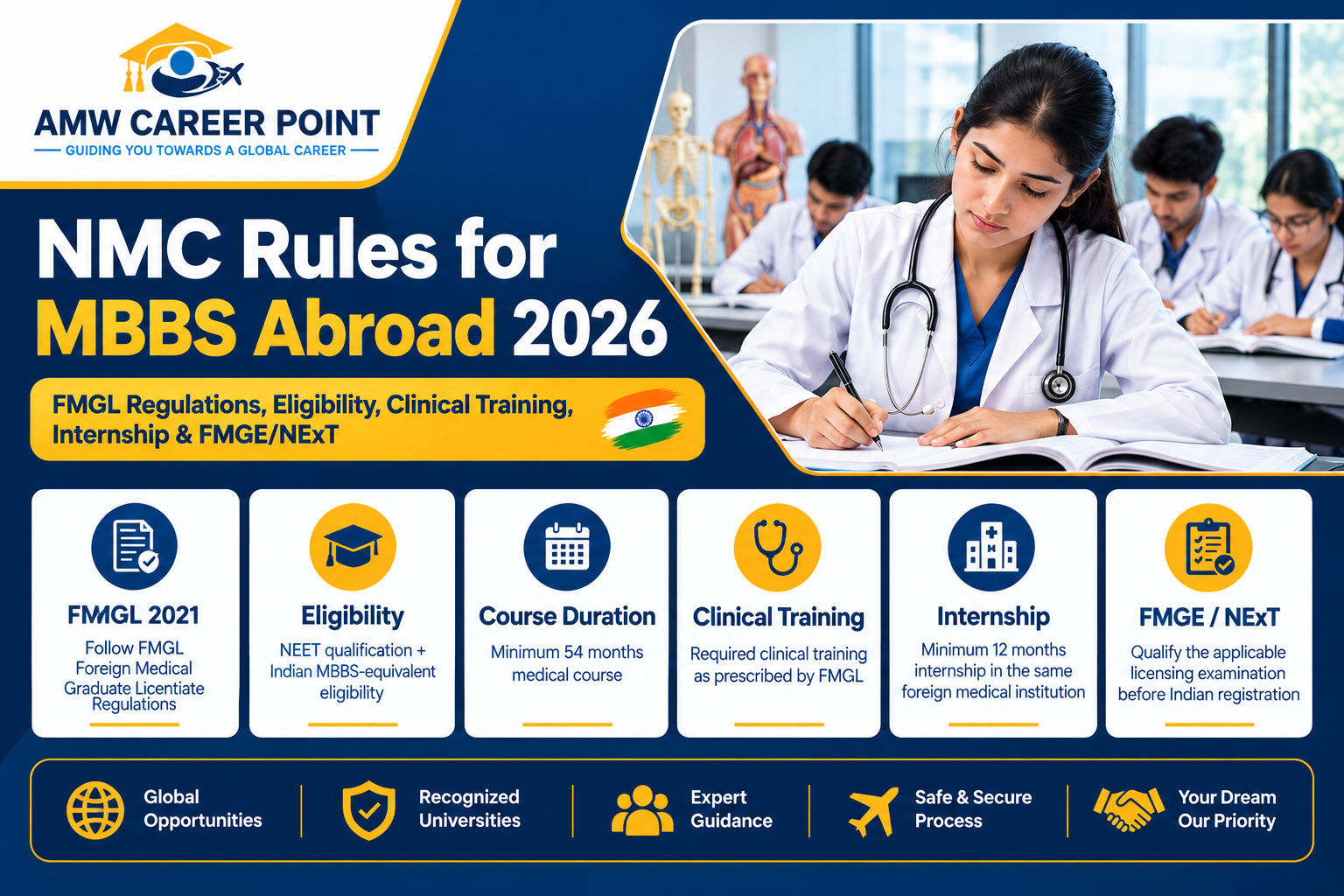
2026 NMC Updates: This guide is built directly from the NMC's current Rules & Regulations page on the Foreign Medical Graduate Licentiate (FMGL) Regulations, 2021, the FMGL FAQ dated 8 June 2026, and related internship regulations andb not from older MCI-era material or generic consultancy summaries. Where the underlying regulation and a clarifying FAQ say different things, this guide identifies which is which. Regulations and advisories change; always cross-check the current position at nmc.org.in before making any admission decision.
NMC Rules for MBBS Abroad in 2026: Quick Overview
What Is the NMC?
The National Medical Commission (NMC) is India's apex regulatory body for medical education and medical practice, established under the NMC Act, 2019, replacing the earlier Medical Council of India (MCI).
Why Does NMC Matter for Indian Students Studying Medicine Abroad?
A foreign medical degree, however reputable the university, only becomes usable for practice in India if it satisfies the NMC's specific regulatory requirements for Foreign Medical Graduates (FMGs). Studying abroad and being permitted to register and practise in India are governed by two different systems, evaluated at two different points in your journey.
What Are the Current Regulations Governing Foreign Medical Graduates?
Instrument | Date | What It Covers |
Foreign Medical Graduate Licentiate (FMGL) Regulations, 2021 | 18 November 2021 | The core binding framework for students who took admission in a foreign medical institution on or after 18 November 2021 |
Recognition of Medical Qualification Regulations, 2023 | 2023 | Governs how medical qualifications (Indian and foreign) are formally recognised for registration purposes |
Compulsory Rotating Medical Internship Regulations | Various notifications | Governs internship structure, including the pathway for FMGs completing part of their internship requirement in India |
FMGL Regulations 2021 — FAQ | 8 June 2026 | Clarifies implementation of specific public notices (see 2026 Updates section) — clarification, not new law |
Reality check: An FAQ can clarify how a regulation is implemented. It is not itself the regulation, and it cannot create new eligibility or relief beyond what the underlying regulation already permits. This distinction matters throughout this guide — treat every FAQ reference as clarification of the FMGL Regulations, 2021, not as an independent rule.
What Are the NMC FMGL Regulations 2021?
This is the foundation of everything else in this guide. FMGL stands for Foreign Medical Graduate Licentiate — the regulatory category and framework that governs Indian citizens and Overseas Citizens of India (OCI) who study medicine abroad and intend to practise in India.
When Did the FMGL Regulations 2021 Come Into Force?
The FMGL Regulations were notified by the NMC on 18 November 2021. They apply to any Indian citizen or OCI who took admission in a foreign medical institution on or after that date and intends to practise medicine in India.
Who Do the FMGL Regulations Apply To?
Students who were already enrolled in a foreign medical institution, or who had already acquired a foreign medical degree, before 18 November 2021 continue to be governed by the earlier Screening Test Regulations, 2002 — not FMGL 2021. This distinction genuinely matters and is frequently missed in generic online content.
Why Were the FMGL Regulations Introduced?
FMGL 2021 replaced the older system, under which the erstwhile MCI maintained lists of "approved" foreign institutions, with a rules-based framework assessing course duration, single-institution structure, medium of instruction, clinical training, and internship requirements — evaluated against the specific course and university, not a country-wide approval status.
FMGL 2021 vs the Earlier MCI Screening-Test Framework
Factor | Screening Test Regulations, 2002 | FMGL Regulations, 2021 |
Basis of recognition | Country/institution appeared on an approved list | Course and institution assessed against specific rules |
Who assesses compliance | Pre-vetted list maintained by regulator | Student/applicant responsibility to verify compliance, checked at registration stage |
Applies to | Students who enrolled before 18 November 2021 | Students who enrolled on or after 18 November 2021 |
Which Students Need to Pay Attention to FMGL Regulations?
Every Indian citizen or OCI who took admission in a foreign medical institution on or after 18 November 2021, and intends at any point to register and practise medicine in India — whether that intention is firm today or only a future possibility.
Why Admission-Year and Applicable-Regulation Dates Matter
Reality check: Two students at the same foreign university, studying an identical course, can be governed by two entirely different regulatory frameworks depending solely on when they were admitted. Always establish which framework applies to your specific admission date before assuming any rule in this guide applies to you directly.
NMC Eligibility Requirements for Indian Students Studying MBBS Abroad
Who Is Considered an Indian Medical Student Going Abroad?
For FMGL purposes, this covers Indian citizens and Overseas Citizens of India (OCI) who pursue a primary medical qualification at a foreign medical institution, with the intention (immediate or future) of practising medicine in India.
Academic Eligibility After Class 12
Competitive, science-stream Class 12 results with Physics, Chemistry, and Biology (PCB) remain the baseline academic starting point — the specific percentage and subject-combination requirements are set by each foreign university, not by the NMC directly, though the NMC's NEET-qualification requirement (below) applies regardless of the university's own admission criteria.
NEET Requirement for Indian Students
A qualifying NEET-UG result is mandatory for any Indian student intending to use a foreign medical degree to practise in India as this is an NMC/FMGL requirement, separate from whatever admission criteria the foreign university itself applies.
NEET Qualification vs NEET Score
The requirement is to have qualified NEET-UG — not to have achieved any specific score or rank. A qualifying result, at the time you took admission abroad, is what FMGL 2021 requires; it does not need to be high enough for an Indian government medical college seat.
Can You Study MBBS Abroad Without NEET?
You can be admitted to some foreign universities without ever having taken NEET, since university admission and NMC eligibility are separate systems (see below) — but doing so puts your future ability to register and practise in India at serious risk under current FMGL rules. For the detailed treatment of this specific question, see our dedicated
MBBS Abroad Without NEET 2026 — internal guide
Does the Foreign University Decide Whether NEET Is Required?
No. A foreign university sets its own admission criteria and may or may not ask for NEET as part of that process — but whether NEET was required for admission is a separate question from whether NEET qualification is required for you to later register in India. The university's admission policy does not override the NMC's own requirement.
Why Foreign University Admission and NMC Eligibility Are Different
Reality check: A foreign university telling you that you're "eligible" to enrol is a statement about their own admission criteria. It is not a statement about whether your course, once completed, will satisfy NMC/FMGL requirements for Indian registration. Treat these as two separate questions throughout your entire decision process — this distinction reappears throughout this guide because it is the single most common source of costly misunderstanding.
Minimum Duration of MBBS Abroad Under NMC Rules
Don't reduce this to "MBBS must be 5.5 years." The regulatory requirement has separate components that need to be understood individually.
What Is the Minimum Medical Education Duration?
The 54-Month Education Requirement
The NMC's current advisory guidance identifies a minimum of 54 months (4.5 years) of medical education, covering theoretical and practical instruction, as a core FMGL requirement.
Why NMC Refers to 54 Months of Education
This figure is expressed in months specifically because foreign academic-year structures and semester systems vary by country — a fixed month count is a more precise, internationally comparable measure than "years," which can be interpreted inconsistently across different national education systems.
Does the 54-Month Requirement Include Internship?
Reality check: No — the 54 months refers specifically to academic (theoretical and practical/clinical) education. The compulsory 12-month internship (covered in full in the next major section) is a separate, additional requirement on top of the 54 months, not a component counted within it.
Can a 5-Year Medical Degree Be Accepted?
Can a 6-Year Medical Degree Be Accepted?
A course structured as 5 academic years (60 months) or 6 academic years clears the 54-month minimum on paper. A course that totals fewer than 54 months of academic education — commonly, some 5-year programmes where the final year is substantially internship rather than academic instruction — does not automatically clear this requirement simply because it's labelled a "5-year course." The actual academic-month count, not the marketing label, is what should be verified against your specific university's official curriculum structure.
What Happens If the University Course Is Shorter Than the Required Duration?
Does an Additional Internship Make a Short Course Compliant?
This is a critical distinction: A course that falls short of the 54-month academic education requirement is not brought into compliance simply by adding extra internship time on top. The academic-duration requirement and the internship requirement are assessed as separate, independent conditions — both must be met on their own terms, not traded off against each other.
Single-Institution Requirement for MBBS Abroad
What Does "Single Institution" Mean?
FMGL 2021 requires that the entire course — academic education and the 12-month internship — be completed at the same foreign medical institution. This is one of the most frequently misunderstood requirements among Indian applicants and, at times, among agents themselves.
Can Students Transfer Universities During MBBS?
Can Students Complete Part of the Course in Another Country?
Can Students Change Universities After Admission?
Treat with real caution: Transferring universities, or splitting your education or internship across more than one institution or country, creates genuine risk to your FMGL compliance. This applies even where the receiving institution is otherwise reputable and even where the transfer is framed as an "upgrade." Do not assume a transfer is safe simply because the university facilitating it says so.
What Is Academic Mobility?
Some universities and countries operate formal academic-mobility or exchange arrangements allowing students to spend part of their programme at a partner institution. Whether such an arrangement is compatible with FMGL's single-institution requirement depends on the specific structure and documentation of that arrangement — it should never be assumed compliant without direct verification.
Why University Transfers Can Create Regulatory Problems
What Should Students Check Before Signing a Transfer Agreement?
Before agreeing to any transfer, academic-mobility arrangement, or split programme, obtain written clarification — ideally cross-checked against current NMC guidance — on whether your specific course structure will still satisfy the single-institution requirement. Retain all documentation.
Medium of Instruction Requirements for Foreign Medical Graduates
Is English Medium Mandatory?
Yes, as a general FMGL expectation. The course should be conducted in English as the medium of instruction. This is one of the most consequential requirements in practice, since it is also one of the most commonly misrepresented in marketing material.
Why Medium of Instruction Matters
Medium of instruction is assessed as part of overall FMGL compliance and can materially affect whether a completed foreign degree is ultimately accepted for Indian registration purposes.
English-Medium Medical Programme
Local Language During Clinical Training
Reality check: A programme can be genuinely English-medium for pre-clinical, lecture-based theory while functioning very differently once clinical rotations begin — many CIS and other destinations require functional local-language ability for real hospital-floor patient interaction from the clinical years onward, even where the university markets itself as "fully English medium."
Can a Course Be Partly English and Partly Local Language?
Genuinely bilingual programme structures — where a meaningful portion of instruction, particularly in later years, shifts to the local language — carry real compliance risk. This has been a specifically flagged concern in some CIS destinations in recent NMC advisories.
What Documents Can Prove the Medium of Instruction?
A written, official statement from the university confirming the medium of instruction for every year and every subject of the specific programme — not a general prospectus claim — is the appropriate document to request and retain.
Why Students Should Not Rely on "English Medium" Marketing Claims
Reality check: "English medium" as used in university marketing and "English medium" as assessed for FMGL compliance are not guaranteed to mean the same thing in practice. Verify the actual, year-by-year, subject-by-subject language of instruction directly and in writing before enrolling — not the summary claim on a website or in a brochure.
Curriculum Requirements for MBBS Abroad
Should the Foreign Medical Curriculum Be Comparable to MBBS in India?
Broadly, yes — FMGL compliance assessment looks at whether the foreign curriculum is commensurate with the structure and content areas taught in Indian medical education, rather than requiring an identical syllabus.
Basic Medical Sciences: foundational science subjects underpinning clinical study.
Pre-Clinical Subjects: Anatomy, Physiology, Biochemistry, and related early-stage subjects.
Para-Clinical Subjects: Pathology, Pharmacology, Microbiology, Forensic Medicine, and related subjects.
Clinical Subjects: Medicine, Surgery, Obstetrics & Gynaecology, Paediatrics, and other core clinical disciplines.
Community Medicine: public-health and community-health-oriented coursework.
Emergency Medicine and Other Clinical Exposure: acute-care and emergency-department exposure as part of clinical training.
Competency-Based Medical Education
Indian medical education has moved toward a competency-based framework; the extent to which a foreign curriculum reflects comparable competency-based outcomes (rather than purely theoretical assessment) is a relevant, though not always explicitly codified, consideration in overall compliance assessment.
How to Compare a Foreign Curriculum With Indian Medical Education
Request the university's official, year-by-year subject and hours breakdown, and compare it against the general structure above — not against a specific Indian college's syllabus, since some variation in sequencing and emphasis is normal even within India's own medical colleges.
Clinical Training Requirements Under NMC Rules
Why Clinical Training Matters
This is one of the areas that deserves the most scrutiny before admission. A degree can satisfy the 54-month and English-medium requirements on paper while still providing genuinely inadequate hands-on clinical exposure — and this gap is a real, documented concern the NMC itself has flagged for specific destinations in recent advisories.
Minimum Clinical Exposure
Hospital-Based Training
Clinical Rotations
Genuine, hands-on clinical training — not purely observational or lecture-based instruction dressed up as "clinical" — through structured hospital rotations across the core clinical departments is the expectation:
Medicine
Surgery
Obstetrics & Gynaecology
Paediatrics
Psychiatry
Emergency Medicine
Community/Primary Healthcare Exposure
Can Clinical Training Be Completed Outside the University's Country?
Can Clinical Training Be Completed in India?
Do not assume this is straightforward: Clinical training conducted outside your enrolling institution and its own affiliated teaching hospital network — including in a third country, or in India during the academic course itself — is not automatically accepted and needs to be verified case-by-case against the specific arrangement's documentation and current NMC guidance before you rely on it.
Why Clinical Training Location Must Be Verified Before Admission
Confirm, in writing, which specific hospitals your university's clinical rotations use, whether those hospitals are formally affiliated with your enrolling institution, and whether any portion of clinical training occurs outside that arrangement — before you commit, not after you discover a gap partway through your degree.
Internship Requirements for Foreign Medical Graduates
What Is the FMG Internship Requirement?
12-Month Internship Requirement
FMGL 2021 requires a minimum 12-month internship, completed after finishing the academic course.
Internship at the Same Foreign Medical Institution
Why internship location matters: The 12-month internship must be completed at the same foreign medical institution where the academic course was completed — reiterating the single-institution requirement specifically for the internship stage. It cannot be shifted to India, or to a different foreign institution, other than through the specific, limited pathway described in the next section.
Can the Internship Be Completed in India?
When Can an FMG Complete Internship in India?
Certain specific circumstances and NMC notices have addressed Indian-institution internship pathways for FMGs — this is not a general substitute for the standard same-foreign-institution internship requirement, and applies only under the specific conditions set out in current NMC guidance (see the dedicated "NMC Rules for Internship in India" section below for the fuller treatment).
NMC-Approved Medical College for Indian Internship
Where an Indian-institution internship pathway does apply to your circumstances, it must be completed at an institution the relevant State Medical Council/NMC framework recognises for that purpose — not any medical college of your choosing.
Internship Duration, Certificate, and Documentation
Beyond the 12-month duration itself, retain complete, signed internship documentation — rotation records, logbooks, attendance records, and a formal completion certificate — throughout, not just at the end. These become essential at the Indian registration stage.
NMC Rules for Clinical Internship in India After MBBS Abroad
Who Needs to Complete Internship in India?
Separately from the foreign 12-month internship requirement above, FMGs who clear the FMGE are generally required to complete an additional Compulsory Rotating Resident Medical Internship (CRMI) in India before permanent registration — governed by the NMC's internship regulations and allocated through the relevant State Medical Council/Director of Medical Education framework, not chosen freely by the student.
Eligibility for Indian FMG Internship
Allocation of Medical Colleges
Indian medical colleges reserve a defined proportion of seats for FMG internship/clinical clerkship purposes, with the specific number determined by State Medical Councils and State Directors of Medical Education — an FMG does not simply select any Indian medical college of their choice.
State Medical Councils and Internship
Can an FMG Choose Any Medical College?
Reality check: No — allocation is managed through the State Medical Council/Director of Medical Education framework, not by direct student choice, and availability is subject to the specific seats reserved for this purpose in a given cycle.
What Happens If Internship Requirements Are Not Completed?
Incomplete internship — foreign or Indian, as applicable to your circumstances — blocks progression to permanent registration. This is not a formality that can be deferred indefinitely.
Foreign Medical Qualification Recognition Under NMC
This is where the most damaging misconception in this entire subject needs to be corrected directly.
What Does Recognition of a Foreign Medical Qualification Mean?
Recognition, in the FMGL context, means your specific completed course and degree — assessed against duration, single-institution structure, medium of instruction, curriculum, clinical training, and internship requirements — is accepted as satisfying the conditions needed to sit the FMGE and pursue Indian registration.
Does NMC "Approve" Every Foreign Medical University?
Correct this directly: No. The NMC's own stated position is that it does not endorse or maintain a list of approved foreign medical institutions or universities for MBBS or equivalent courses. There is no such list to check a university against. Compliance is a course-and-institution-level assessment against the FMGL rules described throughout this guide — not a lookup against an "approved universities" list, because no such official list exists.
University Recognition vs Medical Qualification Recognition
A university being recognised or accredited within its own home country's education system is a separate question from whether a specific medical qualification earned there satisfies FMGL 2021's requirements for Indian registration purposes. Both matter; neither alone is sufficient.
Recognition in the Country of Study
Your degree should also be genuinely recognised and valid for medical practice within the country where you studied — a basic credibility check independent of, and prior to, any Indian-specific FMGL assessment.
NMC/FMGL Compliance
Why WHO/WDOMS Listing Is Not the Same as NMC Recognition
Reality check: A university's listing in the World Directory of Medical Schools (WDOMS) confirms the institution is a documented, internationally recorded medical school. It does not confirm that your specific course satisfies FMGL 2021's duration, medium-of-instruction, single-institution, or internship requirements. Treat WDOMS listing as one useful data point, not as NMC approval — because WDOMS listing and NMC/FMGL compliance are assessed by entirely different bodies for entirely different purposes.
Why "NMC Approved University" Is an Oversimplification
Use precise language: Avoid this phrase, and be sceptical of anyone — including a consultant or agent — who uses it casually. The precise, defensible framing is: "the programme/university should be evaluated against the applicable NMC/FMGL requirements" — not "this university is NMC approved."
What Students Should Actually Verify
Course duration, single-institution structure, medium of instruction, curriculum commensurability, genuine clinical training, and internship structure — individually, in writing, for your specific programme — rather than accepting any blanket approval claim.
How to Check Whether a Foreign Medical University Meets NMC Requirements
Step | Details |
1. Verify the university in its home country | Confirm genuine accreditation and standing within its own national education system. |
2. Verify the medical qualification | Confirm the specific degree awarded and its recognised status for practice in that country. |
3. Check course duration | Confirm the academic-education component meets the 54-month minimum, from the official curriculum structure — not a marketing summary. |
4. Check single-institution structure | Confirm the full course and internship are completed at one institution, with no split arrangements. |
5. Check medium of instruction | Confirm, year-by-year and subject-by-subject, in writing. |
6. Check clinical training | Confirm genuine, hands-on hospital-based rotations across core clinical departments. |
7. Check internship | Confirm the 12-month, same-institution structure. |
8. Check teaching hospital | Confirm formal affiliation between the university and the hospitals used for clinical training. |
9. Check admission-year requirements | Confirm which regulatory framework (FMGL 2021 or the earlier Screening Test Regulations, 2002) applies to your specific admission date. |
10. Obtain written confirmation | Get every point above confirmed in writing from the university, not verbally from an agent. |
11. Check current NMC regulations before paying | Cross-check everything against nmc.org.in's current regulatory material immediately before making any payment. |
The NMC also provides a College and Course Search facility on its official site — this should be used as one part of your verification process, alongside the direct checks above, rather than relying on privately compiled "approved university" lists circulated by consultancies or agents.
NMC Rules for MBBS Abroad Country-Wise
Reality check: The NMC does not maintain separate country-specific rules. The same FMGL framework applies everywhere — what differs is how each country's own education system and university practices interact with that single framework. The summaries below are general orientation points, not verified per-university conclusions; every specific university must still be checked individually using the verification steps above.
Country | Orientation Notes — Still Verify at University Level |
Established programmes with decades of Indian-student history; verify course duration in months (not just "years" labelling), and confirm which years require Russian for genuine clinical-floor communication despite English-medium theory. | |
Newer infrastructure at several universities; verify clinical-training hospital affiliation specifically, given a shorter historical FMGE track record to reference than Russia. | |
A specifically flagged risk area — some popular universities run genuinely bilingual (English/Russian or Kyrgyz) programme structures; request the exact language breakdown of the curriculum in writing. | |
The NMC issued a specific advisory in 2026 flagging inadequate hands-on clinical training at some institutions due to a gap between marketed and actual medium of instruction — treat any Uzbekistan shortlist with heightened, documented verification. | |
Generally strong recent FMGE track record among CIS-adjacent destinations; verify medium of instruction and clinical-hospital affiliation at your specific shortlisted university regardless. | |
A smaller, growing Indian-student destination; apply the same full verification checklist as any other country, given a comparatively thinner public compliance track record to reference. | |
MOE English-medium listing status can change between admission cycles; HSK-level Mandarin is typically required before the internship year — verify current listing status directly and recently, not from an outdated source. | |
Curriculum structure closely mirrors India's own MBBS syllabus; still requires the same duration, single-institution, and internship verification as any other destination. |
For full country-specific detail, see our dedicated country guides — including MBBS in Uzbekistan and MBBS in Armenia — which go into university-level depth beyond this regulatory overview.
NMC Rules for MBBS in Europe
European medical programmes often have meaningfully different structures from CIS or South Asian destinations, particularly around medium of instruction and curriculum sequencing:
Country | Orientation Notes — Still Verify at University Level |
Public Humanmedizin programmes are taught in German, not English — this is Germany's single biggest FMGL compliance question given the English-medium expectation, and should be verified explicitly and directly with the NMC and your specific target university before enrolling. See our full MBBS in Germany 2026 guide. | |
Several public universities teach in English via IMAT-based admission, with Italian required for clinical-year patient interaction — verify the specific programme's English-medium status year-by-year. See our IMAT 2026 guide. | |
Long-established, genuinely English-medium programmes with decades of international-student teaching history. | |
Established English-medium programmes; verify duration structure and clinical-hospital affiliation per university. | |
One of the longer-running English-medium MBBS traditions in Europe; still requires standard duration and internship verification. | |
A small number of well-regarded English-medium programmes at real tuition cost; verify structure per institution. | |
Verify language of instruction and clinical-year structure per specific programme. See our MBBS in Portugal 2026 guide. | |
Verify language of instruction and clinical-year structure per specific programme. See our MBBS in Greece 2026 guide. |
NMC Rules for English-Medium MBBS Abroad
Is English Medium Enough for NMC Compliance?
Necessary, but on its own not sufficient — medium of instruction is one of several FMGL requirements assessed together, not a standalone pass/fail test.
English-Medium Degree vs English-Medium Clinical Training
Reality check: A degree can be genuinely English-medium in its formal theoretical curriculum while clinical training happens predominantly in the local language — these are two different things, and both should be verified separately, specifically for your target programme's clinical years.
Local Language During Patient Interaction
Functional local-language ability for real patient interaction is, in practice, expected at most destinations from the clinical years onward — regardless of the formal medium-of-instruction status of the programme.
Documents Proving Medium of Instruction
How Indian Students Should Verify Language Requirements
Request a written, year-by-year, subject-by-subject breakdown of instruction language directly from the university, and where possible, corroborate it with currently enrolled or recently graduated students at that specific institution.
NMC Rules for MBBS Abroad and NEET
Is NEET Mandatory for Indian Students Studying Medicine Abroad?
Yes — a qualifying NEET-UG result is mandatory for FMGL compliance, regardless of whether your specific foreign university required it for its own admission process.
Why NEET Is Different From NMC Recognition
NEET qualification is one specific eligibility condition within the broader FMGL framework — it does not, by itself, make your course NMC/FMGL-compliant, and it is not a substitute for verifying duration, medium of instruction, clinical training, or internship structure.
NEET Qualification and Foreign Medical Education
Can a Foreign University Admit You Without NEET?
Does Foreign Admission Override Indian Requirements?
Reality check: No. A foreign university's own admission decision has no bearing on whether the NMC's separate NEET-qualification requirement has been satisfied. These remain two independent systems throughout — university admission criteria never override or substitute for NMC/FMGL eligibility requirements.
Low NEET Score vs Non-Qualification
A low but qualifying NEET score satisfies the FMGL requirement; a non-qualifying result does not, regardless of how strong your other academic credentials are. Score level beyond the qualifying threshold is not itself an additional FMGL requirement — but qualification itself is non-negotiable.
NEET and Future Medical Registration in India
For the complete treatment of what happens if you didn't qualify NEET before taking foreign admission, see our dedicated MBBS Abroad Without NEET 2026 guide.
NMC Rules for MBBS Abroad and FMGE
What Is FMGE?
The Foreign Medical Graduate Examination (FMGE), conducted by the National Board of Examinations in Medical Sciences (NBEMS), is the current qualifying screening examination foreign medical graduates must clear before Indian registration.
Who Is Required to Take the Screening Test?
Any Indian citizen/OCI holding a primary foreign medical qualification who intends to register and practise in India — with the specific applicable framework (FMGE, or eventually NExT — see next section) depending on which regime is in force at the time the graduate becomes eligible.
FMGE and Foreign Medical Graduates
FMGE Eligibility
Eligibility to sit FMGE requires that your foreign medical qualification and its underlying course satisfy FMGL 2021's requirements — the assessment covered throughout this guide.
Documents Required
Degree certificate, academic transcripts, internship completion certificate, and other documentation as specified by NBEMS for the specific FMGE session you're registering for — confirm the current, exact document list directly with NBEMS before your intended session.
FMGE Passing Requirements
A fixed minimum passing score applies, set by NBEMS, with no category-based relaxation.
Recent FMGE Pass-Rate Context
Session | Pass Percentage |
June 2025 | 18.61% |
December 2025 | 23.95% |
Don't overstate this data: FMGE pass rates have run roughly between 12% and 24% across recent sessions and vary by cohort and session — treat these as directional context, not a promise or prediction for any individual candidate. No consultant can legitimately guarantee your future FMGE outcome, and this guide does not attempt to.
FMGE Internship After Passing
Clearing FMGE leads to provisional registration and the compulsory rotating internship in India (CRMI), which must be completed at an eligible institution — see the "NMC Rules for Clinical Internship in India" section above.
State Medical Registration
Permanent registration with the relevant State Medical Council follows successful completion of the CRMI — this is the point at which a graduate becomes formally licensed to practise independently in India.
Why FMGE Rules Should Be Checked for Your Admission Cohort
Reality check: FMGE-related rules, session dates, and the FMGE-to-NExT transition timeline are all subject to change. Check the current position specifically for the cohort/graduation year you fall into, directly on the NMC and NBEMS official sites, rather than relying on an article's publication-date snapshot indefinitely.
NMC Rules for MBBS Abroad and NExT
This section requires careful, precise wording — avoid any absolute "FMGE is cancelled from X date" claim.
What Is NExT?
The National Exit Test (NExT), notified under the NMC Act, 2019 and the National Exit Test Regulations, 2023, is a planned common licensing and postgraduate-merit examination intended eventually to apply to both Indian and foreign medical graduates, structured around theory and practical/clinical components.
Why NExT Matters to Foreign Medical Graduates
Once implemented, NExT is designed to eventually replace FMGE as the licensing pathway for foreign medical graduates, in addition to serving PG-selection purposes for all graduates.
NExT vs FMGE
Factor | FMGE | NExT |
Purpose | Licensing exam specifically for FMGs | Licensing exam + PG-selection merit test, for both Indian and foreign graduates |
Format | MCQ-based screening test | Theory (Step 1) plus practical/clinical (Step 2) components, per the notified framework |
Current status (2026) | Active and operational — the current qualifying exam | Deferred; NMC has indicated a multi-year mock-test and feasibility phase before full rollout |
Is NExT Replacing FMGE?
Current, precise position: NExT is designed to eventually replace FMGE for foreign medical graduates, but implementation has been deferred — the NMC has indicated a multi-year phase of mock tests and feasibility review before any full rollout, with commentary suggesting this process could extend toward 2028–2029. A separate 2026 draft amendment to the NMC's registration regulations explicitly retains FMGE as the qualifying examination for FMGs "until NExT comes into force" — meaning FMGE remains the operative requirement for the foreseeable future. There is no confirmed implementation date for NExT specifically as it applies to foreign medical graduates as of this guide's publication.
What Should Current Foreign Medical Students Know?
Prepare for FMGE as the exam actually in force. Do not defer FMGE preparation or attempts on the assumption that NExT will arrive in time to change your specific pathway — current NMC guidance and reporting both indicate this is not a safe assumption for students graduating in the near term.
How Future Licensing Changes Could Affect FMGs
If and when NExT is implemented for foreign medical graduates, transitional rules will determine which cohorts fall under FMGE versus NExT — these transition rules have not yet been finalised publicly for the FMG category specifically.
Why Students Should Follow Official NMC Updates
Reality check: This section reflects the position as understood at the time of this guide's last update (see the date at the top of this page). NExT's timeline is actively evolving — verify the current status directly at nmc.org.in before making any decision that depends on which exam you expect to sit.
Can Foreign Medical Graduates Practise Medicine in India?
What Happens After Completing MBBS Abroad?
University study → Foreign qualification held → Licensing examination (FMGE, or NExT once applicable) → Internship (foreign, and CRMI in India as applicable) → State Medical Council registration → Permanent registration → Independent practice.
Foreign Medical Qualification
Licensing Examination
Internship
State Medical Council Registration
Permanent Registration
Each of these stages must be completed in sequence — none can be skipped or reordered, and completing an earlier stage does not guarantee smooth progression through a later one if compliance gaps exist.
Can an FMG Work as a Doctor Without Registration?
Reality check: No. A completed foreign medical degree, on its own, does not confer any right to practise medicine in India. Formal registration with the relevant State Medical Council, following the full sequence above, is what confers that right — practising without it is not a grey area.
Why a Foreign Medical Degree Alone Is Not Enough
This is worth stating plainly: the degree is a necessary starting point, not the endpoint, of your path to practising in India.
Can Foreign Medical Graduates Do PG in India?
Eligibility for postgraduate medical education: requires completed permanent registration and satisfaction of the relevant PG-entrance framework's own eligibility rules.
NEET-PG/NExT considerations: PG entrance in India currently runs through NEET-PG, with NExT eventually intended to incorporate a PG-merit function as well — verify the current framework applicable to your specific graduation timeline.
Registration requirements: must be satisfied before PG application, not concurrently with it.
Foreign MBBS and Indian PG admission: a compliant, registered foreign medical graduate can generally pursue PG in India on the same competitive basis as an Indian-trained graduate, once registered.
Government vs private PG options: both are technically accessible to a properly registered FMG, subject to the same competitive admission process any other eligible candidate faces.
Reality check: Licensing and registration must come before any realistic PG planning. Do not plan a PG-in-India pathway around a foreign MBBS that has not yet been assessed for FMGL compliance.
Can You Do PG Abroad After MBBS From a Foreign University?
Residency in the country of study: generally the most accessible PG/residency route, subject to that country's own requirements.
Licensing requirements: vary entirely by destination country.
Language requirements: often a genuine additional barrier for postgraduate training in a non-English-medium country.
Country-specific medical registration: required in whichever country you intend to pursue PG training, independent of your undergraduate country.
Moving to a third country: possible in principle but requires meeting that third country's own separate licensing exam and registration requirements — e.g., USMLE for the US, PLAB for the UK, AMC for Australia.
Why MBBS Recognition Does Not Automatically Transfer Between Countries
Reality check: Recognition in your country of study, recognition in India (via FMGL/FMGE), and recognition in any third country are three separate assessments by three separate regulatory bodies. Clearing one does not automatically clear the others.
NMC Rules for Transfer Students and Academic Mobility
Reiterating the single-institution requirement specifically for students already partway through a foreign medical programme: transferring institutions or countries, even mid-course, creates genuine FMGL compliance risk and should never be undertaken without direct, written, current verification against NMC rules — retain every academic, transfer, and migration document involved.
NMC Rules for Online and Hybrid Medical Education
Can MBBS Be Completed Online?
Major red flag: No — and any claim suggesting a genuinely complete MBBS/medical degree can be earned fully online is a significant red flag, not a legitimate pathway. Clinical training in particular cannot be meaningfully delivered remotely — hands-on patient contact is inherent to the requirement, not incidental to it.
Online Medical Lectures vs Online Clinical Training
Some portion of theoretical/lecture-based instruction being delivered online — as happened widely during COVID-19-era disruptions — is a different matter from clinical training itself being delivered remotely, which is not a legitimate substitute for hands-on training under FMGL expectations.
Why Fully Online MBBS Claims Are a Major Red Flag
What Students Should Verify About Blended Programmes
Students whose programmes included a genuine online-instruction component during COVID-19 or the Ukraine-Russia war period should specifically review the NMC's compensatory physical-training requirements — covered in the 2026 Updates section below — rather than assuming any online component automatically disqualifies their degree.
NMC Rules for Clinical Training in a Third Country
Clinical rotations conducted in a country other than where you're enrolled — sometimes offered as an "international rotation" or "elective" — are not automatically accepted as satisfying FMGL clinical-training requirements. Verify, in writing, before starting any such rotation, and retain full documentation of where, when, and under what formal arrangement it occurred.
Documents Foreign Medical Students Should Keep Throughout MBBS
Admission letter
Fee receipts
Academic transcripts (every year)
Course completion certificate
Degree certificate
Internship certificate
Clinical rotation records
Logbooks
Attendance records
Medium-of-instruction certificate (written, from the university)
University recognition documents
Passport and visa records
Migration/transfer documents (if any)
Reality check: Original academic records lost during a 6-year (or longer) programme are extremely difficult, sometimes impossible, to fully reconstruct later — and their absence can directly delay or block your FMGE eligibility and Indian registration process. Keep both physical originals and digital backups from day one.
NMC Compliance Checklist Before Taking Admission Abroad
Academic Eligibility
Class 12 eligibility checked
PCB requirements checked
NEET qualification checked
University
University recognised in home country
Qualification recognised for practice in that country
Official course structure verified in writing
Course
Minimum 54-month academic duration verified
Single-institution requirement checked
Medium of instruction verified year-by-year
Clinical Training
Teaching hospital affiliation verified
Clinical rotations verified as genuine and hands-on
Clinical training location verified
Internship
12-month duration verified
Same-institution location verified
Internship documentation process understood
India Return
FMGE/NExT pathway understood for your likely graduation cohort
Indian CRMI internship requirement understood
State registration pathway understood
NMC Rules for MBBS Abroad: Red Flags to Avoid
"NMC approved university" claims without documentation: no official approved-university list exists — treat this phrase as a warning sign, not reassurance.
"100% FMGE pass guarantee": no legitimate university or consultant can guarantee your individual exam outcome.
"NExT guaranteed" or similar future-exam promises: NExT's implementation and applicability to FMGs remains unconfirmed — no one can guarantee outcomes under a framework not yet in force.
A 5-year course with an unclear internship structure: verify the exact academic-month count and internship arrangement separately.
Any "online MBBS" claim: a fundamental red flag, not a legitimate variant.
Unclear or vague clinical training: if a university can't specify exact teaching-hospital affiliations, treat this as a serious warning sign.
Multiple-country clinical rotations without documentation: undocumented, undefined multi-country arrangements risk single-institution non-compliance.
University transfer promises: particularly mid-course transfer offers framed as upgrades, without clear FMGL-compliance verification.
An unrecognised teaching hospital: verify formal affiliation, not just proximity or informal arrangement.
Extremely low fees relative to comparable programmes: can correlate with genuine compliance or quality gaps — investigate rather than treat as simply a good deal.
Admission without proper academic verification: a university that doesn't rigorously check your Class 12/NEET status is not doing you a favour.
"No NEET needed" marketing: even where technically true for that university's own admission process, this doesn't remove your separate NMC/FMGL NEET-qualification requirement.
Common Mistakes Indian Students Make About NMC Rules
Assuming WDOMS listing means NMC approval
Looking only at tuition fees, without checking regulatory compliance
Checking NMC rules only after graduation, rather than before admission
Ignoring clinical training quality in favour of course cost or campus appearance
Ignoring internship structure until it becomes an immediate, urgent problem
Changing universities without checking the regulatory consequences first
Losing or failing to retain academic documentation throughout the programme
Assuming English medium means no local language is genuinely needed
Assuming a foreign degree automatically allows practice in India
Following outdated MCI-era rules instead of the current FMGL Regulations, 2021 and its 2026 clarifications
NMC Rules for MBBS Abroad: 2026 Regulatory Updates
NMC FMGL FAQ — 8 June 2026
The NMC issued a 12-point FAQ document on 8 June 2026, clarifying implementation of an earlier public notice (18 March 2026) concerning compensatory physical training for Foreign Medical Graduates who completed part of their education through online classes during the COVID-19 pandemic or the Ukraine-Russia war period. The FAQ explicitly states that the 18 March 2026 notice does not create any new eligibility category or additional relief beyond what earlier notices already permitted, and does not supersede the earlier public notice dated 7 December 2023.
NMC 2026 Advisories Relevant to Foreign Medical Students
A separate April 2026 advisory reiterated core FMGL requirements — including the 54-month education minimum and 12-month same-institution internship — and specifically flagged concerns about inadequate clinical training at some Uzbekistan institutions.
2026 Changes/Clarifications Affecting FMGs
A 2026 draft amendment to the NMC's Registration of Medical Practitioners and Licence to Practice Medicine Regulations explicitly retains FMGE as the qualifying examination for FMGs until NExT comes into force — providing helpful clarity on the FMGE/NExT transition question covered earlier in this guide.
COVID-19 / Ukraine-Russia-Affected FMG Provisions
Students who completed part of their education online during these specific disruption periods should review whether the compensatory physical-training requirement applies to them, and complete any required compensation training at their original university before their clinical record is treated as complete.
What Has Not Changed
The core FMGL 2021 framework — 54-month academic minimum, single-institution requirement, English-medium expectation, genuine clinical training, and 12-month same-institution internship — remains the operative structure. The 2026 material clarifies implementation of specific, narrower issues; it does not replace or fundamentally alter FMGL 2021 itself.
How Students Should Track Future NMC Updates
Reality check: Check the NMC's official Rules & Regulations page (nmc.org.in) directly and periodically, particularly before any admission decision, fee payment, or FMGE registration. This guide reflects the position as of its "Last Updated" date at the top of this page — treat any gap between that date and today as a reason to re-verify directly.
NMC Rules for Students Already Studying MBBS Abroad
What current students should check: that their admission-year regulatory framework, course structure, and documentation remain consistent with what was represented at admission.
What if your university changes its curriculum? Request written confirmation of how the change affects your specific compliance status, and retain both old and new curriculum documentation.
What if your university changes clinical hospitals? Verify the new hospital's affiliation status and retain documentation of the change and the reason for it.
What if your university changes the internship structure? Verify this doesn't compromise the same-institution, 12-month requirement.
What if you are asked to transfer? Treat with the same caution outlined in the Academic Mobility section above — verify before agreeing, don't assume it's safe because the university proposes it.
What if you studied during COVID-19 disruptions? Review the compensatory physical-training requirement discussed in the 2026 Updates section above.
What documents should you collect now? Everything listed in the Documents section above — starting today, regardless of how many years remain in your programme.
NMC Rules for Students Planning MBBS Abroad in 2026
Stage | What to Do |
Before applying | Verify your target university and country using the full checklist in this guide — not marketing material. |
Before paying the first fee | Obtain written confirmation of duration, medium of instruction, single-institution structure, clinical training, and internship arrangement. |
Before travelling | Confirm visa, admission, and any pre-departure academic verification requirements are fully in order. |
During medical school | Retain documentation continuously; monitor any changes to curriculum, hospital affiliation, or internship structure. |
Before graduation | Re-verify current FMGL requirements haven't changed in ways that affect your specific cohort. |
Before starting internship | Confirm your internship arrangement satisfies the same-institution, 12-month requirement. |
Before applying for Indian registration | Confirm FMGE (or NExT, if by then applicable to your cohort) eligibility and complete document set. |
MBBS Abroad NMC Compliance: Country Comparison
Important: This table intentionally does not use checkmarks or a simple pass/fail symbol for each country, because compliance is assessed at the university and programme level, not the country level. A checkmark implying blanket country-wide compliance would misrepresent how FMGL 2021 actually works. Use this table to identify which factors need verification for your specific shortlisted university in each country — not as a substitute for that verification.
Country | Course Duration | Medium of Instruction / Clinical Language | Clinical Training / Internship Structure | India-Return Pathway |
Verify per university — long track record available to reference | Confirm English-medium status; Russian typically needed for clinical years | Verify hospital affiliation per university | Verify per university | |
Verify per university — shorter track record than Russia | Confirm English-medium status; local language typically needed for clinical years | Verify hospital affiliation, particularly at newer universities | Verify per university | |
Verify per university; bilingual-structure risk specifically flagged | High-risk area — request exact curriculum language breakdown in writing | Verify hospital affiliation per university | Verify per university | |
Verify per university; specifically flagged by NMC in a 2026 advisory | High-risk area — NMC has flagged inadequate hands-on training at some institutions | Verify hospital affiliation with particular care given the advisory | Verify per university | |
Verify per university — generally strong recent FMGE track record referenced | Confirm English-medium status at established universities | Verify hospital affiliation per university | Verify per university | |
Verify per university — curriculum structure broadly mirrors India's own | Confirm English-medium status; Hindi/Nepali overlap eases daily communication | Verify hospital affiliation per university | Verify per university | |
Verify per university and programme (IMAT-based) | Confirm English-medium status; Italian needed for clinical years | Verify hospital affiliation per university | Verify per university | |
Verify per university — generally strong academic structure | German-medium instruction is the standard — a specific FMGL compliance question to verify directly | Verify hospital affiliation per university | Verify per university, with particular care given the medium-of-instruction question | |
Verify per university — established English-medium tradition | Confirm English-medium status through clinical years | Verify hospital affiliation per university | Verify per university | |
Romania | Verify per university — long-established English-medium tradition | Confirm English-medium status through clinical years | Verify hospital affiliation per university | Verify per university |
Armenia | Verify per university — thinner public track record to reference | Confirm English-medium status per university | Verify hospital affiliation per university | Verify per university |
China | Verify per university; MOE listing status can change between cycles | Confirm current English-medium listing; HSK-level Mandarin typically required pre-internship | Verify hospital affiliation per university | Verify per university |
Hungary | Verify per university — established English-medium tradition | Confirm English-medium status through clinical years | Verify hospital affiliation per university | Verify per university |
NMC Rules vs Foreign University Admission Rules
What the Foreign University Controls
Admission decisions
Tuition and fee structure
Academic selection criteria
University curriculum design
What NMC Controls
Indian medical education regulation
Recognition/registration framework for medical practice in India
Foreign medical graduate requirements (FMGL 2021)
The Indian medical practice pathway (FMGE/NExT, State Medical Council registration)
Why These Two Systems Must Be Evaluated Separately
Example: University Says "Eligible" but NMC Requirements Are Different
Reality check: A university confirming you're "eligible for admission" is answering a question about their own criteria — nationality, academic record, language test scores, and payment capacity, typically. It says nothing about whether the resulting degree will satisfy FMGL 2021. Always ask two separate questions: "Am I eligible for admission here?" and, independently, "Does this specific course satisfy current NMC/FMGL requirements?"
NMC Rules for MBBS Abroad vs MBBS in India
Factor | ||
Admission | NEET-UG (score-based college allocation) | Foreign university's own criteria + separate NMC/FMGL eligibility requirements |
Medical regulator | NMC directly | Foreign regulator for the degree itself + NMC for the India-return pathway |
Course | Indian medical curriculum | Foreign medical curriculum, assessed for commensurability |
Clinical training | Within India | Foreign/approved clinical setting, subject to verification |
Internship | Indian pathway throughout | Foreign internship + potentially additional Indian CRMI requirement |
Licensing | Indian licensing pathway (NExT, once implemented, for Indian graduates too) | FMG licensing pathway (FMGE, or NExT once applicable) |
Registration | Indian Medical Register/State Medical Council directly | Applicable FMG registration route, following FMGL compliance verification |
Is MBBS Abroad Still Safe Under NMC Rules in 2026?
When MBBS Abroad Can Be a Valid Pathway
When the specific university and course are verified, in writing, against every element of FMGL 2021 covered in this guide — before admission, not after.
When MBBS Abroad Becomes Risky
When students or families rely on country reputation, agent assurances, or marketing claims instead of direct, documented, university-level verification.
Why University Selection Matters More Than Country Selection
A compliant university in a country with a mixed reputation will outperform a non-compliant university in a country with a strong general reputation, every time — because FMGL compliance is assessed at the university and course level, not the country level.
Why NMC Compliance Should Be Checked Before Admission
Why "NMC Approved" Is Not Enough
Reality check: Because, as established earlier in this guide, no official "NMC approved university" list exists. Anyone using this phrase to reassure you should be asked, specifically, which FMGL requirements they've verified and how.
Final Decision Framework
University → Qualification → Duration → Curriculum → Clinical Training → Internship → Licensing → Registration.
Work through this sequence for any university you're seriously considering, in order, before making any financial commitment.
Final NMC Compliance Checklist for Indian Students
Stage | What to Confirm |
Before Admission | University and course verified in writing against every FMGL requirement; NEET qualification confirmed; documentation process understood. |
During the Course | Academic records retained continuously; any curriculum, hospital, or structural changes documented and verified for compliance impact. |
Before Graduation | Current FMGL requirements re-checked for your specific cohort; full academic documentation confirmed complete. |
Before Internship | Same-institution, 12-month internship arrangement confirmed; internship documentation process understood. |
Before Returning to India | FMGE (or NExT, if applicable to your cohort by then) eligibility confirmed; complete document set assembled. |
Before Starting Medical Practice | Permanent State Medical Council registration confirmed and in hand — not assumed, not pending, completed. |
Frequently Asked Questions About NMC Rules for MBBS Abroad
Q: What are the latest NMC rules for MBBS abroad in 2026?
A: The core framework remains the FMGL Regulations, 2021 — minimum 54-month academic education, single-institution structure, English-medium instruction, genuine clinical training, and a 12-month same-institution internship. 2026 has brought clarifying material, including an 8 June 2026 FAQ and specific advisories, rather than a new regulatory framework.
Q: What are the FMGL Regulations 2021?
A: The Foreign Medical Graduate Licentiate Regulations, notified 18 November 2021, governing Indian citizens/OCI who study medicine abroad and intend to practise in India — replacing the earlier country/institution-approval-list system with a rules-based, course-level assessment.
Q: Is NEET mandatory for Indian students studying MBBS abroad?
A: Yes — a qualifying NEET-UG result is mandatory for FMGL compliance, regardless of whether the foreign university itself required it for admission.
Q: What is the minimum duration of MBBS abroad under NMC rules?
A: A minimum of 54 months (4.5 years) of academic education, plus a separate, additional 12-month internship at the same institution.
Q: Does NMC require MBBS education to be completed in one institution?
A: Yes — both the academic course and the 12-month internship must be completed at the same foreign medical institution under the single-institution requirement.
Q: Is English-medium MBBS mandatory for Indian students?
A: English medium is a core FMGL expectation, but verify it specifically for clinical years, not just theoretical instruction — many programmes shift toward local-language clinical training even where pre-clinical theory is genuinely English-medium.
Q: Can I complete my medical internship in India after MBBS abroad?
A: The foreign 12-month internship must be completed at your enrolling institution abroad. Separately, most FMGs who clear FMGE also complete an additional Compulsory Rotating Resident Medical Internship (CRMI) in India before permanent registration.
Q: Can foreign medical graduates practise medicine in India?
A: Yes, after completing the full sequence: FMGL-compliant course → FMGE (or NExT, once applicable) → internship (foreign, and CRMI in India) → State Medical Council registration → permanent registration.
Q: Is FMGE still required for foreign medical graduates?
A: Yes, as of 2026, FMGE remains the operative qualifying examination for FMGs. A 2026 draft NMC amendment explicitly retains FMGE until NExT comes into force.
Q: What is NExT and how does it affect foreign medical graduates?
A: NExT (National Exit Test) is a planned common licensing and PG-merit examination intended to eventually replace FMGE for foreign medical graduates. Implementation has been deferred, with no confirmed date for its application to FMGs specifically.
Q: Does WHO/WDOMS listing mean a university is NMC approved?
A: No. WDOMS listing confirms the institution is a documented, internationally recorded medical school — it does not confirm FMGL 2021 compliance, which is assessed separately by the NMC.
Q: How can I verify whether a foreign medical university meets NMC requirements?
A: Use the step-by-step verification process in this guide — checking duration, single-institution structure, medium of instruction, clinical training, internship arrangement, and teaching-hospital affiliation, all confirmed in writing — alongside the NMC's own College and Course Search facility.
Q: Can I change my foreign medical university during MBBS?
A: This creates genuine risk to your single-institution FMGL compliance and should never be undertaken without direct, written, current verification against NMC rules beforehand.
Q: Can I study MBBS abroad through an online or hybrid programme?
A: A fully online medical degree is not a legitimate pathway — clinical training in particular cannot be meaningfully delivered remotely. Some historical online-instruction components (e.g., during COVID-19) are addressed through specific compensatory-training requirements, not treated as automatically disqualifying.
Q: What documents should I verify before taking MBBS admission abroad?
A: Written confirmation of course duration in months, single-institution structure, medium of instruction (year-by-year), genuine clinical training and teaching-hospital affiliation, and internship arrangement — all directly from the university, before paying any fee.