Poland is a European Union and Schengen Area member with one of Europe's largest networks of English-medium medical universities, with 14+ institutions currently teaching medicine entirely in English to international students. It combines a genuine EU degree, structured clinical training in NHS-style teaching hospitals, and total costs that sit meaningfully below Western Europe (UK, Ireland, Germany's private route) while running higher than CIS destinations like Russia, Georgia, or Kazakhstan. Moreover, the admission fees for MBBS in Poland are way lower than most private medical universities in India, as well as the average cost of medical school in Europe. Tuition rates can be anywhere in the range of Rs 800,000 per year to Rs 1,500,000 per year.
Is Poland Good for Indian Students?
Yes, with the right university. Poland has grown from a niche choice into a mainstream one; over 8,000 Indian students were enrolled at Polish universities in the 2024–25 academic year, nearly tripling since 2020. That growth is a genuine signal of confidence. Still, it also means popular universities now have real competition for seats, and entrance exams (covered in detail below) matter more than they did five years ago.
Latest Trends in MBBS in Poland (2026)
Rising demand has pushed entrance-exam competitiveness up at flagship universities (Warsaw, Jagiellonian, Gdańsk), with a strong NEET score alone no longer guaranteeing a seat.
Several universities have shifted from in-person to online oral entrance interviews, making the process more accessible but no less rigorous.
The Type D national visa fee was revised to €200 as of January 2026, with processing extending to 30–60 days during the July–September peak season.
Tuition at most public universities has continued a modest annual increase in line with EU inflation; 2026 figures typically run 5–8% above 2024 figures at the same university.
Why More Indian Students Are going for MBBS in Poland
The honest answer is a combination of factors, not any single one: a genuine EU degree without Germany's language barrier, established universities with centuries of teaching history, structured clinical exposure through the Bologna-process curriculum, and total costs that, while higher than CIS options, remain far below UK, Ireland, or Australian medical degrees.
Key Highlights
Factor | Detail |
EU & Schengen membership | Yes, this is a genuine EU degree with cross-border mobility. |
English-taught medical universities | 14+ public universities |
Typical annual tuition | €10,000 – €17,000 |
Typical total 6-year cost | ₹60L – ₹95L (tuition + hostel + living) |
Indian students currently enrolled (all courses) | 8,000+ (2024–25 academic year) |
Entrance exam | Required at most universities (Biology + Chemistry/Physics, written or oral) |
MBBS in Poland 2026 Quick Overview
Parameter | Detail |
Capital | Warsaw |
Currency | Polish Złoty (PLN) |
Language | Polish (official); English medium for MBBS instruction |
Course Duration | 6 years (5 years academic + 1 year of clinical internship) |
Medium of Instruction | English (Polish language classes are compulsory alongside, for clinical-year patient interaction) |
Tuition Fees | €10,000 – €17,000 per year, university-dependent |
Hostel Fees | €150 – €300 per month (public university dormitories) |
Cost of Living | €500 – €800 per month depending on city (Warsaw highest, Lublin/Białystok lower) |
Intake | Main intake September/October; some universities offer February intake |
Entrance Exam | Required at most public universities, Biology plus Chemistry or Physics, written or oral |
NEET Requirement | Mandatory for Indian students intending to practice in India |
IELTS Requirement | University-dependent; many accept proof of English-medium schooling instead of IELTS. |
NMC Guidelines | Governed by FMGL Regulations, 2021; verify per university, not by country |
WHO/WDOMS Listing | Polish medical universities are WDOMS-listed |
EU Membership | Yes |
Schengen Status | Yes, it has been a member since 2007 |
Visa Type | National Type D student visa |
Degree Awarded | MD (Medical Doctor); this is equivalent to MBBS. |
Does NMC recognize MBBS in Poland?
Yes, but recognition is decided course-by-course under the Foreign Medical Graduate Licentiate (FMGL) Regulations, 2021, not by a blanket "Poland is approved" status. The NMC does not publish a country-wide approved list for any destination, Poland inclu
ded.
What FMGL 2021 Actually Requires
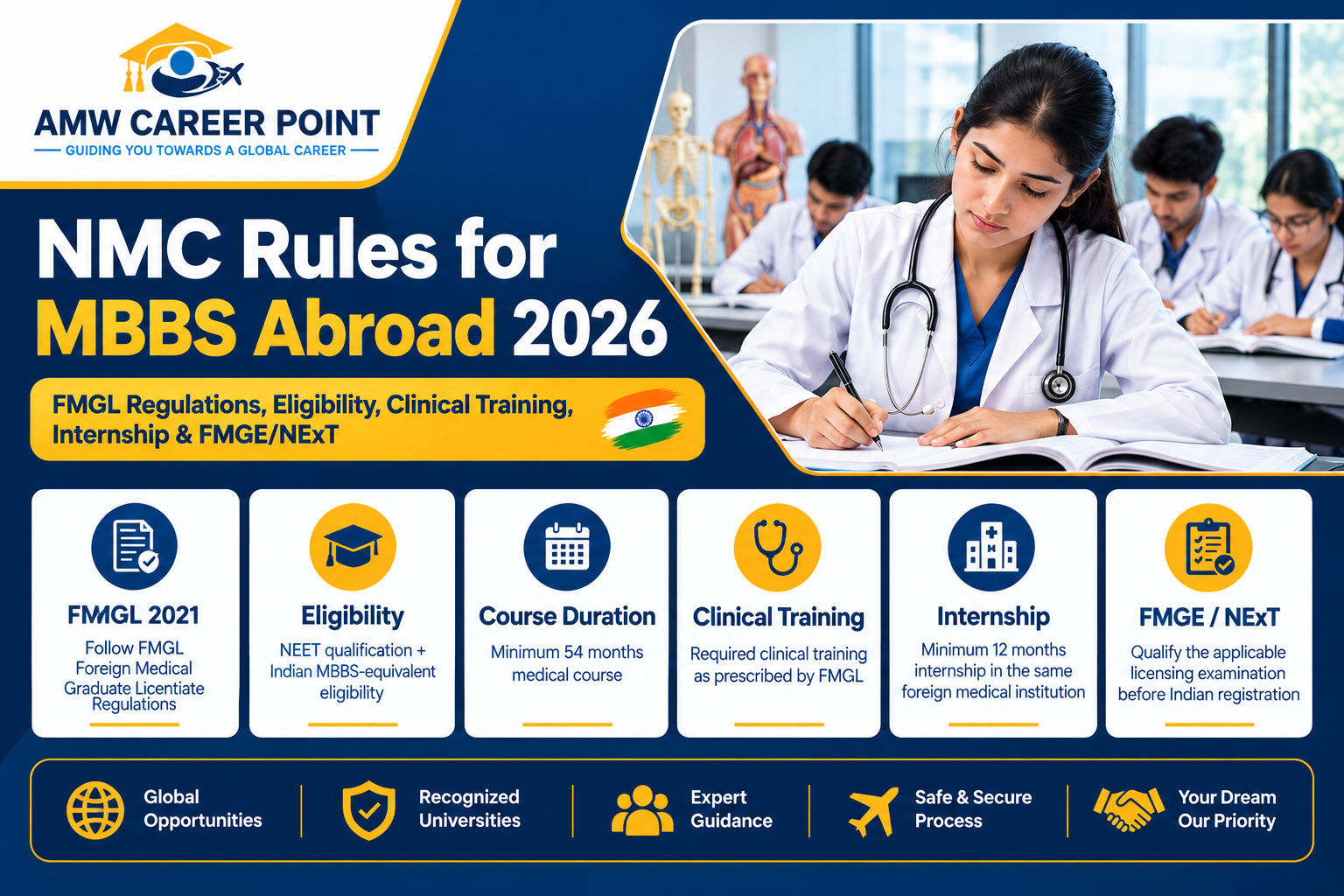
Course duration: Minimum 54 months (4.5 years) of academic study plus a compulsory 12-month internship at the same institution. Poland's standard 6-year (5+1) structure satisfies this when followed as designed.
NEET requirement: A qualifying NEET-UG score is mandatory before admission if you intend to return and practice in India.
Clinical training: Must involve genuine, hands-on hospital exposure. Polish public universities, with their teaching-hospital affiliations, generally satisfy this at the well-established institutions.
Internship: Must be completed at the same foreign institution; do not split the internship between Poland and India or a third country.
Medium of instruction: Must be English throughout; Polish universities teach theory and most clinical instruction in English, though compulsory Polish-language classes exist alongside for patient communication. This dual structure is generally accepted, but always verify the specific university's documentation states English as the medium of instruction.
Degree recognition: The MD/MBBS-equivalent degree must be recognized in Poland itself and listed on WDOMS.
WDOMS listing: Confirm your specific university's current listing directly at www.wdoms.org; listings can change.
Reality check: Verify each university individually rather than relying on "Poland is NMC-approved" claims from a consultant or website. The NMC's own guidance for students planning to study abroad is published at nmc.org.in — cross-check your shortlisted university's compliance there, and don't take any second-hand summary (including this one) as the final word.
Why Study MBBS in Poland?
European Union degree: Automatically recognized across all EU/EEA member states under the Bologna Process, in addition to NMC recognition for India.
English-taught programs: Genuinely English-medium instruction, not a marketing claim; theory, labs, and most clinical teaching happen in English.
Modern hospitals: Teaching hospitals affiliated with the major universities are equipped to EU clinical standards.
Practical learning: Structured clinical rotations from the third year onward, with simulation labs supplementing early hands-on training.
Research opportunities: Established universities run active research programs students can participate in alongside coursework.
Erasmus+ exchange opportunities: Some Polish medical universities allow eligible students to spend a semester at a partner EU university.
International faculty: Larger universities draw faculty and students from dozens of countries, not just Poland and India.
Safe cities: Most Polish university cities rank as low-crime by European standards; see the dedicated safety section below.
High quality of life: Reliable public transport, affordable daily costs relative to Western Europe, and a functioning public healthcare system.
Strong healthcare system: EU-standard hospital infrastructure gives students exposure to modern equipment and protocols.
Advantages and Disadvantages of Studying MBBS in Poland
Advantages
Genuine EU degree with Schengen-area mobility and Bologna Process recognition
Well-established, genuinely English-medium instruction, not a recent add-on
Strong clinical exposure at longer-established public universities
Growing, increasingly well-organised Indian student community
Legitimate part-time work rights during study, with no strict weekly hour cap
Multiple entrance-exam formats (written, oral, or grade-based) exist even if you don't test well under exam pressure
Disadvantages
Higher tuition than in Asian countries, typically 2–3x the cost of Russia, Kazakhstan, or Kyrgyzstan for a comparable clinical-training outcome
Entrance examinations required at most universities, unlike many CIS destinations with grade-based or no-exam admission
Cold winters, particularly October through March, across most university cities
Polish becomes genuinely necessary for clinical-year patient communication, despite English-medium teaching
Higher living expenses than Russia or Kazakhstan, especially in Warsaw
MBBS in Poland vs MBBS in India
Parameter | Poland | India |
Fees (6 years) | ₹60L – ₹95L (public universities) | ₹60L – ₹1.5Cr (private); ₹10L–₹25L (government, extremely limited seats) |
Seats | Structured intake, less oversubscribed than Indian NEET-UG competition | Extremely limited government seats; NEET cutoffs at record highs |
Infrastructure | EU-standard teaching hospitals at established universities | Excellent at top government colleges (AIIMS-tier); variable at private colleges |
Patient Exposure | Strong at established universities from year 3 onward | Very strong at top government colleges due to high patient volumes |
Degree Recognition | EU-wide + NMC (subject to FMGL 2021 compliance) | Automatic in India; requires separate steps for practice abroad |
Research | Active research programs at flagship universities | Strong at top-tier government institutes, more limited elsewhere |
Competition | Entrance exam-based, generally less brutal than NEET-UG cutoffs | NEET-UG cutoffs among the most competitive globally |
Global Opportunities | EU degree opens Europe-wide pathways alongside FMGE/NExT for India | Indian MBBS requires separate exams (USMLE/PLAB/AMC) for any international practice, same as MBBS abroad |
MBBS in Poland vs Other Popular Countries
Parameter | Poland | Hungary | Romania | Italy | |||
Total Cost (6 yrs) | ₹60–95L | ₹18–40L | ₹20–35L | ₹15–25L | ₹55–75L | ₹35–50L | ₹15–45L |
FMGE/NExT Track Record | Solid, growing | Established, variable | Among strongest | Moderate | Solid | Solid | Limited data |
English Medium | Strong | Theory only, mostly | Strong | Theory only, mostly | Strong | Strong | Strong |
Entrance Test | Yes, most universities | Rare | Rare | Rare | Yes, competitive | Rare | IMAT (mandatory) |
EU Degree | Yes | No | No | No | Yes | Yes | Yes |
Living Expenses | Moderate–high | Low | Low–moderate | Low | Moderate–high | Moderate | Low–moderate |
Clinical Exposure | Strong | Variable | Strong | Variable | Strong | Strong | Strong |
Eligibility Criteria for MBBS in Poland
Age: Generally 17–25 years at the time of application; some universities extend this check individually.
PCB Marks: Minimum 50% aggregate in Physics, Chemistry, and Biology at 10+2 (general category); requirements vary slightly by university.
NEET: A qualifying NEET-UG score is mandatory for Indian students intending to practice in India after graduation.
English Requirements: Many universities accept proof of English-medium prior schooling in place of IELTS/TOEFL; others require a minimum IELTS 6.0–6.5 or equivalent.
Passport: Valid Indian passport with at least 18 months' validity from the intended date of travel.
Medical Fitness: A general health certificate and standard vaccination/health screening as required by the specific university and Polish visa process.
Admission Process for MBBS in Poland
Step | Details |
1. University Selection | Shortlist based on budget, entrance-exam format, and verified NMC/FMGL compliance. |
2. Application | Submit the online application via the university's admission portal, typically opening February–March. |
3. Documentation | Submit 10th/12th marksheets, NEET scorecard, passport, and other required documents (see checklist below). |
4. Entrance Exam | Written or oral test in Biology plus Chemistry or Physics, or a grade-based evaluation depending on the university. |
5. Interview | Some universities conduct a brief motivational interview alongside or instead of a written exam. |
6. Offer Letter | Issued after successful review of documents and entrance-exam/interview performance. |
7. Tuition Deposit | An initial tuition payment or deposit is required to confirm your seat, generally within a specified window after the offer. |
8. Visa | Apply for the National Type D student visa with your offer letter and financial proof (see visa section below). |
9. Travel | Book travel after visa approval, allowing time for residence-permit registration on arrival. |
10. Arrival | Register your address, complete residence-permit formalities, and attend university orientation. |
Does Poland Require an Entrance Exam?
Yes, at most Polish public medical universities this is one of the biggest structural differences between Poland and CIS destinations like Russia, Georgia, or Kazakhstan, where admission is frequently grade-based with no formal test.
Biology test: Almost universally required; the core subject tested at every university offering MBBS in English.
Chemistry test: Commonly paired with Biology; some universities let you choose Chemistry or Physics as your second subject.
Online entrance tests: Increasingly common at several universities, including Poznań and the Medical University of Silesia, now run entrance exams or interviews online rather than requiring in-person attendance.
University interviews: A short oral component (sometimes combined with the subject test) assessing motivation and basic subject understanding. The Medical University of Łódź, for instance, runs an oral exam that is a combination of descriptive and multiple-choice questions.
Universities that waive exams: A high MCAT, BMAT, GAMSAT, or UKCAT score can substitute for the university's own entrance test at institutions like the Medical University of Warsaw. Some universities also admit purely on school-leaving grades converted to a points system (Warsaw uses a 300-point scale based on Biology and Chemistry/Physics/Maths grades).
Preparation strategy: Treat this as seriously as NEET preparation; revise NCERT-level Biology and Chemistry specifically for the format (written vs. oral) your target university uses, and request past-year sample questions directly from the admissions office.
Reality check: Many Polish universities require an entrance examination or interview for English-medium medicine, unlike most CIS destinations where admission is often grade-based alone. Don't assume your NEET qualification is sufficient on its own; confirm your target university's exact format before applying.
Top Medical Universities in Poland for Indian Students
Ten universities dominate the Indian-student pipeline into Poland. The four most established are profiled in depth below; the remaining six are summarised in the comparison table that follows.
Medical University of Warsaw
Established in 1809, MUW is Poland's most prestigious medical university and the most competitive on this list for Indian applicants. It's recognized by WHO, NMC, ECFMG, and WFME, and runs its own MUW Competency Test in Biology and Chemistry or accepts BMAT/MCAT/GAMSAT/UKCAT scores in place of it.
Factor | Detail |
Ranking | Poland's top-ranked medical university; strong European standing |
Tuition Fee | ≈ €15,100 per year (≈ ₹1.35L/month equivalent; ≈ ₹1.3Cr total across 6 years at current rates; verify with the university's current fee table) |
Hostel | €200–€300/month |
Duration | 6 years (5+1) |
Medium | English |
Intake | October (main); applications open February–March |
Scholarships | Rector's Scholarship for top academic performers from second year onward; limited merit awards |
NMC Status | FMGL 2021-compliant when course structure is followed as designed; verify current status directly |
Advantages
Highest global recognition among Polish medical universities
Largest, most established Indian student network in Poland
Multiple entrance-exam alternatives (own test or MCAT/BMAT/GAMSAT/UKCAT)
Extensive teaching-hospital network in the capital
Jagiellonian University Medical College
Founded in 1364, Jagiellonian is one of the oldest universities in Europe and consistently the highest-ranked Polish university overall (not just medicine). Its medical college in Kraków carries strong international prestige alongside genuine academic rigor.
Factor | Detail |
Ranking | Poland's highest-ranked university overall; historic international prestige |
Tuition Fee | ≈ $17,500 per year (≈ €16,000) |
Hostel | €180–€280/month |
Duration | 6 years (5+1) |
Medium | English |
Intake | October; applications typically open in the preceding winter |
Scholarships | Limited merit-based awards; Erasmus+ eligibility for qualifying students |
NMC Status | FMGL 2021-compliant when course structure is followed as designed — verify current status directly |
Advantages
Oldest and most prestigious university on this list
Kraków is a large, culturally rich student city with an established international community
Strong research infrastructure and international faculty exchange
Medical University of Lodz
One of the oldest and largest medical universities in Poland, Łódź has graduated MBBS-equivalent students from 62 different countries and maintains a large, mature international program with over 770 English-medium graduates to date.
Factor | Detail |
Ranking | Among Poland's largest and most internationally diverse medical universities |
Tuition Fee | ≈ $17,600 per year (64,800 PLN) |
Hostel | €150–€220/month (Medyków dormitories, walking distance from campus) |
Duration | 6 years (5+1) |
Medium | English |
Intake | October; entrance exam choice of 2 of 4 subjects (Biology, Chemistry, Mathematics, Physics) |
Scholarships | Limited merit-based reductions; standard EU exchange eligibility |
NMC Status | FMGL 2021-compliant when course structure is followed as designed; verify current status directly |
Advantages
Large, mature international student body genuinely diverse, not just Indian-heavy
Flexible entrance-exam subject choice (pick 2 of 4)
Long track record specifically with English-medium international cohorts
Medical University of Gdansk
Established in 1945, Gdańsk is the largest medical institution in Northern Poland, teaching over 5,000 students. It's known for modern infrastructure and strong research facilities, with comparatively lower tuition than Warsaw or Poznań.
Factor | Detail |
Ranking | Leading medical university in Northern Poland |
Tuition Fee | ≈ €10,400 per year, which is among the more affordable flagship options |
Hostel | €150–€250/month |
Duration | 6 years (5+1) |
Medium | English |
Intake | Applications open mid-March, close mid-July for the October intake |
Scholarships | Standard merit-based reductions; Erasmus+ eligible |
NMC Status | FMGL 2021-compliant when course structure is followed as designed; verify current status directly |
Advantages
Lower tuition than Warsaw or Jagiellonian for comparable clinical training quality
Modern campus with strong research facilities
Coastal city with a growing international student community
Other Notable Universities
University | Tuition/Year | City | Entrance Requirement | Key Highlight |
|
| Online oral entrance exam (Biology mandatory + Chemistry/Physics) | Strong research program, English-fluency requirements clearly defined | |
|
| Grade-based or entrance exam, university-dependent | Large international cohort, active alum network | |
|
| Entrance exam (Biology + Chemistry) | Five academic departments, established Pharmacy and Public Health programs alongside Medicine. | |
|
|
| Entrance exam, university-dependent | Smaller class sizes, coastal city |
|
| Entrance exam or grade-based, university-dependent | Lower cost of living than Warsaw/Kraków | |
|
|
|
|
Tuition Fees of Medical Universities in Poland 2026
University | Annual Tuition | Hostel/Month | Application Fee | Entrance Exam Fee | Approx. Total First-Year Cost |
€15,100 | €200–€300 | €100–€150 | Included/varies | ≈ €18,500–€19,500 | |
≈ €16,000 | €180–€280 | €100–€150 | Included/varies | ≈ €19,000–€20,000 | |
Medical University of Lodz | ≈ €16,300 | €150–€220 | €85–€150 | Included in application | ≈ €19,000–€20,000 |
€10,400 | €150–€250 | €85–€150 | Varies by year | ≈ €13,500–€14,500 | |
€14,000 | €150–€250 | €85–€150 | Online exam, low/no extra fee | ≈ €17,000–€18,000 | |
Medical University of Lublin | €12,000 | €150–€250 | €85–€150 | Varies by year | ≈ €15,000–€16,000 |
Wroclaw Medical University | €12,000–€14,000 | €150–€250 | €85–€150 | Varies by year | ≈ €15,500–€17,500 |
Figures are indicative 2026 ranges compiled from multiple current sources and vary by exact program and payment plan. Always request the university's official, current fee schedule in writing before making any payment.
Cost of Living in Poland for Indian Students
Expense | Monthly Estimate (€) |
Hostel/Accommodation | €150 – €300 |
Food | €150 – €250 |
Internet | €10 – €20 |
Local Transport | €15 – €30 (student discounts widely available) |
Mobile | €10 – €15 |
Health Insurance | €30 – €50 (mandatory for non-EU students) |
Books & Study Material | €20 – €40 |
Entertainment | €30 – €60 |
Miscellaneous | €30 – €50 |
Estimated monthly budget: €450 – €800, depending on city (Warsaw and Kraków highest; Lublin, Białystok, and Szczecin more affordable).
Estimated yearly budget (living costs only, excluding tuition): €5,400 – €9,600, broadly consistent with the EUR 6,000–9,000 range reported for Warsaw specifically and somewhat lower in smaller cities.
Scholarships for MBBS in Poland
University Scholarships: Most public universities offer a Rector's Scholarship or equivalent merit award for top-performing students; typically starting from the second year, full tuition waivers are rare, but partial reductions are realistic for strong performers.
NAWA Scholarships: The Polish National Agency for Academic Exchange (NAWA) administers various scholarship and exchange programs for international students; eligibility and available programs change annually. Check syrena.nawa.gov.pl for current offerings.
Erasmus+: Available to enrolled students for semester-long exchanges at partner EU universities; this supplements, rather than replaces, your core Polish degree and tuition.
Government Grants: Limited and primarily aimed at Polish-language program students rather than the English-medium international track most Indian students join.
Merit Scholarships: Awarded based on entrance-exam performance or first-year academic results at several universities.
Need-Based Scholarships: Less common and less generous than Italy's ISEE-based system; don't plan your Poland budget around securing need-based aid.
Reality check: Full tuition waivers in Poland are rare. Realistic financial planning means budgeting for full fees and treating any scholarship as a bonus reduction, not a given. This is different from Italy, where income-based fee assessment can be a core part of the cost model.
Student Visa for Poland
Required Documents
University offer/acceptance letter confirming full-time enrolment
Proof of tuition fee payment or deposit
Valid passport (minimum validity covering the intended stay)
Travel medical insurance covering at least €30,000 for the Schengen Area
Proof of accommodation (dormitory confirmation or rental agreement)
Financial proof with sufficient funds to support yourself (bank statements, education loan sanction letter, or sponsor documents)
Completed e-Konsulat online application form
Passport-size photographs meeting Schengen specifications
Processing Time
Standard processing is around 15 working days from complete document submission, extending to 30–60 days during the July–September peak season. Apply at least 3 months before your course start date.
Visa Fee
The Type D National Visa fee was revised to €200 (approximately ₹18,000–₹21,000) as of January 2026, plus a separate VFS Global service charge of roughly ₹1,800–₹2,000.
Financial Proof
You must demonstrate sufficient funds to support your stay, typically shown through six months of stamped bank statements, an education loan sanction letter, or sponsor financial documents, alongside proof of tuition payment.
Interview
Not always required for the student visa itself, but be prepared for a brief consular interview focused on your genuine intent to study and clear academic/financial planning.
Residence Permit After Arrival
For programs exceeding one year (which MBBS always is), you must apply for a Temporary Residence Permit before your Type D visa expires. This is processed locally in Poland after arrival and is a separate step from the visa itself.
Can Indian Students Work Part-Time in Poland?
Yes. Students holding a valid Type D student visa and Temporary Residence Permit can work in Poland without needing a separate work permit; your student status itself authorizes employment.
Legal work rights: No separate work permit required once you hold your residence permit; no strict weekly hour cap is imposed (unlike the UK's 20-hours/week rule), though you must maintain satisfactory academic progress for permit renewal.
Typical student jobs: IT support and BPO-centre roles (several multinationals including Capgemini, Infosys, and HCL have offices in Poland), English tutoring, hospitality, and translation work.
Hourly wages: Poland's minimum wage stood at PLN 28.10/hour (≈ ₹600/hour) as of January 2026.
Balancing work with medical studies: MBBS is not a part-time-friendly course load, especially from the clinical years onward; treat any part-time income as a supplement to your budget, not a funding pillar. Full-time work during summer/winter breaks is more realistic than regular term-time hours.
Clinical Training During MBBS in Poland
Teaching hospitals: Established universities (Warsaw, Jagiellonian, Łódź, Gdańsk) maintain affiliated teaching-hospital networks that give structured, supervised clinical exposure.
Patient interaction: Begins in a structured way from around the third year, increasing through to the compulsory internship year.
Simulations: Simulation labs supplement early clinical training before students move to live hospital rotations.
Research labs: Available at the larger universities for students interested in academic research alongside coursework.
Internship: The compulsory 12-month internship, completed at the same institution per FMGL 2021, forms the final year of the 6-year structure.
Do You Need to Learn Polish?
Is MBBS taught in English? Yes, theory, labs, and most structured clinical teaching are conducted in English. Polish universities are genuinely English-medium, unlike some CIS programs where this claim doesn't hold up in the clinical years.
When Polish becomes necessary: From roughly the third year onward, once you begin direct patient interaction, many patients in public hospitals, particularly older patients, do not speak English.
Patient communication: This is the core reason Polish matters. Taking a history or explaining a procedure to a patient who only speaks Polish requires functional conversational ability, even though your formal instruction remains in English.
Hospital training: Compulsory Polish-language classes are built into most curricula specifically to prepare you for this; it is not left to chance or self-study.
Suggested language level: Conversational (roughly A2–B1 level) by the start of clinical rotations is a realistic, achievable target if you take the compulsory classes seriously from year one.
Best ways to learn Polish: Attend and actually engage with your university's compulsory Polish classes, use language-exchange apps with Polish students on campus, and practice actively during any part-time work or daily errands rather than treating Polish as a checkbox requirement.
FMGE/NExT After MBBS in Poland
Returning to India to practice requires clearing the FMGE (Foreign Medical Graduate Examination) as of 2026; NExT has not yet replaced FMGE for foreign medical graduates. The NMC has confirmed this transition will happen eventually but has not set a confirmed date. FMGE remains the operative licensing exam.
Returning to India: After your MD/MBBS-equivalent degree and 12-month internship in Poland, you register your degree with the relevant State Medical Council and sit the FMGE.
Licensing pathway: Clear the FMGE (minimum 150/300, a fixed 50% cutoff with no category relaxation) → obtain permanent registration from your State Medical Council.
Internship requirements: Must be completed at your Polish university's affiliated institution, with a split internship risking disqualification.
NMC compliance: Confirm your specific university's course structure satisfies FMGL 2021 before you enroll, not after you've already invested years and fees.
Reality check: Recent NBEMS data shows FMGE pass rates have ranged roughly between 12% and 24% across recent sessions, regardless of source country. Poland's genuinely English-medium instruction and structured clinical exposure are real advantages going into FMGE prep. Still, no country or university can promise you a pass — treat any consultant's guaranteed pass-rate claim with real skepticism.
Career Opportunities After MBBS in Poland
Destination | Pathway |
Practice in India | FMGE (or NExT once implemented) → State Medical Council registration — the primary route for most graduates. |
Practice in Poland | Requires Polish medical chamber registration and functional Polish-language competency for full clinical practice. |
Other EU Countries | EU degree allows registration pathways across the EU/EEA, subject to each country's own language and regulatory requirements. |
United Kingdom | PLAB 1 and 2, then GMC registration with a separate, multi-step process regardless of EU degree status post-Brexit. |
United States | USMLE Steps 1, 2 CK, 2 CS (or current equivalent) plus ECFMG certification, followed by residency matching. |
Canada | MCCQE and NAC exams, plus IMG-specific licensing steps through the Medical Council of Canada. |
Australia | AMC exams or an approved alternative pathway, followed by AHPRA registration. |
Middle East (GCC countries) | DataFlow primary source verification plus the relevant country's licensing exam (e.g., Saudi SMLE, DHA exam). |
Every pathway beyond India requires its own separate licensing exam, and years of additional process; with a Polish MD, these doors keep opening in principle, but none of them are automatic.
Is MBBS in Poland Better Than Russia?
This is one of the most-searched comparisons among Indian MBBS-abroad applicants, and the honest answer depends entirely on what you're optimizing for:
Choose Poland if: You want a genuine EU degree, are comfortable with an entrance exam, and can afford roughly double to triple Russia's total cost for that EU-degree value and generally more consistent English-medium clinical instruction.
Choose Russia if: Your priority is the lowest total cost with an established, decades-long Indian graduate pipeline, and you're willing to build working Russian-language competence for your clinical years.
Neither is objectively "better"; Poland wins on EU degree value and English-medium consistency through clinical years; Russia wins on cost and the sheer scale of its existing Indian student and alumni network. Match the choice to your budget and long-term goals (India-only FMGE return vs. keeping European options open), not to which one ranks higher on a generic "best country" listicle.
Is Poland Safe for Indian Students?
Safety: Poland ranks as one of the safer countries in Europe by standard crime indices; university cities in particular have low violent-crime rates.
Racism: Isolated incidents have been reported by international students, as in most European countries, but they are not a widespread or systemic pattern reported by the established Indian student community; exercise ordinary awareness, particularly late at night in unfamiliar areas.
Public Transport: Extensive, reliable, and affordable, with student discounts widely available across buses, trams, and trains.
Student Cities: Warsaw, Kraków, Wrocław, and Gdańsk all host large international student populations with established support networks.
Healthcare: EU-standard public healthcare system; mandatory student health insurance covers most routine needs.
Weather: Cold winters (often below 0°C, December–February) and mild summers, which are genuinely different from most of India and worth preparing for, both practically and mentally.
Emergency Numbers: 112 is the general EU emergency number, functional throughout Poland for police, medical, and fire services.
Common Challenges Faced by Indian Students
Weather: The adjustment to genuinely cold, dark winters is real; plan for proper winter clothing from year one, not as an afterthought.
Food: Indian grocery availability has improved in larger cities but remains limited in smaller university towns; many students learn to cook early.
Language: Even with English-medium instruction, daily life (grocery shopping, local bureaucracy, hospital rotations) requires functional Polish sooner than most students expect.
Homesickness: A genuine, common adjustment challenge for a 6-year program far from home; building community with other international students early helps.
Entrance exams: The Biology/Chemistry entrance test adds a layer of preparation most CIS-bound students don't face; budget real prep time before applying.
Cost management: Higher living costs than CIS destinations mean tighter monthly budgeting is genuinely necessary, particularly in Warsaw.
MBBS Intake Timeline in Poland (2026)
Period | Milestone |
February – March 2026 | Applications open at most universities for the October 2026 intake |
March – June 2026 | Entrance exams and interviews conducted (format varies by university) |
May – July 2026 | Admission/offer letters issued on a rolling basis |
June – August 2026 | Tuition deposit payment and visa application |
July – September 2026 | Type D visa processing (extends to 30–60 days in peak season) |
Late September 2026 | Travel and arrival in Poland |
Early October 2026 | University orientation |
October 1, 2026 | Classes begin (academic year 2026/2027) |
Documents Required for Admission
Valid passport (minimum 18 months' validity from travel date)
10th and 12th marksheets (apostilled/attested as required)
NEET-UG scorecard (qualifying status)
Birth certificate (in English or officially translated)
Medical fitness certificate
Police clearance certificate (where required by the specific university or visa process)
Passport-size photographs (per Schengen specifications)
English proficiency documents (IELTS/TOEFL or proof of English-medium schooling, where required)
NAWA recognition certificate, which is required if your school-leaving certificate isn't from an EU/EEA country or a country with an existing recognition agreement with Poland
Mistakes Students Should Avoid Before Choosing Poland
Selecting a university without verifying NMC eligibility: Confirm FMGL 2021 compliance for your specific course, not just "Poland is EU-recognised."
Ignoring entrance exam requirements: Assuming NEET qualification alone is enough; most Polish universities require their own separate test.
Underestimating total living costs: Warsaw and Kraków run meaningfully higher than the country-wide averages quoted in generic brochures.
Assuming English alone is enough for clinical years: Compulsory Polish classes exist for a real reason; patient interaction genuinely requires it.
Not checking internship structure: Confirm your internship is completed at the same institution, satisfying FMGL 2021's same-institution requirement.
Frequently Asked Questions
Q: Is MBBS in Poland valid in India?
A: Yes, provided your specific university and course satisfy the FMGL Regulations, 2021, and you clear the FMGE (or NExT, once implemented) and obtain State Medical Council registration.
Q: Is Poland expensive for MBBS compared to other countries?
A: It's more expensive than CIS destinations (Russia, Georgia, Kazakhstan) but meaningfully cheaper than the UK, USA, or Australia. Expect ₹60–95 lakh total for 6 years at most public universities.
Q: Is IELTS compulsory for MBBS in Poland?
A: Not always; many universities accept proof of English-medium prior schooling instead. Check your specific university's requirement; some do mandate IELTS 6.0–6.5 or an equivalent.
Q: Can I get PR (permanent residency) after MBBS in Poland?
A: There's a pathway: after completing your degree, you can apply for a temporary residence permit tied to further study or employment, which can eventually lead toward longer-term residency, subject to Polish immigration rules current at the time.
Q: Can I work during my MBBS studies in Poland?
A: Yes. Students with a valid Type D visa and Temporary Residence Permit can work without a separate work permit. However, MBBS's course load makes regular part-time work genuinely difficult from the clinical years onward.
Q: What is the salary after MBBS in Poland?
A: This depends entirely on where you end up practicing and under which system (India via FMGE, Poland/EU, or elsewhere). There's no single "Poland MBBS salary" figure, since your registration country determines your pay scale, not your degree's country of origin.
Q: Is Poland safer than Russia?
A: Both are generally safe for international students who exercise ordinary precautions. Poland's EU-standard safety indices and established Schengen-area infrastructure give it a slight edge on standardized safety metrics; Russia's Indian student community is larger and more established. Neither presents a significant, documented safety concern for genuine students.
Q: Is NEET compulsory for MBBS in Poland?
A: Yes, if you intend to practice in India after graduation, NEET-UG qualification is mandatory under NMC rules regardless of destination country.
Q: Is Polish language compulsory during MBBS?
A: Yes, as part of the curriculum, compulsory Polish-language classes are built into most programs specifically to prepare you for clinical-year patient interaction, even though formal teaching remains in English.
Q: Which is the best medical university in Poland?
A: There's no single "best" Warsaw, and Jagiellonian carries the strongest international prestige; Gdańsk and Lublin offer strong value at lower tuition; your right choice depends on budget, entrance-exam comfort, and city preference.
Q: What is the total cost of MBBS in Poland?
A: Typically, ₹60–95 lakh across 6 years, including tuition, hostel, and living costs. See the Tuition Fees and Cost of Living sections above for a university-wise and monthly breakdown.
Q: Does Poland require an entrance exam for MBBS?
A: Yes, at most public universities, typically Biology plus Chemistry or Physics, in written or oral format, though some universities admit purely on school-leaving grades.
Q: How long does the Polish student visa take to process?
A: Standard processing is around 15 working days, extending to 30–60 days during the July–September peak season. Apply at least 3 months ahead of your intended travel date.
Q: Can I study MBBS in Poland without IELTS?
A: Often yes; many universities accept proof of prior English-medium schooling instead of IELTS. This varies by university, so confirm directly before assuming you're exempt.
Q: Are Polish medical degrees recognized in the UK, USA, or Canada?
A: The EU degree itself is recognized as a valid medical qualification, but practicing in the UK, USA, or Canada always requires clearing that country's own licensing exam (PLAB, USMLE, or MCCQE/NAC, respectively) regardless of which country your MBBS/MD is from.