If you typed "common admission test for MBBS abroad" into a search engine and landed on pages about IIM percentiles and CAT mock tests, you are not alone. The phrase is so strongly associated with India's MBA entrance exam that it pulls nearly every search in that direction. But you are not here to join a business school. You want to know whether foreign medical universities require a separate entrance exam on top of your NEET-UG score, and if so, what kind.
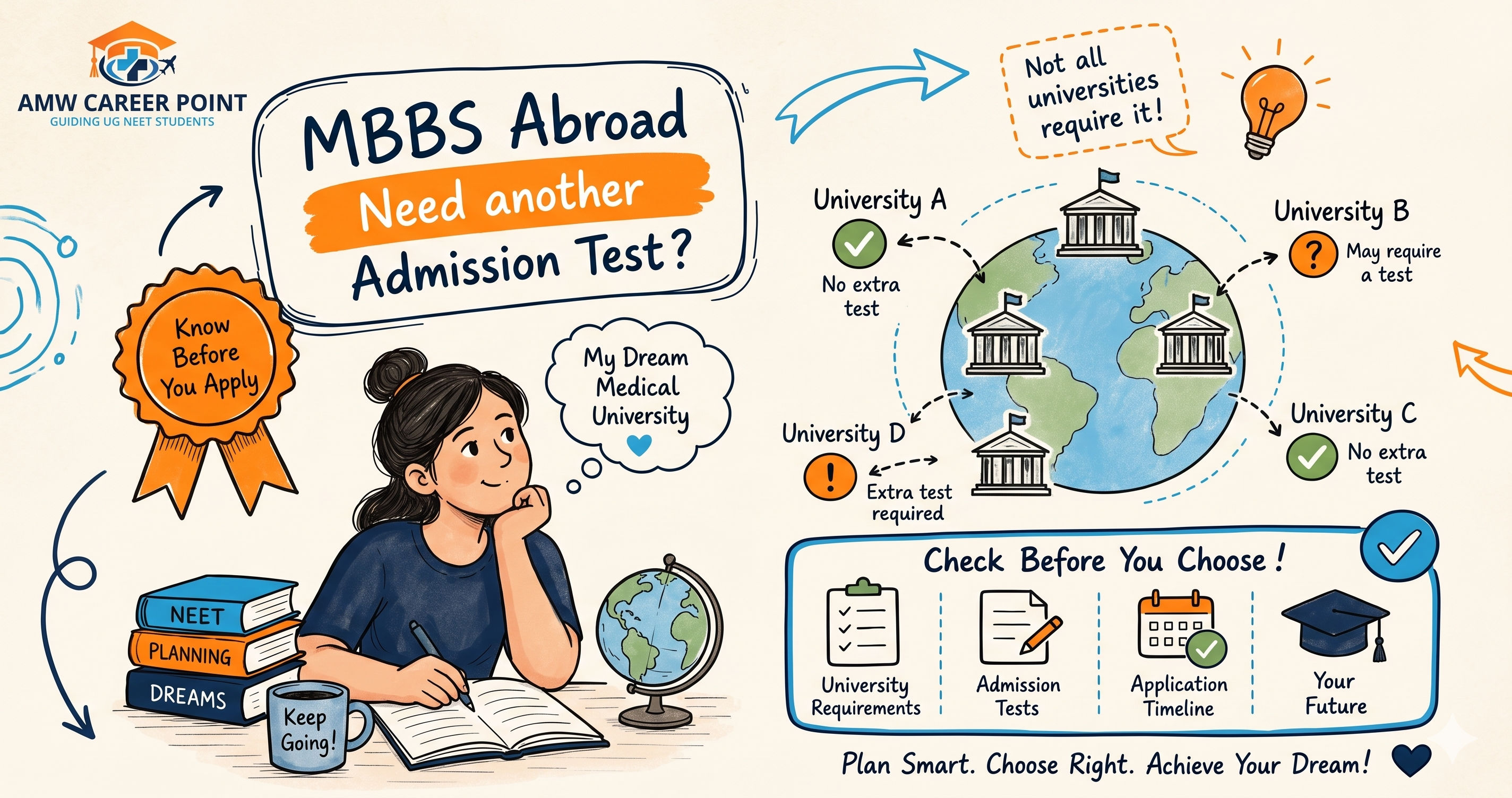
The short answer: for most foreign medical destinations, your NEET scorecard is the primary eligibility credential. The longer answer is that "most" is doing real work in that sentence. A handful of universities and a few country-level systems do require something extra, and the types of assessments vary enough that blanket reassurance can leave you unprepared.
This article gives you a clear map of what actually exists, what NMC rules mandate, and how to verify requirements before you commit to a programme. At AMW Career Point, our team is founded by Foreign Medical Graduates who have navigated this system firsthand, and we have guided students through it since 2009.
What "Common Admission Test" Actually Means in an MBBS Abroad Context
In India, "Common Admission Test" refers specifically to the CAT exam conducted by the IIMs for admission to MBA and management programmes. That exam is entirely unrelated to medical education and has no role whatsoever in MBBS admissions, whether in India or abroad. If you are a NEET-qualified student, CAT is simply not on your checklist.
So when does the phrase appear in a medical context? Occasionally, a university brochure or an agent's marketing material will use "common admission test" or "common entrance test" to describe an internal screening tool the university runs before accepting international students. These are university-specific instruments, not a standardised national exam comparable to NEET.
The terminology is informal and inconsistent: one university may call it an aptitude screen, another calls it an entrance test, and a third conducts an interview and labels it a selection process. None of these are the IIM's CAT, and none of them are unified across all foreign medical universities.
Why the Confusion Costs Students Real Time
The danger is not just wasted search time. Students should be cautious of any agent who claims exclusive access to a hidden or mysterious examination system, using that complexity as a reason why you cannot navigate the process without them.
Understanding that no single common entrance exam exists for MBBS abroad removes that leverage entirely. Your admission credentials start with NEET-UG, and from there the picture becomes university-specific and country-specific.
Common Admission Test Requirements: Does NEET Alone Get You Admitted?
For the majority of popular destinations such as Russia, Uzbekistan, Kazakhstan, Kyrgyzstan, Georgia, and Vietnam, a valid NEET score is the core eligibility proof Indian students must present. Generally, admission is document-based (NEET scorecard and academic transcripts) and may include an interview or university-specific screening.
However, some institutions do run entrance or language assessments of their own, so it is always worth checking the specific requirements of each university rather than assuming a blanket policy applies.
Exceptions exist, and they matter. I.M. Sechenov First Moscow State Medical University in Russia is reported to require a Russian-language entrance examination, including for its English-taught General Medicine track. Some other Russian state universities conduct university-specific aptitude or English screening tests. Russia does not operate a single uniform additional exam policy, which means requirements differ from institution to institution, even within the same country.
Country-Level Exams in Other Destinations
Beyond the popular MBBS-abroad destinations for Indian students, other countries operate genuinely national admission tests:
Italy's IMAT is a nationally coordinated entrance exam required for international applicants seeking places in English-taught public medical programmes.
The UCAT is required by many undergraduate medicine programmes in the United Kingdom.
Australia and New Zealand use the UCAT ANZ for participating institutions.
The Philippines has its own NMAT for medical programme applicants.
These are meaningfully different from informal university screens: they are government-administered, competitive, and non-negotiable for the programmes that require them.
For Indian students targeting Russia, Kazakhstan, Kyrgyzstan, and Uzbekistan specifically, the available information indicates that no standardised national entrance exam beyond NEET is universally required, though individual universities may conduct interviews or internal assessments. Georgia operates its own unified national examinations, and any student considering a Georgian institution should verify current requirements directly with the country's official educational authority.
Three Types of Assessments NEET Students Actually Encounter Abroad
1. University-Specific Aptitude or Subject Tests
Some universities run their own internal test covering biology, chemistry, and sometimes physics at secondary-school level. These are not standardised national exams and are not administered by any government body. Difficulty varies widely; many resemble a brief knowledge confirmation rather than a competitive filter. The questions that matter are whether passing or failing the test affects your admission standing, and whether the university provides written documentation of the process before you pay any fees.
2. Country-Level Medical Screening Exams
A handful of countries require all entrants to medical programmes, including international applicants, to pass a national screening examination. These carry substantially more weight than university-run tests because they are government-mandated. Because these requirements can change year to year, verifying the current policy directly with the country's official educational authority is essential.
Destination | Primary Admission Basis | Additional Test Required? | Language Requirement |
Russia | NEET Score + Class 12 PCB | Rare (University-specific basic test) | English (Basic Russian taught for clinicals) |
Uzbekistan | NEET Score + Class 12 PCB | Internal screening / interview | English (Basic Uzbek/Russian for clinicals) |
Kazakhstan | NEET Score + Class 12 PCB | Basic science screening | English (Basic Kazakh/Russian for clinicals) |
Italy | IMAT Examination | Yes (IMAT mandatory) | English |
Nepal | NEET Score or MECEE-BL | Yes (MECEE or NEET matching) | English |
Philippines | Class 12 + BS-MD pathway | Yes (NMAT before MD stage) | English |
3. Language Proficiency Tests: English and Local Language
Many foreign medical universities that market English-medium programmes are located in non-English-speaking countries. Some universities accept a Medium of Instruction certificate from an Indian school as proof that a student studied in English, making IELTS or TOEFL unnecessary. Others require an internal English placement test.
Separately, clinical rotations regularly involve local-language interaction with patients, even when classroom instruction is in English. A handful of programmes require students to demonstrate basic local-language readiness before entering clinical years. This is the category that most commonly catches students off guard.
Why NMC Compliance Must Be Your Primary Filter Before Anything Else
Before you concern yourself with what admission test a university uses, confirm that the university and its admission pathway are fully compliant with National Medical Commission rules. A strong NEET score and a passed university screening test are worthless if your degree will not be recognised in India when you return to sit the Foreign Medical Graduates Examination (FMGE) or National Exit Test (NExT).
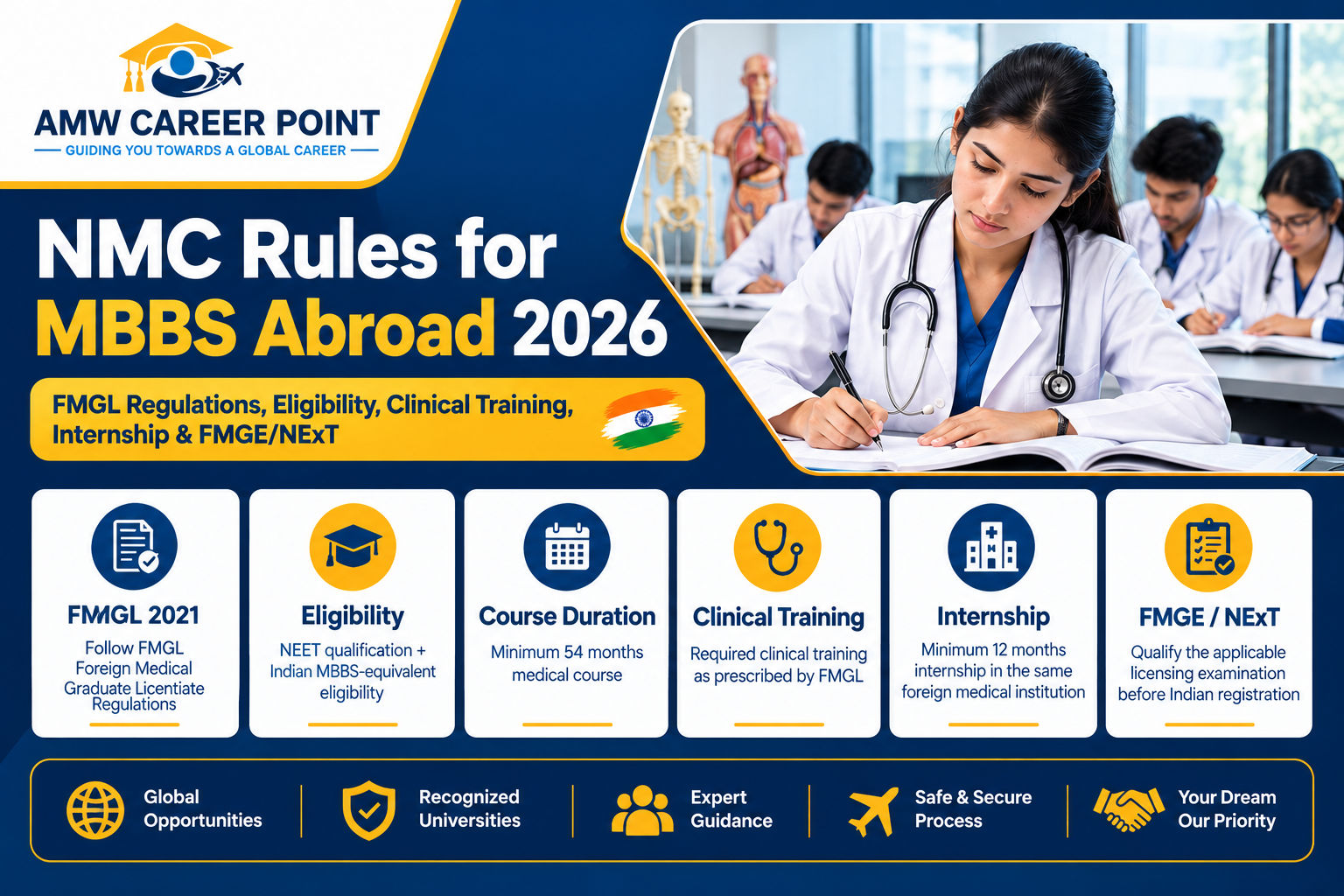
The NMC sets out several non-negotiable requirements under the FMGL Regulations 2021:
NEET-UG Qualification: Mandatory for Indian citizens and eligible OCI cardholders seeking a primary medical qualification abroad.
Course Duration: Minimum 54 months (4.5 years) of academic instruction followed by a separate 12-month clinical internship at the same institution.
Medium of Instruction: The entire course must be delivered strictly in English.
Practice Licensing: The degree must confer eligibility to practice medicine in the host country with equal rights as domestic citizens.
No Transfers: Credit transfers and split-campus dual degrees are strictly barred.
Red Flags That Suggest a Testing Requirement is Non-Compliant
"NEET Exemption": An agent who suggests that a low NEET score can be "offset" by passing a university's own test is misleading you: no university-administered exam replaces the NMC's NEET requirement.
Unclear Recognition: Any institution that fails to grant licensing rights in its home country offers no pathway to Indian practice registration.
Hidden Exam Fees: Any test that charges a disproportionate fee under the label of "entrance processing" deserves serious scrutiny.
Split Campuses: Any arrangement involving completing part of your degree at one institution and clinical training at a separate, unaffiliated site creates severe eligibility violations under NMC rules.
How to Confirm Your University's Requirements Before You Commit
The verification process is straightforward: start with the official NMC gazette and ensure the program structure matches the FMGL 2021 mandate. Then visit the university's official admissions page directly (not an agent's summary) to confirm testing, medium of teaching, and licensing policies in writing.
The Pre-Application Checklist
[ ] The programme structure completely satisfies NMC FMGL 2021 criteria.
[ ] You hold a valid NEET-UG qualifying score obtained before seeking admission.
[ ] The curriculum covers at least 54 months of studies plus a 12-month internship.
[ ] Instruction is delivered in English, with transparent local language training for hospital rounds.
[ ] Any university test or interview details have been provided in writing.
[ ] The degree confers full clinical practice rights in the host country.
[ ] All fee structures (tuition, hostel, visa) are confirmed via official university invoices.
Unsure if your target university requires a separate test?Speak directly with our Foreign Medical Graduate counsellors for an institutional verification of your eligibility and entrance criteria.
The Bottom Line
"Common admission test" in an MBBS abroad context is not the IIM's CAT, is not standardised across countries, and is not universally required. Your NEET-UG score is your primary credential.
The reliable approach is to verify each university's curriculum against the NMC FMGL guidelines, collect confirmation in writing, and work with an adviser whose recommendations are transparent. Verify your chosen university today and contact our counsellors at AMW Career Point to begin your evaluation with guidance from Foreign Medical Graduates who have been through it themselves.