In FMGE 2024, Georgia ranked number 1 globally with a 35.65% pass rate. 4,221 Georgian medical graduates appeared for the exam, out of which 1,505 passed. Moreover, the global average in 2024 was 25.80%. This shows that Georgia outperformed every other major MBBS abroad country. That is the single most important number about MBBS in Georgia, especially in 2026.
Then again, there is the 2026 policy change that sent thousands of Indian families into panic mode when the Georgian government announced that state-funded universities, including Tbilisi State Medical University (TSMU), would not admit new international students from the 2026–27 academic year. The families who had been researching TSMU for months felt the ground shift under them.
Here is what most advisors did not tell families: Georgian American University (GAU) posted an FMGE 2024 score of 80.33%. BAU International University posted 63.29%. Georgian National University SEU posted 60.39%. All three of them are private universities. The policy change did not close Georgia's doors to Indian students. It redirected them toward institutions that were already delivering better FMGE outcomes.
This blog help you understand the complete picture: what the state university ban actually means, real FMGE university-wise data, the honest fee breakdown (Georgia is not a ₹25 lakh destination, the real range is ₹35–65 Lakhs), the top 10 private universities, the new 2026 immigration requirements nobody is talking about, and the full admission process for September to October intake 2026.
FMGE 2024 Data for universities in Georgia 35.65% national average (ranked #1 globally). GAU: 80.33%. BAU: 63.29%. SEU: 60.39%. Caucasus University. 55.10%. Global FMGE average 2024: 25.80%. Georgia outperforms every Central Asian MBBS destination on this metric.
Key Decision Factors for Indian Students |
1. FMGE Outcomes: Georgia is the best FMGE-performing country globally in 2024 at 35.65% above Kazakhstan, Kyrgyzstan, Russia, and the Philippines. GAU posts 80.33%, BAU 63.29%, SEU 60.39%. Measurably better FMGE outcomes justify the cost premium over Central Asia. |
2. State University Ban: 2026: Georgian state universities (TSMU, TSU, Akaki Tsereteli, Batumi Shota Rustaveli) stopped admitting new international students from 2026–27. Existing students are unaffected. New applicants must choose from Georgia's private university ecosystem, which, as the FMGE data shows, already delivers better outcomes. |
3. Cost: Georgia is more expensive than Central Asian MBBS destinations. Annual tuition can range from USD 4,000–6,500 (₹3.88–6.31 lakh/year). The real total 6-year cost for MBBS in Georgia is around ₹35–65 Lakhs, depending on the university and lifestyle. Higher than Kazakhstan or Kyrgyzstan, but the FMGE results speak for themself for the right student profile. |
4. Admission: No donation. No capitation fees. No entrance exam beyond NEET. Applications open for September–October 2026 and February 2027 intakes. New 2026 immigration requirements: mandatory health insurance (30,000 GEL minimum) and updated D1 visa documentation. |
5. Location: Tbilisi is one of the most liveable student cities in the Caucasus. Rated the 7th safest country globally. Cold winters (0 to −8°C in Tbilisi) but significantly milder than Bishkek or Almaty. Georgian cuisine, culture, and student infrastructure are well-developed. Indian food, mess facilities, and student networks are established near all major private university campuses. |
What Is MBBS in Georgia? The Overview for Indian Students
MBBS in Georgia is a 6-year programme (5 academic years plus 1 mandatory internship) at NMC-approved private medical universities. The programme follows the NMC FMGL Gazette 2021 structure and leads to a Doctor of Medicine (MD) degree recognised for NExT eligibility in India and USMLE/PLAB eligibility internationally.
Georgia became a serious MBBS abroad destination for Indian students from the mid-2010s. What makes it different from other Central Asian countries is not just the fees, but the quality of clinical training, a European education framework (ECTS credit system), genuinely English-medium instruction throughout, and way better FMGE outcomes. The price premium is real. So are the FMGE outcomes.
Tbilisi, the capital, is where most medical universities are located and where the largest Indian student community in Georgia lives. Batumi, on the Black Sea coast, has fewer options but a warmer, coastal environment. After the 2026 state university ban, nearly all new Indian MBBS enrollments in Georgia will be at Tbilisi-based private universities.
Georgia MBBS in a Glance 2026
Particulars | Details |
Country | Georgia (Caucasus region, which is between Eastern Europe and Western Asia) |
Main MBBS Cities | Tbilisi (primary), Batumi (secondary) |
Course Offered | Doctor of Medicine (MD) MBBS Equivalent |
Course Duration | 6 Years with 5 academic years + 1 mandatory internship at same university |
Medium of Instruction | English (100%) at all recommended private universities |
NEET Requirement | Mandatory for Indian students with 150+ per NMC norms; 300+ recommended |
Total 6-Year All-In Cost (at ₹97/USD) | ₹35–65 Lakhs, depending on university and lifestyle |
FMGE 2024 Georgia National Average | 35.65% (4,221 appeared, 1,505 passed) #1 globally |
FMGE 2024 GAU (Best) | 80.33% (68 candidates) |
FMGE 2024 BAU | 63.29% |
FMGE 2024 SEU (Georgian National University) | 60.39% |
FMGE 2024 Caucasus University | 55.10% |
State University Ban | Effective 2026–27: TSMU, TSU, Akaki Tsereteli, Batumi Shota Rustaveli closed for new international admissions. |
NMC & WHO Status | Yes, all recommended private universities are NMC-, WHO-, and WDOMS-compliant. |
Intake Period | September–October (primary); February (secondary) |
Delhi to Tbilisi Flight | Approximately 6–8 hours via Dubai, Istanbul, or Kyiv (no direct flight) |
Understand The 2026 Georgia State University Ban
What happened: Georgia's Minister of Education, Givi Mikanadze, announced that state-funded universities will stop admitting foreign students starting with the 2026–27 academic year, as part of a "Citizen-First" education reform. The government wants to concentrate public funding on Georgian citizens and align state universities with the national labour market.
Universities Closed for New International Admissions from 2026
University | Type | Status for New 2026 Admissions | Existing Students |
State | Closed for new international admissions | Unaffected with a complete degree | |
State | Closed for new international admissions | Not Affected | |
State | Closed for new international admissions | Not Affected | |
State | Closed for new international admissions | Not Affected | |
All Private Universities (GAU, BAU, SEU, Caucasus, DTMU, New Vision, GRUNI, etc.) | Private | OPEN for new international admissions 2026 | Not Affected |
The truth about this change: Three of the top four FMGE performers in Georgia, GAU (80.33%), BAU (63.29%), and SEU (60.39%), are private universities. The state university ban did not close Georgia to Indian students. It redirected them toward universities already delivering better FMGE outcomes. Most Indian families who were planning to attend TSMU are actually in a stronger position after being redirected to GAU or BAU.
What if you are already enrolled at TSMU or Batumi Shota Rustaveli?
Nothing changes. Continue your degree as planned. Your enrollment, fee structure, degree validity, NMC compliance status, and NExT eligibility are completely unchanged. The policy applies to new admissions only.
Is the MBBS in Georgia NMC-approved?
At the private university level, all recommended Georgian institutions on this list are NMC-, WHO-, and WDOMS-compliant. Georgia has not faced the pattern of NMC advisories that Uzbekistan has. The compliance record for Georgian private universities has been consistent.
That said, NMC compliance is not a fixed certificate. Verify at the time of admission and again at graduation. Programme-level verification matters specifically the internship structure and English-medium documentation.
NMC Compliance Checklist for Georgian Private Universities
WDOMS Listing: Verify the university is listed at wdoms.org under the specific programme you are enrolling in. This is a prerequisite for NExT eligibility.
100% English Medium Throughout: All lectures, practicals, labs, and examinations must be in English for all 6 years. Georgian private universities recommended here maintain this standard. Verify this in writing in the admission letter.
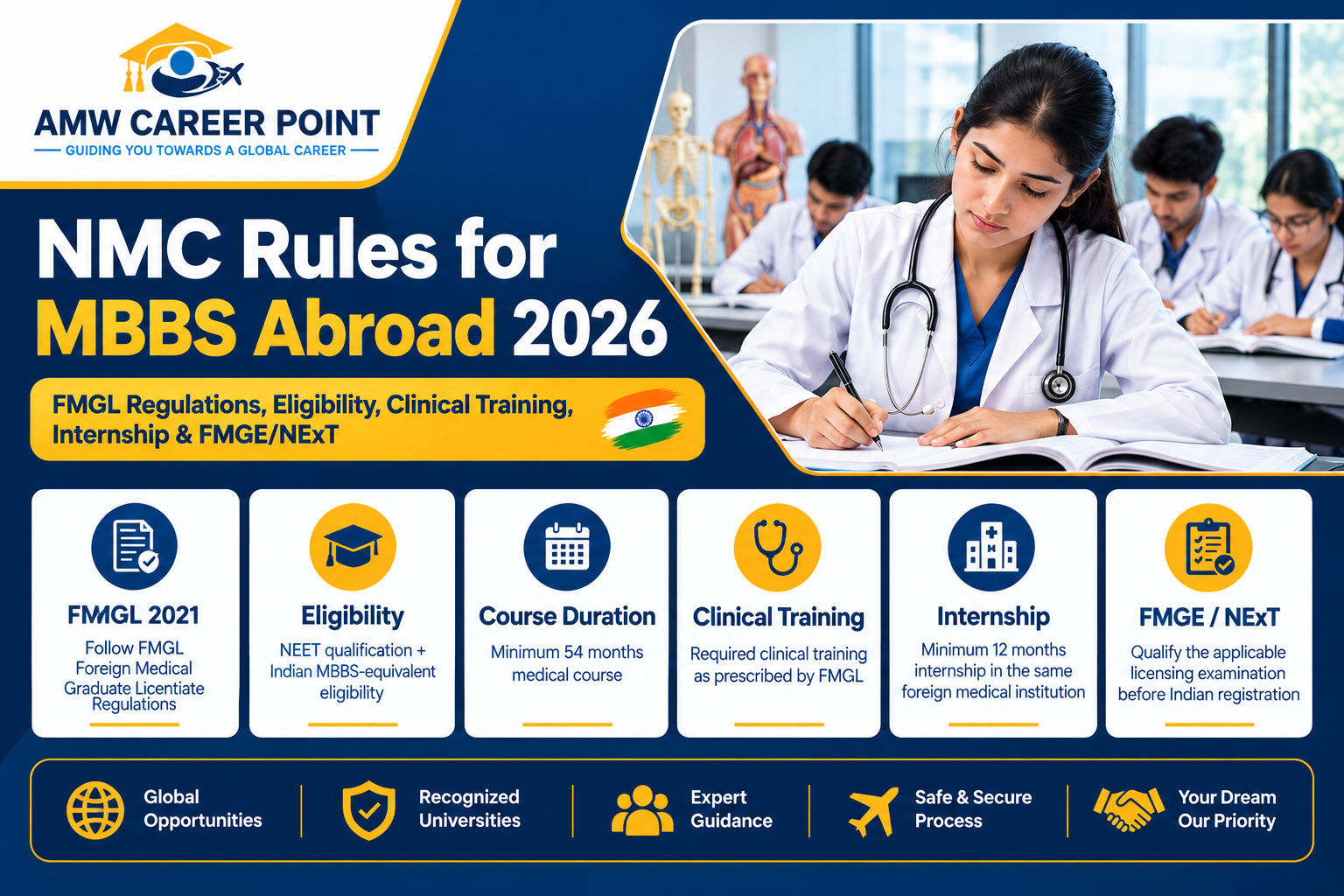
Course Duration of 54 Months Academic + 12-Month Internship: The 6-year structure (5 academic + 1 internship year) satisfies the 54-month academic minimum. Programmes shorter than this do not meet NMC requirements.
Internship at the Same University in Georgia: The mandatory 12-month internship must be completed at the same university in Georgia, not at an Indian hospital, and not transferred. Confirm this in writing before enrolling.
NEET Qualification: Valid NEET UG score mandatory. Within 3 years of the qualifying year. Minimum 150 marks (General category) for MBBS abroad eligibility per NMC norms.
Local Licensure Eligibility: Graduates must be eligible to register and practise medicine in Georgia upon completion. Confirm with the university.
FMGE 2024 Georgia Global Ranking
Georgia's 35.65% national FMGE average in 2024 makes it the top-performing country globally, which is above Nepal (26–30%), the Philippines (26–28%), and Kazakhstan (40–50% for Almaty universities only). The honest framing: Georgia as a country is more consistent than Kyrgyzstan or Uzbekistan. The gap between Georgia's best and worst universities is narrower than the Bukhara vs Samarkand or KRSU vs Jalal-Abad gaps.
But university choice still matters. GAU at 80.33% and SEU at 60.39% are not the same as the experience at a newer private university in the 28–35% range. The 45-point gap between Georgia's best and the lower performers is still better than in Central Asia.
FMGE 2024 Result of Georgia Universities
University | Type | FMGE 2024 Pass % | Candidates (approx.) | Interpretation |
Private | 80.33% | 68 | Outstanding. Meaningful sample. Over 3× global average. Consistent across 2022–2024. | |
Private | 63.29% | Not fully reported | Excellent. Strong and improving. Top-3 in Georgia. | |
Private | 60.39% | Not fully reported | Excellent. 5,300-bed hospital affiliation. Strong clinical base. | |
Private | 55.10% | Not fully reported | Very strong. Consistently outperforms the national average. | |
Private | ~40–50% est. | Established | Strong and consistent. One of the oldest private medical universities in Georgia. | |
Private | ~35–40% est. | Established | Improving trend. FMGE-integrated curriculum. Affordable fees. | |
Private | ~30–38% est. | Growing | Strong clinical focus. Research emphasis. Improving outcomes. | |
Private | ~30–36% est. | Established | Stable outcomes. More affordable fees. Reasonable option. | |
Private | ~28–35% est. | Established | Established private institution. Modest fees. Consistent outcomes. | |
Private | ~25–35% est. | Newer | Newer institution. Growing. Outcomes developing. |
FMGE 2024 university-wise data:
GAU (80.33%)
BAU (63.29%)
SEU (60.39%),
Caucasus University (55.10%)
NBEMS compilation: DTMU, GRUNI, New Vision, European University, and Alte estimates are trend-based. National average 35.65% (4,221 appeared, 1,505 passed) from NBEMS 2024 official data. Always verify against the latest NBEMS FMGE report.
Top Private Medical Universities in Georgia for Indian Students 2026 Detailed Comparison
With state universities closed to new international admissions, every Indian student in 2026 is choosing from Georgia's private university ecosystem. Here is an honest comparison of fees at ₹97/USD, FMGE data, infrastructure, and a direct recommendation for each university.
University | Annual Tuition (USD) | Annual Tuition (₹97/USD) | FMGE 2024 | Batch Size | Hospital Infrastructure | Best For | ||||
Georgian American University (GAU) | USD 6,000 | ₹5.82 lakh/yr | 80.33% (68 candidates) | Small — ~60–80/yr | Own simulation centre + affiliated hospitals | FMGE-first students | ||||
BAU International University | USD 5,500–6,500 | ₹5.34–6.31 lakh/yr | 63.29% | Moderate | Strong hospital network in Tbilisi | Premium FMGE | ||||
Georgian National University SEU | USD 5,000–6,000 | ₹4.85–5.82 lakh/yr | 60.39% | Large with 4,000 intl. students | 5,300-bed affiliated hospital | Largest international | ||||
Caucasus University | USD 4,500–5,500 | ₹4.37–5.34 lakh/yr | 55.10% | Moderate | Own hospital + affiliates | Strong FMGE at | ||||
David Tvildiani Medical University (DTMU) | USD 6,000–7,000 | ₹5.82–6.79 lakh/yr | ~40–50% | Moderate | Our teaching hospital is one of the best in Georgia | Premium clinical | ||||
Grigol Robakidze University (GRUNI) | USD 4,500–5,000 | ₹4.37–4.85 lakh/yr | ~35–40% | Moderate | Affiliated hospitals in Tbilisi | FMGE-integrated | ||||
New Vision University | USD 4,500–5,500 | ₹4.37–5.34 lakh/yr | ~30–38% | Moderate | Research hospital affiliation | Research-oriented. | ||||
European University Georgia | USD 4,000–5,000 | ₹3.88–4.85 lakh/yr | ~30–36% | Moderate | Affiliated hospitals | Most affordable | ||||
Petre Shotadze Tbilisi Medical Academy | USD 4,500–5,500 | ₹4.37–5.34 lakh/yr | ~28–35% | Moderate | Affiliated hospitals | Established | ||||
Alte University Tbilisi | USD 4,000–5,000 | ₹3.88–4.85 lakh/yr | ~25–35% | Smaller | Developing infrastructure | Budget option. | ||||
|
|
|
|
|
|
|
|
|
|
|
Our honest recommendation for 2026: If FMGE is the primary criterion and budget allows, GAU or BAU are the strongest choices in Georgia and worldwide for MBBS abroad. If the budget must stay below ₹45 Lakhs all-in, Caucasus University or GRUNI offer strong FMGE outcomes at lower fees. European University is the budget-first option for students where Georgia is the priority, but the ₹65 Lakh range is not feasible.
MBBS in Georgia Fee Structure 2026 Complete Breakdown
Georgia is not a ₹25 lakh MBBS destination. Sources that quote this figure are either using outdated data, using an outdated exchange rate, or excluding living costs. With realistic living expenses, the honest total range is ₹35–65 Lakhs for 6 years all-in. This is higher than Kazakhstan (₹28–38 Lakhs) and Kyrgyzstan (₹22–28 Lakhs). The FMGE data premium justifies it, but students and parents must go in with real expectations.
University-Wise Tuition and Hostel Fee Breakdown 2026
University | Annual Tuition (USD) | Annual Tuition (₹) | Annual Hostel (USD) | Annual Hostel (₹) | Notes |
Georgian American University (GAU) | USD 6,000 | ₹5,82,000 | USD 3,000 | ₹2,91,000 | Hostel 2.5km from the campus in |
BAU International University | USD 5,500–6,500 | ₹5,33,500–6,30,500 | USD 2,500–3,000 | ₹2,42,500–2,91,000 | Modern campus. Well-established Indian student infrastructure. |
Georgian National University SEU | USD 5,000–6,000 | ₹4,85,000–5,82,000 | USD 2,000–2,800 | ₹1,94,000–2,71,600 | Largest |
Caucasus University | USD 4,500–5,500 | ₹4,36,500–5,33,500 | USD 2,000–2,500 | ₹1,94,000–2,42,500 | Strong value for the FMGE data, it |
DTMU (David Tvildiani) | USD 6,000–7,000 | ₹5,82,000–6,79,000 | USD 2,500–3,500 | ₹2,42,500–3,39,500 | Premium fees, own teaching hospital, strong clinical exposure. |
Grigol Robakidze University (GRUNI) | USD 4,500–5,000 | ₹4,36,500–4,85,000 | USD 1,800–2,200 | ₹1,74,600–2,13,400 | One of the more affordable private options for |
New Vision University | USD 4,500–5,500 | ₹4,36,500–5,33,500 | USD 1,800–2,500 | ₹1,74,600–2,42,500 | Research-focused. Good clinical |
European University Georgia | USD 4,000–5,000 | ₹3,88,000–4,85,000 | USD 1,600–2,200 | ₹1,55,200–2,13,400 | Most affordable private Tbilisi |
Total 6-Year All-In Cost
Cost Component | Budget Private (GRUNI/European) | Mid-Range (Caucasus/SEU) | Premium (GAU/BAU/DTMU) |
Tuition fees for 6 years | ₹23.3–29.1 lakh (USD 4,000–5,000/yr) | ₹27–33 lakh (USD 4,500–5,700/yr) | ₹35–42 lakh (USD 6,000–7,200/yr) |
Hostel Cost for 6 years | ₹10.5–12.8 lakh | ₹11.6–16.3 lakh | ₹14.6–20.3 lakh |
Food & Living (USD 300–500/month) | ₹20.9–34.9 lakh | ₹20.9–34.9 lakh | ₹20.9–34.9 lakh |
One-Time Initial (visa, airfare, insurance, docs) | ₹1.5–2.0 lakh | ₹1.5–2.0 lakh | ₹1.5–2.0 lakh |
Total 6-Year All-In (Approx.) | ₹35–45 lakh | ₹45–55 lakh | ₹55–65 lakh |
Living cost breakdown for Tbilisi: hostel meals + personal expenses typically USD 300–500/month depending on lifestyle. Students who cook at home spend closer to USD 200–300/month. Students eating out regularly spend USD 400–550/month. Tbilisi is affordable by European standards but more expensive than Bishkek or Almaty for Indian students. Confirm fees directly with the university before payment.
MBBS Course Structure in Georgia: Year-by-Year Breakdown
The 6-year programme at Georgian private medical universities follows the European Credit Transfer and Accumulation System (ECTS) alongside the NMC FMGL Gazette 2021 structure. This dual-framework approach, European academic rigour combined with NMC compliance, is part of what produces better FMGE outcomes than purely NMC-minimum programmes.
Phase 1. Pre-Clinical (Years 1 & 2)
Foundation subjects with high FMGE MCQ density. Georgian private universities, particularly GAU and BAU, integrate FMGE-aligned teaching earlier than most Central Asian programmes, which is one of the structural reasons for the FMGE differential.
Human Anatomy: full dissection labs at all recommended private universities
Physiology & Biochemistry
Histology & Embryology
Medical Biology, Genetics
Medical Physics & Chemistry
Georgian language basics: Minimal hospitals are internationally oriented in Tbilisi
Phase 2. Para-Clinical (Year 3)
Pharmacology and Pathology are taught here, the two highest MCQ-density subjects in NExT. Georgian universities integrate clinical hospital visits from Year 3 onward, earlier than many international programmes. Students who simultaneously revise Phase 1 subjects this year build the foundational preparation that separates Georgia's high pass rate from its lower pass rates.
Pathological Anatomy & Pathological Physiology
Pharmacology: Highest NExT MCQ weightage; Georgian universities' FMGE coaching integration starts here
Microbiology & Immunology
Forensic Medicine (introductory)
Community Medicine (introductory)
Phase 3. Clinical (Years 4 & 5)
Hospital-based rotations in Tbilisi's university-affiliated hospitals. Georgia has a significantly more developed hospital ecosystem than any Central Asian MBBS destination. Multi-speciality hospitals in Tbilisi see a diverse patient population, including Western tourists, making the variety of clinical cases genuinely broader than at affiliates in Bishkek or Tashkent.
Year 4: Internal Medicine, General Surgery, Obstetrics & Gynaecology, Paediatrics, Neurology, Radiology, Anaesthesiology
Year 5: Oncology, Urology, ENT, Ophthalmology, Infectious Diseases, Dermatology, Psychiatry, Forensic Medicine, Community Medicine
Phase 4. Internship (Year 6 Mandatory)
Full-time 12-month clinical internship at the same university's affiliated hospitals in Georgia. Mandatory under NMC FMGL Gazette 2021. Must be completed in Georgia, not at an Indian hospital. Covers Medicine, Surgery, Paediatrics, OBG, and Emergency Care. The programme concludes with State Graduation Exams. Graduates receive the Doctor of Medicine degree.
FMGE and NExT: The Honest Version for Students Choosing Georgia
The numbers again, clearly stated.
Georgia's FMGE 2024 national average: 35.65% #1 globally, above the global average of 25.80%. GAU: 80.33%. BAU: 63.29%. SEU: 60.39%. Caucasus University: 55.10%.
One honest caveat on GAU's 80.33%: this is based on 68 candidates. Compare this to Bukhara's 47.83% from 299 candidates; larger samples are more statistically reliable benchmarks. GAU's 80.33% is consistent across 2022, 2023, and 2024 (35%, 37%, and 80%, respectively, by some data trackers), which increases confidence. But students should not treat it as a guaranteed personal outcome; it is the best available evidence, not a promise.
FMGE Country Comparison: Georgia vs Central Asia
Country / University | FMGE 2024 Pass % | Language in Clinics | 6-Yr Total Cost (₹97/USD) | Verdict |
Georgia, GAU (best) | 80.33% (68 candidates) | English throughout | ₹55–65 lakh | Best FMGE in the world at a premium cost. Justified for FMGE-first priority. |
Georgia, BAU, SEU, Caucasus | 55–63% | English throughout | ₹45–58 lakh | Excellent outcomes. Competitive cost relative to FMGE premium. |
Georgia national average | 35.65%, 1 globally | English throughout | ₹35–65 lakh (range) | The most consistent MBBS abroad country for FMGE. University choice still matters. |
Kazakhstan Almaty (KazNMU, KRMU) | 40–50% | English + Kazakh in hospitals | ₹28–38 lakh | Comparable to Georgia mid-tier; significantly lower cost. No 2026 ban issues. |
Kyrgyzstan KRSU (best) | 39.66% | English + Kyrgyz in hospitals | ₹22–26 lakh | Close to Georgia budget options; lower cost; no FMGE coaching culture yet. |
Uzbekistan, Bukhara (best) | 47.83% | English + Uzbek in hospitals | ₹22–28 lakh | Strong data, but NMC 2026 advisory flagged. Verify before applying. |
Russia's national average | 26–30% | Moderate Russian in clinics | ₹22–45 lakh | Wide quality range. Some top universities are comparable to Georgia. |
What Determines FMGE/NExT Success in Georgia
University choice: The biggest difference is that GAU/BAU/SEU deliver outcomes 20–40 percentage points above lower-tier Georgian options.
NExT prep from Year 1: Georgia's top universities integrate FMGE coaching from Year 3; students who begin MCQ practice from Year 2 independently see the best outcomes.
Active clinical engagement in Years 4 and 5: Georgia's hospital infrastructure is the best of any MBBS abroad destination; students who use it actively outperform those who treat it passively.
Language: Georgia's private universities are genuinely English-medium in all academics. Clinical patient interactions can involve basic Georgian phrases, but this is rarely a significant barrier in Tbilisi's international hospital environment.
2026 Georgia Visa and Immigration For Indian Students
Georgia has updated its immigration requirements for international students arriving in 2026. These changes are not mentioned on most MBBS blogs and have practical implications for the admissions and travel processes.
Requirement | What It Means for Indian MBBS Students |
Mandatory Health Insurance | From 2026, students must have health insurance with at least 30,000 GEL in coverage. This must be obtained before or immediately upon arrival. |
D1 Student Visa | Standard student visa for non-EU citizens. Required for stays beyond 1 year—processing via the Georgian embassy or an authorised visa agent. |
Student Registration | Must register with Georgian migration authorities within the first weeks of arrival. Late registration creates complications at visa renewal. |
New Work Rights (March 2026) | From March 2026, new laws may allow student visas to serve as more flexible work permits for part-time employment. Verify current status with the university. |
Accommodation Proof | Some universities now require proof of hostel or private accommodation booking before issuing the full admission documentation for visa purposes. |
Eligibility Criteria for MBBS in Georgia 2026
Criteria | Requirement |
10+2 Subjects | Physics, Chemistry, Biology (PCB) mandatory |
Minimum Marks for General Category | 50% aggregate in PCB |
Minimum Marks for SC/ST/OBC | 40% aggregate in PCB |
NEET UG | Mandatory for Indian students. 150+ per NMC norms. 300+ is preferred for GAU, BAU, SEU. |
Minimum Age | 17 years as of 31 December 2026 |
Maximum Age | 25 years as of 31 December 2026 |
Passport Validity | Minimum 6 months from travel date (18 months preferred) |
NEET Score Validity | Valid for 3 years from the qualifying year |
Language Test | No IELTS or TOEFL required at most Georgian private universities; basic English proficiency interview at some. |
Health Insurance | Mandatory from 2026: minimum 30,000 GEL coverage. Arrange before or immediately on arrival. |
Admission Process for MBBS in Georgia 2026
Georgian private universities offer both September–October and February intakes. September is the primary intake. Applications at top universities (GAU, BAU, SEU) can fill up by July–August, so students who begin after NEET 2026 results in June have a workable but not unlimited window.
University Shortlisting & Counselling: With state universities closed, the 2026 choice set is entirely from Georgia's private ecosystem.
Document Collection & Verification: Our team provides the Georgia-specific checklist. Documents are verified before submission. Errors in the document verification stage can delay visa processing and can cause students to miss the September intake.
Application Submission: Direct online submission to the chosen university. GAU and BAU applications can be completed in 5–7 working days. Admission letters arrive within 7–14 days of a complete application.
Admission Letter & Programme Confirmation: Verify that the admission letter specifies the 6-year English-medium MD programme with the mandatory internship at the same university. This is the NMC compliance check.
Fee Payment, First Instalment: Most Georgian private universities allow fee payment in two instalments per year (beginning of each semester). The first instalment payment confirms the seat.
Mandatory Health Insurance: Arrange health insurance (minimum 30,000 GEL coverage) before or immediately upon arrival.
D1 Visa Application: Apply through the Georgian embassy or authorised agent. Processing time: 2–4 weeks.
Pre-Departure Briefing: Our team covers Tbilisi orientation, currency (Georgian Lari GEL), SIM cards, hostel setup, Indian mess locations, winter gear essentials, and the migration registration process.
Arrival & Registration: Our local Tbilisi team meets students at Shota Rustaveli International Airport (TBS). Migration and student registration are handled within the first two weeks of arrival.
Documents Required for Admission
10th and 12th Marksheets
NEET UG Scorecard
Valid Passport with a minimum 6 months' validity from travel date
Passport-size photographs with a white background, 70% face
Birth Certificate
Medical Certificate & HIV/AIDS test results
Invitation / Admission Letter from the university
Migration Certificate (if applicable)
Gap Certificate (if any academic gap year)
Proof of health insurance 30,000 GEL minimum in 2026
Student Life in Tbilisi, What Indian MBBS Students Actually Experience
Tbilisi is one of the most genuinely livable student cities in the Caucasus. Historically, it is the crossroads of Eastern Europe and Western Asia, architecturally and culturally rich, and increasingly cosmopolitan. Numbeo rates Georgia the 7th safest country in the world. Violent crime in Tbilisi, particularly in student neighbourhoods, is very rare.
Area | What Indian Students at Tbilisi Medical Universities Experience |
Indian Community | Growing and established. Indian restaurants, mess facilities, and grocery stores in Saburtalo (GAU area) and Vake (SEU, Caucasus area). Not as large as Bishkek, but well-established and expanding. |
Food | Indian mess is available near all major private university campuses. Monthly food cost: ₹13,000–22,000 (cooking at home) to ₹22,000–38,000 (eating out regularly). Vegetarian options are available as well. |
Hostel | Private university hostels are modern, furnished, heated, and equipped with Wi-Fi. Monthly hostel cost: USD 200–300 (₹19,400–29,100/month) at most universities. Most universities offer hostel and meals packages. |
Climate | Tbilisi winters: 0 to −8°C. Milder than Bishkek (−10 to −20°C) or Almaty (−10 to −15°C). Summers are warm (25–35°C). Autumn and spring are distinctly pleasant. The first winter is an adjustment for students from warm Indian states; after that, it feels like home. |
Safety | Tbilisi is among the safest capital cities in Eastern Europe/Caucasus. Numbeo Safety Index: 74.2/100. Student neighbourhoods near GAU, BAU, and SEU are well-lit, active, and secure. No significant crime concerns reported by Indian students. |
Weekends | Tbilisi Old Town (Narikala Fortress, Shardeni Street). Kazbegi mountain region (3 hrs). Black Sea coast via Batumi (5 hrs by road or 45 min by air). Wine country in Kakheti (2 hrs)—Europe's oldest wine tradition. Georgia invented wine 8,000 years ago. |
Flights Home | No direct Delhi to Tbilisi flight. Via Dubai: 7 to 8 hours total. Via Istanbul: 7-9 hours. Via Yerevan: less common but available. Return flights: ₹25,000 to ₹ 55,000, depending on the route and season. |
Key Takeaways
Georgia has ranked first globally for FMGE 2024: 65% national average, the highest of any MBBS abroad country. GAU: 80.33%. BAU: 63.29%. SEU: 60.39%. Caucasus University: 55.10%. No other country consistently delivers outcomes at this level.
State University Ban Private Universities Were Already Better: TSMU, TSU, Akaki Tsereteli, and Batumi Shota Rustaveli closed for new international admissions from 2026. Three of Georgia's top four FMGE performers are private universities. The ban redirected students toward better-outcome institutions.
Honest Cost: ₹35–45 Lakhs all-in for budget private universities (GRUNI, European University). ₹45–55 Lakhs for mid-range (Caucasus, SEU). ₹55–65 Lakhs for premium (GAU, BAU, DTMU). Georgia is more expensive than Central Asia. The FMGE data justifies the premium for the right student profile.
New 2026 Immigration Requirements: Mandatory health insurance (30,000 GEL minimum), updated D1 visa requirements, and student registration within arrival weeks. Arrange insurance before or immediately on arrival in Georgia.
University Choice Still Matters: GAU at 80.33% and European University at 30–36% are not the same. The gap is narrower than in Uzbekistan or Kyrgyzstan, but it is real. Start with the FMGE data, then evaluate fees, batch sizes, and hospital quality.
100% English Medium: All recommended Georgia private universities are genuinely English-medium in their academic programs. Clinical patient interaction involves basic Georgian, but the language barrier is lower than in any Central Asian destination.
Safety and Liveability: Georgia is the 7th safest country globally. Tbilisi is significantly safer and more cosmopolitan than Bishkek, Almaty, or Tashkent. Student life quality is higher, with a real trade-off in cost.
NEET Mandatory: 150+ per NMC norms minimum. Our team recommends 300+ for GAU, BAU, and SEU. Score valid for 3 years from the qualifying year.
Best For Students Who:
Have qualified NEET with 300+ for GAU/BAU/SEU; 150+ for other private universities
Want the strongest FMGE outcomes of any MBBS abroad country, and are prepared to pay the cost premium for it
Need a total MBBS budget of ₹35–65 Lakhs all-in over 6 years.
Want English-medium education with no meaningful language barrier in academics
Value safety, liveability, and European-quality academic frameworks over cost minimisation
Are prepared to start NExT preparation from Year 1 and work consistently through the degree
Frequently Asked Questions
Q1. Is an MBBS in Georgia valid in India?
Yes, students who graduate from NMC-approved, English-medium Georgian private universities and complete their 6-year programme (including the mandatory 12-month internship at the same university) are eligible for NExT and can obtain an Indian medical licence.
Q2. What is the FMGE pass rate for MBBS in Georgia?
Georgia ranked first globally for FMGE 2024, with a 35.65% national average (4,221 candidates, 1,505 passed). University-wise: GAU 80.33%, BAU 63.29%, SEU 60.39%, Caucasus University 55.10%. The global FMGE average in 2024 was 25.80%. Georgia outperforms every other major MBBS abroad country at the national level.
Q3. What is the total cost of MBBS in Georgia?
The total 6-year all-in cost is ₹35–45 Lakhs for budget private universities (GRUNI, European University), ₹45–55 Lakhs for mid-range (Caucasus, SEU), and ₹55–65 Lakhs for premium universities (GAU, BAU, DTMU). There is no way the total cost is ₹15–25 Lakhs, as others quote; they are either using outdated exchange rates or not including living costs.
Q4. Why did Georgia ban international students from state universities?
Georgia's government announced a "Citizen-First" higher education reform from 2026–27, concentrating public funding on Georgian citizens and aligning state universities with national labour market priorities. This closed TSMU, TSU, Akaki Tsereteli, and Batumi Shota Rustaveli to new international admissions.
Q5. Which is the best medical university in Georgia for FMGE?
Based on FMGE 2024 data: GAU (80.33%), BAU (63.29%), SEU (60.39%), Caucasus University (55.10%). For the most balanced combination of FMGE outcomes and fees at ₹97/USD, Caucasus University (55.10% FMGE at USD 4,500–5,500/year) offers strong value. For absolute FMGE priority and no budget issues, GAU is the answer.
Q6. What NEET score is required for MBBS in Georgia?
NMC requires a minimum NEET score of 150 for MBBS abroad (General category). For Caucasus University, GRUNI, New Vision, and European University, students with 150–300 are regularly admitted. A stronger NEET score improves chances.
Q7. What are the new 2026 visa and immigration requirements for Georgia?
From 2026, Indian students must hold mandatory health insurance with a minimum coverage of 30,000 GEL from the day of arrival. The D1 student visa process has been updated and now requires proof of residence and university admission documentation. Student registration with Georgian authorities must be completed within the first weeks of arrival.
Q8. How does Georgia compare to Kazakhstan and Kyrgyzstan for MBBS?
Georgia is more expensive (₹35–65 Lakhs vs ₹28–38 Lakhs in Kazakhstan vs ₹22–28 Lakhs in Kyrgyzstan at comparable rates) but delivers significantly stronger FMGE outcomes. Georgia's national average (35.65%) outperforms Kazakhstan's Almaty averages (40–50% for top universities only) and is well above Kyrgyzstan's national average (25.05%).