The most common misconception Indian medical aspirants carry into their research is that NEET is the only exam that matters. The second most common is that every country requires an entrance exam. Both are wrong and both lead students to either over-prepare for exams they don’t need or under-prepare for ones they do.
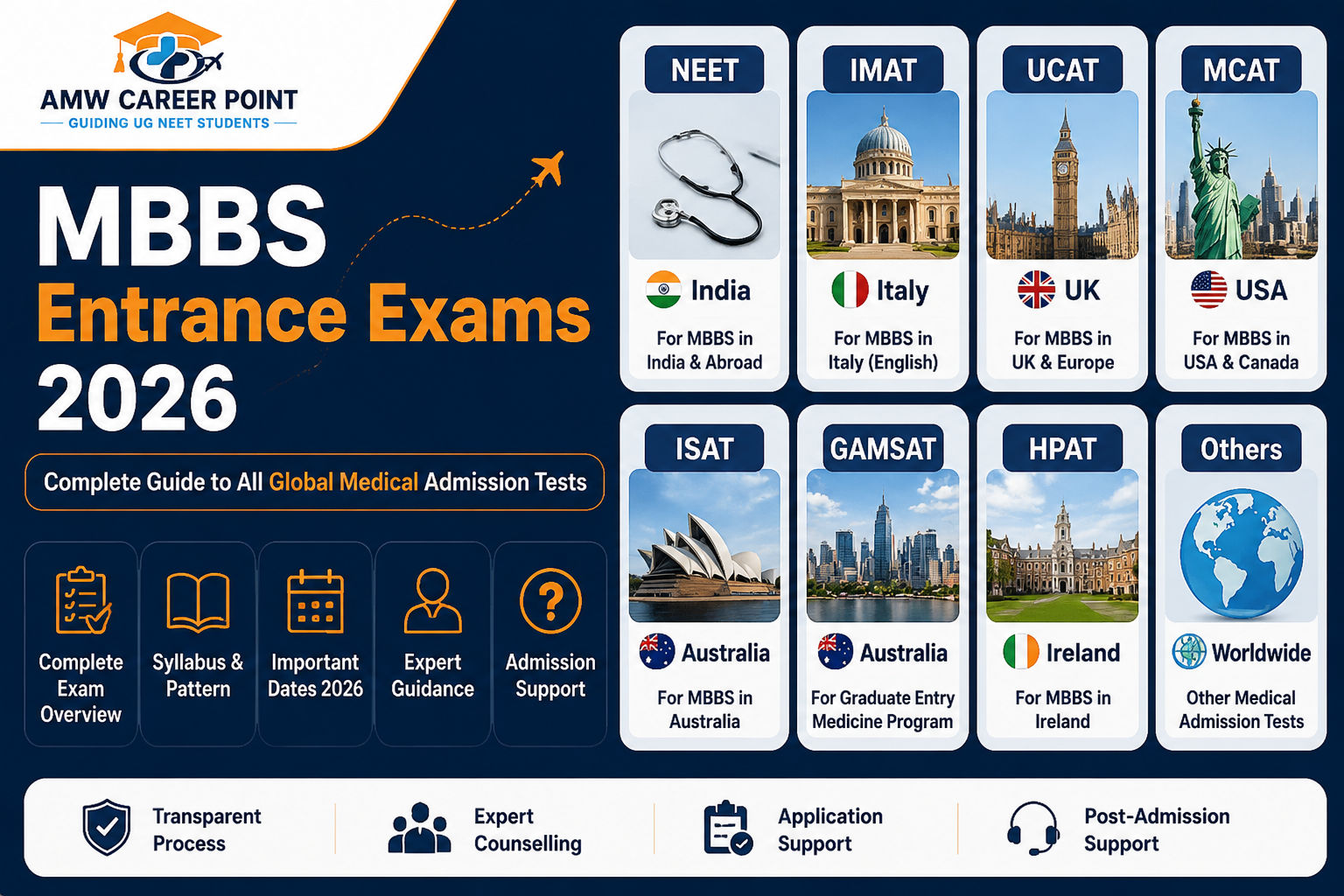
The honest picture: some countries require their own specific entrance exams (Italy’s IMAT, the UK’s UCAT, Ireland’s HPAT); some require graduate-level exams that are not directly accessible from Indian Class 12 (the MCAT for the USA and Canada, GAMSAT for Australia’s graduate-entry programmes); and several major MBBS-abroad destinations Russia, Georgia, Kyrgyzstan, Kazakhstan, Uzbekistan, and the Philippines require no additional entrance exam beyond your academic credentials and a qualifying NEET score for NMC India purposes.
This guide maps every medical entrance exam to the countries and universities that require it, explains each exam’s structure and difficulty honestly, and ends with a direct decision framework: which exam do you actually need for your specific destination and career goal? Start at the Quick Comparison table in Part 2 if you already know your destination. Start at Part 3’s decision guide if you’re still deciding.
Why Do Countries Use Different Medical Entrance Exams?
Medical school admission is one of the most consequential selection decisions any education system makes. Countries have developed different testing frameworks based on their own academic traditions, available seat counts, and the specific qualities they want medical students to demonstrate before admission. Understanding why the diversity exists helps you navigate it.
Reason for Variation | How It Shapes the Exam | Examples |
Education system structure | Countries with 4-year undergraduate degrees before medical school (USA, Canada) use graduate-level aptitude tests (MCAT). Countries with 5–6 year direct-entry medicine from Class 12 (India, Italy, UK undergraduate) use different instruments. | India: NEET (direct from Class 12). USA: MCAT (after bachelor’s degree). Italy: IMAT (direct from secondary school). |
Merit-based seat allocation | Countries with limited public university seats use standardised exams to create transparent, comparable ranking. Italy’s 15 non-EU seats at Milan are allocated purely by IMAT score. | Italy IMAT, UK UCAT, Australia GAMSAT |
Clinical aptitude testing | Some systems prioritise testing cognitive aptitude and situational judgement over pure academic knowledge, recognising that medical school grades don’t predict clinical performance well. | UCAT (UK, Australia, NZ) tests Verbal Reasoning, Abstract Reasoning, Situational Judgement — no factual science content |
Language and international access | Exams designed to assess international students separately from domestic ones create dedicated streams with own criteria. | IMAT: international students across all countries sit the same paper. UCAT: separate version for Australia/NZ (UCAT ANZ) |
Graduate vs undergraduate entry | Many countries offer both direct-entry and graduate-entry medicine, requiring different exams for each pathway. | Australia: UCAT for undergraduate, GAMSAT for graduate. UK: UCAT for most undergraduate, GAMSAT for some graduate-entry programmes. |
Government regulation | Standardisation is mandated by national medical councils or health ministries to ensure consistent quality standards. | India’s NMC mandated NEET as the single national exam. Italy’s MUR conducts IMAT under national authority. |
How Medical Admission Works Around the World — The Overview
Country / Region | Entry Type | Primary Exam | Other Requirements | Duration of Degree |
Direct from Class 12 | NEET (mandatory) | Board marks; counselling (MCC / State) | 5.5 years (MBBS + internship) | |
Direct from secondary school | IMAT (English-medium public) / Own tests (private universities) | Universitaly registration; Declaration of Value | 6 years (LM-41) | |
Direct from A-Levels (UG) or after degree (graduate) | UCAT (most UG programmes) / GAMSAT (some graduate-entry) | A-Level grades (Biology + Chemistry); interview | 5–6 years (UG); 4 years (graduate-entry) | |
After bachelor’s degree | MCAT | GPA; MCAT; interview; essays | 3–4 years (MD) | |
Direct (UG) or after degree (graduate) | UCAT ANZ (UG) / GAMSAT (graduate) | ATAR (UG); GPA (graduate); interviews | 5–6 years (UG); 4 years (graduate) | |
Direct from Leaving Certificate (UG) or after degree (graduate) | HPAT (UG) / GAMSAT (graduate, RCSI/UCC) | Leaving Certificate points; HPAT score; interview | 5–6 years | |
Russia / Georgia / Kyrgyzstan / Kazakhstan / Uzbekistan | Direct from Class 12 (for Indian students) | No additional entrance exam (NEET qualifying sufficient for NMC purposes) | Academic certificates; NEET scorecard; visa; documents | 5–6 years (varies by country) |
Direct from Class 12 / after pre-medical BS | No separate entrance exam for Indian students (some universities require NMAT locally) | Academic certificates; NEET scorecard; CHED-recognised university | 54-month MD + 12-month internship | |
Direct from Class 12 | No separate entrance exam; DGME process (GPA + NEET percentile formula) | Class 10/12 GPA; NEET scorecard; equivalence fee | 5 years + 1 year internship | |
USA | After bachelor’s degree (Graduate entry) | MCAT | GPA; letters of recommendation; interview; AMCAS application | 4 years (MD) |
Quick Comparison of All MBBS Entrance Exams One-Table Overview
Use this table first. If your destination is already fixed, find the exam you need, then go to its dedicated section for full details.
Exam | Full Name | Countries / Pathways | Entry Type | Duration | Score / Format | Validity | Approx. Fee (2026) | Difficulty |
National Eligibility cum Entrance Test | India (mandatory for all MBBS). Also mandatory for NMC Eligibility Certificate for any Indian studying MBBS abroad. | UG (from Class 12) | 200 minutes | 720 marks max; 180 MCQs; −1 negative | Current year only | ₹1,700 (Gen); ₹1,000 (SC/ST) | Moderate–High | |
International Medical Admissions Test | Italy (English-medium public universities) | UG (from Class 12 equivalent) | 100 minutes | 90 marks max; 60 MCQs; +1.5/−0.4 | Current year only | €130 (~₹12,500) | High | |
University Clinical Aptitude Test | UK (most medical schools); Singapore; some others | UG and some graduate | 2 hours | 300–3,600 per section (scaled); SJT: Band 1–4 | 1 year | £75 (UK); A$225+ (ANZ) | High (aptitude) | |
Medical College Admissions Test | USA, Canada (graduate-entry medicine) | Graduate (after bachelor’s degree) | ~7.5 hours (6.5 hrs testing) | 472–528 total; 118–132 per section | 3 years (most schools) | USD 330 (~₹27,500) | Very High | |
International Student Admissions Test | Australia (selected universities for international students; usage varies by institution) | UG | 3 hours | 200 multiple choice questions; scaled score | 1 year | A$255+ (est.) | Moderate–High | |
Graduate Australian Medical School Admissions Test | Australia (graduate-entry); Ireland (UCC, RCSI, UL, TCD graduate); UK (some graduate-entry) | Graduate (after bachelor’s degree; minimum 2–3 years) | ~5.5 hours | Section I, II, III scored separately; overall score out of 100 | 2 years | A$540 (~₹28,000) | Very High | |
HPAT | Health Professions Admission Test | Ireland (UG medicine: NUIG, UCC, UL, TCD) | UG (from Leaving Certificate / Class 12 equivalent) | 2.5 hours | Scaled score (200 max total); 3 sections | 1 year | €125–150 (~₹11,000–13,000) | High (aptitude) |
UCAT ANZ | UCAT Australia New Zealand | Australia, New Zealand (undergraduate medical schools) | UG (after Year 12 / IB) | 2 hours | Same format as UCAT | 1 year | A$225+ | High (aptitude) |
BMAT | BioMedical Admissions Test | DISCONTINUED in 2024 | N/A — historical only | — | — | — | — | — (see note) |
Which Entrance Exam Do You Actually Need? The Complete Decision Guide
This is the section most students need before everything else. Answer the question “Where do I want to study?” first the exam follows from the destination, not the other way around.
Target Country / Pathway | Exam Required | Notes for Indian Students |
India (Government or Private MBBS) | NEET — mandatory | No other exam required. NEET rank determines access to government (AIQ + state quota) and private seats. |
Italy (English-medium public university — Bologna, Pavia, Milan, Padua etc.) | IMAT — mandatory | IMAT is the only pathway to English-medium public university Medicine in Italy. Non-EU students nominate one university. See Part 5. |
Italy (Private — Humanitas) | Humanitas Aptitude Test (HAT) + interview | Own written test broadly similar to IMAT in structure; portfolio and interview also required. No IMAT needed. |
Italy (Private — UniCamillus) | UniCamillus own entrance test | Separate from IMAT. No IMAT needed. Check current status of NMC/WDOMS listing. |
United Kingdom (Undergraduate Medicine) | UCAT — required by most UK medical schools | Sits alongside A-Level (or equivalent) grades. Some universities also require an interview after UCAT shortlisting. No BMAT (discontinued 2024). |
United Kingdom (Graduate-Entry Medicine) | GAMSAT (some schools) or UCAT | Graduate-entry programmes at some UK universities use GAMSAT; others use UCAT. Requires a completed bachelor’s degree. |
USA (MD) | MCAT — mandatory | US medical schools admit only after a bachelor’s degree (undergraduate pre-med). MCAT is taken after completing relevant prerequisites. Indian Class 12 students cannot apply directly. |
Canada (MD) | MCAT — mandatory (most schools) | Similar to USA: requires bachelor’s degree first. Some Canadian schools have limited international seats; competition is very high. |
Australia (Undergraduate Medicine) | UCAT ANZ — required by most undergraduate medical schools | Australian Year 12 equivalent (ATAR) + UCAT ANZ + interview. International undergraduate medical seats at Australian universities are limited and expensive (A$90,000+/year). |
Australia (Graduate-Entry Medicine) | GAMSAT — mandatory | After a bachelor’s degree. Most competitive pathway in Australia. Universities include Melbourne, Monash, ANU, Flinders, Notre Dame. |
Australia (International, selected universities) | ISAT (some universities) | ISAT usage varies — confirm the current requirement of each specific Australian university before applying. |
Ireland (Undergraduate Medicine) | HPAT — mandatory for Irish undergraduate medicine | Leaving Certificate (or equivalent) points + HPAT score combined. Trinity College Dublin, NUIG, UCC, UL use HPAT for undergraduate entry. |
Ireland (Graduate-Entry Medicine) | GAMSAT — mandatory | RCSI and UCC graduate-entry programmes use GAMSAT. Requires bachelor’s degree. |
New Zealand (Undergraduate Medicine) | UCAT ANZ | Similar to Australia undergraduate pathway. Very limited international places; extremely competitive. |
Russia | No additional entrance exam | NEET qualifying score + academic certificates sufficient for NMC-approved Russian universities. Some universities may conduct their own English proficiency or aptitude screening. |
Georgia | No additional entrance exam | Direct admission based on academic credentials. NEET qualifying is required for NMC Eligibility Certificate. |
Kazakhstan | No additional entrance exam | Direct admission at NMC-approved universities based on academic credentials. |
Kyrgyzstan | No additional entrance exam | Direct admission. NEET qualifying required for NMC. Verify language of instruction certificate per university. |
Uzbekistan | No additional entrance exam | Direct admission. Newer MBBS ecosystem; verify current NMC approval per university. |
Philippines | No separate entrance exam for Indian students | Some Philippine universities require NMAT (Philippine licensing test) for local students; this is generally not required of foreign applicants for admission. NEET qualifying required for NMC. |
Bangladesh | No separate entrance exam; DGME process | Admission uses combined GPA (Class 10 + 12) and NEET percentile formula via DGME. No separate aptitude test. |
Nepal | No separate entrance exam for Indian students | Indian nationals do not require a student visa for Nepal. Academic credentials + NEET qualifying sufficient. NMC compliance must be verified per college. |
NEET Complete Guide for Indian Students
NEET (National Eligibility cum Entrance Test) is the single national medical entrance exam for all MBBS, BDS, and AYUSH admissions in India, conducted by the National Testing Agency (NTA). For Indian students pursuing
, it is mandatory to obtain the NMC Eligibility Certificate required to sit for FMGE/NExT after graduation.
Full Name | National Eligibility cum Entrance Test (NEET UG) |
Conducted By | National Testing Agency (NTA), India |
Purpose | (1) MBBS/BDS/AYUSH admission in India. (2) NMC Eligibility Certificate for Indian students pursuing MBBS abroad. |
Frequency | Once per year (typically May) |
Mode | Paper-based (OMR) — offline only |
Duration | 200 minutes (3 hours 20 minutes) |
Total Questions | 180 MCQs |
Maximum Marks | 720 |
Marking Scheme | +4 correct; −1 wrong; 0 unanswered |
Registration Fee | ₹1,700 (General); ₹1,600 (EWS/OBC-NCL); ₹1,000 (SC/ST/PwD); ₹1,700 (Outside India) |
Score Validity | For Indian admission: current year only. NMC uses valid qualifying NEET score — confirm current NMC policy on validity at time of Eligibility Certificate application. |
Attempts | No lifetime limit. One attempt per year. No upper age limit (per Supreme Court ruling). |
Number of Test Centres | 500+ cities across India; select international centres |
NEET Exam Pattern 2026
Subject | No. of Questions (Section A + Section B) | Marks | Topics |
Biology (Zoology + Botany) | 90 questions (35+15 each; students attempt 35+10) | 360 marks | Cell biology, genetics, ecology, human physiology, plant physiology, evolution, biotechnology, biodiversity |
Chemistry | 45 questions (35+15; attempt 35+10) | 180 marks | Physical chemistry, organic chemistry, inorganic chemistry (Class 11 + 12 NCERT) |
Physics | 45 questions (35+15; attempt 35+10) | 180 marks | Mechanics, thermodynamics, optics, electricity, modern physics, waves (Class 11 + 12 NCERT) |
TOTAL | 180 questions attempted | 720 marks | — |
NEET Qualifying Cutoff 2026 (Indicative)
Category | Qualifying Percentile | Approx. Qualifying Marks (Indicative) | Purpose |
General (UR) | 50th percentile | ~162 marks | Minimum to be eligible for Indian counselling and NMC Eligibility Certificate |
OBC / SC / ST / EWS | 40th percentile | ~130 marks | Minimum for reserved category candidates |
PwD | 45th percentile (General PwD) / 40th percentile (reserved PwD) | ~130–145 marks | Minimum for PwD category |
NEET Preparation Strategy
NCERT First, Always: NCERT Class 11 and 12 Biology, Physics, and Chemistry textbooks are the primary source for approximately 70–80% of NEET questions. Complete them before adding any supplementary material.
Biology Is the Decider: Biology accounts for 360 of 720 marks. Students who score 330+ in Biology and perform averagely in Physics and Chemistry consistently clear high cutoffs. Prioritise Biology without neglecting the others.
Mock Tests From Month 4 Onward: Full timed mocks (200 minutes, 180 questions) should begin 4–5 months before the exam. Error analysis after each mock is more valuable than the mock itself.
Revision Cycles: Topic-complete does not mean topic-retained. Build 3–4 revision cycles into your preparation calendar. Anki or physical flashcards for biology facts are the most efficient retention tools at scale.
IMAT Complete Guide for Indian Students Targeting Italy
A complete, dedicated IMAT guide is available at amwcareerpoint.com/imat-exam-for-indian-students. This section covers the essentials and the strategic decisions specific to Indian students.
Full Name | International Medical Admissions Test |
Conducted By | Ministry of Universities and Research (MUR), Italy |
2026 Exam Date | 30 September 2026 (confirmed 3 July 2026) |
Mode | Paper-based, offline, simultaneous worldwide |
Duration | 100 minutes |
Questions | 60 MCQs (5 options; 1 correct) |
Marking | +1.5 correct; −0.4 wrong; 0 unanswered. Maximum: 90 points. |
Sections | Biology (23), Chemistry (15), Physics & Maths (13), Logical Reasoning (5), General Knowledge/Reading (4) |
Registration Fee | €130 (~₹12,500–14,500). Non-refundable. |
Registration Portal | Universitaly (universitaly.it) — only official channel |
Score Validity | Current year only — not transferable to the next admission cycle |
Attempts | No lifetime limit. One per year. |
India Test Centre | New Delhi (BC Education India / British Council) — limited seats; fill within hours of window opening |
One-University Rule | Non-EU students nominate one university only — irreversible. Score is evaluated only at that university’s non-EU ranking. |
What Makes IMAT Different from NEET
Factor | NEET | IMAT |
Core Philosophy | Deep subject knowledge and memorisation across Biology, Physics, Chemistry from NCERT | Conceptual understanding + logical reasoning; less rote; application-focused |
Biology Weight | 50% of total marks (360/720) | 38% of total marks (34.5/90); fewer questions but all require conceptual application |
Physics | 25% of marks; NCERT-based; formulas and problem-solving | Part of a combined Physics & Maths section (13 questions / 21.5%); application-based, not derivation |
Maths | Not in NEET | Included in Physics & Maths section: algebra, functions, probability, geometry |
Logical Reasoning | Not in NEET | 5 questions: argument analysis, deduction, problem-solving. Non-knowledge-based but time-intensive. |
Difficulty Source | Depth of factual knowledge required and question volume under time pressure | Conceptual reasoning; the negative marking strategy; logical reasoning under time pressure |
Preparation Overlap | NEET Biology directly reinforces IMAT Biology topics. NCERT Chemistry overlaps IMAT Chemistry significantly. | A student who has prepared for NEET has a 6–8 month IMAT-specific preparation advantage. Pure IMAT from scratch requires 9–12 months. |
IMAT Preparation Strategy
Use Post-2023 MUR-Style Papers Only: The exam format changed significantly in 2023 when MUR replaced Cambridge Assessment. Pre-2023 papers have different question styles and are misleading for current preparation.
Biology First: 23 questions, 34.5 marks — more than any other section. Cell biology, genetics, human physiology, and molecular biology are consistently high-yield. Students with strong NEET Biology preparation adapt fastest to IMAT.
Physics and Chemistry Are Conceptual: IMAT does not require deep calculation. It tests whether you understand the concept well enough to apply it to a novel scenario. Depth over breadth is the wrong approach; aim for conceptual clarity across all topics.
Logical Reasoning Requires Daily Practice: Five questions worth 7.5 marks. Students who ignore this section consistently under-perform in it. Begin daily 15-minute logical reasoning practice from Month 1.
UCAT Complete Guide for Students Targeting the UK and Australia
UCAT (University Clinical Aptitude Test) is the primary medical school entrance exam for undergraduate medicine in the UK, used by approximately 32 of the 40 UK medical schools. A separate version — UCAT ANZ — is used by most undergraduate medical schools in Australia and New Zealand.
Full Name | University Clinical Aptitude Test |
Administered By | UCAT Consortium (independent, non-profit) |
Countries | United Kingdom (32+ medical schools); Australia (UCAT ANZ version); New Zealand (UCAT ANZ); Singapore (NUS) |
Mode | Computer-based; taken at Pearson VUE test centres |
Duration | Approximately 2 hours total (each section separately timed) |
Score Format | Sections 1–4: scaled 300–900 per section; Section 5 (SJT): Band 1–4 |
Score Validity | 1 year (for the current UK/ANZ entry cycle) |
Registration Period | Typically opens May; testing July–September |
2026 Registration | Opens approximately May 2026; testing July–September 2026 |
Fee (UK Applicants) | Approx. £75 UK; £115 EU/international (test in UK). £135–145 if testing outside UK. |
Fee (ANZ Applicants) | A$225+ (within ANZ); varies for testing elsewhere |
Attempts | One per admissions cycle. Can re-sit in the next cycle. |
UCAT Sections — What Each Tests
Section | Questions / Time | What It Tests | Why It Matters |
Verbal Reasoning | 44 questions / 21 minutes | Ability to critically evaluate information presented in written passages. Multiple-choice; True/False/Can’t Tell and A/B/C/D formats. | Reflects clinical communication skills; medical practice requires reading and critically evaluating written information under time pressure. |
Decision Making | 29 questions / 31 minutes | Logical reasoning, statistical analysis, argument analysis, diagrammatic reasoning. | Models clinical decision-making skills: evaluating evidence, drawing conclusions, assessing risk. |
Quantitative Reasoning | 36 questions / 24 minutes | Numerical problem-solving using tables, charts, and graphs. Maths at approximately GCSE level. | Medical practice requires data interpretation (lab results, risk statistics). Does not test advanced maths. |
Abstract Reasoning | 50 questions / 12 minutes | Identify patterns in abstract shapes and figures. | Tests fluid intelligence and pattern recognition — valuable for diagnostic thinking in medicine. |
Situational Judgement Test (SJT) | 69 questions / 26 minutes | Evaluate your response to workplace scenarios involving ethics, professionalism, communication, and teamwork. | Medical schools use SJT to assess non-cognitive attributes. Band 1 is the top band; Band 4 is unacceptable to most schools. |
UCAT vs NEET — For Indian Students Considering the UK
Factor | UCAT | NEET |
Content | No factual science content. Purely cognitive aptitude. | Heavy factual science content from NCERT Biology, Physics, Chemistry |
Preparation Approach | Timed aptitude practice; speed and accuracy are the primary variables. Knowledge cannot be ‘studied’ for UCAT in the traditional sense. | Deep content knowledge + exam technique. Both contribute to score. |
Difficulty Source | Extreme time pressure per question; cognitive stamina across 2 hours | Depth of factual recall and application; question volume under time |
Score Usage | Used to shortlist for interview. Each university sets its own score thresholds. A high UCAT does not guarantee admission — interview performance also matters significantly. | Used for rank-based seat allocation. Higher rank = better college. No interview for MBBS in India. |
NEET Preparation Benefit | NEET preparation does not directly help UCAT. Different skills entirely. | N/A |
Indian Student Access | Requires A-Levels or equivalent secondary qualification that UK universities accept. Indian Class 12 (CBSE/State Board) may need additional assessment; verify per medical school. | All Indian students |
MCAT — Complete Guide for Students Targeting USA and Canada
The MCAT (Medical College Admissions Test) is the most demanding medical entrance exam in the world by both duration and difficulty. It is administered by the AAMC (Association of American Medical Colleges) and is mandatory for admission to MD programmes in the USA and most MD programmes in Canada.
Critical Context for Indian Students: The MCAT is a graduate-level exam. US medical schools admit students only after completing a 4-year bachelor’s degree (undergraduate pre-medicine). An Indian student who has just completed Class 12 cannot apply to a US MD programme. The pathway is: Class 12 → 4-year undergraduate degree in India or USA (with pre-med courses: Biology, Chemistry, Physics, Biochemistry, Psychology, Statistics) → MCAT → US MD application. Minimum total time before starting US MD: 4+ years after Class 12.
Full Name | Medical College Admissions Test |
Administered By | Association of American Medical Colleges (AAMC) |
Countries | USA (all MD programmes); Canada (most MD programmes) |
Entry Requirement | Bachelor’s degree (or near-completion); pre-medical coursework in Biology, Chemistry, Physics, Biochemistry, Psychology, Statistics |
Duration | Approximately 7.5 hours total (6.5 hours testing + mandatory breaks) |
Sections | 4 sections: CPBS, CARS, BBFLS, PSBB (see below) |
Scoring | 472–528 total (118–132 per section). Median score at US MD schools: approximately 511–512 (83rd percentile). |
Score Validity | 3 years (most schools); some schools: 2 years |
Registration Fee (2026) | USD 330 (~₹27,500) standard; USD 105 rescheduling fee |
Testing Windows | January, April, May, June, July, August, September (multiple dates per month) |
Attempts | 3 attempts in a single year; 4 in two years; 7 lifetime maximum |
MCAT Sections
Section Code | Full Name | Time | Questions | Content |
CPBS | Chemical and Physical Foundations of Biological Systems | 95 min | 59 | General chemistry, organic chemistry, physics applied to biology. Passage-based. |
CARS | Critical Analysis and Reasoning Skills | 90 min | 53 | Humanities and social science reading comprehension. No science background needed. Tests reasoning and argument analysis. Most challenging for non-English-native students. |
BBFLS | Biological and Biochemical Foundations of Living Systems | 95 min | 59 | Biology, biochemistry, molecular biology. Passage-based. |
PSBB | Psychological, Social, and Biological Foundations of Behaviour | 95 min | 59 | Psychology, sociology, biology of behaviour. Tests understanding of social determinants of health. |
Is MCAT Relevant for Indian Students?
The MCAT is relevant only for Indian students who have completed or are completing a bachelor’s degree and specifically target US or Canadian MD programmes. Given the complexity and cost of the US MD pathway (4-year undergraduate + 4-year MD + 3–7 year residency, at $50,000–$70,000 USD per year), most Indian medical aspirants who want to practice in India or pursue a more affordable international MBBS will find the Philippines, Georgia, or Italy more appropriate than the US MD route. MCAT preparation is a full-time 3–6 month commitment on top of completing undergraduate prerequisites.
ISAT International Student Admissions Test
ISAT (International Student Admissions Test) has historically been used by certain Australian universities to assess international students applying for undergraduate medical programmes. Its usage is not uniform across Australian medical schools — some require it, some have moved to UCAT ANZ, and others use their own criteria for international applicants.
Full Name | International Student Admissions Test | |
Administered By | Australian Council for Educational Research (ACER) | |
Countries / Use | Australia (selected undergraduate medical schools for international applicants). Check each university’s current requirements — usage varies and has changed in recent years. | |
Duration | 3 hours | |
Format | 200 multiple-choice questions; Reading, Mathematics, Writing (optional for some programmes) | |
Score | Scaled score; percentile-ranked | |
Score Validity | 1 year | |
Registration Fee | A$255+ (estimate; confirm on ACER website for 2026) | |
Entry Type | Undergraduate (from secondary school / Class 12 equivalent) | |
GAMSAT, HPAT, UCAT ANZ & the Exam That No Longer Exists
GAMSAT: Graduate Australian Medical School Admissions Test
Full Name | Graduate Australian Medical School Admissions Test |
Administered By | ACER (Australian Council for Educational Research) |
Countries | Australia (graduate-entry medicine: University of Melbourne, Monash, ANU, Flinders, Notre Dame, Wollongong); Ireland (UCC, RCSI, UL, TCD); UK (some graduate-entry programmes) |
Entry Type | Graduate only. Requires a completed bachelor’s degree or near-completion. Minimum 2–3 years of undergraduate study required by most schools. |
Duration | Approximately 5.5 hours (split across multiple sections with breaks) |
Testing Dates | March and September each year (two sittings) |
Sections | Section I: Reasoning in Humanities and Social Sciences (75 questions, 100 min). Section II: Written Communication (2 essays, 70 min). Section III: Reasoning in Biological and Physical Sciences (110 questions, 170 min). Chemistry and Biology knowledge required for Section III. |
Scoring | Each section scored separately; universities weight sections differently. Some weight Section III most heavily. Overall score out of approximately 100. |
Score Validity | 2 years |
Fee (2026 estimate) | A$540 (~₹28,000) per sitting |
Difficulty | Very High. GAMSAT Section III requires university-level Chemistry and Biology knowledge, not just Class 12 content. |
GAMSAT for Indian Students: Relevant only for Indian students who have completed a bachelor’s degree and specifically target graduate-entry medicine in Australia or Ireland. GAMSAT Section III requires degree-level Chemistry and Biology preparation, typically takes 6–12 months of dedicated study after completing the relevant degree-level courses.
HPAT Health Professions Admission Test (Ireland)
Full Name | Health Professions Admission Test |
Administered By | ACER (for Irish universities) |
Countries | Ireland (undergraduate medicine: Trinity College Dublin, NUI Galway, University College Cork, University of Limerick) |
Entry Type | Undergraduate (from Leaving Certificate or equivalent) |
Duration | 2.5 hours |
Sections | Section 1: Logical Reasoning and Problem Solving (44 Qs, 40 min). Section 2: Interpersonal Understanding (36 Qs, 65 min). Section 3: Non-Verbal Reasoning (20 Qs, 40 min). |
Scoring | Max 300 total. No negative marking. Not pass/fail — score combined with Leaving Certificate points. |
Timing | Typically administered in February; results in April |
Fee (2026 estimate) | €125–150 (~₹11,000–13,000) |
Score Validity | 1 year |
Indian Student Note | Indian Class 12 students may be eligible if their board qualifications are accepted as equivalent to Irish Leaving Certificate by the specific medical school. Verify per institution before registering. |
UCAT ANZ Australia and New Zealand Version
UCAT ANZ is the Australian and New Zealand version of UCAT, identical in format and structure to the UK UCAT but scored separately and used for admissions in the ANZ region. Most Australian and New Zealand undergraduate medical programmes that accept direct-from-secondary-school entrants now use UCAT ANZ.
Format | Identical to UK UCAT: 5 sections (Verbal Reasoning, Decision Making, Quantitative Reasoning, Abstract Reasoning, SJT) |
Duration | 2 hours total |
Testing Period | July–September (aligned with ANZ secondary school academic calendar) |
Fee (2026 estimate) | A$225+ within Australia/NZ; higher for international test centres |
Score Validity | 1 year |
Key Difference from UK UCAT | ANZ score pool is separate. High ANZ scores are compared against other ANZ applicants; UK UCAT scores compete against UK applicants. The percentile context differs. |
BMAT — The Exam That No Longer Exists (Historical Context Only)
BMAT (BioMedical Admissions Test) was discontinued at the end of 2024. It was previously required by Cambridge, UCL, Leeds, Manchester, Imperial, and several other UK medical schools. Cambridge now uses their own A-Level-based assessment and interview-focused process; UCL and other former BMAT users have moved to UCAT only. If you find any 2025 or 2026 guide recommending BMAT preparation, it is outdated and should not be followed.
Countries That Don’t Require Additional Medical Entrance Exams
This is the section that matters most for students who are asking “Where can I study MBBS without sitting another exam?” The answer is: the majority of MBBS-abroad destinations available to Indian students do not require any additional entrance exam beyond your academic credentials and NEET qualifying score.
Country | Additional Exam Required? | Admission Basis | NMC Condition | Notes |
No | Class 12 marksheet + NEET scorecard + documents | NEET qualifying required for NMC Eligibility Certificate post-graduation | Some universities conduct an English proficiency screening; not a standardised entrance exam | |
No | Class 12 marksheet + NEET scorecard + documents | NEET qualifying required for NMC EC | Direct admission; application is document-based | |
No | Class 12 marksheet + NEET scorecard + documents | NEET qualifying required for NMC EC | Direct admission at NMC-approved universities | |
No | Class 12 marksheet + NEET scorecard + documents | NEET qualifying required for NMC EC | Verify English-medium instruction per university; some universities have bilingual programmes that are NExT-disqualifying | |
No | Class 12 marksheet + NEET scorecard + documents | NEET qualifying required for NMC EC | Newer MBBS ecosystem; fewer NMC-approved universities than Russia/Georgia | |
No (for Indian students) | Class 12 + NEET scorecard; some universities require NMAT locally for Filipino students | NEET qualifying required for NMC EC; Embassy advisory June 2026 confirmed NMC compliance for CHED-recognised programmes | Pre-medical bridge year may be required at some universities | |
No separate aptitude exam | DGME process: combined Class 10/12 GPA + NEET percentile formula | NEET qualifying required for NMC EC | Safety situation requires independent current verification for 2026 | |
No separate exam | Class 12 marksheet + NEET qualifying; no student visa required for Indian nationals | NEET qualifying required for NMC EC; NMC compliance must be verified per college | NMC approval status of Nepal colleges must be independently verified |
Entrance Exam Difficulty Comparison An Honest Assessment
Difficulty is not a single axis. Different exams are hard in different ways: NEET is hard because of the depth and volume of factual content; MCAT is hard because of its graduate-level content and duration; UCAT is hard because of extreme time pressure on aptitude tasks; GAMSAT is hard because of the combination of degree-level science and writing under time pressure.
Exam | Academic Content Depth | Aptitude Demand | Time Pressure | Preparation Time (Avg.) | Competition Ratio | Overall Difficulty |
NEET | Very High (Class 11–12 NCERT in depth) | Low (factual MCQs) | High (180 Qs / 200 min) | 12–24 months | ~15:1 (seats:qualified) | High |
IMAT | Moderate (broad Science; conceptual) | Moderate (Logical Reasoning section) | High (60 Qs / 100 min) | 6–12 months | ~15:1 (non-EU seats:applicants at competitive universities) | High |
UCAT | None (no factual science) | Very High (pure cognitive aptitude) | Very High (all sections strictly timed) | 3–6 months of daily practice | Varies by medical school; typically 5–10:1 for interview shortlisting | High (aptitude) |
MCAT | Very High (degree-level Biology, Chemistry, Biochemistry, Psychology) | High (CARS section is pure reasoning) | High (7.5 hrs total) | 3–6 months full-time after degree | ~3:1 (US MD admission rate ~7–12%) | Very High |
GAMSAT | High (degree-level Chemistry and Biology for Section III) | High (Section I: humanities reasoning; Section II: writing) | High (5.5 hrs total) | 3–6 months after degree | ~6:1 for Australian graduate-entry | Very High |
HPAT | None (no science content) | High (logical reasoning, interpersonal scenarios, non-verbal reasoning) | Moderate | 3–4 months | ~8:1 for Irish undergraduate medicine | High (aptitude) |
ISAT | Moderate (Reading, Maths) | Moderate | Moderate | 2–3 months | Varies by Australian university | Moderate–High |
Medical Entrance Exam Preparation Timeline By Exam
Exam | Optimal Start | Month 9–12 | Month 6–8 | Month 3–5 | Month 1–2 | Final 2 Weeks |
NEET | 12–24 months before exam | Complete NCERT Biology, Physics, Chemistry concepts | First full mocks; identify weak subjects; chapter-level revision | 3–4 full mocks per month; error analysis; subject revision cycles | Daily mocks; Biology high-yield topic revision; reduce new content | NCERT re-read of Biology plant kingdom and human physiology; past papers |
IMAT | 8–12 months before exam (Sept) | Complete IMAT Biology syllabus (highest weightage); begin Chemistry | Finish Biology and Chemistry; begin Physics/Maths and Logical Reasoning (daily practice) | First full timed mocks (post-2023 MUR papers); error analysis per section | 2 full mocks per week; Biology high-yield review; skipping strategy refinement | Logical Reasoning patterns; Biology cell division and genetics; past paper timing |
UCAT | 3–6 months of daily practice before test window | N/A (no long-horizon content to cover) | Begin daily timed UCAT section practice; identify weakest section | Escalate practice frequency; work on slowest section specifically | Full timed tests; SJT band practice; Decision Making accuracy | Full timed test daily; review pacing strategy per section |
MCAT | 4–6 months full-time after completing undergraduate prerequisites | Content review: Biology, Biochemistry, Chemistry, Physics, Psychology | Passage-based practice; CARS daily reading; full Kaplan/Princeton Review content books | Full AAMC practice exams (4 official); section-specific weak-area focus | Official AAMC materials only; daily CARS passages | Light review of weakest content area; mental and physical rest |
GAMSAT | 4–6 months before sitting | Section III: degree-level Chemistry and Biology refresh; Section I: humanities reading | Section II: essay writing practice (argument structure); timed essay drafts | Full timed GAMSAT practice tests; Section III accuracy focus | Review Chemistry reactions and Biology systems; essay structure practice | Rest and consolidation; light science review |
HPAT | 3–4 months before exam (typically February) | Begin logical reasoning practice; familiarise with question types | Interpersonal Understanding scenarios; Non-Verbal Reasoning pattern practice | Full timed HPAT practice tests; speed-building per section | Daily timed practice tests; SJT-style interpersonal questions | 1 full test; review pacing; mental preparation |
Which Entrance Exam Should You Choose? A Decision Framework
The exam does not determine the destination. The destination determines the exam. Start by answering the career goal question, then follow the decision logic below.
Based on Career Goal
Career Goal | Recommended Destination(s) | Exam Required |
Practice in India after MBBS abroad | Russia, Georgia, Kyrgyzstan, Kazakhstan, Philippines, Bangladesh (any NMC-compliant destination) | NEET only. No additional exam required at most of these destinations. |
Practice in Italy / stay in EU after Italian MBBS | Italy (public university via IMAT) | NEET (for NMC EC) + IMAT (for Italian admission). Esame di Stato in Italian for Italy practice. |
Practice in the UK via PLAB | Any NMC/GMC-eligible MBBS destination Italy, Russia, Georgia, etc. | No specific entry exam beyond MBBS admission; PLAB 1 and 2 taken after graduation |
Practice in the USA via USMLE | Italy (strong ECFMG alignment); Philippines (American curriculum); Any ECFMG-eligible destination | No US-specific entrance exam needed at undergraduate level; MCAT is for US MD admission, not for USMLE eligibility |
Undergraduate medicine in the UK | UK medical schools | UCAT + A-Level equivalent qualifications + interview |
Undergraduate medicine in Ireland | Irish medical schools | HPAT (UG entry) or GAMSAT (graduate entry) |
US MD (long-term route) | USA after bachelor’s degree | MCAT (after 4-year undergraduate degree) |
Graduate medicine in Australia | Australian graduate-entry medical schools | GAMSAT (after bachelor’s degree) |
Based on Budget
Budget (Total Programme) | Accessible Pathways | Exam Strategy |
Under ₹25 Lakh total | Russia, Kyrgyzstan, Uzbekistan, Georgia (lower-range universities) | NEET only — no additional exam investment needed. Focus NEET preparation entirely. |
₹25–45 Lakh total | Russia, Georgia, Kazakhstan, Philippines, Italy (public + DSU scholarship) | NEET + potentially IMAT if Italy is preferred. IMAT preparation: 6–9 months additional. |
₹45–80 Lakh total | India (mid-tier private); Italy (public without scholarship); Philippines premium universities | NEET essential. IMAT optional for Italy. No other exams needed unless UK/Australia targeted. |
Above ₹80 Lakh / international | UK (UCAT pathway); Australia (GAMSAT); Italy (Humanitas); India top deemed | NEET + UCAT for UK; NEET + GAMSAT for Australia graduate; IMAT for Italy public |
Based on Academic Background
Academic Background | Exam Fit | Reasoning |
Strong NEET Biology + average Physics/Chemistry | IMAT is a strong secondary choice after NEET | NEET Biology preparation overlaps 60–70% of IMAT Biology. IMAT Physics/Chemistry and Logical Reasoning require 3–6 months of additional specific preparation. |
Strong critical reasoning; moderate science | UCAT or HPAT are aptitude-based and don’t penalise weak science content | Students with strong reasoning and communication skills but weaker factual science recall often perform better on UCAT than NEET |
Strong all-round academic profile; completed or near-completing a degree | MCAT or GAMSAT are appropriate | Graduate-level exams require degree-level science background. Only suitable for students at that stage of their academic journey. |
Average across subjects; strong memory | NEET + MBBS abroad (no additional exam destinations) | No-additional-exam destinations (Russia, Georgia, Kyrgyzstan) are the most accessible for students who qualify NEET but are not competitive for IMAT or UCAT pathways |
Exam Fees, Registration & All-In Costs for 2026
Exam | Registration Fee | Testing Location Options | Prep Material Cost (Est.) | Retake Policy & Retake Cost | Total First-Attempt Cost (Est.) |
NEET | ₹1,700 (Gen); ₹1,000 (SC/ST) | 500+ cities across India | ₹20,000–1,00,000 (coaching + materials) | One attempt per year; next year: same fee | ₹21,700–1,01,700 |
IMAT | €130 (~₹12,500) | New Delhi (India); Dubai; Italy test centres | ₹15,000–50,000 (online platforms, past papers) | Next year: new €130 registration; no retake within cycle | ₹27,500–62,500 |
UCAT | £75 (UK test); £135+ (outside UK) | Pearson VUE centres; India: multiple cities | £50–200 (prep books + official practice) | Next admissions cycle: full fee again | ₹9,000–30,000 |
MCAT | USD 330 (~₹27,500) | Prometric centres globally; available in India (Mumbai, Delhi, Hyderabad, Chennai, Bengaluru) | USD 200–500 (Kaplan/Princeton Review; AAMC official materials) | USD 330 per retake; scheduling fee if rescheduled | ₹30,000–70,000 |
ISAT | A$255+ (~₹13,500+) | ACER centres; limited international locations | A$50–100 (ACER official practice) | Next year: new registration | ₹15,000–25,000 |
GAMSAT | A$540 (~₹28,000) | Australia, Ireland, UK; limited international | A$100–200 (official ACER preparation; graduate science textbooks) | A$540 per sitting; two sittings per year | ₹30,000–60,000 (excl. textbooks) |
HPAT | €125–150 (~₹11,000–13,000) | Ireland test centres only; no international locations | €50–100 (ACER practice materials) | Next year: new registration | ₹12,000–20,000 |
For students targeting both India and an abroad destination: the total exam investment is NEET (₹21,700+) plus the destination-specific exam (IMAT: ₹27,500; UCAT: ₹9,000+). Preparing for both simultaneously is manageable for NEET + IMAT (6‒9 month overlap in Biology and Chemistry), but requires independent daily Logical Reasoning and Physics/Maths sessions for IMAT beyond NEET preparation.
Common Mistakes Students Make With Medical Entrance Exams
Preparing for BMAT (Discontinued in 2024): BMAT no longer exists. Students preparing for it in 2026 are wasting preparation time on an exam that cannot be used for any application. Switch to UCAT immediately.
Confusing NEET with a Foreign University Entrance Exam: Foreign universities in Russia, Georgia, and Kyrgyzstan do not ask for or assess your NEET score. NEET is an NMC India condition for your Eligibility Certificate after graduation. These are different things with different functions.
Targeting US MD Without Understanding the Pathway: MCAT cannot be taken without completing relevant undergraduate coursework. An Indian student who has just completed Class 12 cannot sit MCAT or apply to a US MD programme. The pathway is a minimum 8-year post-Class 12 journey before US MD graduation.
Ignoring UCAT ANZ vs UK UCAT Distinctions: These are separate exams with separate score pools. An Australian university uses UCAT ANZ scores; a UK university uses UK UCAT scores. You register and sit separately for each.
Applying to Multiple Countries With Different Exam Requirements Simultaneously Without Enough Preparation Time: Some students apply for IMAT (Italy), UCAT (UK), and NEET simultaneously. This is manageable for NEET + IMAT — the subject overlap is real. NEET + UCAT is harder because UCAT is pure aptitude and does not overlap with NEET content at all. NEET + MCAT is not realistic from Class 12.
Missing Registration Deadlines: IMAT registration typically closes in early September. UCAT testing windows are July–September. HPAT is February. GAMSAT is March and September. Exam registration deadlines cannot be extended. Missing them means waiting a full year.
Using Old Past Papers: IMAT changed significantly in 2023 (Cambridge Assessment out; MUR question-setting in). BMAT past papers are irrelevant post-2024. MCAT changed significantly in 2015. Always confirm the current exam specification before selecting preparation materials.
Assuming ‘No Entrance Exam’ Countries Require No Process: Russia, Georgia, and Kyrgyzstan do not require a separate entrance exam — but they do require a qualifying NEET score (for NMC purposes), verified academic documents, visa processing, and NMC compliance verification at the university level. ‘No exam’ does not mean ‘no process.’
2026 Updates Every Medical Aspirant Should Know
Update | What Changed / What to Know | Impact on Students |
BMAT Discontinued (2024) | BMAT ceased in 2024. UK universities (Cambridge, UCL, Leeds, Manchester) no longer accept or require BMAT scores. | Any student who was preparing for BMAT for UK medical school must pivot to UCAT. This affects 2026 applicants who planned on BMAT from 2024 guidance. |
IMAT 2026 Date Confirmed | 30 September 2026, confirmed by MUR on 3 July 2026. This is a later date than some previous years, giving candidates more preparation time. | Students targeting Italy for 2026 entry have the confirmed exam date to plan around. Registration window expected late August – early September 2026. |
Philippines Embassy Advisory (17 June 2026) | Embassy of India, Manila issued a formal advisory confirming the Philippine MD from CHED-recognised institutions is NMC-compliant, following House Resolution No. 73 (March 2026). | Strengthens the Philippines as a no-additional-exam MBBS destination with confirmed NMC compliance, relevant for students looking for English-medium MBBS without IMAT or UCAT preparation. |
NMC FMGL Gazette 2021 — Bilingual Programme Disqualification | NMC’s regulations disqualify graduates of bilingual-medium (non-100%-English) programmes from NExT eligibility. Kyrgyzstan has some bilingual programmes; Russia has universities with Russian-language clinical years. | Students choosing no-additional-exam destinations must still verify that 100% English-medium instruction is confirmed in writing per university. The absence of an entrance exam does not remove NMC compliance obligations. |
NMC NExT Transition | NExT (National Exit Test) is expected to replace FMGE for foreign medical graduates and replace MBBS final exams for Indian graduates simultaneously. Roll-out timeline as per NMC notifications. | Students enrolling in MBBS (India or abroad) in 2026 may graduate into a NExT-based licensing system rather than FMGE. Monitor NMC notifications for implementation dates and syllabus. |
UCAT 2026 Registration | UCAT 2026 registration opens approximately May 2026; testing runs July–September 2026. | UK and ANZ applicants targeting 2027 university entry (taking UCAT in 2026) should register early. Test centres fill quickly in peak periods. |
India MBBS Seat Expansion | India now has approximately 1,36,939 MBBS seats across 823 medical colleges for 2026–27 — the largest ever. Despite this, government seat competition remains intense given 23+ lakh NEET 2026 applicants. | More seats have not materially reduced the pressure for government MBBS access. NEET rank competition for government seats remains as intense as ever. |
Final Verdict
The most expensive mistake a medical aspirant can make is choosing an exam before choosing a destination. UCAT preparation is wasted if you end up going to Russia. MCAT preparation is inaccessible if you have just completed Class 12. BMAT preparation is wasted because the exam no longer exists.
The framework is simple and should be applied in this order:
Step 1: Choose your destination: Based on budget, career goal, family expectations, and NEET rank. The decision frameworks in AMW’s country-specific guides cover this in detail.
Step 2: Identify the exam your destination requires: Use the table in Part 3. Most Indian students will find that NEET alone covers the majority of realistic MBBS-abroad destinations.
Step 3: Assess the preparation overlap: NEET + IMAT is the most manageable combination (60–70% Biology overlap). NEET + UCAT requires separate aptitude preparation. NEET + MCAT is not realistic from Class 12.
Step 4: Plan your timeline against both exam calendars: IMAT is always September. UCAT is July–September. NEET is May. HPAT is February. GAMSAT is March and September. Build your annual plan around these fixed windows, not around when you feel ready.
Step 5: Verify university-specific requirements before finalising: Even within a country, requirements vary. Humanitas does not use IMAT. Some Australian universities have dropped ISAT for UCAT ANZ. Some UK schools add interviews; others are UCAT-score-only for shortlisting. Always check the specific institution’s current requirements.
AMW Career Point guides students through every step of this decision — from which exam applies to your specific destination, to which university within that destination is right for your NEET score and FMGE track record. Contact us after your NEET 2026 results for a personalised assessment.
Frequently Asked Questions
Q1. Which entrance exam is compulsory for MBBS abroad?
NEET is the only entrance exam that is compulsory for all Indian students pursuing MBBS abroad, not because foreign universities require it, but because NMC India requires a qualifying NEET score to issue the Eligibility Certificate that permits you to sit FMGE/NExT after graduation. Beyond NEET: Italy requires IMAT, the UK requires UCAT, the USA requires MCAT. Russia, Georgia, Kyrgyzstan, Kazakhstan, Uzbekistan, and the Philippines require no additional entrance exam.
Q2. Is NEET enough to study medicine abroad?
NEET qualifying is sufficient for admission to MBBS programmes in Russia, Georgia, Kyrgyzstan, Kazakhstan, Uzbekistan, and the Philippines — the most popular MBBS-abroad destinations for Indian students. For Italy (IMAT), UK (UCAT), Ireland (HPAT), or Australia (UCAT ANZ / GAMSAT), separate exams are required in addition to NEET.
Q3. Which countries require IMAT?
Only Italy. IMAT is specifically designed for admission to English-medium Medicine programmes at Italian public universities. No other country uses IMAT for medical admissions.
Q4. Is UCAT harder than NEET?
They test different things and are hard in different ways. NEET is hard because of the depth and volume of factual science content from NCERT. UCAT is hard because of extreme time pressure on cognitive aptitude tasks with no factual content to prepare in the traditional sense. A student who excels at rapid information processing and critical reasoning may find UCAT more manageable than NEET. A student who excels at deep content mastery may find NEET more accessible. Neither is objectively harder — they require different skills.
Q5. Can I study MBBS without NEET?
You can enrol at a foreign university without NEET, as foreign universities do not require it. However, without qualifying NEET, the NMC will not issue an Eligibility Certificate, which means you cannot sit FMGE/NExT and cannot practice medicine in India. If practicing in India is your goal, NEET is effectively mandatory regardless of where you study.
Q6. What exam is required for Italy medical school?
IMAT (International Medical Admissions Test) for English-medium public universities. Private universities (Humanitas, Cattolica, UniCamillus) have their own separate admission processes that do not use IMAT. TOLC-MED is used for Italian-language programmes and requires C1+ Italian proficiency — not applicable for most Indian students.
Q7. What exam is required for UK medical school?
UCAT (University Clinical Aptitude Test) is required by approximately 32 of 40 UK medical schools for undergraduate medicine. A-Level (or equivalent) qualifications are also required. BMAT was discontinued in 2024 and is no longer accepted. Graduate-entry programmes at some UK universities use GAMSAT.
Q8. What is the difference between UCAT and MCAT?
UCAT is a 2-hour aptitude test used for undergraduate UK/ANZ/NZ medical school admission; no science content; tests cognitive abilities. MCAT is a 7.5-hour graduate-level science exam used for US and Canadian MD admission after a bachelor’s degree; requires degree-level Biology, Chemistry, Biochemistry, and Psychology knowledge. UCAT does not replace MCAT and vice versa — they are used by entirely different countries for entirely different pathways.
Q9. Which is the easiest medical entrance exam?
There is no single easiest exam — difficulty depends on your specific skills. HPAT and UCAT are purely aptitude-based with no factual science content, which some students find easier than content-heavy exams like NEET and MCAT. ISAT is generally considered less demanding than GAMSAT or MCAT. However, the easiest exam in terms of preparation effort is NEET for students who have built strong NCERT foundations over 2+ years, because the content is predictable and structured.
Q10. Which countries don’t require additional entrance exams for MBBS?
Russia, Georgia, Kazakhstan, Kyrgyzstan, Uzbekistan, Philippines, Bangladesh, and Nepal do not require any entrance exam beyond NEET qualifying (which is an NMC India requirement, not a university requirement) for Indian students. Admission to these universities is document-based: Class 12 marksheets, NEET scorecard, passport, and visa.
Q11. Which entrance exam should Indian students prepare for?
NEET first, always. It is mandatory for any pathway that involves practicing in India. After NEET: if targeting Italy, prepare for IMAT (6‒9 months additional preparation; significant NEET Biology overlap). If targeting UK, prepare for UCAT (3–6 months aptitude practice). If targeting USA after a degree, prepare for MCAT. If targeting Russia/Georgia/Kyrgyzstan, no additional exam preparation is needed.
Q12. Can I take UCAT from India?
Yes. UCAT is available at Pearson VUE test centres in India (typically in major cities). Seats are limited and fill quickly during the July–September testing window. Register early. The same UCAT score is used for UK applications; ANZ applicants take UCAT ANZ, which has its own separate registration.
Q13. Can I take MCAT from India?
Yes. MCAT testing centres are available in Mumbai, Delhi, Hyderabad, Chennai, and Bengaluru. Registration is through AAMC’s website. However, you must have completed the relevant undergraduate coursework (Biology, Chemistry, Physics, Biochemistry, Psychology, Statistics) before MCAT preparation is meaningful. Students who have only completed Class 12 are not ready to sit MCAT.
Q14. Is IMAT harder than NEET?
IMAT and NEET test overlapping but distinct skills. NEET requires deeper factual recall across a broader syllabus. IMAT requires narrower but more conceptually applied knowledge, plus logical reasoning and Physics/Maths that are not in NEET. A strong NEET Biology student will adapt faster to IMAT Biology than a student starting from scratch. IMAT’s Logical Reasoning section has no NEET equivalent and requires separate dedicated practice.
Q15. What is GAMSAT used for in India?
GAMSAT is not used for Indian medical admission. It is used by graduate-entry medical programmes in Australia and Ireland. It is relevant for Indian students who have completed a bachelor’s degree and are targeting Australian graduate-entry medicine or the Royal College of Surgeons Ireland (RCSI) graduate programme. Students targeting GAMSAT should have at least degree-level Chemistry and Biology preparation.