Most blogs about MBBS in Philippines will tell you it is “affordable and English-medium.” That sentence has been true for years, and it still tells you nothing about whether your degree will actually let you practice medicine in India. This one is different.
Here is the development that changes the calculation for 2026: the Embassy of India in Manila issued a formal advisory on 17 June 2026 confirming that MD degrees from CHED-recognised institutions in the Philippines comply with the NMC's Foreign Medical Graduate Licentiate (FMGL) Regulations. This follows House Resolution No. 73, adopted by the Philippine House of Representatives on 11 March 2026, which formally endorsed the same compliance position. For a destination that has spent the last few years surrounded by ambiguity, this is the clearest signal yet that MBBS in Philippines is a legitimate, NMC-recognised route to a medical career, provided you pick the right university and verify the right paperwork.
This guide walks through exactly what the Embassy advisory says, what it does not yet resolve, the real FMGE numbers university by university, the honest fee breakdown, and the full step-by-step admission process for September–October 2026. No brochure language. No inflated claims.
What Is MBBS in Philippines? The Overview Indian Students Actually Need
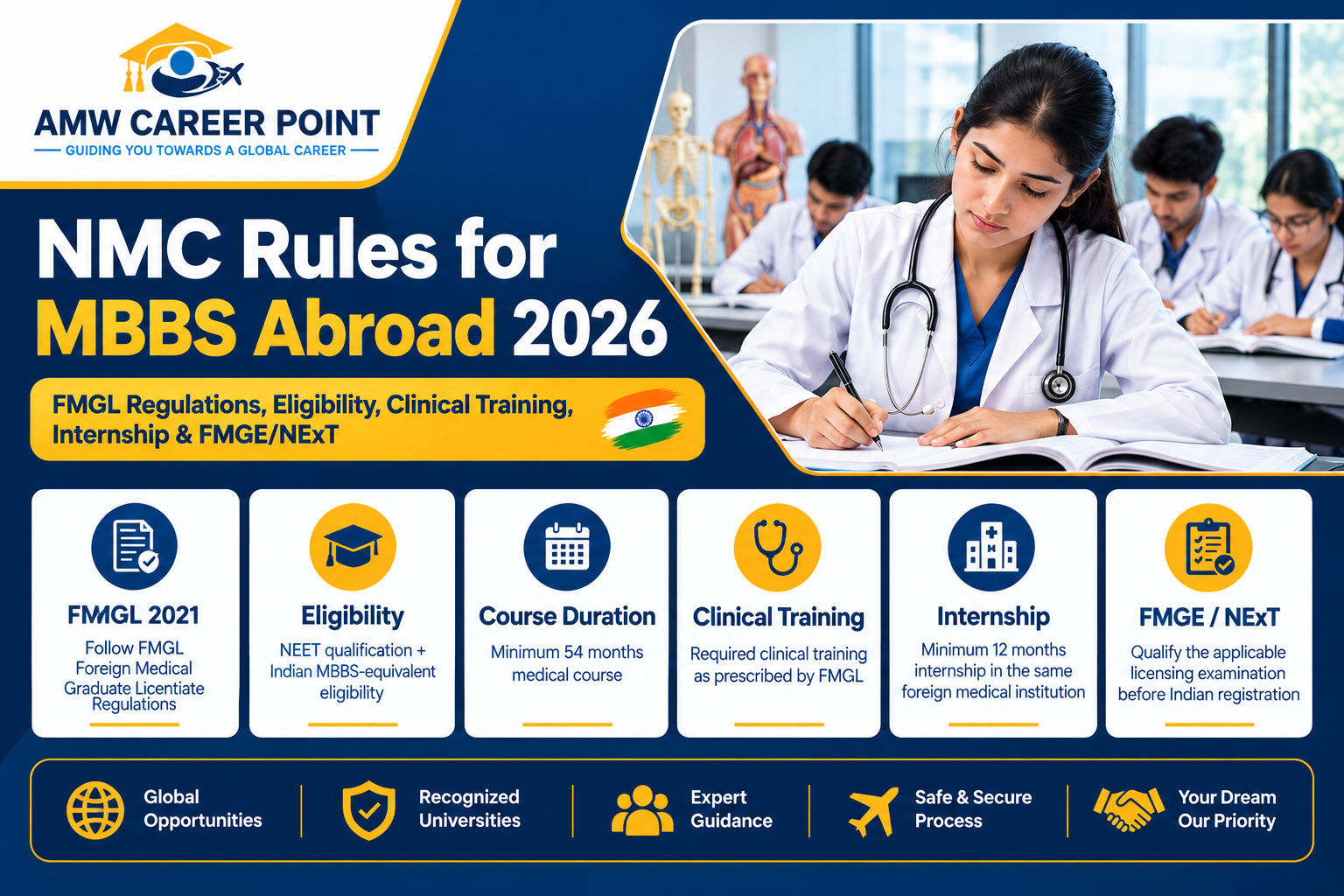
An MBBS in the Philippines is awarded as a Doctor of Medicine (MD) degree, the Philippine equivalent of MBBS, at CHED-recognised Higher Education Institutions (HEIs). Per the Embassy of India's June 2026 advisory, the professional MD curriculum runs 54 months (excluding the pre-medical BS phase), is delivered entirely in English, covers the mandatory subjects listed under the NMC notification dated 18 November 2021, and is followed by a 12-month internship at the same institution or its attached teaching hospital.
The structure that catches most Indian students off guard is the pre-medical bridge. Philippine medical education traditionally follows a BS-then-MD pattern for Filipino students, where a four-year undergraduate science degree precedes four years of MD study. Most universities that actively recruit Indian students run a shortened or waived pre-medical bridge for NEET-qualified applicants with a strong 12th-grade science background, condensing this phase to roughly one to two years. The total time an Indian student spends in the Philippines bridge year, 54-month MD, and 12-month internship combined typically lands between 5.5 and 7 years, depending on the university's specific bridge policy. This detail is rarely spelt out clearly, and it is the single biggest variable in how long the full degree actually takes. Furthermore, for more information, visit Advisory on Medical Education in the Philippines at https://www.eoimanila.gov.in/alerts-details/6821
Manila, Cebu, and Davao are the three cities that matter most for Indian medical aspirants. Manila is the capital and the country's largest academic hub, home to long-established institutions such as the University of Santo Tomas. Cebu has built one of the largest Indian student communities in the country around universities such as UV Gullas College of Medicine and Southwestern University. Davao, in the south, is anchored by Davao Medical School Foundation, one of the most recognised names among Indian MBBS-abroad consultants for over a decade.
Philippines MBBS at a Glance in 2026
Country | Republic of the Philippines (Southeast Asia) |
Main MBBS Cities | Manila (primary), Cebu, Davao, Iloilo, Baguio |
Course Offered | Doctor of Medicine (MD) MBBS Equivalent |
Course Duration | Pre-medical bridge (1–2 yrs, varies) + 54-month MD + 12-month internship — total approx. 5.5–7 years |
Medium of Instruction | English (100%) at CHED-recognised institutions |
NEET Requirement | Mandatory for Indian students intending to practice in India; min. 50% PCB aggregate (General), 40% (SC/ST/OBC) |
Total All-In Cost | ₹18–35 Lakhs depending on university, city, and bridge-year length |
FMGE Pass Rate (National, Recent Years) | Approx. 18–27% — wide spread by university; some institutions post 40–56% |
Embassy Advisory Status | Confirmed NMC FMGL compliance Embassy of India, Manila, 17 June 2026 |
PLE (Local Licensure) | Optional for India-bound students; reciprocity for Indian nationals not yet established |
Intake Period | Primary intake: September–October 2026. Some universities also run a mid-year intake. |
The Embassy of India Advisory: What Actually Changed in June 2026
This is the section that makes this guide different from anything published before mid-2026.
The Embassy of India, Manila, has periodically issued advisories on Philippine medical education for years, largely because the question of NMC compliance for the MD programme had never been formally settled. That changed with a sequence of three developments culminating in the Embassy's advisory dated 17 June 2026.
1: CHED's Letter Confirming FMGL Compliance (8 May 2025)
The Commission on Higher Education (CHED) wrote to the Embassy confirming that the MD degree awarded by Philippine HEIs satisfies the NMC's Foreign Medical Graduate Licentiate Regulations, provided the programme meets five specific conditions: a 54-month MD curriculum excluding the pre-medical BS phase, the mandatory subjects specified under the NMC's 18 November 2021 notification, 100% English-medium instruction, a 12-month internship at the same institution or its attached hospital, and a Certificate of Registrability for practice in the Philippines.
2: House Resolution No. 73 (11 March 2026)
The Philippine House of Representatives adopted Resolution No. 73, formally endorsing that the MD programme from CHED-recognised HEIs is fully compliant with NMC regulations for Indian students. The resolution goes further, stating that full practice of medicine is a privilege available to all MD graduates of CHED-recognised institutions, Filipino or foreign, once they pass the Philippine Licensure Examination (PLE), and, for foreigners, subject to compliance with immigration law.
3: The Embassy Advisory (17 June 2026)
The Embassy's advisory consolidates both developments and adds the practical caveat that matters most to Indian students and parents: students who intend to take admission at a CHED-recognised institution and return to practice in India should independently verify and satisfy themselves that all NMC-prescribed conditions are met before enrolling, and again before relying on the degree.
What This Means In Practice: The advisory is a country- and regulatory-level confirmation that indicates that the MD framework in the Philippines can be NMC-compliant. It does not certify any individual university. Verification still has to happen at the institutional level for every student, every time.
The PLE Reciprocity Gap: What No Other Blog Explains Clearly
This section will not change your eligibility to practice in India. It will change your understanding of what this degree does and does not unlock.
Under Philippine law, every medical graduate, Filipino or foreign, must pass the Physician Licensure Examination (PLE) to register and practice medicine inside the Philippines. But foreign graduates can only sit the PLE if the laws of their home country extend the same right to Filipino citizens, under the same rules that apply to that country's own nationals. As of the Embassy's June 2026 advisory, guidance from the competent authorities in India on establishing this reciprocity is still awaited.
In plain terms: an Indian MD graduate from a CHED-recognised Philippine university cannot currently sit the PLE or practise medicine in the Philippines because India has not yet established the reciprocal arrangement required by Philippine law. This has no bearing on practising in India. NExT eligibility runs on a separate NMC framework. Still, it closes off the option of staying on to practice locally, which is a realistic plan for some students at other MBBS-abroad destinations.
WARNING: Some education consultants market Philippine MD programmes with the promise of “practice locally or move to the US/UK via USMLE.” The local-practice route is currently closed to Indian graduates due to the unresolved PLE reciprocity issue. CHED has separately confirmed there is no PLE requirement for graduates intending to practice in the USA, UK, Canada, Australia, or Switzerland after meeting those countries' own licensing requirements, so the USMLE pathway remains genuinely open. Verify any claim about local Philippine practice independently before it factors into your decision.
Is the MBBS in the Philippines NMC-approved?
This is a university-level question, not a country-level one. The Embassy advisory confirms the regulatory framework can be compliant, but more than 25 institutions across the Philippines offer the MD programme, and not all of them satisfy every condition the NMC requires. A handful of universities have built two decades of Indian-student infrastructure and a track record of compliant graduates. Others have not. Picking the wrong one undoes the benefit of the entire advisory.
NMC Compliance Checklist: Every University Must Satisfy All Six
WDOMS Listing: Verify the institution at wdoms.org. If it is not listed, FMGE/NExT eligibility is blocked regardless of any other factor.
54-Month MD Curriculum (Excluding Pre-Medical BS): The professional MD phase must run the full 54 months. Shortcuts or compressed timelines outside this structure risk non-compliance with the NMC.
100% English Medium Throughout: Lectures, clinical rotations, and examinations must be conducted entirely in English, per the Embassy's confirmed compliance condition.
Mandatory Subjects Per NMC Notification (18 Nov 2021): The curriculum must cover every subject specified in Schedule I of this notification. Ask the university registrar for a subject-by-subject curriculum map before enrolling.
12-Month Internship at the Same Institution: The clinical internship must be completed at the same university or its directly attached hospital, not in India, not at an unaffiliated hospital.
Certificate of Registrability: The university must be able to issue this certificate confirming the student's eligibility for practice registration in the Philippines, even if the student does not intend to use it locally.
NMC regulations are periodically updated, and Philippine compliance is a relatively recent and still-evolving determination. Always verify the latest NMC notification at the time of admission and again before graduation. The Embassy advisory and House Resolution No. 73 reflect the position as of June 2026, confirming there have been no subsequent changes before finalising any university.
FMGE Data University-Wise
The Philippines' national FMGE pass rate has hovered in the 18–27% range over the last several exam cycles, broadly comparable to Russia's national average and noticeably below top-tier destinations such as Kazakhstan and Georgia. But the national figure hides the same pattern seen across most MBBS-abroad destinations. The gap between the best and weakest universities is quite distinguishable. Furthermore, some of the Philippines universities that students can look into are
1. AMA School of Medicine
2. Cebu Institute of Medicine
3. Angeles University Foundation School Of Medicine
4. Manila Central University Filemon D. Tanchoco
5. Davao Medical School Foundation College of Medicine
6. University of Perpetual Help System Dalta Jonelta Foundation School of Medicine
7. Our Lady of Fatima University
8. Gullas College of Medicine Inc, University of the Visayas
Southwestern University PHINMA (Cebu) and Manila Central University have both posted FMGE pass rates well above the national average in recent cycles in the 40–56% range, while several smaller, less Indian-student-focused institutions post figures in the low double digits. Davao Medical School Foundation, the most established name among Indian consultants, has historically produced some of the country's highest-scoring individual FMGE candidates, even when its aggregate pass percentage tracks closer to the national average.
University | City | Recent FMGE Pass % | Who Should Choose This University |
Manila Central University | Manila | ~50–56% (recent cycles) | Students prioritising the strongest available FMGE outcomes. Smaller Indian batch sizes than Cebu/Davao. |
Southwestern University PHINMA | Cebu | ~40–41% | Among the most consistent performers for Indian students. Strong Cebu-based Indian community. |
Davao Medical School Foundation (DMSF) | Davao | Near the national average, with consistently strong individual top scorers | Our most recommended Davao option is the oldest and most established Indian student infrastructure in the country. |
UV Gullas College of Medicine | Cebu | Near the national average | Large Indian community, modern campus. Good for students prioritising peer support and infrastructure. |
University of Perpetual Help System DALTA | Las Piñas / Manila | Near the national average | Budget-friendly Manila option with an established international student programme. |
Emilio Aguinaldo College | Manila | Near national average | Established Manila-based institution with a long history of accepting international medical students. |
University of Santo Tomas | Manila | Limited recent Indian-student cohort data published | The Philippines' oldest university; prestige-driven choice, though with less Indian-student infrastructure than the Cebu or Davao options. |
FMGE figures for Manila Central University and Southwestern University reflect recently published cohort-level results; figures described as “near national average” are trend estimates based on published NBEMS country-level data and AMW enrolment outcomes, not confirmed university-specific NBEMS releases. Always verify the latest NBEMS FMGE report, university by university, before finalising any choice.
MBBS in Philippines Fee Structure 2026 Complete Breakdown
MBBS in the Philippines fees vary more by university bridge-year policy than by city. Annual MD tuition typically runs ₹2–6 Lakhs per year. Still, the total all-in figure tuition, bridge year, hostel, food, and living costs across the full programme is the number that actually matters for budgeting.
Cost Component | Manila / Cebu (Established Universities) | Davao (DMSF) | Budget Manila Options |
Tuition for Full Programme | ₹14–20 lakh | ₹12–16 lakh | ₹10–14 lakh |
Bridge Year (if required) | ₹1.5–3 lakh | ₹1.5–3 lakh | ₹1–2.5 lakh |
Hostel for Full Programme | ₹3–5 lakh | ₹2.5–4 lakh | ₹2–3.5 lakh |
Food & Living for Full Programme | ₹4–6 lakh | ₹3.5–5.5 lakh | ₹3–5 lakh |
One-Time Initial Costs | ₹1–1.5 lakh | ₹1–1.5 lakh | ₹0.8–1.2 lakh |
Total All-In (Approx.) | ₹24–35 lakh | ₹20–30 lakh | ₹18–26 lakh |
This compares favourably with Russia and Central Asia at the lower end and sits roughly in line with Georgia and Kazakhstan at the upper end, with the added consideration of the bridge-year variable, which other destinations generally lack.
MBBS Course Structure in Philippines Phase by Phase
Phase 1: Pre-Medical Bridge (Duration Varies By University)
Foundational science coursework is required before the professional MD curriculum begins. Universities that actively enrol NEET-qualified Indian students typically shorten or waive significant portions of this phase, recognising the need for 12th-grade PCB preparation. Confirm this in writing; the length of this phase is the biggest variable in your total years abroad.
General Biology, Chemistry, and Physics review
Basic Biostatistics and Research Methods
English Communication and Filipino Culture orientation modules (varies by institution)
Phase 2: Pre-Clinical MD (Years 1–2 of the 54-Month MD)
High-weightage FMGE subjects are concentrated here. Students who treat this as a settling-in period rather than the foundation for NExT preparation pay for it later.
Human Anatomy, Physiology, and Biochemistry
Microbiology and Immunology
Pathology (introductory)
Phase 3: Clinical MD (Years 3–4 of the 54-Month MD)
Clinical clerkships rotate through major specialities at the university's affiliated teaching hospitals. The Philippines' American-influenced clinical curriculum is one of the more frequently cited advantages for USMLE-track students in particular.
Internal Medicine, General Surgery, Obstetrics & Gynaecology, Paediatrics
Psychiatry, Community Medicine, Emergency Medicine
Pharmacology and Forensic Medicine, integrated through clinical years
Phase 4: Internship (12 Months, Same Institution)
Mandatory full-time clinical internship at the same university's hospital network with a hard NMC requirement explicitly confirmed in the Embassy advisory. Graduates receive the MD degree, which functions as the MBBS-equivalent qualification for NExT purposes once all compliance conditions are verified.
Eligibility Criteria for MBBS in Philippines 2026
10+2 Subjects | Physics, Chemistry, Biology (PCB), which is mandatory |
Minimum Marks for General | 50% aggregate in PCB |
Minimum Marks for SC/ST/OBC | 40% aggregate in PCB |
NEET UG | Mandatory for any student intending to practice in India. Valid for 3 years from the qualifying year. |
NMAT (National Medical Admission Test) | Required by several Philippine universities as a local admission test, in addition to NEET. Confirm the university requirements before applying. |
Minimum Age | 17 years as of 31 December 2026 |
Passport Validity | Minimum 6 months from travel date (12 months preferred) |
Language Test | No IELTS or TOEFL required |
Pre-Medical Bridge | Required at most universities unless 12th-grade science coursework is recognised as equivalent, verify per institution. |
Admission Process for MBBS in the Philippines 2026
Applications for the September–October 2026 intake typically close by July–August. Students who start the process immediately after the NEET 2026 results in June have a comfortable window; students who wait until August will be rushing to complete incomplete paperwork against university deadlines.
Counselling & University Shortlist: Compare bridge-year length, FMGE track record, fees, and Indian community size across Manila, Cebu, and Davao options based on your NEET score and budget.
Document Collection & Verification: Check the Philippines-specific checklist and verify NMC-compliance documentation, curriculum map, WDOMS listing, and Language of Instruction confirmation before submission.
Application Submission: Direct to the chosen university. Offer or acceptance letters typically arrive within 10–20 days of a complete application.
Seat Confirmation: Confirm the seat with an initial deposit. At this stage, request the university's written confirmation of a 54-month MD duration, English-medium delivery, and same-institution internship.
Student Visa Processing: Indian nationals require a Philippine student visa (9F) processed through the Philippine Embassy/Bureau of Immigration before travel.
Arrival & Bridge-Year/Enrolment: Final enrolment, hostel allocation, student ID
Documents Required10th and 12th Marksheets
NEET UG Scorecard
Valid Passport (6+ months validity from travel date)
Passport-size photographs with a white background
Birth Certificate
Medical Certificate & required health screening results
Offer/Acceptance Letter from the university
NMAT scorecard (if required by the chosen university)
Bank statement (financial proof, where required for visa processing)
Manila vs Cebu vs Davao City-by-City Guide for Indian Students
Category | Manila | Cebu | Davao |
Top Universities | University of Santo Tomas, Emilio Aguinaldo College, Perpetual Help DALTA, Manila Central University | UV Gullas College of Medicine, Southwestern University PHINMA, Cebu Doctors' University | Davao Medical School Foundation |
FMGE Profile | Mixed Manila Central among the strongest performers | Strong Southwestern among top performers nationally | Near national average; strong individual top scorers historically |
Indian Community | Largest and most diverse capital city scale | Large and well-established, particularly around UV Gullas | Smaller but the most historically established for Indian MBBS students |
Climate | Hot, humid tropical climate year-round (25–35°C); typhoon season June–November | Similar tropical climate, slightly more moderate; less typhoon exposure than Manila | Warmest and most typhoon-sheltered of the three major cities |
Cost of Living | Higher with capital-city pricing | Moderate | Most affordable of the three |
Flights to India | Manila (MNL)–Delhi/Mumbai direct or via Dubai/Singapore. 6–10 hrs. | Cebu (CEB)–India via Manila, Singapore, or Dubai. Add 2–3 hrs. | Davao (DVO)–India via Manila or Cebu. It is the least direct of the three routes. |
Key Takeaways
The Embassy Advisory Is Real and Significant: On 17 June 2026, the Embassy of India confirmed NMC FMGL compliance for the Philippine MD programme, backed by CHED's May 2025 letter and House Resolution No. 73 (March 2026). This is a genuine regulatory clarification, not a marketing claim.
University Choice Still Decides Everything: The advisory confirms the framework can be compliant. It does not certify any specific institution. Verify the six-point NMC checklist for every university individually.
The PLE Reciprocity Gap Is Real: Indian graduates cannot currently sit the PLE or practice inside the Philippines because Indian authorities have not established reciprocity. This does not affect NExT eligibility for practice in India.
The Bridge Year Is the Hidden Variable: Total time in the Philippines ranges from roughly 5.5 to 7 years, depending on how much pre-medical bridge coursework your chosen university requires. Get this in writing before enrolling.
Total Cost: ₹18–35 Lakhs all-in, depending on the university, city, and bridge-year length, making it among the more affordable English-medium MD destinations available to Indian students.
FMGE Reality: National pass rates have ranged roughly 18–27% in recent years, with Manila Central University and Southwestern University posting figures well above that range. University choice drives outcome far more than country choice.
Frequently Asked Questions (FAQs)
Q1. Is an MBBS in the Philippines valid in India after the June 2026 Embassy advisory?
Yes, in principle, the Embassy of India has confirmed that an MD degree from a CHED-recognised institution complies with the NMC FMGL Regulations, provided that the 54-month curriculum, English-medium delivery, mandatory subject coverage, and same-institution internship conditions are met. This is a university-level verification, not an automatic blanket approval. Confirm compliance at admission and again before relying on the degree for NExT.
Q2. What is the FMGE pass rate for MBBS in Philippines?
National pass rates have ranged roughly 18–27% across recent FMGE cycles. Manila Central University and Southwestern University PHINMA have posted significantly higher recent results, in the 40–56% range, while several smaller institutions sit well below the national average.
Q3. Can I practice medicine in the Philippines after graduating?
Not currently. The Philippine Licensure Examination (PLE) is open only to foreign graduates whose home country extends reciprocal rights to Filipino citizens; India has not yet established such reciprocity. This does not affect your eligibility to return to India and sit NExT, which operates under a separate NMC framework.
Q4. How long does an MBBS in the Philippines actually take?
The professional MD curriculum is 54 months, plus a mandatory 12-month internship. Most Indian students must also complete a pre-medical bridge phase before the MD begins, typically shortened to 1–2 years for NEET-qualified applicants. Total time abroad usually ranges from 5.5 to 7 years, depending on the university's specific bridge-year policy.
Q5. What is the total cost of MBBS in Philippines?
The total all-in cost of tuition, bridge year, hostel, food, and living expenses across the full programme typically ranges from ₹18–35 Lakhs, depending on the university, city, and bridge-year length. Confirm current fees directly with the university or with AMW before making any payment.
Q6. What NEET score is required for MBBS in Philippines?
NMC requires a minimum aggregate of 50% in PCB for General category students (40% for SC/ST/OBC) and a qualifying NEET UG score for any student intending to practice in India. Several universities also require the NMAT (National Medical Admission Test) as a separate local admission requirement; confirm this per institution.