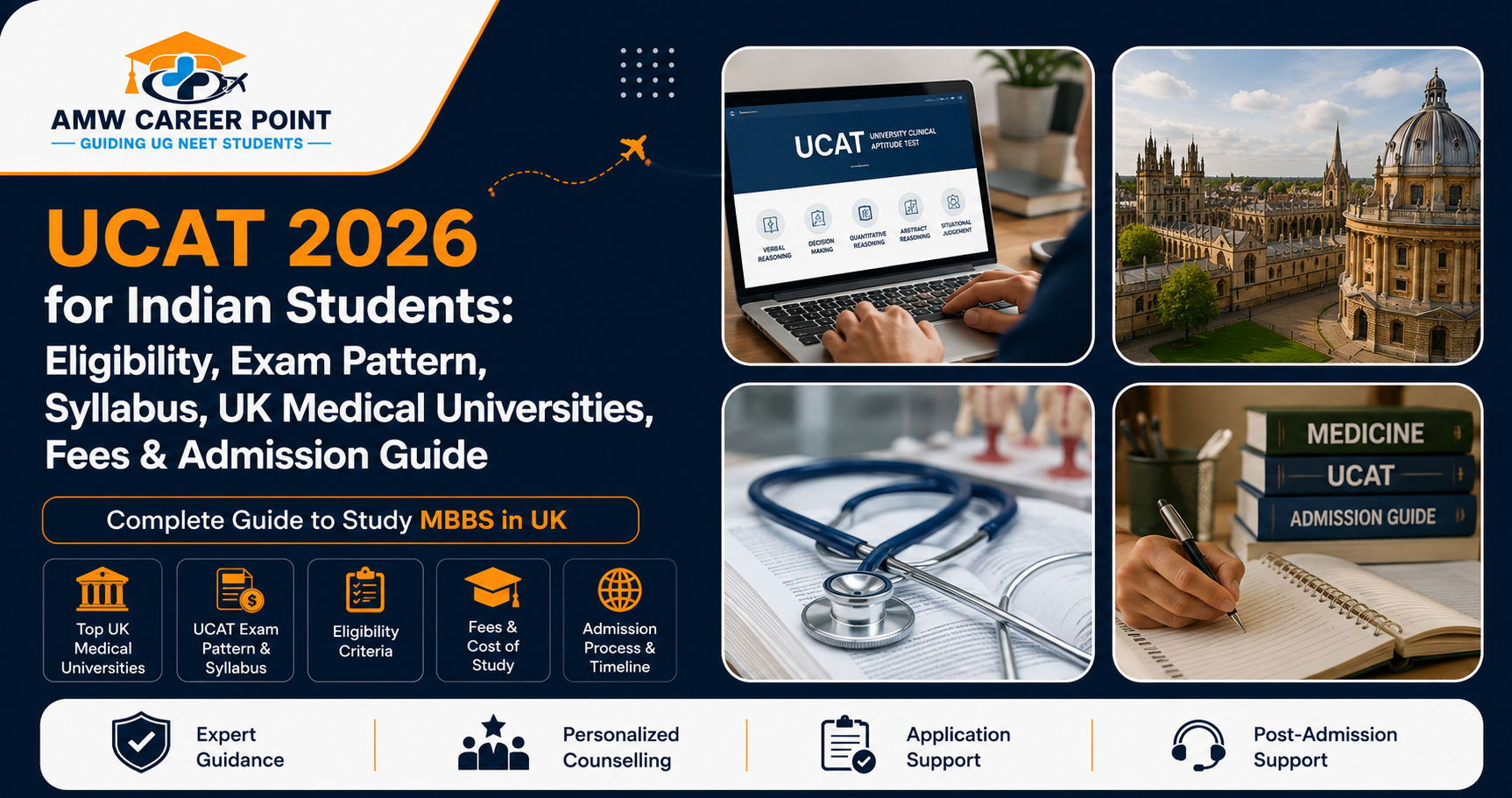
The UCAT (University Clinical Aptitude Test) is a computer-based admissions test used by a board of UK medical center and partner universities as part of selection for medicine and dentistry. Pearson VUE administers it on behalf of the UCAT Consortium, a group of universities that have agreed to use the test as a standardized aptitude measure alongside academic grades, personal statements and interviews.
What UCAT stands for
University Clinical Aptitude Test, previously called the UKCAT until it was renamed in 2019 when the test also launched in Australia and New Zealand as UCAT ANZ.
Who administers it
Pearson VUE delivers the test at test centers in the UK and 130+ countries worldwide, under rules set by the UCAT Consortium.
Why UK medical schools use it
UCAT does not test subject knowledge; no Biology, Chemistry or Physics content is examined. It is designed to assess cognitive skills and professional behaviors (verbal reasoning, decision-making, quantitative reasoning and situational judgment) that the Consortium considers relevant to medical and dental training, as a standardized measure that sits alongside, not instead of, academic grades.
UCAT vs a traditional subject-based entrance exam
This is the single most important framing for an Indian audience used to NEET. UCAT is not a syllabus-based science exam. There is nothing to "study" in the sense of a defined curriculum; preparation instead focuses on speed, technique, and familiarity with question types under serious time pressure.
Medicine, dentistry, and partner-university applications
UCAT is used for medicine and dentistry admissions at UK Consortium universities, and by a small number of partner/associate institutions outside the UK, including some in Singapore. Some UCAT ANZ Consortium universities in Australia and New Zealand also accept UCAT ANZ results for their own admissions.
Can Indian students sit the UCAT?
Yes, this is fully covered in the next section.
Can Indian Students Take UCAT?
Yes. Indian citizens, school-leaving Class 12 students, gap-year applicants, and graduates alike can register for and sit the UCAT, provided they meet the UCAT Consortium's eligibility rules for their respective applicant category. Being eligible to sit UCAT, however, does not automatically mean being eligible for every UK medical school's specific course requirements. UCAT itself instructs candidates to check each university's course-specific entry requirements separately. |
International candidates
UCAT is explicitly designed to be sat internationally; the test is delivered through Pearson VUE centers in 130+ countries. Applicants outside the UK are treated as international candidates and pay the international fee (covered below).
Indian citizens and age considerations
There is no separate UCAT-specific age floor beyond the general expectation that candidates are completing, or have completed, the qualification level (Class 12/A-Level equivalent) that would let them apply for the relevant undergraduate course in the same admissions cycle.
Gap-year students and graduates
Both groups are eligible to sit the UCAT, subject to each target university's own policy on gap-year and graduate applicants; some universities run separate graduate-entry pathways with entirely different admissions tests (see the Graduate Entry Medicine section later in this guide).
University-specific requirements: the critical distinction
Important Distinction Sitting UCAT does not, by itself, make an Indian student eligible for a specific UK medical school. Each university sets its own separate academic requirements (grades, subject prerequisites), English-language requirements, and international-student quota, all of which must be checked individually before applying, regardless of UCAT score. |
Is UCAT Required for Indian Students Applying to UK Medical Schools?
With the BioMedical Admissions Test (BMAT) discontinued from 2024 entry onward, UCAT is now the only admissions test used for undergraduate medicine across UK Consortium universities, including former BMAT users Oxford, Cambridge, Imperial, UCL, Brighton and Sussex, and Lancaster, all of which completed their move to UCAT by 2025 entry. No UK medical school currently uses BMAT for 2027 entry.
That said, UCAT compulsion is set at the university and course level, not by a single blanket national rule:
UCAT is compulsory for the relevant undergraduate medicine/dentistry courses at every UCAT Consortium university
A small number of universities do not require UCAT; these generally run on different admissions timelines or are private/independent providers
Some graduate-entry medicine (GEM) courses use GAMSAT instead of, or alongside, UCAT; policy varies by university and can change between cycles
Alternative requirements may apply to specific applicant groups (e.g., certain widening-access or graduate pathways)
Applicants intending to start a relevant course in 2027 (or deferred entry in 2028) must sit the UCAT between 13 July and 24 September 2026. This is a fixed, non-negotiable national testing window, not a suggestion.
UCAT 2026: Important Dates & Deadlines
Event | 2026 Date |
UCAT account creation/registration opens | 20 May 2026 |
Booking opens | 23 June 2026 (14:00 UK time) |
Access arrangements deadline | 10 September 2026 (15:00 UK time) |
Booking deadline (no exceptions) | 16 September 2026 (15:00 UK time) |
Testing window | 13 July – 24 September 2026 |
Bursary application/evidence deadline | 24 September 2026 (15:00 UK time) |
UCAS equal-consideration deadline (medicine) | 15 October 2026, 18:00 UK time |
UCAT results delivered to universities | Early November 2026 |
UK medicine entry begins | 2027 |
Can I apply after the UCAT deadline?
No, the 16 September 2026 booking deadline is a hard stop with no exceptions made by the UCAT Consortium. If you have not booked a test by then, you cannot sit UCAT in the 2026 cycle at all, regardless of the UCAS deadline still being weeks away.
Can I take UCAT after applying through UCAS?
No, practically speaking, UCAT must be sat within the fixed July–September testing window, which closes before the UCAS medicine deadline of 15 October. Universities require the UCAT score as part of the application, so the sequence is fixed: sit the UCAT first, then submit your UCAS application.
What happens if I miss the 2026 UCAT?
Missing the 2026 window means missing the opportunity to apply for 2027-entry UCAT-required courses this cycle. The next opportunity is the 2027 UCAT cycle, which feeds into the 2028 entry with a full-year delay.
UCAT 2026 Test Format: Complete Exam Structure
Do Not Use Old UCAT Articles Referencing Abstract Reasoning Abstract Reasoning was removed from UCAT starting with the 2025 test cycle. Any resource, book, or blog still listing five sections or a total cognitive score out of 3,600 is describing the pre-2025 format and is out of date. The current, 2026-verified structure has four sections and a cognitive total out of 2,700. |
The UCAT 2026 has four separately timed sections, always delivered in this fixed order:
Verbal Reasoning
Decision Making
Quantitative Reasoning
Situational Judgment
The full exam runs just under two hours (approximately 1 hour 57 minutes including instruction periods), with no breaks between sections in the standard format. There are 184 questions in total across the four sections.
UCAT 2026 Syllabus: Section-by-Section Breakdown
Verbal Reasoning
Verbal Reasoning tests the ability to read and critically evaluate written information and determine whether specific conclusions can be drawn from it, not prior subject knowledge. You are presented with 11 passages of roughly 750 words each, with 4 questions attached to every passage (44 questions total). You get 22 minutes of answering time (plus 1 minute 30 seconds for instructions), which works out to roughly 30 seconds per question. Two question types appear: True/False/Can't Tell items based strictly on the passage, and best-answer items asking you to identify the main conclusion or correct summary from four options.
Decision Making
Decision Making assesses your ability to make sound judgments using complex information, through logical puzzles, syllogisms, Venn diagrams, probabilistic reasoning, and argument evaluation. It is the largest section: 35 questions in 37 minutes (roughly 63 seconds per question, the most generous per-question allowance of any section, reflecting the cognitive complexity of some multi-part items). This section was expanded in the 2025 restructuring and absorbed some of the reasoning demand previously spread across the discontinued Abstract Reasoning section.
Quantitative Reasoning
Quantitative Reasoning tests numerical problem-solving less about raw arithmetic and more about interpreting data presented in charts, graphs, and tables, then applying percentages, ratios, averages, rates, and proportions to reach an answer. There are 36 questions in 26 minutes (roughly 43 seconds per question), with a basic onscreen calculator provided.
Not NEET-Level Science This is not equivalent to NEET-level Physics, Chemistry or Maths, and it is worth being direct about that distinction for an Indian audience. Quantitative Reasoning tests numerical reasoning and data interpretation under time pressure; it does not examine a syllabus-driven body of scientific content the way NEET's PCB paper does. Strong NEET-level maths ability helps with speed, but it is not what the section is actually assessing. |
Situational Judgement
The Situational Judgment Test (SJT) measures your capacity to understand real-world clinical or professional scenarios and to identify the most appropriate and important responses, testing professionalism, ethical decision-making, prioritization, communication, and patient-centered behavior. There are 69 questions in 26 minutes, based on roughly 22 scenarios, each with several follow-up items. Full marks are awarded for matching the correct answer, and partial marks for a close answer. This section works differently from the other three and is scored separately (see the Scoring section below).
UCAT 2026 Exam Pattern: Questions, Timing & Calculator
Section | Questions | Answering Time | Approx. Time/Question | Score |
Verbal Reasoning | 44 | 22 minutes | ~30 seconds | 300–900 |
Decision Making | 35 | 37 minutes | ~63 seconds | 300–900 |
Quantitative Reasoning | 36 | 26 minutes | ~43 seconds | 300–900 |
Situational Judgement | 69 | 26 minutes | ~23 seconds | Band 1–4 |
Total | 184 | ~111 minutes + instructions | — | Cognitive: 900–2,700 + SJT band |
Each section also has its own separate, shorter timed instruction period (roughly 1.5–2 minutes) before the answering time begins. These instruction periods are not included in the answering-time figures above, but they do count toward the total time at the test center.
Onscreen calculator
A basic onscreen calculator is provided only during the Quantitative Reasoning section and is not available in the other three sections.
Keyboard shortcuts, flagging, and the review screen
The UCAT interface allows candidates to flag individual questions for review and revisit them within the same section's time limit. Still, time saved or lost in one section cannot be transferred to another, since each section has its own independent timer.
Time management
Because scoring does not penalize wrong answers (there is no negative marking), leaving a question unanswered is strictly worse than guessing; with an unanswered question scoring zero, while a guess has a chance of being correct.
Breaks
There are no breaks between sections in the standard UCAT format; the exam runs continuously from Verbal Reasoning through to Situational Judgment. Candidates approved for extra time or other access arrangements should confirm their specific format directly with the UCAT Consortium, since arrangements are assessed and applied individually.
UCAT 2026 Scoring System
UCAT scoring has two genuinely separate components, and confusing them is a common mistake:
Cognitive score: 900–2,700
Verbal Reasoning, Decision Making and Quantitative Reasoning are each scored on a scaled range of 300–900. The three are added together for a cognitive total between 900 and 2,700. (Under the pre-2025 format that included Abstract Reasoning, the maximum was 3,600; any cutoff or average you see quoted on that scale is outdated and needs converting or discarding.)
Situational Judgment: Band 1–4
SJT is reported separately as a band from 1 (strongest) to 4 (weakest) and does not add to the 2,700 cognitive total. Several medical schools, including Manchester, Nottingham and Edinburgh, per their own current published policy, automatically reject Band 4 SJT results regardless of how strong the cognitive score is.
Results are typically available to the candidate on the day of the test itself (through the Pearson account), while the official score report and delivery to universities follows a separate, later timeline; universities generally receive results directly in early November, ahead of interview season.
What Is a Good UCAT Score in 2026?
There Is No Single Universal Cutoff Do not treat any single number as "the" UCAT cutoff; this is one of the most common and most damaging misconceptions among applicants. UK medical schools use UCAT scores in genuinely different ways: some set a fixed minimum threshold, some rank all applicants by score, some weight UCAT alongside academic performance in a combined formula, some use it purely to decide interview invitations, and some take a fully holistic view with no published number at all. A score that clears the bar at one university may sit well below another's typical interview threshold. |
With that caveat central to how this section should be read, some general reference points from current 2026-cycle data:
The national average cognitive score is approximately 1,880 out of 2,700
A score of around 2,100 or above meets the threshold at most UK medical and dental schools
2,220+ places a candidate in the top decile nationally
2,300+ is considered competitive at high-demand schools including Bristol, Manchester, King's and Sheffield
Oxford's 2026-entry data showed a mean score of 2,217.5 among shortlisted applicants and 2,407.1 among offer-holders, out of 2,700, illustrating how much higher "competitive" runs at the most selective schools specifically
Most universities set their actual interview threshold only after the testing window closes, based on that year's full applicant pool, meaning a fixed number cannot be predicted with certainty in advance, even by the university itself.
How UK Medical Schools Use UCAT Scores
This is far more useful than any single cutoff figure. UK medical schools fall into five broad models, and knowing which model a target school uses changes how a candidate should plan their shortlist:
Model | How It Works | Example (2026/27-cycle policy, reconfirm directly) |
Fixed threshold | A published minimum score below which an application isn't considered further | Edinburgh: minimum total cut-off of 1,850 for 2027 entry; automatic rejection for Band 4 SJT |
Ranking/decile | All applicants are ranked by score and divided into deciles; a decile-based score is added to academic ranking. | Several Russell Group schools rank applicants into 10 equal groups before combining them with academic scores. |
Weighted formula | UCAT contributes a fixed percentage alongside academic attainment | Exeter: 25% UCAT weighting, 75% academic attainment, combined into a single 'Exeter score' |
Interview-selection only | UCAT determines who is invited to interview; the interview itself decides the offer | Glasgow: applicants meeting screening criteria are allocated interviews based on UCAT score |
Holistic, no published cutoff | UCAT is one of several factors considered together, with no single stated threshold | Some schools describe a fully holistic review rather than a hard numeric bar. |
For 2027 entry, roughly half of UK medical schools publish a specific numeric interview threshold, while the rest use deciles, a points system, or a fully holistic approach with no stated cutoff. Always verify a target school's current methodology directly from its own admissions page; this table illustrates the models, not a definitive per-university figure for the year you apply.
UCAT Score Percentiles: What Does Your Score Mean?
A percentile tells you where your score sits relative to that year's full cohort of test-takers, distinct from a university's own threshold. The UCAT Consortium publishes an interim cohort report in mid-September and final national decile data in late September or early October, before the UCAS deadline, so applicants can see exactly where their score ranks nationally before finalizing their four medical school choices.
Interpreting score → percentile → competitiveness
A score that places you in a strong national percentile does not automatically make you competitive at every school; a top-decile national score may still fall short of Oxford or Cambridge's typical offer-holder range, while comfortably clearing the threshold at a school with a lower typical interview cutoff.
Minimum threshold vs competitive score
A "minimum threshold" is the lowest score a school will consider; falling below it usually results in automatic rejection, regardless of the rest of the application. A "competitive score" is meaningfully higher than that threshold and reflects what typically secures an interview or offer in practice. Confusing the two, assuming that clearing the minimum makes you a strong candidate, is a common and costly misreading.
UCAT vs NEET: Which Exam Is Harder?
Factor | NEET | UCAT |
Purpose | Indian medical admission | UK medical/dental selection |
Subjects | Physics, Chemistry, Biology (syllabus-based) | Verbal/decision/quantitative reasoning + situational judgement (aptitude-based) |
Competition pool | India-wide, several hundred thousand candidates | UK and international applicant pool, ~41,000+ UK sitters in 2025 |
Format | Subject-knowledge exam | Aptitude and reasoning test |
Science knowledge required | High a full PCB syllabus | Minimal no defined content syllabus to revise |
Time pressure | High | Extremely high which is among the tightest per-question timing of any major admissions test |
Situational Judgment component | No | Yes, a distinct, separately scored section |
Retake policy | Can be reattempted in future NEET cycles | Once per test cycle only; retaking twice in the same year is treated as candidate misconduct. |
Neither Is Objectively "Easier"
NEET and UCAT test fundamentally different abilities. NEET rewards deep, syllabus-based subject mastery accumulated over years of study. UCAT rewards speed, pattern recognition, numerical reasoning under pressure, and professional judgment, none of which map onto a defined content syllabus a student can "finish." A strong NEET performer is not automatically a strong UCAT performer, and vice versa; the honest answer to "which is harder" is that they are hard in different, largely non-transferable ways.
UCAT vs IMAT for Indian Students
For students weighing UK medicine against Italy's public-university IMAT pathway covered in full in AMW's dedicated IMAT 2026 guide, the two differ across nearly every dimension that matters to an Indian applicant:
Factor | UCAT (UK) | IMAT (Italy) |
Eligibility basis | UCAT score + academic grades + university-specific requirements | IMAT score (biology, chemistry, general knowledge and logical reasoning content); NEET establishes basic eligibility only |
Exam structure | Pure aptitude/reasoning, no fixed content syllabus | Content-based science exam with defined syllabus, plus logic/reasoning |
Science content | Minimal | Significant, biology and chemistry content genuinely tested |
Reasoning component | Central to the entire test | A defined section, not the whole test |
Language of instruction | English throughout | English at IMAT-entry public universities; Italian for DSU-linked or Italian-medium tracks |
Tuition (public, non-scholarship) | £30,150–£70,554/year, which is among the most expensive MBBS-abroad destinations | €2,500–5,000/year without DSU; €156/year with a qualifying DSU scholarship |
Living expenses | High in London £1,300–1,400/month; elsewhere £900–1,300/month | €450–1,200/month depending on city, per AMW's cost guide |
Scholarships | Limited full-funding availability for undergraduate international medicine | Italy's ISEE-linked DSU system can waive tuition to €156/year and provide a stipend based on qualifying family income. |
Number of universities | 40+ UCAT Consortium medical schools | Multiple public universities admitting via IMAT; see AMW's IMAT guide for the current list. |
Admissions process | UCAT → UCAS (4 medicine choices max) → interviews → offers | IMAT score directly ranks applicants against available seats |
Clinical pathway | NHS-integrated clinical training throughout the course | Italian public-hospital clinical training |
Post-graduation licensing (India) | FMGE/NExT required for Indian practice; see the GMC/NMC section below | FMGE/NExT required for Indian practice, subject to FMGL compliance verification |
The practical divide is largely financial and structural: UCAT/UK offers NHS-integrated training and strong international recognition at a very high cost with limited international scholarship availability, while IMAT/Italy offers EU credentials at a dramatically lower cost for ISEE-qualifying families; see AMW's IMAT 2026 guide for the complete admissions and cost breakdown.
UCAT vs Other International Medical Entrance Exams
Exam | Country/Region | Format | Science Content |
UCAT | UK, plus Singapore/international partners | Aptitude + situational judgment | Minimal |
IMAT | Italy (public universities) | Content-based science + logic | Significant |
ISAT | Select international/EU medical programs | Aptitude-based, similar family to UCAT | Minimal |
MCAT | USA (mainly graduate-entry) | Content-heavy science + reasoning | Very high |
GAMSAT | UK/Australia graduate-entry medicine | Science, reasoning and writing | High |
NEET | India | Physics, Chemistry, Biology | Very high |
This positions UCAT and IMAT/ISAT at the aptitude-and-logic-focused end of the spectrum, with MCAT, GAMSAT and NEET clustered at the content-heavy end. Students who are strong on subject knowledge but find aptitude-style speed tests difficult should weigh this pattern carefully before committing significant preparation time to any one route; see AMW's MBBS Entrance Exams 2026 guide for the fuller picture across all major pathways.
UCAT Universities 2026/27: Which Medical Schools Accept UCAT?
With BMAT fully discontinued, UCAT is now required for undergraduate medicine at essentially all UK medical schools, currently around 36–40 institutions across the UCAT Consortium, including every former BMAT university (Oxford, Cambridge, Imperial, UCL, Brighton and Sussex, Lancaster). The official UCAT Consortium university list is the primary, authoritative source; precisely because policies for 2027 entry can shift between cycles, always cross-check directly before finalizing a shortlist.
Six Schools Don't Accept International Students At All Anglia Ruskin, Sunderland, Edge Hill, Bangor, Lincoln and Pears Cumbria currently admit home (UK) students only, regardless of how attractive their advertised fee looks. Don't spend one of your four UCAS medicine choices on a school that structurally cannot admit an Indian applicant; confirm international eligibility before shortlisting, not after. |
Best UK Medical Universities Accepting UCAT for Indian Students
A working shortlist across the selectivity and cost spectrum, reflecting currently published 2026/27-cycle information. Reconfirm every cell directly with the university before applying, since fees and thresholds are reviewed annually.
University | Course Length | International Fee (2026/27) | UCAT Selection Method |
6 yrs (MBBS/BSc) | £58,600/year (~£3,51,600 total) | UCAT + academic screening; only 74 international places/year — highly competitive | |
6 yrs (MBChB) | £32,100 (yrs 1–2) / £49,000 (yrs 3–5) | Fixed minimum total cut-off (1,850 for 2027 entry); automatic rejection for Band 4 SJT | |
5 yrs | £29,000 (yrs 1–2), rising in clinical years | UCAT + academic scoring; one of the lower-cost GMC-accredited options | |
University of Oxford | 6 yrs (A100) | £49,400 (yrs 1–3) / £65,250 (yrs 4–6) | 50% UCAT + 50% contextualised GCSE at shortlisting; 2026-entry offer-holder mean ~2,407/2,700 |
University of Cambridge | 6 yrs (A100) / 4 yrs graduate (A101) | £29,052–£70,554 (medicine at the top end) + annual college fee £11,500–14,950 | UCAT considered alongside academics; nearly all shortlisted applicants interviewed by College |
University College London (UCL) | 6 yrs | £47,450+/year (rising in clinical years) | UCAT considered with academics; 2026-cycle overseas threshold reported around 2,300 |
University of Nottingham | 5–6 yrs | From ~£30,200/year | UCAT + academic screening; among the lower-fee options |
University of Southampton | 5 yrs | From ~£30,200/year | Applicants ranked by UCAT score to determine Selection Day invitations |
University of Exeter | 5 yrs | Mid-range international fee | Weighted formula: 25% UCAT, 75% academic attainment, combined into a threshold Exeter score |
University of Glasgow | 5 yrs | Mid-range international fee | UCAT-based interview allocation after screening; 2025-entry threshold reported around 2,500 |
UCAT Medical Universities: International Student Requirements
Beyond UCAT and tuition, every UK medical school independently sets its own academic and language requirements for international applicants. The checklist below is what genuinely needs verifying, university by university, before an Indian student commits a UCAS choice:
CBSE/ISC/State Board acceptance and equivalency grading
IB and A-Level acceptance where relevant
Whether NEET is required for admission (see the dedicated section below)
Biology requirement grade and subject-specific expectations
Chemistry requirement
Physics/Maths requirement, where applicable
Minimum overall marks/predicted grades
English-language requirement and accepted tests (IELTS/TOEFL)
Whether an interview or MMI is required, and its format
The university's UCAT score methodology (threshold, ranking, weighted, holistic)
International tuition fee for the specific year of entry
International student quota/number of places available
None of these can be safely generalized across universities; a requirement true at one school (e.g., a specific Chemistry grade) may not apply, or may apply differently, at another.
Can CBSE Students Apply to UK Medical Schools Through UCAT?
Yes, in principle, CBSE Class 12 with a strong PCB (Physics, Chemistry, Biology) profile is a recognized qualification pathway that UK medical schools regularly consider for international applicants. What matters in practice:
Class 12 predicted grades (for early-cycle applications) and final grades (for confirmation of any conditional offer)
Subject-specific requirements most schools expect: Chemistry plus at least one of Biology, Physics or Maths at a strong grade
University-specific grade equivalency tables mapping CBSE percentages/grades to the UK grading system
Individual university policy: CBSE acceptance and the exact equivalency standard vary by institution and must be checked directly, not assumed
Can Indian State Board Students Apply Through UCAT?
The same framework applies to State Board qualifications (Rajasthan Board, Maharashtra Board, Karnataka Board, UP Board, and other recognized state boards) as to CBSE. UK universities generally maintain equivalency standards for major Indian boards. Still, acceptance and the specific grade-equivalency threshold must be confirmed with each university's international admissions office rather than assumed to be automatic.
Is NEET Required to Study Medicine in the UK Through UCAT?
This question genuinely needs two separate answers, because it conflates two entirely different regulatory systems.
The UK university admission requirement
UK universities do not require NEET for admission to a UK medical degree. UK medical schools admit based on the UCAT, academic grades (CBSE/ISC/State Board/A-Level/IB), and interviews; NEET does not factor into their selection criteria at all.
The Indian regulatory requirement for an Indian citizen intending to practice in India
A Separate, Later Question An Indian citizen (or OCI) who completes a foreign medical degree, including a UK degree, and wishes to practice medicine in India must separately satisfy the NMC's Foreign Medical Graduate Licentiate (FMGL) framework, which is a distinct requirement from anything the UK university itself asks for. NEET's role here is specifically tied to India's own regulatory framework for foreign medical graduates, not to UK admission. This distinction between UK admission requirements and Indian regulatory requirements is covered in full in the GMC/NMC section further down this guide, and in AMW's MBBS Abroad Admission Pathways 2026 and What to Do After NEET Results 2026 guides. |
UCAT and English-Language Requirements
UCAT itself is delivered entirely in English, and Verbal Reasoning in particular is language-dependent, but sitting and passing UCAT does not automatically satisfy a university's separate English-language entry requirement.
UCAT is in English throughout, with no language options
Performing well on UCAT (especially Verbal Reasoning) demonstrates strong English comprehension, but is not formally treated as equivalent to an IELTS/TOEFL certificate by admissions offices
IELTS/TOEFL requirements vary by university; some set a minimum overall band with sub-scores, others set different thresholds entirely
English-medium schooling exemptions vary; some UK universities waive IELTS for applicants who studied entirely in English-medium schools; others do not, or apply this only under specific conditions
Indian students should check each medical school's current English-language policy individually rather than assuming a strong UCAT Verbal Reasoning score exempts them from IELTS/TOEFL
Does UCAT Have an English Language Requirement?
UCAT Eligibility ≠ University English-Language Eligibility UCAT does not itself impose a separate English-language proficiency requirement to register or sit the test — anyone eligible to sit UCAT can do so regardless of English test scores. But this is entirely independent of each university's own English-language entry requirement for admission, which is set and assessed separately. Meeting one does not automatically mean meeting the other. See AMW's Language Requirements for MBBS Abroad 2026 guide for the fuller comparison across destinations. |
UCAT Registration Process 2026: Step-by-Step
Create a UCAT account; A new account is required every cycle, even for returning candidates, from 20 May 2026 onward.
Register your intent to sit the test through your account dashboard.
Check your eligibility against the UCAT Consortium's current rules for your applicant category.
Apply for a bursary or access arrangements from your dashboard; if eligible, do this before booking.
Wait for booking to open on 23 June 2026 at 14:00 UK time.
Select your preferred test center, date and time.
Pay the test fee (see below) to confirm your UCAT booking.
Carefully review and check your appointment confirmation email.
Sit the test at your booked Pearson VUE center.
Receive your score on the day through your Pearson account.
UCAT Exam Fees 2026
Candidate Category | 2026 Fee |
UK candidates | £70 |
International candidates (including India) | £115 |
Bursary Scheme (eligible UK candidates only) | Covers the test fee in full and is not available to international candidates |
Indian applicants, sitting as international candidates, should budget for the £115 international fee. Rescheduling is permitted before the 16 September booking deadline, subject to slot availability; missing a booked test without canceling in advance forfeits the fee. The bursary scheme that covers the test fee for eligible candidates is restricted to UK-domiciled applicants and does not extend to international candidates sitting from India.
Can UCAT Be Taken in India?
Yes. UCAT is delivered through Pearson VUE test centers in over 130 countries worldwide, including India.
Indian test-center availability varies by city: Major metros are more likely to have an active Pearson VUE center than smaller towns
Locate centers through the Pearson VUE test center locator linked from your UCAT account once booking opens
If your closest center has no availability on your preferred date, you can book a different Indian city or, if genuinely necessary, a center in a neighboring country, but this depends entirely on seat availability at booking time
Book as early as possible after 23 June 2026; September dates and popular centers are in high demand and fill quickly
UCAT ID Requirements for Indian Students
UCAT's official ID policy requires an original, unexpired, government-issued photographic ID at the test center; copies, screenshots, or expired documents are not accepted.
Passport: The most reliable and universally accepted ID for international sittings
The name on your ID must match the name on your UCAT account exactly, including spelling and order
A clear, recent photograph and, where applicable, a legible signature are required on the ID
Aadhaar and other government-issued Indian IDs may be accepted depending on current UCAT Consortium policy; passport remains the safest default for international sittings and should be your primary planning assumption
Bring the original document: A digital copy, PDF, or photograph of the ID on your phone will not be accepted at the test center
Confirm ID Requirements Directly Before Test Day The UCAT Consortium can update ID policy details between cycles. Before traveling to your test center, re-check the current, exact ID policy directly on the official UCAT website rather than relying on this or any other secondary guide. |
UCAT Exam Day: What Happens?
Arrive at the test center well ahead of your booked appointment time. Pearson VUE centers generally recommend arriving with a buffer for check-in and security procedures
Present your original, valid photo ID matching your account name exactly
Undergo standard test-center security procedures (ID verification, personal item storage, and in some cases a physical check)
Sit at an assigned computer terminal for the full test
Use of scratch paper or laminated note boards is typically provided by the center for working out Quantitative Reasoning and questions on decision making; bringing personal paper and pens is not permitted
No breaks between sections in the standard format; the test runs continuously
Report any technical issues to test-center staff immediately during the test, not after
Any form of misconduct (including attempting to sit the test more than once in a cycle) can result in results being withdrawn
Leaving early before completing all sections is possible but not advisable; once you exit a section, you cannot return to it
UCAT Preparation: How to Prepare from India
Because the UCAT has no defined content syllabus, preparation is fundamentally about technique, speed, and familiarity, not about memorizing facts. Realistic ranges by starting point, not a single fixed hour count:
3-month plan
Weeks 1–4: build familiarity with all four question types using official free resources. Weeks 5–8: timed section-by-section practice, tracking accuracy separately from speed. Weeks 9–11: full timed mock tests under real exam conditions, with a structured error log after each one. Final week: light review only; avoid cramming new question types just before test day.
2-month plan
Compress the same structure: 2 weeks of question-type familiarisation, 4 weeks of timed section practice and error-log review, final 2 weeks of full mocks and targeted weak-area drilling.
1-month plan
Only realistic for a candidate already comfortable with the question formats. Focus almost entirely on timed practice and full mocks rather than learning new content; the priority becomes pacing and stamina, not technique-building from scratch.
2-week revision plan
Final-stretch consolidation only: 2–3 full timed mocks, review of the error log built over the preceding weeks, and rest in the final 48 hours. This window is not sufficient to build technique from zero; it assumes the bulk of preparation is already done.
UCAT Preparation Strategy for Each Section
Verbal Reasoning strategy
Practice skimming for structure before reading for detail; build the discipline of answering strictly from the passage rather than outside knowledge or assumption, since Type 1 True/False/Can't Tell questions specifically penalize inferential over-reach.
Decision Making strategy
Build fluency with Venn diagrams, syllogisms, and basic probability under time pressure; this section offers the most variety of question types, so a repeatable method for each question type matters more than raw speed.
Quantitative Reasoning strategy
Train mental arithmetic and estimation so that the onscreen calculator becomes a speed tool rather than a crutch; practice recognizing what a question is actually asking before reaching for a calculation.
Situational Judgment strategy
Study the GMC's core principles around patient safety, professionalism, confidentiality, and teamwork, since SJT scenarios are built around these, but also practice the section's specific time pressure (roughly 23 seconds per question), which surprises many otherwise well-prepared candidates.
Across all four sections, the underlying skill progression is the same: accuracy first, then speed, then full-length timed mocks to build stamina and pacing instinct.
How Many Hours Should You Study for UCAT?
There is no single verified official figure, and any resource claiming an exact number ("you need precisely 200 hours") is presenting a guess as a fact. What's realistic is a range: most well-prepared candidates report spending 40-100+ hours of focused practice spread across 6–12 weeks, with the wide range reflecting genuine differences in starting familiarity with timed multiple-choice testing, not a flaw in any individual study plan. Consistent, spaced practice with regular full mocks tends to outperform the same total hours crammed into a short window.
Best UCAT Preparation Resources
Official UCAT resources start here.
The UCAT Consortium explicitly recommends its own free official preparation materials as the first resource for every candidate: question tutorials covering each section's format, official practice tests built to the current 2026 specification, and interactive test tools that replicate the actual exam interface (including the onscreen calculator and flagging system). These are free, current, and built by the organization that sets the real exam; they should be exhausted before turning to any paid resource.
Additional resources
Commercial question banks useful for volume of practice once official materials are exhausted
Books: Can help with foundational technique, though most are now supplementary to online question banks
Coaching (covered separately below)
YouTube: Useful for technique explainers, less reliable for full-length timed practice
Full-length mock exams from reputable, current (2026-format) providers. This is Critical for pacing and stamina regardless of which other resources are used
Should Indian Students Take UCAT Coaching?
This is genuinely a judgment call, not a universal answer. Here's an objective look at the three main approaches:
Self-study
Lower cost, maximum flexibility around school/college schedules, and works well for disciplined students comfortable building their own structured plan from official and commercial resources. Requires strong self-motivation to maintain a consistent, timed-practice routine without external accountability.
Coaching
Provides structure and accountability, and ensures the coaching is genuinely current, with familiarity specifically with the 2026 four-section format (older coaching material built around the discontinued five-section format is a real risk to watch for). Higher cost, and quality varies significantly between providers.
Hybrid
A common middle path: self-study through official free resources for the bulk of preparation, supplemented by a shorter, focused coaching block or a small number of expert-reviewed mock tests closer to the test date. This can combine the cost efficiency of self-study with targeted expert feedback where it matters most.
Whichever route is chosen, the one non-negotiable check is currency: any coaching provider or resource still teaching a five-section format with Abstract Reasoning or a 3,600-point scale is using outdated material and should be avoided.
UCAT Mock Tests: How to Use Them Properly
Diagnostic test: One early full mock, before structured preparation begins, to identify genuine strengths and weaknesses rather than assumed ones
Timed practice: Section-by-section drilling under strict time limits, not untimed practice, since UCAT's defining challenge is speed under pressure
Full mocks: Complete, uninterrupted sittings that replicate real exam length and format, ideally at the same time of day as your booked test
Error log: A structured record of every missed question, categorized by reason (misread the question, ran out of time, genuine knowledge gap in technique), reviewed regularly rather than just noted and forgotten
Section-wise improvement: Track score trends per section over time, not just overall score, since a flat overall average can hide one badly underperforming section
Final-week mocks: One or two full mocks in the final week to confirm pacing and build test-day confidence, not to cram new technique
How UCAT Results Are Sent to Universities
Candidates receive a personal score report on the day of testing, accessible through their UCAT/Pearson account. This lets you plan your UCAS medicine choices with your actual score in hand, before the UCAS deadline. Separately, the UCAT Consortium delivers official results directly to every UK university a candidate applies to, on a fixed national schedule typically in early November, after the UCAS medicine deadline has passed and applications have been submitted. Candidates do not need to send their score to universities themselves; the transmission is automatic and centralized.
UCAT Score vs Medical School Selection
There Is No Universal UCAT Cutoff for All UK Medical Schools This bears repeating because it's the single most common misconception. A score that comfortably clears the interview threshold at one university may not even meet the minimum requirement at another. Building a UCAS shortlist around a single assumed 'good score' rather than each target university's actual published methodology is one of the most avoidable mistakes an applicant can make; see the university selection methodology table earlier in this guide. |
UCAS Application for Medicine After UCAT
UCAS (Universities and Colleges Admissions Service) is the single centralized system through which all full-time undergraduate applications to UK universities, including medicine, are submitted.
UCAS registration: Create an account and complete personal/academic details
Course choices: Select your target universities and courses (see the choice-limit rules below)
Application questions: UCAS moved to a new free-text question format (replacing the traditional single personal statement) for recent cycles; confirm the current format for the 2027-entry cycle directly on UCAS before drafting
Reference: A teacher/school reference is required as part of the application
Predicted grades: Provided by your school for Class 12/final-year students applying before results are out
UCAT score: Submitted automatically by the UCAT Consortium directly to your chosen universities, not manually attached by you
Deadline: 15 October 2026, 18:00 UK time, for medicine, dentistry, veterinary medicine and all Oxford/Cambridge courses
Application fees: Currently a single fixed fee covering up to five choices
How Many UK Medical Schools Can You Apply to Through UCAS?
UCAS allows a maximum of five course choices in total. Within that overall limit, medicine (along with dentistry and veterinary medicine/science) is restricted to a maximum of four choices; the remaining fifth choice, if used, must be a different, non-medicine subject.
You cannot apply to both Oxford and Cambridge for undergraduate medicine in the same cycle, and it's one or the other (the exception is Cambridge's graduate-entry A101 course, which allows both in specific circumstances)
Almost all serious medicine applicants use all four available medicine choices to maximize their chances, given how competitive UK medical admissions are
The fifth choice, if used, is commonly a related science course (useful as a platform for graduate-entry medicine later) or a genuinely different subject entirely; it's a personal decision, not a formal requirement
Applications to non-UK medical schools (including any outside the UCAS system) do not count against this four-choice limit
Verify the Exact 2027-Cycle Wording Before Applying. UCAS rules and application formats are reviewed and may be updated between cycles; confirm the exact wording on UCAS's own site before finalizing your choices, rather than relying on this or any other secondary source alone. |
UCAT + UCAS Timeline for an Indian Student
May 2026 → UCAT registration opens (20 May) June 2026 → UCAT booking opens (23 June) July–September 2026 → UCAT testing window (13 July – 24 September) September 2026 → UCAS submission preparation, using your known UCAT score 15 October 2026, 18:00 UK time → UCAS medicine application deadline Late 2026 / early 2027 → Interviews (MMI or panel, school-dependent) 2027 → Medicine begins |
UK Medical School Interviews After UCAT
An offer to interview is not an offer of a place; interviews are a separate, decisive stage of selection, typically running from November through March, after UCAT results are delivered and UCAS applications close.
Multiple Mini Interviews (MMI): A series of short, timed stations, each testing a different skill or scenario
Panel interviews: A more traditional, single extended conversation with two or more interviewers
Ethical scenarios: Testing reasoning through medical-ethics-style dilemmas, not requiring prior clinical knowledge
Communication: Clarity, structure and active listening under pressure
Motivation for medicine: Genuine, specific reasons rather than generic answers
NHS knowledge and current healthcare-system awareness: A meaningful expectation for UK-specific applications
Work experience and reflection: What was observed and learned, not just where it happened
Professionalism: Including how candidates discuss failure, feedback and ethical grey areas
International student considerations: Some schools run separate international-applicant interview slots or formats; confirm this directly
What Is MMI for UK Medical Schools?
The Multiple Mini Interview (MMI) format breaks the traditional single interview into a series of short, independently timed stations, typically 5–10 minutes each, that a candidate rotates through in sequence.
Station format: Each station tests a specific skill (ethics, communication, teamwork, data interpretation, role-play) independently of the others
Time limits: Strictly enforced per station, with a signal to move on regardless of whether the candidate feels finished
Common themes: Patient confidentiality, consent, resource allocation, teamwork under pressure, and reflection on experience
Ethical questions: Presented as scenarios requiring reasoned judgment, not a single 'correct' memorized answer
Communication tasks: Explaining a concept clearly, or communicating difficult information appropriately
Role-play: Some stations simulate a conversation with a standardized patient or colleague actor
Because each station is scored independently, a single weak station does not necessarily sink an overall MMI performance, unlike a single traditional panel interview, where one bad stretch can dominate the entire assessment.
UCAT + Interview: Which Is More Important?
It depends on the university genuinely, not as a deflection. Three broad patterns:
UCAT-heavy selection
Schools using a fixed threshold or ranking model rely heavily on the UCAT to decide who is even invited to interview; a weak UCAT score can end an application before the interview stage even begins.
Interview-heavy selection
Schools that use UCAT mainly as a screening gate and then weight the interview much more heavily in the final offer decision effectively make the interview the decisive stage for anyone who clears the initial bar.
Holistic selection
Some schools combine UCAT, academics and interview performance into a single weighted or fully holistic judgment with no single dominant factor. Exeter's published 25% UCAT / 75% academic formula, which feeds into a threshold for interview invitations, is one concrete example of this middle ground.
The practical takeaway: know each shortlisted university's specific model (from the methodology table earlier in this guide) rather than assuming UCAT or interview performance matters more everywhere.
UK Medical School Fees for Indian Students
International tuition fees vary enormously across UK medical schools from around £29,000/year at the most affordable GMC-accredited options to over £70,000/year at Cambridge. Many schools also charge a materially higher rate for clinical years (typically years 3 onward) than for pre-clinical years, so a 'from' figure quoted for Year 1 can meaningfully understate the true multi-year cost.
University | Pre-Clinical Fee/Year | Clinical Fee/Year | Course Duration |
University of Leicester | £29,000 (yrs 1–2) | Higher: please confirm current rate directly | 5 years |
University of Nottingham / Southampton | ~£30,200/year | Rises in clinical years at most schools | 5 years |
University of Edinburgh | £32,100 (yrs 1–2) | £49,000 (yrs 3–5) | 6 years (MBChB, includes intercalated year) |
University College London (UCL) | £47,450 (yrs 1–2) | Rises in yrs 3+ confirmed directly | 6 years |
University of Oxford | £49,400 (yrs 1–3) | £65,250 (yrs 4–6) | 6 years (compulsory intercalated degree) |
Imperial College London | £58,600/year flat | Same rate throughout | 6 years (MBBS/BSc) |
University of Cambridge | £29,052–£70,554 (medicine at top end) | Plus, annual college fee £11,500–14,950 | 6 years (A100) or 4 years graduate (A101) |
Six-year courses (Oxford, Cambridge, UCL, Imperial, Edinburgh) cost the most overall; the extra year, layered on top of already-higher annual fees, is a significant compounding factor that many families underestimate when comparing headline 'per-year' figures across universities with different course lengths.
Total Cost of Studying Medicine in the UK for an Indian Student
Tuition alone is not the number to plan around. A realistic total-cost framework:
Cost Category | Realistic Range |
Tuition (5–6 years, international rate) | £150,000–£420,000+ depending on university and course length |
Accommodation | Varies sharply by city; London runs materially higher than most other UK cities |
Food | Part of the broader living-cost budget below |
Transport | Local transport costs, plus flights to/from India |
Visa application fee | £558 (from 8 April 2026), same whether applying from India or switching within the UK |
Immigration Health Surcharge (IHS) | £776/year of visa validity, paid upfront for the full course duration |
UCAT test fee | £115 (international rate) |
UCAS application fee | A single fixed fee covering up to five choices |
Flights | Return flights India–UK, at minimum once per year in practice |
Books/equipment | Course-specific; clinical years often add equipment costs |
Living costs (9-month visa financial-requirement benchmark) | £13,761 (London) or £10,539 (outside London), held for 28 days before visa application a useful proxy for annual living costs, though actual annual spend can run higher across a full 12 months |
Is Studying Medicine in the UK Expensive for Indian Students?
Yes, the UK sits at the most expensive end of every major MBBS-abroad destination AMW covers, once the full course is priced out, not just Year 1 tuition.
Destination | Realistic All-In Total (Full Course) |
UK (UCAT route) | ₹2.3 crore – ₹5.5 crore+ |
India private medical college | ₹50 lakh – ₹1.5 crore+ depending on state, college and quota |
Italy (IMAT route, no DSU scholarship) | ₹65–97 lakh over 6 years |
Italy (IMAT route, with qualifying DSU scholarship) | A fraction of the above income-dependent |
₹22–56 lakh over 6 years, university-dependent | |
₹18–30 lakh over 5–6 years | |
Uzbekistan (NMC-compliant universities) | ₹19–35 lakh over 6 years |
On cost alone, the UK is not competitive with any of AMW's other covered destinations, including a private Indian medical college in many cases see AMW's MBBS Abroad Cost 2026 guide for the full country-by-country breakdown. The UK's case rests on factors other than price: NHS-integrated clinical training, the GMC's international standing, and the strength of a UK medical degree as a credential not affordability.
Scholarships for Medicine in UK for Indian Students
University scholarships: Some UK medical schools now offer dedicated international scholarships; for example, Imperial's new Imperial Inspires Scholarship offers £15,000/year for international Faculty of Medicine students from 2027 entry, per current university material
International/merit scholarships: Offered by some universities based on academic profile, generally covering a portion, not all, of tuition
Financial aid: Need-based support is more common at postgraduate level than for international undergraduate medicine
Government schemes: Some students pursue government-sponsored or bilateral scholarship schemes; availability and terms vary and should be checked against current, official sources
External scholarships: Offered by third-party foundations and trusts, generally competitive and limited in number
Can Indian Students Get Fully Funded Medicine in UK?
Honestly: full funding for international undergraduate medicine in the UK is uncommon, not the norm. It's worth being direct about this rather than implying it's a realistic default expectation.
Undergraduate medicine is different from postgraduate scholarships most large, well-publicised UK scholarship schemes target postgraduate study, not undergraduate international medicine specifically
University-specific awards (like Imperial's example above) typically cover a meaningful portion of tuition, not the full cost including living expenses
External funding exists but is competitive and limited in number relative to the size of the international applicant pool
Family/self-financing remains the dominant funding model for Indian students pursuing UK medicine
Education loans from Indian or international lenders are the most common way families bridge the gap between available funds and total course cost
UK Student Visa for Indian Medical Students
Requirement | 2026 Detail |
Visa application fee | £558, from 8 April 2026 (up from £524) same rate whether applying from India or switching within the UK |
Immigration Health Surcharge (IHS) | £776/year of visa validity, paid upfront in full for the entire course duration |
Confirmation of Acceptance for Studies (CAS) | Issued by the university after an unconditional offer is accepted required to apply |
Financial requirement (maintenance funds) | £1,529/month in London (£13,761 for 9 months) or £1,171/month outside London (£10,539 for 9 months), held in the applicant's account for 28 consecutive days before applying |
English-language requirement | Generally CEFR B2 for degree-level courses, via an approved Secure English Language Test check the specific university's accepted test list |
Passport | Valid, original passport required for the application and biometric appointment |
TB test certificate | Mandatory for applicants from India as part of the standard document checklist |
Dependants | Rules tightened from January 2024 most undergraduate students, including medicine, generally cannot bring dependants; PhD/doctoral-level exceptions exist but don't apply to undergraduate medicine |
Work restrictions | Student visa holders can generally work up to 20 hours/week during term time see the next section for why this shouldn't be treated as a funding strategy |
Can Indian Medical Students Work While Studying in UK?
Student visa holders on most UK degree courses can generally work up to 20 hours per week during term time and more during official holidays, subject to their specific visa conditions.
Medicine's academic workload is exceptionally demanding, particularly from the clinical years onward, when timetabled hospital placements often extend well beyond a standard teaching day
Clinical placements frequently run on rotating or unpredictable schedules that make consistent part-time work genuinely difficult to sustain
Whether part-time employment is realistic varies enormously by individual and by year of study; pre-clinical years generally allow more flexibility than clinical years
Don't Plan Around Part-Time Work as a Funding Strategy Given the scale of UK medical tuition (tens of thousands of pounds per year), 20 hours/week of part-time work at typical student wages makes a marginal dent in the total cost, not a meaningful one, and risks compromising academic performance in one of the most demanding undergraduate courses available. Budget the full course cost from confirmed funding sources (family resources, scholarships, education loans) rather than counting on term-time work to close a funding gap. |
Medicine in the UK: Course Duration
Standard undergraduate medicine: Typically 5 years at most UK medical schools
Six-year courses: Oxford, Cambridge, UCL, Imperial and Edinburgh run a compulsory six-year structure that includes a built-in intercalated (research) year, adding both time and cost compared to the 5-year standard
Graduate-entry medicine (GEM): Accelerated 4-year courses for applicants who already hold an undergraduate degree (see the dedicated section below)
Optional intercalated years: Some 5-year courses outside Oxbridge/Imperial/UCL/Edinburgh offer an optional additional intercalated year, which adds a further year of fees if taken
University-specific differences: Always confirm the exact course length for a specific university and course code rather than assuming a uniform 5- or 6-year structure across the board
Graduate Entry Medicine vs Undergraduate Medicine
Factor | Undergraduate Medicine (UCAT route) | Graduate Entry Medicine (GEM) |
Eligibility | Class 12/A-Level or equivalent, no prior degree required | Requires an existing undergraduate degree, generally at 2:1 classification or above |
Admissions test | UCAT (nearly universal for undergraduate medicine) | Varies by university — some require GAMSAT only, some allow UCAT or GAMSAT, some require UCAT only; no single universal rule |
Course duration | 5–6 years | Typically 4 years (accelerated) |
Competition | High | Very high — fewer places, drawn from a smaller but highly qualified applicant pool |
International applicants | Standard international fee status and quota rules apply | Same international fee status applies; places are often even more limited than undergraduate entry |
Cambridge's four-year Graduate Course in Medicine (A101) is one concrete example which is open to applicants with at least a 2:1 in any subject, with its own separate UCAT requirement, its own interview process, and only around 20–25 places a year, making it one of the most competitive graduate-entry routes in the UK.
Can Indian Graduates Use UCAT for Medicine in the UK?
UCAT ≠ Every UK Medicine Course Indian graduates can use UCAT for undergraduate-entry medicine courses that accept graduate applicants (some undergraduate courses do accept graduates alongside school-leavers). But for dedicated graduate-entry medicine (GEM) courses specifically, policy varies significantly by university: some require GAMSAT only, some offer a choice between GAMSAT and UCAT, and some require UCAT only with no GAMSAT option at all. Assuming 'UCAT = every UK medicine course' is a genuine and common planning mistake, please confirm the specific admissions test required for each course and university before committing preparation time to either exam. |
What Happens After Getting a UK Medical Degree?
Medical degree (MBChB/MBBS/MB BChir/MB BCh, 5–6 years) ↓ Graduation primary medical qualification (PMQ) awarded, listed in WDOMS ↓ Provisional GMC registration with the medical school is automatically applied for on the graduate's behalf. ↓ Foundation Year 1 (F1) supervised practice in an approved training post ↓ Full GMC registration granted on satisfactory completion of F1 ↓ Foundation Year 2 / postgraduate specialty training pathway ↓ Specialization (GP, medical/surgical specialties, etc.) |
Can Indian Students Practice Medicine in the UK After Studying There?
Yes — a genuine UK medical school graduate follows the standard UK pathway above, regardless of nationality. This is worth clearly separating from a different, unrelated scenario:
Scenario | GMC Route |
UK medical school graduate (any nationality, including Indian students who studied their whole degree in the UK) | Provisional registration is automatically arranged by the medical school at graduation, based on holding a UK primary medical qualification (PMQ) recognized under the Medical Act 1983, and then following the standard Foundation Program pathway above. |
Indian MBBS graduate who studied in India (or another non-UK country) and wants to move to the UK afterward | An entirely different, international medical graduate (IMG) route currently centered on the GMC's PLAB exam (being transitioned to the UKMLA UK Medical Licensing Assessment as the single assessment for both UK graduates and IMGs; check the GMC's current transition timeline) plus English-language proficiency (IELTS/OET) and an acceptable internship pattern. |
Can a UK Medical Degree Be Used to Practice in India?
This is the question most directly relevant to AMW's audience, and it deserves the same careful, non-simplified treatment given to every other country in AMW's content.
Foreign medical graduate framework: An Indian citizen (or OCI) who completes a UK medical degree and wants to practice in India must satisfy NMC's Foreign Medical Graduate Licentiate (FMGL) Regulations, 2021: The same regulatory framework AMW's other country guides describe for Russia, Georgia, Central Asia and elsewhere.
NMC requirements: Including minimum course duration, English medium of instruction (which UK medicine satisfies by definition, since it is taught entirely in English), and defined clinical training and internship structure requirements.
Licensing examination: FMGE/NExT, the same licensing exam pathway required of any foreign medical graduate seeking to register in India, UK included.
Internship: NMC's internship requirements for foreign graduates must be separately checked against the specific structure of the UK course and the UK's own Foundation Program, since the two systems weren't designed with each other in mind.
Registration: Full registration with an Indian State Medical Council remains the final step, contingent on clearing FMGE/NExT.
Current regulatory uncertainty: NMC's registration framework for foreign medical graduates has been subject to updates and clarifications; this is exactly the kind of detail that changes and must be verified against NMC's current published rules at the time a student is actually completing their course, not assumed from older material.
Verify Before Enrolling, Not After Graduating A UK medical degree does not automatically mean NMC registration in India. Students planning to study medicine in the UK with an eventual return to India in mind should verify NMC's current FMGL requirements and how a specific UK university's course structure maps onto them before enrolling, following the same principle AMW applies across every other country guide it publishes. See AMW's NMC New Registration Rules 2026 guide for the full current framework. |
UCAT → UK Doctor vs NEET → India Doctor vs MBBS Abroad → India
Pathway | Entrance Exam | Degree | Main Regulatory Pathway |
India (govt/private MBBS) | NEET | Indian MBBS | Direct Indian State Medical Council registration |
UK (UCAT route) | UCAT + university-specific selection | UK medical degree (MBChB/MBBS/MB BChir/MB BCh) | GMC (to practice in UK); separately, FMGE/NExT + NMC FMGL if returning to practice in India |
Italy (IMAT route) | IMAT + university ranking | Italian medical degree | Italian/EU registration (to practice in Italy/EU); separately, FMGE/NExT + NMC FMGL if returning to India |
Other MBBS abroad (Russia, Georgia, Central Asia, etc.) | NEET + university-specific admission | Foreign medical degree | Host-country registration; FMGE/NExT + NMC FMGL for Indian practice |
The pattern worth internalizing: every non-Indian pathway carries two separate regulatory questions — eligibility to practice in the country of study, and eligibility to practice in India afterward if that's the plan. The UK is not an exception to this pattern, even though its degree is taught in English and carries strong international recognition.
Is UCAT Worth It for Indian Students?
UCAT/UK medicine makes sense if:
The student specifically wants the UK, not medicine abroad generically
Family budget genuinely supports ₹2.3 crore–₹5.5 crore+ over the course, without straining other financial priorities
The student has consistently strong academics (CBSE/ISC/State Board/A-Level/IB) meeting UK universities' typical entry bar
The student is comfortable with high-pressure, fast-paced aptitude testing rather than syllabus-based exams
The student can realistically meet a specific university's full requirement set: academic, English-language, UCAT methodology and interview format
The student understands and accepts the UCAT → UCAS → interview → offer sequence and its fixed, unforgiving deadlines
UCAT/UK medicine may not be ideal if:
Budget is the primary constraint; the UK is the most expensive destination among every country AMW covers
The goal is the lowest-cost route into a medical degree specifically
The underlying goal is practicing in India, and a lower-cost country with straightforward FMGL compliance would achieve the same regulatory outcome for materially less money
The student isn't yet academically competitive for UK medical school admission standards
The student strongly prefers syllabus-based, content-driven exams over fast-paced aptitude testing
Advantages of UCAT for Indian Students
A direct undergraduate pathway into medicine, without a separate foundation year for most applicants
No traditional science-heavy entrance syllabus to master, unlike NEET or IMAT
40+ UK medical schools to choose from, spanning a wide range of teaching styles and clinical environments
An internationally recognized admissions pathway and a globally respected medical education system
The opportunity to train within the NHS, one of the world's largest integrated clinical training environments
Disadvantages of UCAT for Indian Students
Very high competition, both from UK home applicants and a global international pool for a capped number of international places
The highest tuition of any destination in AMW's coverage, by a wide margin
High living costs on top of tuition, particularly in London
Limited international places at many top schools (Imperial's 74/year is one concrete example)
University-specific requirements that must each be individually verified; there is no single simplified national standard
Genuine interview pressure as a decisive, separate stage after UCAT
An unforgiving UCAS deadline (15 October) with no flexibility
A significant visa process and cost layer on top of tuition and living expenses
A separate, non-automatic path back to Indian licensing (FMGE/NExT + NMC FMGL) if the eventual goal is practicing in India
UCAT vs Studying MBBS Abroad Through NEET
Factor | UCAT → UK | NEET → MBBS Abroad (Russia/Kyrgyzstan/Uzbekistan/Georgia/Armenia, etc.) |
Entrance exam | UCAT (aptitude-based, no science syllabus) | NEET (Physics/Chemistry/Biology, syllabus-based) |
Tuition | £29,000–£70,554+/year | $2,300–$10,000/year, university-dependent, a fraction of UK rates |
Living expenses | Among the highest of any destination, especially in London | Generally low to moderate, varying by country and city |
Language | English throughout, but university-specific entrance/English requirements still apply. | Varies by country; some are genuinely English-medium, some carry local-language entrance or clinical requirements (see AMW's language guides) |
Clinical training | NHS-integrated, extensive teaching-hospital access | Varies by university; genuinely strong at established institutions, weaker at some smaller ones; requires case-by-case verification |
Degree duration | 5–6 years | 5–6 years, university-dependent |
Licensing (host country) | GMC (UK) | Host country's own medical regulatory body |
NMC requirements (India) | FMGE/NExT + FMGL compliance: the same requirement, layered on top of an already-expensive degree | FMGE/NExT + FMGL compliance: the same requirement, but layered on top of a dramatically less expensive degree |
Career opportunities | Strong UK/international recognition if staying abroad; same FMGE/NExT step if returning to India | Recognition varies by university reputation; same FMGE/NExT step if returning to India. |
Return-to-India pathway | Identical regulatory requirement to every other foreign degree; UK prestige does not shortcut FMGE compliance | Identical regulatory requirement; this is the commercially relevant point for cost-conscious families planning to return to India |
The core insight for a family whose end goal is to practice in India: the FMGE/NExT and NMC FMGL requirements are essentially the same regulatory hurdle regardless of which foreign country the degree comes from. A UK degree does not shortcut this step. For families where returning to India is the primary plan, this makes cost, clinical training quality, and straightforward FMGL compliance, not country prestige, the factors that should drive the decision.
Step-by-Step UCAT Roadmap for an Indian Student
Step 1: Check UK medical school eligibility: Academic profile, board equivalency, and realistic fit against UK entry standards
Step 2: Shortlist universities: Using the selection-methodology table earlier in this guide, not fee or reputation alone
Step 3: Check international student requirements: For each shortlisted university individually
Step 4: Create UCAT account: From 20 May 2026
Step 5: Book UCAT: From 23 June 2026, as early as possible
Step 6: Prepare: Using the plans and section strategies covered earlier
Step 7: Take UCAT: Within the 13 July–24 September 2026 window
Step 8: Analyze your score: Against the specific methodology of each shortlisted university, not a generic number
Step 9: Finalize medical-school choices: Up to four medicine choices, plus an optional fifth non-medicine choice
Step 10: Submit UCAS: 15 October 2026, 18:00 UK time
Step 11: Prepare for interviews: MMI or panel, depending on each school's format
Step 12: Receive offers and evaluate them against total cost, not just prestige
Step 13: Meet conditions: final Class 12/board exam results confirming any conditional offer
Step 14: CAS + Student visa apply once an unconditional offer is confirmed
Step 15: Start medicine 2027 entry
UCAT 2026 Application Checklist for Indian Students
☐ Passport
☐ Academic transcripts
☐ Class 10 results
☐ Class 12/predicted results
☐ Biology grade evidence
☐ Chemistry grade evidence
☐ Physics/Maths grade evidence, where required
☐ English-language evidence, where required (IELTS/TOEFL)
☐ UCAT registration
☐ UCAT score report
☐ UCAS application
☐ Teacher/school reference
☐ UCAS application questions/personal statement
☐ Interview preparation
☐ Financial documents for the visa financial requirement
☐ Visa documents (CAS, TB test certificate, passport, IHS payment)
Common Mistakes Indian Students Make With UCAT
Mistake 1: Preparing for UCAT like NEET
UCAT has no content syllabus to revise; treating it as a knowledge exam wastes preparation time that should go toward timed technique practice instead.
Mistake 2: Choosing universities before checking international requirements
A university's reputation or headline fee means nothing if it doesn't accept international students at all, or if the specific course has requirements the student doesn't meet.
Mistake 3: Using old UCAT syllabus information
Any resource still referencing Abstract Reasoning or a 3,600-point scale is describing the pre-2025 format and will actively mislead preparation.
Mistake 4: Assuming one UCAT cutoff applies everywhere
University selection methodologies genuinely differ; see the dedicated methodology table earlier in this guide.
Mistake 5: Ignoring UCAS's October deadline
15 October 2026, 18:00 UK time, is a hard deadline for medicine, not the more commonly known January deadline that applies to most other UCAS courses.
Mistake 6: Ignoring English-language requirements
A UCAT score does not automatically satisfy a university's separate IELTS/TOEFL requirement.
Mistake 7: Ignoring international tuition fees until late in the process
The gap between UK international fees and those of other MBBS-abroad destinations is large enough to shape the decision early rather than come as a late surprise.
Mistake 8: Assuming UCAT guarantees admission
UCAT is one input among several; strong academics, interview performance, and meeting every university-specific requirement all remain necessary.
Mistake 9: Confusing UK medical admission with GMC registration
Getting into a UK medical school and being licensed to practice are two entirely separate processes, separated by years of further training.
Mistake 10: Ignoring the Indian/NMC pathway after graduation
A UK medical degree does not automatically translate into practicing rights in India; FMGE/NExT and NMC FMGL compliance remain separate, necessary steps.
UCAT 2026 Frequently Asked Questions
What is UCAT 2026?
UCAT 2026 is the current testing cycle of the University Clinical Aptitude Test, sat between 13 July and 24 September 2026 for entry to UK medical/dental courses starting in 2027 (or deferred 2028 entry).
Can Indian students take UCAT?
Yes, Indian citizens, including Class 12 school-leavers, gap-year applicants and graduates, can sit UCAT as international candidates, subject to the UCAT Consortium's eligibility rules.
Is UCAT required for UK medicine?
It's compulsory for the relevant courses at UCAT Consortium universities, effectively all UK medical schools now that BMAT has been discontinued, though a small number of schools run different admissions processes and some graduate-entry courses use GAMSAT instead or as an alternative.
Is NEET required for UCAT?
No, NEET is not required by UK universities for UCAT-based admission. It becomes relevant only later and separately for an Indian citizen seeking to register with the NMC after completing a foreign medical degree.
Is UCAT harder than NEET?
They test fundamentally different abilities. NEET is a deep, syllabus-based science exam, while UCAT is a fast-paced aptitude and reasoning test with no fixed content syllabus. Neither is objectively 'harder' in a way that carries over to both.
What is the UCAT syllabus?
UCAT has no fixed content syllabus. It tests verbal reasoning, decision-making, quantitative reasoning, and situational judgment and reasoning skills, not subject knowledge.
How many sections does UCAT have?
Four: Verbal Reasoning, Decision Making, Quantitative Reasoning, and Situational Judgment. Abstract Reasoning, a former fifth section, was removed starting with the 2025 cycle.
What is a good UCAT score?
There's no single universal figure, but current 2026-cycle reference points are: the national average is around 1,880/2,700; 2,100+ meets most schools' thresholds; 2,300+ is competitive at high-demand schools.
What is the UCAT cutoff?
There is no single universal cutoff; each university sets its own threshold, ranking system, or holistic methodology. See the university selection methodology table in this guide.
Which UK universities accept UCAT?
Effectively all UK medical schools, roughly 36–40 institutions across the UCAT Consortium, including Oxford, Cambridge, Imperial, UCL and every other former BMAT university.
Can international students apply through UCAT?
Yes, though six UK medical schools (Anglia Ruskin, Sunderland, Edge Hill, Bangor, Lincoln, Pears Cumbria) currently admit home students only; confirm international eligibility before shortlisting any specific school.
Can CBSE students apply to UK medicine?
Yes, with a strong PCB profile subject to each university's own grade-equivalency standard and requirements, checked individually.
Can Indian State Board students apply?
Yes, following the same framework as CBSE acceptance and grade-equivalency standards must be confirmed with each university.
Can I take UCAT in India?
Yes, UCAT is delivered through Pearson VUE test centers in India as part of its 130+ country network; book early since popular dates and centers fill quickly.
How much does UCAT cost?
£70 for UK candidates; £115 for international candidates, including those sitting from India.
When is UCAT 2026?
The testing window runs 13 July to 24 September 2026, with bookings opening 23 June 2026.
Get UK Medicine Guidance Alongside Your MBBS-Abroad Options AMW Career Point works on a zero-commission, student-first model since 2009. If you're weighing UCAT/UK medicine against a lower-cost MBBS-abroad pathway, we'll walk through the real total cost, NMC/FMGL implications, and university-specific requirements for both, not just the UK. |