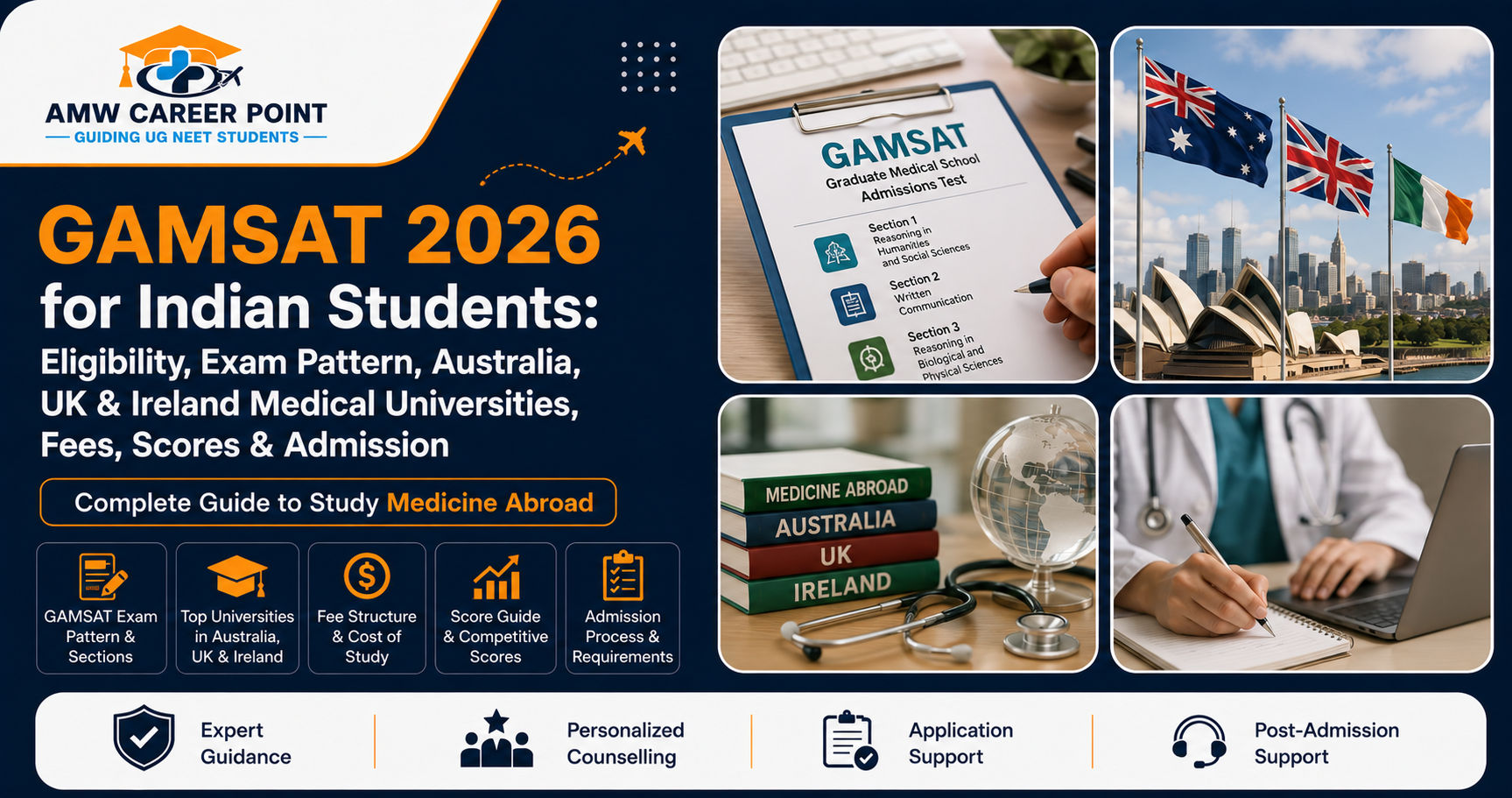
GAMSAT (Graduate Medical School Admissions Test, originally the Graduate Australian Medical School Admissions Test) is a computer-based admissions test developed and administered by ACER (the Australian Council for Educational Research). It's designed to assess the capacity to undertake high-level intellectual study in medical and health professional programs, not to test how well you memorized Class 11–12 Biology, Chemistry, and Physics.
GAMSAT exists specifically for graduate-entry medicine programs for people who already hold, or are completing, a bachelor's degree, as opposed to school-leaver programs that admit students straight after Class 12 (the route NEET-UG governs in India). Universities in Australia, the UK, and Ireland use it. Still, which specific universities, and whether they accept international applicants like Indian citizens, varies enormously, which is the entire reason this guide exists.
Reality check: GAMSAT is not an exam for every student who has just finished Class 12. It's primarily relevant to graduate-entry pathways, and exact eligibility still depends on the specific university you're targeting, not on GAMSAT eligibility alone.
Can Indian Students Take GAMSAT in 2026?
Yes, Indian citizenship does not itself prevent you from sitting GAMSAT. ACER makes the test available to anyone applying to a course for which GAMSAT is a prerequisite, provided they can meet the relevant academic entry requirements. But three separate things need to be true, not just one:
You must be academically eligible: completed or currently enrolled in a bachelor's or undergraduate honors degree.
Your intended university must actually use GAMSAT: not every medical school in Australia, the UK, or Ireland does, and international-applicant policies differ sharply by university; this is the single most misunderstood part of GAMSAT among Indian applicants.
Sitting GAMSAT does not automatically make you eligible for every medical school: a GAMSAT score is one input among several; GPA, prerequisite subjects, English proficiency, and interviews all matter too.
Who Is Eligible for GAMSAT?
GAMSAT eligibility is not simply "only science students can take it." ACER's own criterion is broad: completed or currently enrolled in a bachelor's degree, but university-specific entry requirements still apply on top of that base eligibility.
Background | GAMSAT Test Eligibility | Notes |
Completed a bachelor's degree | Eligible to sit GAMSAT | Yes |
Currently completing a bachelor's degree. | Eligible to sit GAMSAT | Yes, in final year at most universities |
Honors degree holders | Eligible | Often viewed favorably for GPA calculation |
BSc graduates | Eligible | Most common Indian applicant background |
BPharm graduates | Eligible to sit; university eligibility varies | Check specific university's accepted-degree list |
BDS graduates | Eligible to sit; university eligibility varies | High-value pathway; see dedicated section below |
Nursing graduates | Eligible to sit; university eligibility varies | Some universities specifically welcome healthcare-background applicants |
Biotechnology/Life Science graduates | Eligible | Strong Section III preparation overlap |
Engineering and non-science graduates | Eligible to sit GAMSAT itself | University-specific; do not assume automatic exclusion or automatic inclusion. |
Can You Become a Doctor After Completing a Bachelor's Degree in India?
Yes — this is the exact pathway graduate-entry medicine exists for. Here's the realistic sequence, stage by stage:
Bachelor's Degree in India (any recognized undergraduate degree, science or otherwise)
Check University Eligibility: Confirm your specific target university accepts your degree background and international applicants
Take GAMSAT Where Required: Not every graduate-entry program requires it; some accept MCAT instead for international applicants
Apply to Graduate-Entry Medicine through the correct system (GEMSAS, direct university application, UCAS, or CAO depending on country)
Interview/University Selection Where Applicable: MMI or panel interview
Medical Degree: Usually a 4-year accelerated MD/MBChB
Internship/Clinical Training as required by the awarding country
Medical Registration Pathway: In your country of study, and separately in India if you intend to return and practice
This is the section that most generic GAMSAT articles skip entirely; they explain the exam but not the full journey from an Indian bachelor's degree to a career as a practicing medical professional.
What Is Graduate-Entry Medicine?
Graduate-entry medicine (GEM) refers to medical degree programs designed for students who already hold an undergraduate degree, as opposed to direct/undergraduate-entry medicine, which admits students straight from secondary school (the NEET-UG route in India, or A-level entry in the UK).
Typical previous-degree requirement: a bachelor's degree, usually with a minimum GPA or classification (e.g., a UK 2:1 Honors or equivalent).
Course duration: often shorter than undergraduate medicine, commonly 4 years for graduate-entry vs. 5–6 years for direct-entry because students already bring foundational academic maturity and, often, relevant prior coursework.
Still highly competitive: a shorter course does not mean easier admission; graduate-entry places are frequently more oversubscribed per seat than direct-entry programs, precisely because they draw from a determined, self-selected applicant pool.
Which Countries Accept GAMSAT for Medical Admission?
Country | Main Use of GAMSAT | Entry Type | Application Route | International Students |
Primary use for most graduate-entry medical schools | Graduate entry | GEMSAS (domestic) / direct university application (international) | University-specific verification individually | |
Selected graduate-entry programs only | Graduate and some direct-entry programs | UCAS, alongside a separate GAMSAT registration with ACER | Very limited; most GAMSAT-using UK schools do not accept international students (see below) | |
Major use for graduate-entry medicine | Graduate entry (4 schools) | CAO (EU/UK/EEA) or direct application (other non-EU, including India) | Eligibility and fee status differ significantly by applicant category | |
Other destinations | Selected programs only | Varies | University-specific | Verify individually; do not assume GAMSAT transfers automatically |
GAMSAT 2026: Australia, UK or Ireland Which Pathway Is Best for Indian Students?
Factor | Australia | UK | Ireland |
Type of medical pathway | Graduate entry (most schools) | Selected programs only | Graduate entry |
GAMSAT use | Major, most-used test | University-specific, and international acceptance is rare | Major, used by all 4 GEM schools |
Application system | GEMSAS (domestic) / direct (international) | UCAS + separate ACER registration | CAO or direct application depending on category |
International eligibility | University-specific, generally more open than UK | Very limited, only a handful of schools accept international GAMSAT applicants. | Fee-status and university-specific |
Approximate annual tuition (international) | AUD 65,000–105,000+ | £35,000–£50,000+ | €51,000–€61,000 |
Best fits | Students prioritizing the widest range of GAMSAT-accepting schools | Students specifically targeting Liverpool, Swansea, Ulster, or Worcester's international routes | Students wanting an EU-adjacent degree with a concentrated set of 4 established GEM schools |
Reality check: This article will not declare one country universally "best." Australia has the widest range of GAMSAT-accepting schools and the most established international-applicant pathway; the UK's GAMSAT-using schools overwhelmingly restrict international applicants to just four programs; Ireland offers a concentrated, well-established set of four graduate-entry schools with clearer non-EU application routes. Match the choice to your budget and which specific universities actually admit international GAMSAT applicants, not to a generic "best country" ranking.
GAMSAT 2026 Important Dates and Test Windows
GAMSAT runs two sittings a year: March and September. Which one is useful for you depends entirely on your target country, university, and intake year; do not register for a sitting until you know this.
Milestone | March 2026 Sitting | September 2026 Sitting |
Written Communication (remote-proctored) | 28 February – 1 March 2026 | 22–23 August 2026 |
Reasoning in Humanities & Social Sciences + Reasoning in Biological & Physical Sciences (test center) | 20–22 March 2026 | 11–13 September 2026 |
Standard registration closes | 5 February 2026 (9 pm AEDT) | 13 July 2026 (10 pm AEST). Some UK-specific guidance lists a standard deadline of 30 June 2026; always confirm the exact date for your course on ACER's site. |
Late registration window | Available after standard deadline for an extra fee | Available after standard deadline for an extra fee |
Typical result release | Approximately 5–6 weeks after the final test date (~late April/early May) | Approximately 5–6 weeks after the final test date (~October) |
Which GAMSAT Sitting Should Indian Students Take?
UK and Irish graduate-entry medicine applicants overwhelmingly use the September sitting, since that's the cycle their admissions timelines are built around. Australian applicants more commonly use the March sitting, though this varies by university and application round. Do not register for a GAMSAT sitting until you know which university and intake you are targeting. Score validity periods are course- and cycle-specific (see the Score Validity section below), and registering for the wrong sitting can cost you a full admission cycle.
GAMSAT 2026 Registration: Step-by-Step Process
Step | Details |
1. Shortlist your universities first | Before registering for GAMSAT, know which universities you're targeting; this determines which sitting, and whether GAMSAT is even the right test. |
2. Check which GAMSAT results they accept | Confirm the specific sittings and validity window for your target university's current cycle. |
3. Create an ACER account | Registration and payment both happen through your ACER account at gamsat.acer.org. |
4. Register for the correct GAMSAT sitting | March or September, based on Step 1–2. |
5. Pay the registration fee | Online via credit card (Mastercard/VISA); see the Fees section below. |
6. Select country/course application details correctly | Tick the correct destination country/course boxes during registration so your results are routed to the right institutions. |
7. Complete test arrangements | Choose your test center location, date, and AM/PM session. Seats are limited and allocated on a first-come, first-served basis. |
8. Download/check admission information | Review ACER's current Information Booklet for exact requirements before test day. |
9. Prepare for the test | Begin section-wise preparation; see the Preparation section below. |
GAMSAT Fees 2026 for Indian Students
Fee Component | 2026 Amount |
Australia registration | AUD $568 (includes Practice Test A) |
Ireland registration | €378 |
UK registration | £296 |
Late registration/late center change | AUD $114 / €83 / £71 |
Overseas levy (outside Australia, Ireland, and the UK) | AUD $208; this applies to Indian test-takers sitting at a non-Australia/Ireland/UK center |
GAMSAT Fee for Indian Students
Payment is made online in the currency of your chosen registration category (AUD, EUR, or GBP); there is no separate India-specific registration category. Since no GAMSAT test center currently operates in India (see the next section), most Indian applicants register under the country category corresponding to their nearest available test center. The AUD $208 overseas levy typically applies on top of the base registration fee. Budget for exchange-rate fluctuation between your payment date and test date, and factor in late fees if you're registering close to a deadline.
Can Indian Students Take GAMSAT From India?
This needs a nuanced answer; do not assume "yes, entirely from home." GAMSAT's 2026 delivery model treats its sections differently:
Written Communication (Section II) is remotely proctored for all test-takers; worldwide, this part genuinely can be taken from India.
Humanities & Social Sciences (Section I) and Biological & Physical Sciences (Section III) are normally conducted through physical test centers. ACER's confirmed 2026 test-center locations are Australia, Ireland, the UK, New Zealand, and Singapore; there is currently no confirmed test center in India.
Alternative remote delivery for Sections I and III may be available only under specific circumstances — including where no test center is available in the candidate's country, or where the candidate meets ACER's defined distance criteria. This is not a general-purpose "take it from home" option; it's a conditional exception.
Do not get this wrong: For most Indian applicants in 2026, the realistic answer is that Written Communication can be completed remotely from India, but Sections I and III will most likely require travel to a physical test center. Singapore is typically the nearest option. Confirm the exact current alternative-delivery rules directly on ACER's registration portal before you plan your test-day logistics, since this policy is exactly the kind of detail that can change between cycles.
GAMSAT 2026 Exam Pattern
Section | Area Tested | Delivery | Key Skills |
Section I | Reasoning in Humanities and Social Sciences | Test center session | Critical reasoning, interpretation of complex written and visual material |
Section II | Written Communication | Remote proctoring | Written argument development and communication |
Section III | Reasoning in Biological and Physical Sciences | Test center session | Scientific reasoning across Biology, Chemistry, and Physics |
The test-day structure for Sections I and III totals 4 hours and 10 minutes of test time, administered at a physical test center; Written Communication is delivered separately via remote proctoring on its own date.
Section I: Reasoning in Humanities and Social Sciences
Covers interpretation of written passages, social sciences and humanities material, and, where applicable, visual material, testing critical reasoning, inference, and your ability to understand complex information under time pressure.
Section II: Written Communication
Do not treat this as a conventional English grammar exam. It tests written responses to prompts, your ability to communicate and develop an argument, structure, clarity, and interpretation of the prompt itself. Weak performance in Section II is one of the most common and most avoidable reasons Indian applicants underperform overall.
Section III: Reasoning in Biological and Physical Sciences
Section III is not simply a Class 11–12 NEET revision test. It covers Biology, Chemistry, and Physics, but the emphasis is on scientific reasoning and problem-solving in unfamiliar scenarios, applying knowledge rather than recalling memorized facts. Students who prepare for GAMSAT the way they prepared for NEET (heavy memorization, formula drilling) are frequently surprised by how differently Section III is actually tested.
GAMSAT Syllabus 2026: Complete Section-Wise Breakdown
Section | Major Areas | Skills Required | Best Preparation Method |
Humanities & Social Sciences | Literature, ethics, social sciences, cultural and historical texts, visual material interpretation | Critical reading, inference, reasoning under time pressure | Wide reading of quality non-fiction/literary material; timed passage practice |
Written Communication | Argumentative and reflective writing prompts (often paired, contrasting themes) | Argument development, structure, originality, clarity | Regular timed essay practice with structured feedback, not memorized essays, which ACER notes generally score poorly |
Biology | Cell biology, genetics, human physiology, ecology at an undergraduate-adjacent reasoning level | Applying biological concepts to novel problems | Concept-based revision paired with applied practice questions, not rote memorization |
Chemistry | General and organic chemistry fundamentals, applied through reasoning-based questions | Quantitative and conceptual problem-solving | Practice problems that require multi-step reasoning, not formula recall alone |
Physics | Core mechanics, energy, and physical-science fundamentals | Applied scientific reasoning | Focus on conceptual understanding over formula memorization |
Why Non-Science Graduates Should Not Automatically Assume They're Ineligible
Section III does require scientific reasoning ability, but GAMSAT eligibility itself is not restricted to science graduates. The harder question for a non-science graduate is whether they can build sufficient Section III competence within their preparation window, not whether the test disqualifies them outright.
Why Science Graduates Should Not Assume GAMSAT Will Be Easy
A strong science background helps with Section III but does nothing for Sections I and II, which test reasoning and writing skills many science-heavy applicants haven't actively practiced since school. Underestimating Sections I and II is one of the most common mistakes among Indian science graduates.
GAMSAT Scoring System Explained
GAMSAT produces individual section scores plus an overall score, calculated using ACER's weighting formula (Section III is typically weighted more heavily than Sections I and II in the overall score, though the exact weighting and how it's used is set by ACER, not by individual universities). Do not describe a score as a universal "pass" unless the specific university explicitly has such a threshold; most don't operate a simple pass/fail cutoff.
What Is a Good GAMSAT Score?
There is no single GAMSAT score that guarantees admission to every institution. Selection depends on the combination of:
The specific university
Your applicant category (domestic vs. international)
Your GPA/academic results
Interview performance
The country and program
That cycle's overall competition level
Your international status specifically, where it affects the selection formula
GAMSAT Cutoff 2026: University-Wise Score Requirements
University | Country | Programme | Minimum/Competitive Score | Other Selection Factors |
ANU (Australia) | Australia | MChD (Doctor of Medicine & Surgery) | Min. overall 55, min. 50 per section (domestic); selection also uses 50:50 GAMSAT/GPA weighting | GPA ≥ 5.6, interview |
Deakin University (Australia) | Australia | Doctor of Medicine | Min. overall 50, min. 50 per section | GPA ≥ 5.0, 50:50 GAMSAT/GPA for interview selection |
Swansea University (UK) | UK | MBBCh Graduate Entry (A101) | Min. overall 50, min. 50 in Section III specifically; 2024 cycle's actual Home-applicant cutoff ran to 53 | 2:1 Honors degree, Assessment Day, IELTS 7.0 for non-native speakers |
University of Limerick (Ireland) | Ireland | Graduate Entry Medicine | A minimum GAMSAT score of 53 was required to receive an offer in the 2025 cycle. | CAO/direct route depending on category |
These figures illustrate why score requirements must be treated as institution- and cycle-specific; a "good GAMSAT score" at one university can fall short at another. Always separate a university's published minimum score from the historically competitive score actually needed to receive an offer, and confirm both directly before you set a target.
How Long Is a GAMSAT Score Valid?
GAMSAT validity differs by country, institution, and application cycle; there is no single universal expiry period. For UK programs commencing in 2027, ACER's current guidance lists specific March and September 2025 and 2026 sittings as the eligible results for that particular application cycle. For Ireland, acceptable GAMSAT sittings similarly depend on your intended entry year. Some UK guidance describes scores as valid for roughly two years, but treat this as indicative only. Always confirm against your specific target university's current cycle rules.
GAMSAT Results 2026: When Are Results Released?
Results are typically released approximately 5–6 weeks after the final test date of each sitting and delivered through your ACER account. From there, your university application process (GEMSAS, direct application, UCAS, or CAO, depending on the country) governs when and how that score is actually used in your admission decision. Receiving your GAMSAT score is a milestone, not the end of the process.
GAMSAT vs Other Medical Entrance Exams
Factor | GAMSAT | NEET |
Main audience | Graduates / current bachelor's-degree students | Undergraduate applicants straight from Class 12 |
Main purpose | Graduate-entry medical school selection | Undergraduate medical admission in India |
Focus | Reasoning, writing, and applied sciences | Physics, Chemistry, Biology (largely recall-based) |
Typical pathway | Medicine after a completed/near-complete degree | Medicine directly after Class 12 |
Geography | Selected international graduate-entry programs | India-specific regulatory relevance |
GAMSAT vs UCAT
UCAT targets direct-entry (undergraduate) medical applicants straight from school, largely in the UK, New Zealand, and Australia, testing situational judgment and cognitive ability rather than written communication or applied science reasoning. GAMSAT, by contrast, is graduate-entry-focused and includes a substantial written component UCAT doesn't have. If you're weighing both, see our dedicated UCAT 2026 for Indian Students guide for the direct-entry comparison.
GAMSAT vs ISAT
Factor | GAMSAT | ISAT |
Primary audience | Graduates/current bachelor's students | Selected direct-entry applicants |
Medical pathway | Graduate entry | Mostly undergraduate/direct pathways |
Writing section | Yes Section II | Different format, less writing-heavy |
Science reasoning | Yes Section III | Different emphasis and structure |
Main destinations | Australia/UK/Ireland | Selected Australian and global universities |
See our ISAT 2026 for Indian Students guide for a more in-depth, direct-entry-focused comparison.
GAMSAT vs MCAT
MCAT is the primary US medical school admissions test, and, notably, several GAMSAT-using universities including Melbourne, ANU, and Deakin in Australia, and Swansea in the UK accept the MCAT as an alternative to GAMSAT specifically for international applicants residing outside their home country. If a US pathway is on your radar too, weigh GAMSAT's broader acceptance across Australia/UK/Ireland against MCAT's narrower but deeper US-specific relevance and generally greater depth of science content.
All Medical Entrance Exams Compared
Exam | Main Target Student | Main Destination | Exam Focus | Medicine Pathway |
GAMSAT | Graduates/near-graduates | Australia, UK, Ireland | Reasoning + writing + sciences | Graduate entry |
NEET-UG | Class 12 completers | India | Physics, Chemistry, Biology (recall-based) | Direct entry |
UCAT | Class 12 completers/school-leavers | UK, NZ, Australia | Cognitive ability, situational judgment | Direct entry |
ISAT | Selected direct-entry applicants | Selected Australia/global universities | Science and reasoning, different format from GAMSAT | Mostly direct entry |
MCAT | Graduates/near-graduates | USA (and some GAMSAT-alternative routes) | Heavy science content depth | Graduate entry (US model) |
Best Universities Accepting GAMSAT for Indian Students
Reality check: Do not treat any single list as universal. Every university needs separate verification of whether it (a) uses GAMSAT at all, (b) accepts international/Indian applicants specifically on that GAMSAT-assessed route, and (c) for the exact intake year you're targeting. This is the single biggest source of wasted GAMSAT registrations.
GAMSAT Medical Universities in Australia
University | Programme | Duration | GAMSAT/Alternative | GPA/Academic Requirement | Interview | International Eligibility |
Doctor of Medicine | 4 yrs | GAMSAT or MCAT | WAM ≥ 75 for guaranteed-entry route; otherwise assessed case-by-case | MMI | International applicants outside Australia may submit MCAT (min. 492) or GAMSAT. | |
Doctor of Medicine | 4 yrs | GAMSAT (entry pathways vary by applicant category) | University-specific verify current cycle | Yes | International route exists; verify current eligibility directly | |
MChD | 4 yrs | GAMSAT (min. 55 overall, min. 50/section) or MCAT (min. 125/section) for international applicants | Weighted GPA ≥ 5.6 | Yes, 50:50 with GPA for interview selection | International applicants apply directly, not via GEMSAS | |
Doctor of Medicine | 4 yrs | GAMSAT (min. 50 overall & per section) or MCAT (min. 125/section) | GPA ≥ 5.0 | Yes, 50:50 GAMSAT/GPA basis | International applicants apply directly to Deakin, not via GEMSAS | |
Doctor of Medicine | 4 yrs | GAMSAT, university-specific requirement | University-specific verify current cycle | Yes | International applicants apply directly |
University of Melbourne Graduate Medicine Through GAMSAT
Melbourne's Doctor of Medicine is a 4-year graduate-entry program. International applicants residing outside Australia at the time of application may submit either the GAMSAT or the MCAT (minimum score of 492); international applicants already residing in Australia must use the GAMSAT. A Guaranteed Entry pathway exists for eligible students with a WAM of 75 or above, who are then invited to an MMI in mid-September without needing to sit the GAMSAT. Confirm current eligibility and application deadlines (Melbourne's 2026 round closed 15 June) directly with the university.
Australian National University (ANU) Medicine and GAMSAT
ANU's MChD requires a weighted GPA of at least 5.6 (25% weighting) and a GAMSAT score with a pass in all sections and a minimum overall score of 55 (25% weighting) for domestic-pathway selection; international applicants may submit an MCAT score instead, with a minimum of 125 in each section. International applicants apply directly to ANU rather than through GEMSAS.
Deakin University Medicine Through GAMSAT
Deakin's 4-year Doctor of Medicine requires a minimum weighted GPA of 5.0 and a GAMSAT score of at least 50 overall, with no section below 50 (or an MCAT score of at least 125 in each section for eligible international applicants). Selection for interview uses a 50:50 GAMSAT/GPA composite; international applicants apply directly to Deakin.
Other Australian Graduate-Entry Medical Schools Accepting GAMSAT
Beyond the four profiled above, GAMSAT is also used by the University of Western Australia, the University of Adelaide, Griffith University, Macquarie University, Flinders University, the University of Tasmania, and the University of Notre Dame Australia (Sydney/Fremantle), each with its own GPA weighting, interview structure, and international-applicant policy. For the 2027 Australian graduate-entry cycle, GEMSAS (the centralized domestic application system that most of these schools participate in) lists key 2026 milestones: March 2026 GAMSAT testing, publication of its Medicine Admission Guide in early April, and applications opening on 1 May and closing on 29 May 2026 for participating schools. International applicants generally apply directly to each university rather than through GEMSAS.
GAMSAT Universities in the UK for Indian Students
Do not get this wrong: This is the single most important caveat in this entire guide for UK-bound applicants: ACER's current UK admissions guidance states that international students are not accepted on most GAMSAT-using UK programmes, with named exceptions at present being the A100 programme at the University of Liverpool, the A101 programme at Swansea University, the A101 at Ulster University, and the A101 programme at the University of Worcester. GAMSAT-using UK schools you will see listed elsewhere, including ScotGEM (St Andrews/Dundee), Nottingham, City St George's, Surrey, Plymouth, Chester, Exeter, Keele, UEA, Sunderland, and Brunel, largely restrict their GAMSAT-assessed entry to UK/Home applicants only. Always verify current international eligibility directly with the specific school before you register for GAMSAT with a UK application in mind.
University | Programme | International Tuition | GAMSAT Requirement | International Eligibility |
Swansea University | MBBCh Graduate Entry (A101) | £48,350/year (Sep 2026 international rate) | Min. 50 overall, min. 50 in Section III; 2024 Home cutoff ran to 53 | Yes, one of the few UK schools with a confirmed international GAMSAT route |
University of Liverpool | MBChB (A100) | University-specific; verify current international rate | University-specific | Yes, per ACER's current listing |
Ulster University | MBBCh (A101) | University-specific; verify current international rate | University-specific | Yes, per ACER's current listing |
University of Worcester | Medicine (currently international-only intake) | University-specific; verify current rate | University-specific | Yes, currently structured specifically for international applicants |
Nottingham, St George's, Surrey, Plymouth, ScotGEM, and others | Various GEM/A101 routes | £35,000–£50,000+/year where international places exist at all | University-specific | Largely Home/UK-applicant only on the GAMSAT route — verify before registering |
Swansea University Medicine Through GAMSAT
Swansea's four-year MBBCh Graduate Entry program (UCAS code A101) is one of the clearest genuine international-applicant routes among UK GAMSAT schools. It requires a 2:1 Honors degree (or equivalent), a minimum GAMSAT score of 50 overall, with at least 50 in Section III, an IELTS score of 7.0 (with no component below 6.5, including Speaking at 7.0) for non-native English speakers, and a face-to-face Assessment Day with three stations. 2026 international tuition is £48,350 for Year 1. Competition is real: the 2025 cycle received 868 applications for 142 confirmed places, an overall offer rate of roughly 26%, and the actual Home-applicant cutoff ran to 53, four points above the published minimum.
GAMSAT Universities in Ireland
Ireland runs four Graduate Entry Medicine (GEM) programs, all using GAMSAT:
University | City | Programme | Approx. Fee Positioning | International Applicant Route |
Dublin | GEM (4 yrs) | Non-EU fee bracket among the higher end in Ireland. Verify the current 2026/27 published rate directly with RCSI. | Direct application for non-EU/non-Atlantic Bridge applicants | |
Dublin | GEM (4 yrs) | Non-EU fee bracket is on the higher end in Ireland; verify the current rate on UCD's international fees page. | Direct application for non-EU applicants | |
Cork | GEM (4 yrs) | Non-EU fee bracket generally at the lower end among Irish GEM schools; verify current rate. | Direct application for non-EU applicants | |
Limerick | GEM (4 yrs) | Verify current non-EU rate directly with UL | Direct application for non-EU applicants; 2025 cycle required a minimum GAMSAT score of 53 for an offer |
Non-EU GEM tuition across these four Irish schools broadly clusters between roughly €51,000 and €61,000 per year, with UCC generally at the lower end and UCD/RCSI at the upper end. Always confirm the current published figure directly, since these are among the fastest-changing numbers in this guide.
North American applicants apply through the centralized Atlantic Bridge Program; other non-EU applicants, including Indian citizens, generally apply directly to each university individually; EU, UK, and EEA applicants apply through the CAO. Confirm which category applies to you before assuming a specific application route.
GAMSAT Eligibility by Indian Degree Background
Can Indian BSc Students Take GAMSAT?
Yes, BSc is the most common Indian applicant background for GAMSAT. Confirm your degree completion status, GPA/percentage conversion to the target university's scale, any prerequisite subjects the specific program requires, and whether your BSc structure is treated as equivalent to the university's expected undergraduate degree.
Can BDS Graduates Take GAMSAT?
This is a high-value, frequently searched question among Indian applicants. BDS graduates are generally eligible to sit GAMSAT itself, since it only requires a completed or near-complete bachelor's degree. However:
University-specific medical school rules on accepting a prior medical/dental qualification vary — some universities are entirely open to it, others assess it case-by-case, and a few have specific policies about applicants with an existing health-professional qualification.
Professional and licensing implications differ from a pure BSc-to-medicine pathway — a BDS graduate pursuing GAMSAT-based medicine should specifically ask each shortlisted university how they treat an existing dental degree in their selection process, not assume it's either an advantage or a disadvantage by default.
Can BPharm Students Take GAMSAT?
Yes, BPharm graduates are eligible to sit GAMSAT under ACER's general bachelor's-degree criterion. University-specific acceptance of a BPharm background for graduate-entry medicine varies — verify directly rather than assuming a pharmacy background is automatically viewed as directly relevant.
Can Nursing Graduates Take GAMSAT?
Yes. Nursing graduates are GAMSAT-eligible, and some graduate-entry medical schools specifically welcome applicants with existing healthcare/clinical backgrounds — this can be a genuine strength in an interview. However, it doesn't change the core GAMSAT eligibility requirement itself.
Can Non-Science Graduates (Arts, Engineering) Take GAMSAT?
Being eligible to sit the GAMSAT is a separate question from meeting a specific university's medical school entry requirements. Engineering, arts, humanities, and commerce graduates are all GAMSAT-eligible in principle. The real question is whether you can build sufficient Section III (science reasoning) competence in your preparation window, and whether your specific target university's prerequisite-subject policy accepts your degree background.
Academic Requirements for Indian Students: Degree-Wise Summary
Indian Qualification | Can Sit GAMSAT? | University Eligibility Depends On | Additional Notes |
BSc | Yes | University's GPA/percentage conversion and any prerequisite subjects | Most common and best-understood applicant background |
BPharm | Yes | University-specific acceptance policy | Verify directly; not universally accepted the same way as BSc |
BDS | Yes | University-specific policy on prior health-professional qualifications | Ask specifically how the university treats existing dental degrees |
Nursing | Yes | University-specific policy; healthcare background often a soft positive | Can strengthen interview positioning |
Biotechnology | Yes | GPA/percentage conversion; generally strong Section III overlap | Natural fit for Section III preparation |
Physiotherapy | Yes | University-specific policy | Verify directly |
Engineering | Yes | University-specific prerequisite-subject and GPA policy | Section III preparation gap needs realistic planning |
Arts/Humanities | Yes | University-specific prerequisite-subject and GPA policy | Often a strength for Sections I and II; Section III needs dedicated build-up |
Minimum GPA or Percentage Required for Graduate Medicine
There is no single universal percentage or GPA figure that applies across every GAMSAT-using university. Australian schools typically use a weighted GPA on a scale up to 7.0 (ANU requires ≥5.6, Deakin ≥5.0, for example); UK schools typically require a 2:1 Honors classification or equivalent; Irish schools set their own minimum academic thresholds. Converting an Indian percentage-based degree result into each of these scales is genuinely a university-specific request; request the exact conversion method from each shortlisted university's international admissions office rather than relying on a generic online GPA converter.
GAMSAT and English-Language Requirements
Important: GAMSAT does not replace IELTS, TOEFL, PTE, or other university English-language requirements where these apply.
Keep three separate requirements distinct: the university's own admission English-language threshold (e.g., Swansea's IELTS 7.0 with sub-scores), the destination country's student-visa English requirement, and separately again any professional medical-registration English requirement you'll face after graduation (for instance, AHPRA in Australia applies its own English-proficiency standard at registration, independent of what got you admitted). For a full breakdown, see our Language Requirements for MBBS Abroad guide.
Do Indian Students Need NEET to Take GAMSAT?
No, NEET is not a GAMSAT eligibility requirement. Keep three separate things apart: (1) GAMSAT eligibility itself, which is governed by ACER's bachelor's-degree criterion; (2) the specific foreign university's own admission requirements, which do not involve NEET; and (3) India's own regulatory requirements governed by the NMC's FMGL Regulations, 202, which do require NEET-UG qualification if you intend to return and practice medicine in India after your foreign degree. GAMSAT-based admission abroad and NMC/FMGE eligibility to practice in India are two entirely separate systems that happen to both matter to the same applicant.
How to Prepare for GAMSAT 2026
6-Month Study Plan: Ideal starting point if you're planning well ahead; allows deep, unhurried Section III science rebuild alongside gradual Section I/II reasoning and writing practice.
4-Month Study Plan: A realistic, common timeline structured around building core reasoning skills first, then layering timed practice tests in the final 6–8 weeks.
3-Month Study Plan: Workable if you already have a reasonably strong academic/reasoning foundation, but requires disciplined daily practice from day one.
8-Week Intensive Plan: High-pressure but sometimes the only option given registration timing; prioritize timed full-length practice papers over broad content review at this stage.
Section-Wise Preparation Strategy
Section I: build comfort reading dense humanities/social-science material under time pressure, practice inference and reasoning, not just comprehension.
Section II: write regularly, under timed conditions, on paired/contrasting prompts, and get structured feedback. Avoid memorized essays; ACER specifically notes these generally score poorly, since prompts are designed to make pre-written responses obvious and ill-fitting.
Section III Biology, Chemistry, Physics: prioritize applied reasoning practice over content re-memorization; layer in Mathematical Reasoning and general scientific problem-solving skills, since GAMSAT tests application in unfamiliar scenarios far more than recall.
Best GAMSAT Preparation Resources
Start with official ACER materials. ACER's registration fee includes access to the specified official preparation materials for the relevant test cycle; this should be your baseline, since it's the closest available approximation of the actual question style and difficulty. Beyond that, third-party practice tests, question banks, prep books, tutoring, and study groups can supplement but should never replace the official material.
Should Indian Students Take GAMSAT Coaching?
Factor | Self-Study | Online Coaching | Private Tutor |
Cost | Lowest | Moderate | Highest |
Discipline required | Highest entirely self-driven | Structured, but still requires self-discipline for independent practice | Lower tutor provides structure and accountability |
Science background support | Depends on your existing foundation | Structured content modules available | Personalized to your specific gaps |
Writing feedback quality | Limited peer or self-review only | Variable, depending on the program | Typically the most detailed and personalized |
Best for | Strong independent learners with a solid existing foundation | Students wanting structure without 1:1 cost | Students needing significant Section II/III rebuilding in a short window |
Common GAMSAT Preparation Mistakes
Starting preparation before choosing target universities, wasting effort on sittings or emphasis that don't match your actual target
Treating GAMSAT like NEET heavy memorization instead of applied reasoning practice
Ignoring Section II because it "doesn't feel like a real science exam"
Memorizing content instead of building reasoning skill under time pressure
Ignoring strict timing constraints during practice
Using outdated preparation material not aligned with the current test structure
Not checking score validity against your specific target university's current cycle
Ignoring GPA requirements while over-focusing on GAMSAT score alone
Assuming GAMSAT alone guarantees admission, regardless of GPA, interview, or international-eligibility factors
Medical School Interviews After GAMSAT
Most GAMSAT-using medical schools that shortlist you will require an interview, typically a Multiple Mini Interview (MMI) format with several short stations. However, some universities use a single-panel interview instead. These assess ethics, communication, professionalism, teamwork, and motivation, not further academic content.
GAMSAT + GPA + Interview: How Medical Schools Actually Select Students
A high GAMSAT score does not automatically overcome failure to meet academic eligibility requirements. Most universities combine GAMSAT, GPA, prerequisite subjects, and interview performance into a composite selection formula, typically with a GAMSAT/GPA weighting close to 50:50 for interview invitations, followed by a further composite (often also roughly 50:50) between that score and interview performance for the final offer. Applicant category (domestic vs. international) and, at some universities, specific bonus adjustments (rural background, prior clinical experience, financial disadvantage) can further shift this calculation.
Total Cost of Becoming a Doctor Through GAMSAT
Tuition Fees for Graduate-Entry Medicine, by Country
Country | Annual Tuition (International) | Estimated Total Tuition (4-yr program) |
Australia | AUD 65,000 – 105,000+/year (Monash and Melbourne at the top of this range) | AUD 260,000 – 420,000+ |
UK | £35,000 – £50,000+/year at GAMSAT-accepting international-eligible schools (e.g., Swansea £48,350) | £140,000 – £200,000+ |
Ireland | €51,000 – €61,000/year across the 4 GEM schools | €204,000 – €244,000 |
Total Cost Breakdown
Beyond tuition, budget realistically for:
GAMSAT registration (AUD 568 / €378 / £296, plus overseas levy where applicable)
Test travel, where an in-person test center requires it (most likely for Indian applicants, given no confirmed India test center)
University application fees
Tuition (by far the largest line item; see table above)
Accommodation
Food and daily living expenses
Health insurance (compulsory in all three countries for international students)
Student visa fees
Flights (multiple round trips across a 4-year program)
General living expenses and course materials
Reality check: For a 4-year international GAMSAT-based medical degree, realistic total costs (tuition plus living) run roughly ₹1.4–2.2 Crore in Australia, ₹1.2–1.8 Crore in the UK, and ₹1.1–1.7 Crore in Ireland, at current exchange rates before accounting for currency fluctuation over a 4-year program. Treat these as planning ranges, not quotes, and obtain a detailed written breakdown from your shortlisted university before committing funds.
Scholarships for Graduate-Entry Medicine
University scholarships: merit-based partial tuition reductions offered directly by some medical schools.
Merit scholarships: tied to academic or GAMSAT performance at a handful of universities.
International student scholarships: broader university-wide awards some international medical students may qualify for, separate from medicine-specific funding.
Partial tuition waivers: more common than full scholarships, reduce, rather than eliminate, your total cost.
Government funding where eligible: largely restricted to domestic/EU applicants in all three countries — rarely available to international Indian applicants.
Education loans: the most realistic funding mechanism for most Indian families pursuing this pathway, given how limited genuine scholarship coverage is at this level.
Can Indian Students Get a Fully Funded Scholarship for Graduate Medicine?
Honestly: rarely, and only in highly competitive, university-specific cases. Most available support is a partial tuition reduction rather than full funding, and even when tuition is substantially covered, living costs often remain the student's responsibility. Do not plan your finances around securing a full scholarship; plan around full self-funding and treat any scholarship as a genuine bonus.
Student Visa Requirements After Getting a Medical School Offer
Core requirements are broadly similar across all three destinations, though exact rules and fees should always be verified through official government sources at the time of application:
A confirmed offer/Confirmation of Enrolment from your university
Financial evidence covering tuition and living costs for the relevant visa period
Compulsory health insurance (OSHC in Australia; equivalent schemes in the UK and Ireland)
Complete visa documentation specific to the destination country's student visa category
Evidence of satisfactory academic progression for subsequent-year visa renewals, where applicable
Reality check: Verify all current student-visa rules directly through each country's official immigration website (e.g., Australia's Department of Home Affairs, the UK's official gov.uk visa pages, Ireland's INIS/immigration service) immediately before applying; visa rules and fees change more frequently than almost any other figure in this guide.
Can Graduate Medical Students Work Part-Time?
Student visa rules in all three countries generally permit some part-time work but do not treat it as a means to finance full international medical tuition. A graduate-entry medical curriculum, particularly from the clinical years onward, leaves little realistic room for regular part-time hours, and visa-permitted work hours are rarely enough to make a meaningful dent in tuition costs that run into six figures (in local currency) across the program. Plan your finances assuming zero part-time income, and treat any part-time earning as a modest supplement, not a funding pillar.
How Long Is Graduate-Entry Medicine?
Country | Typical Program Type | Duration |
Australia | Graduate-entry MD | 4 years (most schools) |
UK | Graduate-entry GEM/A101 programs | 4 years (accelerated) direct-entry A100 programs run 5–6 years |
Ireland | Graduate Entry Medicine (GEM) | 4 years across all 4 GEM schools |
University-specific variations exist; some UK schools run slightly different structures for their graduate-entry vs. direct-entry tracks, even within the same institution. Always confirm the exact duration for your specific target program.
Graduate-Entry Medicine vs MBBS After Class 12
Factor | Direct Entry After Class 12 | Graduate Entry Through GAMSAT |
Previous degree | Not required | Usually required |
Entry exam | NEET/UCAT/IMAT/ISAT, etc. | GAMSAT, where applicable |
Age/time investment | Earlier start | Longer overall educational journey: bachelor's degree plus 4-year medical program |
Medical course structure | Varies by country, typically 5–6 years | Often accelerated/graduate-specific 4-year structure |
GAMSAT vs Studying MBBS Abroad Directly After NEET
If you haven't yet completed a bachelor's degree, direct-entry MBBS abroad in destinations like Russia, Georgia, Kazakhstan, Poland, Italy, or others covered elsewhere on this site is a fundamentally different, and for most Indian NEET-qualified students, faster and less expensive route to a medical degree than completing a bachelor's degree first and then pursuing GAMSAT-based graduate entry. GAMSAT genuinely makes sense as a primary pathway when you already have or are already committed to completing a bachelor's degree, not as a reason to delay a direct-entry MBBS abroad decision you could make today. See our Best Country for MBBS Abroad guide for the direct-entry comparison.
Is GAMSAT Worth It for Indian Students?
GAMSAT May Be Worth It If:
You already have, or are completing, a bachelor's degree
You specifically want graduate-entry medicine, not a direct-entry restart
You are academically strong and can realistically meet GPA/classification thresholds
You can manage the financial commitment realistically, ₹1.1–2.2 Crore across the program
You are targeting universities that currently specifically accept international GAMSAT applicants
You are prepared for a genuinely competitive selection process including interviews
GAMSAT May Not Be the Best Route If:
You want the cheapest possible route to a medical degree
You haven't yet researched the real international tuition figures involved
You don't currently meet your target university's academic entry requirements
You are expecting a good GAMSAT score alone to guarantee admission
A more suitable direct-entry MBBS-abroad pathway would get you to a medical degree faster and at lower cost
Complete GAMSAT Admission Roadmap for Indian Students
Step |
Decide your destination: Australia, UK, or Ireland. |
Check whether the university accepts Indian/international applicants on its GAMSAT-assessed route. |
Confirm GAMSAT is actually required (vs. an MCAT-alternative or non-GAMSAT route) |
Check which GAMSAT sitting is valid for your intended intake year. |
Check degree eligibility for your specific Indian qualification. |
Check GPA/academic requirements and how your Indian result converts. |
Check prerequisite subjects, if any. |
Check English-language requirements (IELTS/TOEFL/PTE) separately from GAMSAT. |
Register for GAMSAT through your ACER account. |
Prepare section-wise, on a realistic timeline (see Preparation section) |
Take GAMSAT at the correct sitting. |
Receive your score via your ACER account. |
Submit your university application through the correct system (GEMSAS/direct/UCAS/CAO) |
Attend an interview/MMI if required. |
Receive your offer |
Arrange funding: tuition loan, family funding, and any scholarship applied for |
Apply for your student visa. |
Begin graduate-entry medicine |
GAMSAT 2026 Checklist for Indian Students
Bachelor's degree eligibility checked
University shortlist prepared
International applicant eligibility checked
GAMSAT requirement confirmed
Correct test sitting selected
Score validity checked
ACER account created
Registration completed
Fees budgeted (including overseas levy)
Test-center travel arrangements checked
GPA calculated and converted to target university's scale
Degree equivalency checked
Prerequisite subjects checked
IELTS/TOEFL/PTE requirement checked separately from GAMSAT
GAMSAT preparation plan created
Official ACER practice material reviewed
Application deadline checked
Interview/MMI requirement checked
Full tuition budget prepared (not just Year 1)
Scholarships researched realistically
Visa requirements checked with official government sources
Common Mistakes Indian Students Make With GAMSAT
Taking GAMSAT before choosing target universities
Assuming every medical school that uses GAMSAT accepts international applicants
Assuming GAMSAT is only for science graduates
Assuming every non-science graduate is automatically eligible for every university, without checking prerequisites
Ignoring GPA requirements while over-focusing on GAMSAT score alone
Ignoring degree equivalency and GPA-conversion questions until late in the process
Registering for the wrong GAMSAT sitting relative to their target intake
Using an expired or not-yet-valid score for their target application cycle
Ignoring Section II preparation because it "doesn't feel like science"
Treating GAMSAT preparation like NEET preparation memorization over reasoning
Ignoring interview/MMI requirements until an offer is already at stake
Underestimating total financial costs: tuition, living, insurance, visa, and flights across 4 full years
Confusing university admission with professional medical registration in the country of study
Not checking India's own NMC/FMGL regulatory requirements before committing to an overseas pathway, if returning to India is part of the plan
Frequently Asked Questions
Q: What is GAMSAT?
A: GAMSAT (Graduate Medical School Admissions Test) is a computer-based admissions test developed by ACER, used by graduate-entry medical schools primarily in Australia, the UK, and Ireland, to assess capacity for high-level intellectual study in medicine and health professions.
Q: What is the full form of GAMSAT?
A: Graduate Medical School Admissions Test, originally the Graduate Australian Medical School Admissions Test.
Q: Can Indian students take GAMSAT?
A: Yes. Indian citizenship doesn't itself prevent you from sitting the GAMSAT, provided you meet ACER's academic eligibility (a completed or nearly completed bachelor's degree) and your target university's own requirements.
Q: Who is eligible for GAMSAT?
A: Anyone who has completed, or is currently completing, a bachelor's or undergraduate honors degree, and is applying to a course for which GAMSAT is required. Eligibility is not restricted to science graduates.
Q: Can I take GAMSAT after BSc?
A: Yes, BSc is the most common Indian applicant background for GAMSAT.
Q: Can BPharm graduates take GAMSAT?
A: Yes, BPharm graduates are GAMSAT-eligible; university-specific acceptance of the degree background for medical school entry still needs separate verification.
Q: Can BDS graduates take GAMSAT?
A: Yes, in terms of GAMSAT test eligibility. Individual medical schools' policies on applicants with a prior dental/medical qualification vary and should be checked directly.
Q: Can nursing graduates take GAMSAT?
A: Yes, nursing graduates are GAMSAT-eligible, and some schools view an existing healthcare background favorably in the wider selection process.
Q: Can non-science graduates take GAMSAT?
A: Yes, GAMSAT eligibility itself isn't restricted to science graduates, but Section III's science-reasoning content means non-science graduates need a realistic preparation plan for that section specifically.
Q: Is GAMSAT accepted in Australia?
A: Yes, Australia is GAMSAT's primary and most widely used market, across most graduate-entry medical schools.
Q: Is GAMSAT accepted in the UK?
A: Yes, at a specific list of UK universities, but international-applicant acceptance on the GAMSAT route is currently limited mainly to Liverpool (A100), Swansea (A101), Ulster (A101), and Worcester most other GAMSAT-using UK schools restrict this route to Home/UK applicants.
Q: Is GAMSAT accepted in Ireland?
A: Yes, all four Irish Graduate Entry Medicine schools (RCSI, UCD, UCC, and University of Limerick) use GAMSAT.
Q: Can I take GAMSAT from India?
A: Written Communication is remotely proctored and can be done from India. Sections I and III normally require a physical test center currently in Australia, Ireland, the UK, New Zealand, or Singapore, not India, with alternative remote delivery available only under specific, limited circumstances.
Q: Is GAMSAT available fully online?
A: No, while Written Communication is remote, Sections I and III typically require attending a physical test center unless you meet specific alternative-delivery criteria.
Q: What is the GAMSAT fee in 2026?
A: AUD $568 (Australia), €378 (Ireland), or £296 (UK), plus an AUD $208 overseas levy for test-takers outside those three countries, which applies to most Indian applicants.
Q: What is the GAMSAT syllabus?
A: Three sections: Reasoning in Humanities and Social Sciences, Written Communication, and Reasoning in Biological and Physical Sciences (Biology, Chemistry, Physics) with an emphasis on applied reasoning over memorized recall throughout.