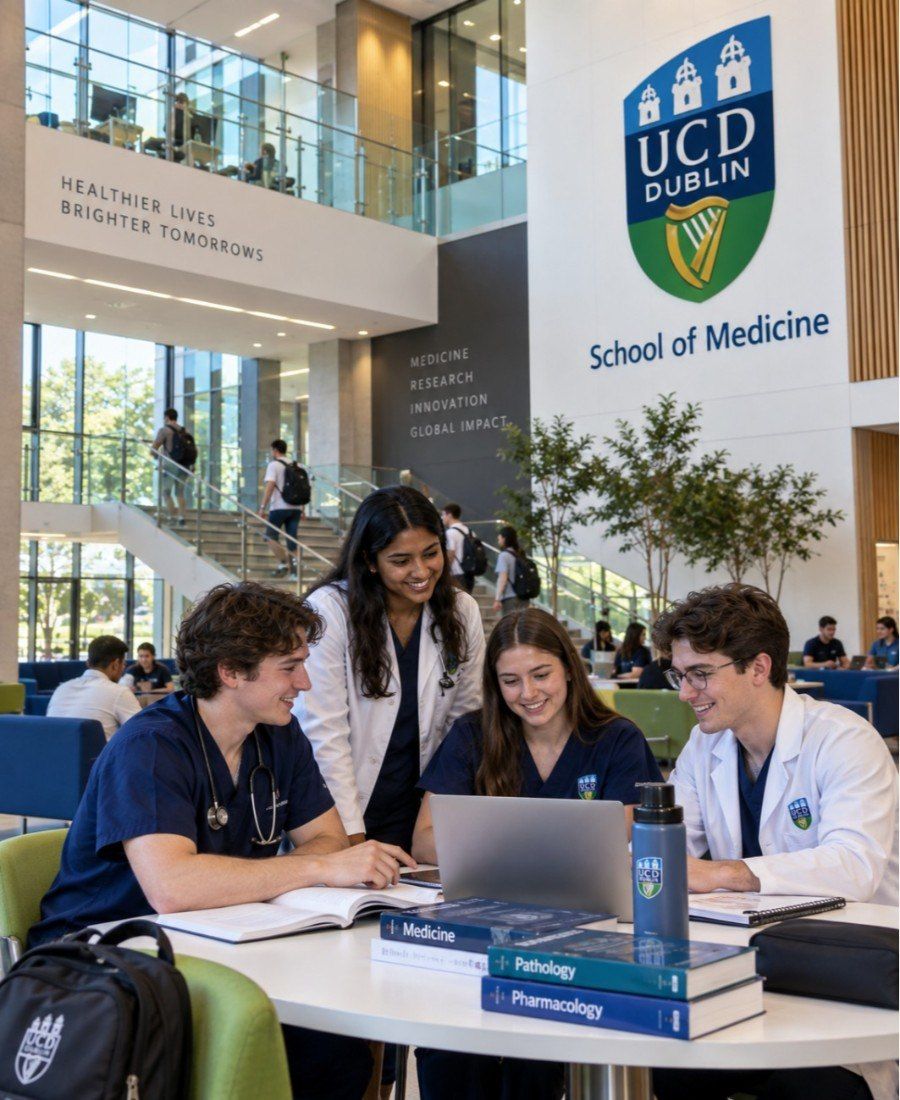
There is a specific kind of medical school that only comes from 170 years of continuous operation, and the UCD School of Medicine is one of them. Founded in 1854 as the Catholic University Medical School, the same institution where Gerard Manley Hopkins once lectured in halls next to medical students, it has trained doctors without interruption ever since. The degree they award, the MB BCh BAO, is directly recognised by the Irish Medical Council, the UK's General Medical Council, ECFMG in the United States, and medical councils in Malaysia and beyond. For a student thinking about where to build a medical career that is not locked to one country, that breadth of recognition is the first thing to understand.
UCD is Ireland's largest university, now ranked #118 in the QS World University Rankings 2026, its highest-ever global position, above Trinity College Dublin (#75), which has a smaller, more concentrated research profile, in terms of total output. The School of Medicine specifically operates across two campuses: the main academic and pre-clinical teaching campus at Belfield in Dublin 4, and the clinical training environment spanning two of Ireland's largest and busiest acute hospitals, St Vincent's University Hospital and Mater Misericordiae University Hospital, plus 20+ affiliated training hospitals and 120+ primary care practices spread across Ireland. That network of over 350 hospital consultants, 450 family practitioners, and 75 radiographers is the largest clinical faculty of any medical school in the country.
Two entry pathways exist, and most guides treat them as interchangeable. They are not. The five-year undergraduate programme (UEM, direct entry) requires a strong school leaving examination result, the HPAT for Irish and EU applicants, and, for non-EU international students, a separate application process through UCD's international admissions office, with a minimum of 90% in the top five Class XII subjects for Indian applicants. The four-year Graduate Entry Medicine programme (GEM) requires a completed bachelor's degree of any discipline with at least a 2.1 result, plus either a valid GAMSAT score of 57 or an MCAT of 503. GEM is genuinely accelerated; it compresses the pre-clinical foundation into the first trimester and begins patient contact in semester two of Year 1. For students who already hold a science degree, or even a non-science degree, the GEM route is often more realistic than it sounds.
What most competitor pages never explain clearly is what the MB BCh BAO actually means for a graduate's global options. In Ireland, after graduation, all doctors complete a mandatory one-year internship before achieving full IMC registration. After that, they can enter the Irish specialist training pathway, apply to the UK for F1/F2 training, pursue USMLE and US residency (UCD's International Team specifically coaches students on this), or apply to postgraduate programmes in Canada, Australia, Malaysia, or Singapore. The degree does not just open one door. Because it is an Irish medical degree from a university with 170 years of operation, it carries institutional trust with medical regulators on four continents in a way that very few degrees can match.
St Vincent's University Hospital, where UCD students rotate through their clinical years, is not simply a large general hospital. It is Ireland's premier academic hospital for liver disease and transplantation, a designated cancer centre, and the national referral centre for several high-complexity specialities. For a student rotating through Gastroenterology, Hepatology, or Oncology at St Vincent's, the case volume and clinical complexity are comparable to those at the great academic medical centres in the UK and significantly higher than what most European countries offer at the equivalent stage of training. The Mater Misericordiae University Hospital, UCD's second main teaching site, covers Cardiology, Cardiothoracic Surgery, Neurology, and Neurosurgery at a similarly high level. These are not hospitals that exist primarily to teach; they are national referral centres that teach because training the next generation of doctors is part of their institutional mandate.
The cost reality at UCD needs to be stated directly. For non-EU international students, the annual tuition for Medicine is EUR 57,680 (approximately INR 51.9 lakh at current rates). Add Dublin accommodation typically EUR 750–1,300 per month on campus, or €600–€900 per month in shared off-campus housing, and living costs of around EUR 700–1,000 per month, and the total annual spend runs to approximately EUR 75,000–85,000. That is a significant number. However, fees are locked in at the year of entry and do not increase during the programme, providing cost certainty that most European private medical schools do not offer. And the degree that comes out the other side is recognised in the UK without any further examination. This distinction matters enormously for students planning to work in Britain after graduation.
One detail that competitor pages consistently omit is the Student Summer Research Awards programme. Each year, around 100 medicine students undertake an eight-week supervised laboratory, clinical, or medical education project either in Ireland or at partner institutions internationally. This is a five-credit, assessed academic programme, not an informal research elective. Students who win competitive SSRA awards build a research publication record before graduating, which directly strengthens applications for competitive specialist training posts in Ireland, the UK, and North America. The programme has produced gold award winners in cancer research at the undergraduate level. That kind of research infrastructure during an MBBS or equivalent is genuinely rare.