
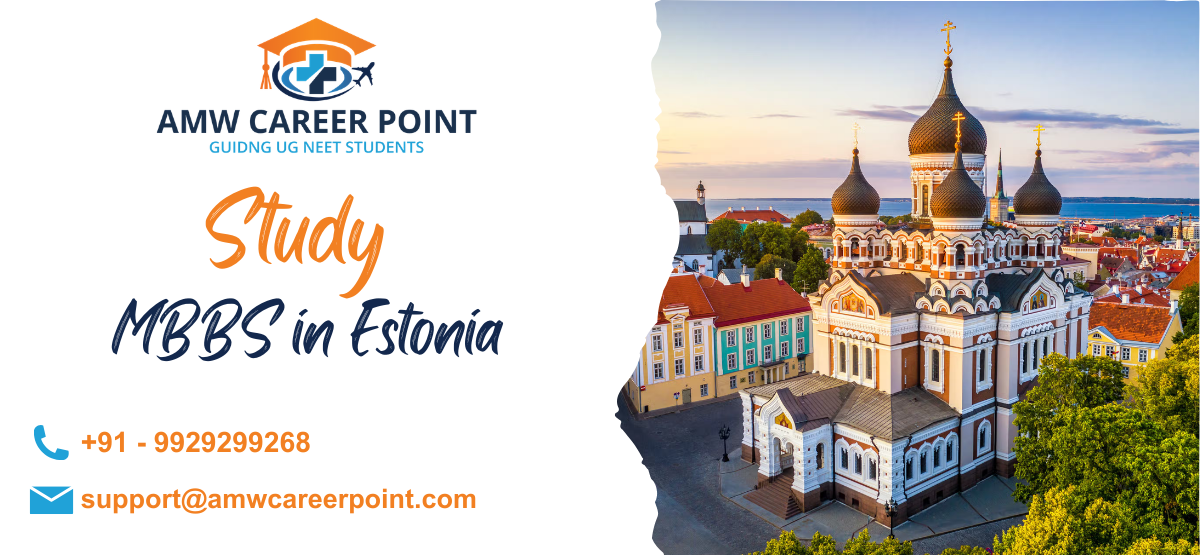
MBBS in Estonia
Estonia has emerged as a modern and academically advanced destination for medical studies in Europe. The country’s medical universities focus strongly on research-based learning, early clinical exposure, and a student-centered education system.
Estonia follows the European Credit Transfer and Accumulation System (ECTS), allowing students to transfer credits and pursue higher education across European Union countries. As a participant in the Bologna Process, Estonia maintains high academic standards and international mobility.
One of the major advantages of studying MBBS in Estonia is the availability of English-taught medical programs, making it convenient for international students. Additionally, Estonia offers a safe, technologically advanced, and multicultural environment with a comparatively affordable cost of living compared to Western Europe.
With expert counseling from AMW Career Point, students can receive complete guidance regarding eligibility, admission procedures, documentation, and visa processes for Estonia.
Key Highlights of Studying MBBS in Estonia
| Aspect | Details |
|---|---|
| Degree Awarded | MD (Equivalent to MBBS in many countries) |
| Duration of Course | 6 years (Including clinical rotations/internship) |
| Medium of Instruction | English |
| Recognition | WHO, ECFMG, European Medical Authorities |
| Eligibility Criteria | 10+2 with Physics, Chemistry, Biology; English proficiency (IELTS/TOEFL if required) |
| Entrance Exams | Some universities may conduct entrance exams/interviews |
| Top Medical Universities | University of Tartu, Tallinn University |
| Academic Curriculum | ECTS-based; integrated theoretical & practical learning |
| Clinical Exposure | Begins from early academic years |
| Tuition Fees (Approx.) | €10,000 – €14,000 per year |
| Cost of Living (Approx.) | €300 – €600 per month |
| Accommodation | University hostels & private apartments available |
| Work Opportunities | Part-time work permitted; post-study work options |
| Post-MBBS Scope | PG in Europe/USA/India; globally recognized degree |
Geography of Estonia
Estonia is a Northern European country located in the Baltic region. It shares borders with:
-
Latvia (South)
-
Russia (East)
-
Baltic Sea (West & North)
-
Gulf of Finland (North)
It is one of the three Baltic States along with Latvia and Lithuania.
Estonia covers approximately 45,000 square kilometers, making it one of the smaller European nations. The terrain is mostly flat and low-lying, with an average elevation of around 50 meters above sea level.
The country is known for its natural beauty, featuring:
-
Dense forests (covering nearly 50% of land area)
-
Numerous lakes and wetlands
-
Over 2,300 islands, including Saaremaa and Hiiumaa
-
Large freshwater bodies like Lake Peipus (shared with Russia)
Estonia is also recognized for its strong focus on environmental sustainability and digital innovation, making it unique among European countries.
Geographic Overview of Estonia
| Feature | Description |
|---|---|
| Location | Northern Europe, Baltic region |
| Total Area | ~45,000 sq. km |
| Terrain | Flat, forests, lakes, wetlands |
| Major Islands | Saaremaa, Hiiumaa |
| Major Lakes | Lake Peipus, Lake Võrtsjärv |
| Important Rivers | Emajõgi, Pärnu, Narva |
| Forest Cover | ~50% of land area |
| National Parks | Lahemaa, Soomaa, Matsalu, Vilsandi |
| Natural Resources | Peat, shale oil, limestone, forests |
| Biodiversity | Protected flora & fauna |
Climate and Weather in Estonia
Estonia experiences a temperate seasonal climate influenced by both maritime and continental weather systems. The country has four distinct seasons, each offering unique environmental conditions.
Due to its northern location, Estonia experiences noticeable variations in daylight hours throughout the year. Coastal regions generally have milder winters compared to inland areas.
Seasonal Weather Overview
| Season | Months | Average Temperature | Weather Conditions |
|---|---|---|---|
| Winter | December – February | -5°C to -1°C | Cold, snowy, short daylight hours |
| Spring | March – May | 2°C to 12°C | Gradual warming, melting snow |
| Summer | June – August | 16°C to 21°C | Warm, sunny, long daylight hours |
| Autumn | September – November | 4°C to 10°C | Cool, colorful foliage, moderate rainfall |
Estonia receives moderate rainfall throughout the year, with slightly wetter months during late summer and autumn. Snowfall is common in winter, particularly in inland regions. Windy conditions are frequent due to the coastal geography.
Overall, Estonia offers a balanced seasonal climate suitable for students who enjoy experiencing diverse weather patterns.
Here is your fully rewritten, professionally structured content with AMW Career Point naturally included:
Natural Resources of Estonia
Estonia, located in Northern Europe along the eastern coast of the Baltic Sea, possesses several important natural resources that significantly contribute to its economy and energy production. Despite being a relatively small country, Estonia has effectively utilized its natural wealth, particularly in the energy and mineral sectors.
The most valuable natural resource of Estonia is oil shale, which plays a central role in the country’s electricity generation. Estonia is one of the few nations globally that extensively uses oil shale as a primary energy source. In addition, the country has notable reserves of peat, limestone, clay, phosphorite, sand, and gravel, supporting industries such as construction, agriculture, and cement production.
Forests cover more than 50% of Estonia’s land area, making timber another vital renewable resource. The country also benefits from freshwater reserves, rivers, lakes, and a well-preserved coastline that supports fishing and tourism industries.
Major Natural Resources of Estonia
| Natural Resource | Description / Usage | Economic Importance |
|---|---|---|
| Oil Shale | Used for electricity generation | Major domestic energy source |
| Peat | Fuel and soil improvement | Agriculture and energy |
| Limestone | Construction & cement production | Infrastructure sector |
| Phosphorite | Used in fertilizers | Limited use; environmental concerns |
| Clay | Ceramics & construction | Building materials |
| Sand & Gravel | Road and building projects | Infrastructure development |
| Forests (Timber) | Wood, pulp & paper | Export and renewable sector |
| Freshwater | Lakes & rivers | Drinking water & agriculture |
| Coastal Resources | Fishing & marine biodiversity | Tourism & fisheries |
Estonia is increasingly investing in renewable energy and environmental sustainability to ensure long-term ecological balance while utilizing its natural resources responsibly.
Famous Cities in Estonia
Estonia is known for blending medieval heritage with modern innovation. Despite its compact size, the country has several culturally and economically significant cities.
1. Tallinn
The capital city, Tallinn, is famous for its well-preserved medieval Old Town, which is a UNESCO World Heritage Site. It is also recognized as a major technology and startup hub in Europe.
2. Tartu
Tartu is Estonia’s intellectual center and home to the country’s oldest and most prestigious university.
3. Narva
Located on the Russian border, Narva is known for its cultural diversity and historic landmarks such as Narva Castle.
4. Pärnu
Often called Estonia’s summer capital, Pärnu is popular for beaches, spa resorts, and vibrant tourism.
5. Viljandi
A culturally rich town known for folk music festivals and scenic lake views.
Famous Cities Overview
| City | Key Highlights | Notable Attractions |
|---|---|---|
| Tallinn | Capital, medieval Old Town, tech hub | Old Town, Alexander Nevsky Cathedral |
| Tartu | University city | University of Tartu, National Museum |
| Narva | Border city | Narva Castle |
| Pärnu | Seaside tourism | Pärnu Beach |
| Viljandi | Cultural festivals | Castle Ruins, Lake Viljandi |
Famous Festivals in Estonia
Estonia is celebrated for its vibrant cultural festivals that highlight music, dance, film, and heritage traditions.
| Festival | Time | Location | Description |
|---|---|---|---|
| Laulupidu (Song Festival) | Every 5 years (July) | Tallinn | Massive choir event symbolizing unity |
| Tantsupidu (Dance Festival) | Every 5 years | Tallinn | Traditional folk dance celebration |
| Viljandi Folk Music Festival | July | Viljandi | Major Baltic folk festival |
| Tallinn Music Week | Spring | Tallinn | Contemporary music & culture |
| Pärnu Film Festival | July | Pärnu | Documentary & cultural films |
| Jaanipäev | June 23–24 | Nationwide | Midsummer celebration |
These festivals reflect Estonia’s national pride, creativity, and strong cultural identity.
Religion in Estonia
Estonia is considered one of the most secular countries in the world. A large portion of the population identifies as non-religious, influenced by historical and social developments.
However, religious diversity exists, with Christianity being the most practiced faith, particularly Eastern Orthodox and Lutheran denominations.
Major Religions in Estonia
| Religion | Approx. Population | Remarks |
|---|---|---|
| Non-religious | 60–70% | Majority population |
| Eastern Orthodox | ~16% | Mainly Russian-speaking community |
| Lutheran | ~10% | Historically dominant |
| Other Christian groups | ~2% | Baptists, Catholics, etc. |
| Other religions | <1% | Islam, Judaism, Buddhism |
Estonia guarantees freedom of religion and promotes tolerance and coexistence.
Famous Foods of Estonia
Estonian cuisine is simple, hearty, and based on natural ingredients such as potatoes, rye bread, pork, dairy, mushrooms, and fish.
Popular dishes include:
-
Verivorst – Traditional blood sausage
-
Kama – Roasted grain mixture with yogurt
-
Mulgipuder – Mashed potato & barley dish
-
Rosolje – Beetroot and potato salad
-
Silgusoust – Herring stew
-
Kohuke – Chocolate-covered curd snack
-
Leib (Rye Bread) – Staple bread
Wild berries and forest mushrooms are commonly used in traditional recipes.
Famous Vegetarian Foods of Estonia
Although traditional cuisine includes meat, Estonia offers several vegetarian-friendly dishes based on grains, dairy, and vegetables.
| Dish | Description | Key Ingredients |
|---|---|---|
| Kama | Sweet grain dessert | Barley, rye, yogurt |
| Mulgipuder | Potato & barley porridge | Potatoes, barley |
| Rye Bread | Traditional bread | Rye flour |
| Mushroom Soup | Forest mushroom soup | Mushrooms, cream |
| Vegetable Pirukad | Vegetable-filled pastries | Dough, vegetables |
Transportation in Estonia
Estonia has a modern and efficient transportation system, including buses, trams, trains, ferries, taxis, and air travel.
| Mode | Description | Examples |
|---|---|---|
| Bus | Major public transport | Tallinn city buses |
| Tram | Urban rail in Tallinn | 4 tram lines |
| Train | Intercity electric trains | Tallinn–Tartu |
| Ferry | Island & international travel | Tallinn–Helsinki |
| Taxi/Ride-share | App-based services | Bolt, Uber |
| Air | International travel | Tallinn Airport |
Estonia is also known for eco-friendly transport and digital ticketing systems.
International Airports in Estonia
Estonia’s aviation network is small but efficient, connecting the country to major European destinations.
| Airport | City | IATA | Remarks |
|---|---|---|---|
| Lennart Meri Tallinn Airport | Tallinn | TLL | Main international airport |
| Tartu Airport | Tartu | TAY | Limited international flights |
| Pärnu Airport | Pärnu | EPU | Seasonal services |
| Kuressaare Airport | Saaremaa | URE | Domestic & charter flights |
Got it 👍 I’ve rewritten your content with AMW Career Point branding and a more professional, promotional tone — clean, informative, and student-focused.
Why Study MBBS in Estonia? – AMW Career Point
Estonia is rapidly emerging as one of the most preferred destinations in Europe for medical education. With its modern infrastructure, globally recognized medical degrees, and English-medium programs, Estonia provides a high-quality education experience for international students.
AMW Career Point helps Indian students secure admission to top medical universities in Estonia with complete guidance from counseling to visa processing. Estonia’s medical programs emphasize practical learning, clinical exposure, and research-based education, ensuring students receive global-standard training.
Key advantages of studying MBBS (MD equivalent) in Estonia:
-
Medium of Instruction: English
-
Total Duration: 6 years (including clinical training)
-
Global Recognition: WHO, ECFMG, EU, GMC (UK), etc.
-
Affordable Tuition Fees compared to USA/UK
-
Safe and technologically advanced country
-
Strong post-study career opportunities
With the expert support of AMW Career Point, students can confidently begin their international medical journey in Estonia.
MBBS in Estonia – Fee Structure & Overview (Guidance by AMW Career Point)
Estonia offers a Doctor of Medicine (MD) degree, equivalent to MBBS in India. The education system follows European standards and provides excellent clinical exposure.
Estimated Annual Fee Structure
| Particulars | Annual Cost (Euro) | Approx. Cost in INR* |
|---|---|---|
| Tuition Fees | €11,000 – €15,000 | ₹9.9 – ₹13.5 Lakhs |
| Hostel/Accommodation | €2,000 – €3,500 | ₹1.8 – ₹3.1 Lakhs |
| Food & Living | €2,000 – €3,000 | ₹1.8 – ₹2.7 Lakhs |
| Health Insurance | €300 – €500 | ₹27,000 – ₹45,000 |
| Visa & Permit | €100 – €200 | ₹9,000 – ₹18,000 |
| Miscellaneous | €500 – €1,000 | ₹45,000 – ₹90,000 |
| Total Estimated Annual Cost | €15,900 – €23,200 | ₹14 – ₹20 Lakhs |
*INR values may vary based on exchange rates.
AMW Career Point provides complete financial guidance, documentation support, and transparent fee counseling to help students plan effectively.
Cost of Studying MBBS in Estonia for Indian Students – AMW Career Point
For Indian students, Estonia offers a balanced combination of affordability and European-quality education. Compared to countries like the USA, UK, or Australia, Estonia provides a cost-effective medical degree without compromising academic standards.
Estimated Annual Expenses
| Category | Euro (Approx.) | INR (Approx.) |
|---|---|---|
| Tuition Fees | €11,000 – €15,000 | ₹9.9 – ₹13.5 Lakhs |
| Accommodation | €2,400 – €4,800 | ₹2.2 – ₹4.3 Lakhs |
| Food & Daily Expenses | €1,800 – €3,000 | ₹1.6 – ₹2.7 Lakhs |
| Insurance | €300 – €600 | ₹27,000 – ₹54,000 |
| Visa & Permit | €100 – €200 | ₹9,000 – ₹18,000 |
| Books & Materials | €200 – €400 | ₹18,000 – ₹36,000 |
| Miscellaneous | €500 – €1,000 | ₹45,000 – ₹90,000 |
| Total Estimated Cost | €16,300 – €25,000 | ₹14.8 – ₹22.5 Lakhs |
With AMW Career Point, students receive end-to-end admission assistance, from university selection to post-arrival support.
Duration of MBBS (MD Equivalent) in Estonia – AMW Career Point
The medical program in Estonia is structured to provide both theoretical knowledge and practical clinical training.
| Program Component | Duration | Details |
|---|---|---|
| Preclinical Studies | 3 Years | Basic medical sciences (Anatomy, Physiology, Biochemistry, etc.) |
| Clinical Studies | 3 Years | Hospital rotations & practical exposure |
| Total Duration | 6 Years | Complete MD Degree |
| Internship (if required) | 1 Year | Depends on licensing country |
| Medium | English | For international students |
The 6-year MD program builds a strong foundation in medical sciences and prepares students for global licensing exams.
Alright 👍 I’ve completely rewritten your content with AMW Career Point branding, keeping it professional, SEO-friendly, and student-focused.
Studying MBBS in Estonia: Advantages and Disadvantages – AMW Career Point
Estonia is emerging as a promising European destination for students aspiring to pursue MBBS abroad. With its modern healthcare infrastructure, advanced digital ecosystem, and European Union–aligned education system, Estonia offers high academic standards and global exposure.
AMW Career Point provides complete guidance for Indian students seeking admission to medical universities in Estonia. From counseling and university selection to visa assistance, we ensure a smooth and transparent admission journey.
However, before choosing Estonia for MBBS (MD equivalent), students should understand both the advantages and challenges.
Advantages and Disadvantages of Studying MBBS in Estonia
| Advantages | Disadvantages |
|---|---|
| Globally recognized degree aligned with EU standards | Limited number of universities offering English-medium medical programs |
| High-quality education with modern research facilities | Living expenses may be higher than some Asian countries |
| Affordable tuition compared to Western Europe and the USA | Estonian language may be required during clinical practice |
| Safe and student-friendly environment | Competitive admission process |
| Opportunities for EU-based internships and exposure | Cold climate may be challenging for some students |
| Advanced digital learning infrastructure | Limited intake seats for international students |
| European healthcare system exposure | Licensing exams required for practice in some countries |
With expert counseling from AMW Career Point, students can evaluate whether Estonia aligns with their academic and career goals.
MBBS Syllabus in Estonia – AMW Career Point Guidance
The MBBS-equivalent degree in Estonia is known as the Doctor of Medicine (MD) program, typically completed in 6 years. The curriculum follows EU medical standards and combines theoretical learning with extensive clinical training.
Below is the structured year-wise syllabus overview:
| Year | Subjects / Modules | Focus Areas |
|---|---|---|
| 1st Year | Anatomy, Physiology, Biochemistry, Medical Ethics, Terminology | Basic Medical Sciences |
| 2nd Year | Histology, Pathology, Microbiology, Immunology, Behavioral Sciences | Disease Mechanisms & Immune System |
| 3rd Year | Pharmacology, Pathophysiology, Clinical Skills | Drug Action & Early Clinical Training |
| 4th Year | Internal Medicine, Surgery, Pediatrics, Radiology, Public Health | Clinical Rotations Begin |
| 5th Year | Obstetrics & Gynecology, Neurology, Psychiatry, Family Medicine | Specialized Clinical Training |
| 6th Year | Emergency Medicine, Electives, Clinical Rotations, Research Project | Advanced Clinical Exposure & Thesis |
Throughout the course, students develop:
-
Communication and patient-handling skills
-
Evidence-based medical knowledge
-
Practical hospital-based experience
-
Research and clinical decision-making abilities
With professional admission support from AMW Career Point, students receive guidance on university selection, documentation, and future licensing pathways.
FAQs About Studying MBBS in Estonia – AMW Career Point
1. Is MBBS in Estonia recognized globally?
Yes, medical degrees from Estonian universities are recognized by international medical authorities and comply with European Union standards. Graduates can apply for licensing exams in various countries as per local regulations.
2. What is the duration of MBBS in Estonia?
The MD program (equivalent to MBBS) in Estonia generally takes 6 years, including clinical training.
3. What is the medium of instruction?
Medical programs for international students are typically taught in English.
4. What are the eligibility criteria?
Students must complete 12th grade with Physics, Chemistry, and Biology. English proficiency and academic merit are important, and some universities may conduct interviews or entrance tests.
5. Are entrance exams required?
Certain universities may conduct entrance exams or interviews to assess academic knowledge and communication skills.