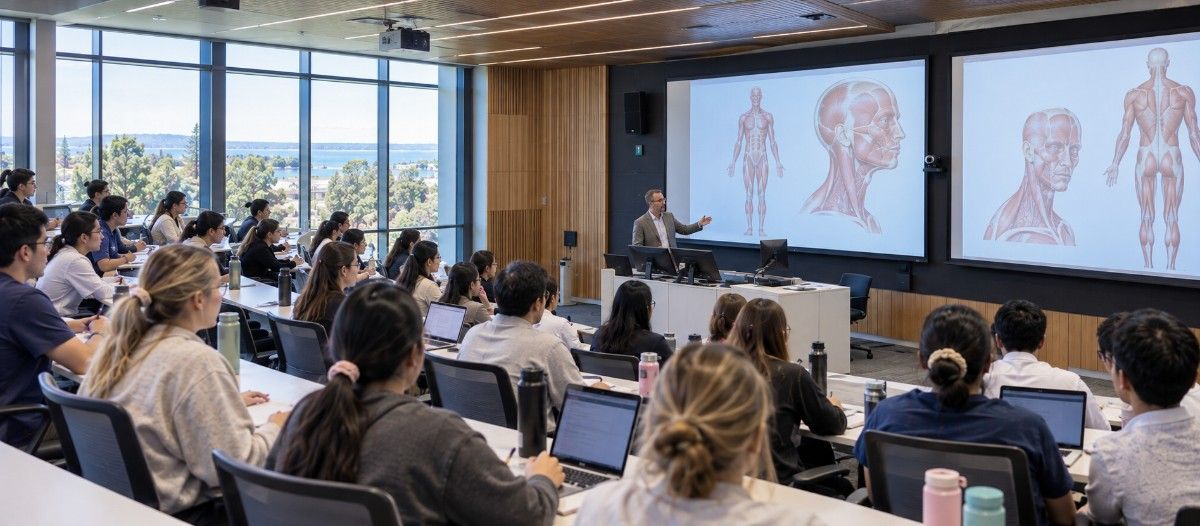
Deakin University’s School of Medicine in Geelong has built one of the most respected graduate-entry medical programmes in Australia in a remarkably short institutional time, and it has done so through a very clear sense of what it is trying to produce. The programme, launched in 2008, has from its first cohort emphasised rural health, regional medicine, and the production of graduates who actively choose to practise outside Australia’s major metropolitan centres. This is not incidental to the curriculum design; it is the curriculum design, and it shapes everything from where clinical placements are held to who receives bonus points in the admissions process.
The four-year Doctor of Medicine (MD) at Deakin is based at the Geelong Waurn Ponds campus for the first two years of pre-clinical and early clinical training, before students move to metropolitan, rural, and regional sites across Victoria for their final two years. Students from rural backgrounds receive meaningful admissions advantages: the Rural Training Stream has its own intake with a three-tier priority system, and Tier 1 applicants (from Deakin’s rural footprint) do not even need a GAMSAT score. For students from smaller Indian cities, towns, or rural backgrounds who share this community medicine orientation, Deakin’s admissions philosophy creates a genuine opening.
The 2026 intake benchmark figures speak to the programme’s selectivity: average GPA of 6.72 (out of 7.0) and average GAMSAT score of 65.9. These are competitive but not exclusively stratospheric; they are achievable for a well-prepared student who has made smart use of their undergraduate years. Offers are based on a 50/50 split between interview score and combined GPA/GAMSAT composite, meaning the panel interview carries real weight. Deakin uses a Multiple Mini Interview (MMI) format, a series of short, scenario-based stations rather than a single traditional interview, which many students find more manageable than a high-stakes conventional panel.
Annual tuition for international students is approximately AUD 78,000–88,000 (approximately ₹44–50 lakh), with a total four-year MD tuition of approximately AUD 312,000–352,000 (approximately ₹1.78–2.01 crore). Living costs in Geelong, which are significantly more affordable than in Melbourne or Sydney, are approximately AUD 18,000–25,000 per year. This lower cost of living is a genuine advantage: Geelong is not a compromise city; it is one of Victoria’s most liveable regional centres, situated on Corio Bay about 75 kilometres from Melbourne with regular and fast train connections to the city.