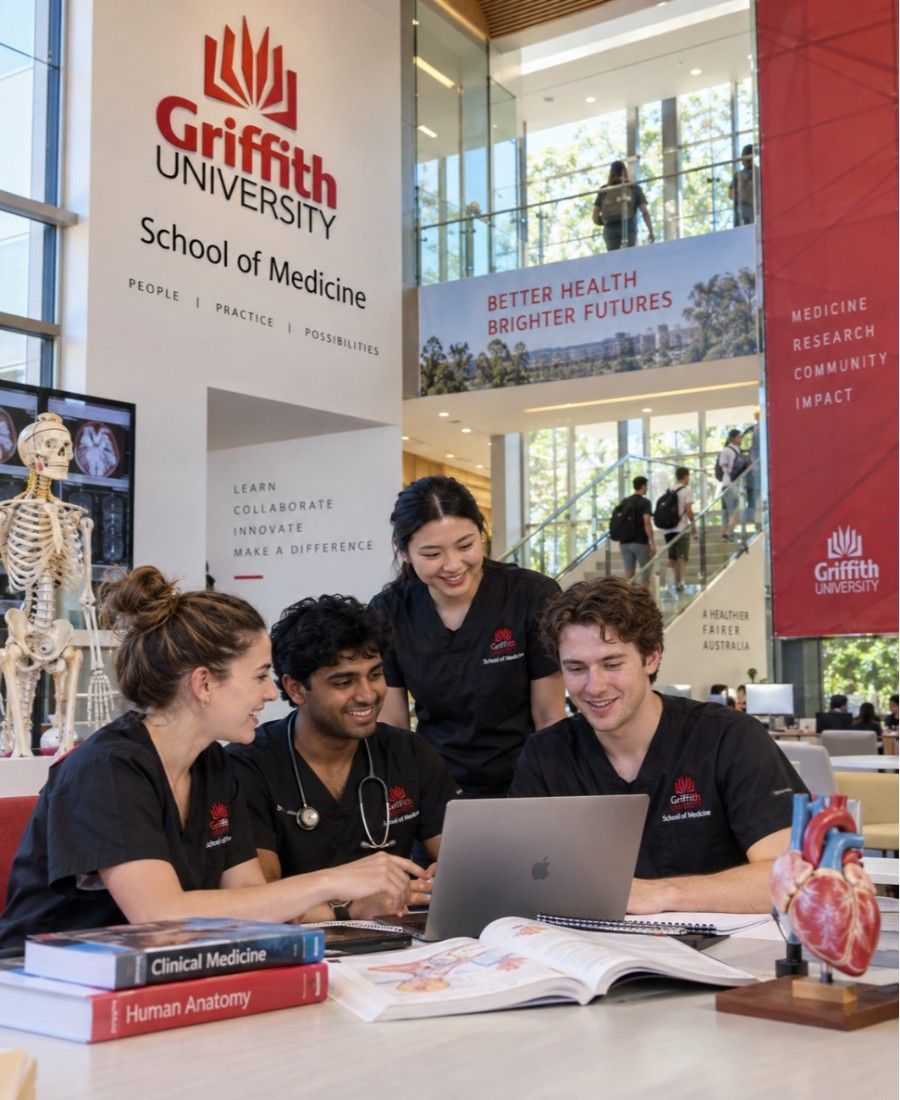
Griffith University runs a medical program with one clear edge. It lets international students apply directly for the Doctor of Medicine. This differs from Bond University nearby. At Bond, international students need a longer, indirect route in. At Griffith, you apply straight through Griffith International. You sit the GAMSAT or MCAT. You compete for a real, fixed number of places each year.
Griffith University started in 1971. It welcomed its first students in 1975. The School of Medicine came much later. It opened in 2005. The first graduates walked out in 2008. Today, more than 1,200 Griffith medical graduates work in independent practice or speciality training. They work across Australia and beyond. Globally, Griffith sits at 268th in the 2026 QS World University Rankings. It has also climbed back into the world's top 300 in the Times Higher Education Rankings 2026. This puts it equal 14th in Australia. It sits third in Queensland, specifically. Its Life Sciences and Medicine subject area also performs well in the 2026 QS Subject Rankings.
The Doctor of Medicine (MD) at Griffith runs for four years, full-time. It sits at AQF Level 9, an Extended Master's degree. This is a graduate-entry program. You need a finished bachelor's degree, or nearly one, before you apply. Two main routes lead into it. The first is the Bachelor of Medical Science (BMedSc). It is a fast, two-year degree. You can study it at the Gold Coast or Brisbane South (Nathan) campus. It suits high-achieving Year 12 leavers. Most aim for an ATAR near 99. Only 30 places are open each year at each campus. This makes it genuinely competitive. Students who reach a GPA of 5.5 or higher in the BMedSc get guaranteed entry into the MD. They skip the GAMSAT and the interview, too.
The second route is graduate entry. Here, you finish any undergraduate degree first, in any field. Griffith actively welcomes applicants from all academic backgrounds. Science is not required. You then sit either the GAMSAT or the MCAT. GAMSAT needs a minimum of 50 in each section. The MCAT requires a minimum score of 123 in each section. Your GPA and test score combine on a 50:50 basis. This ranks you for an interview. That interview is called the Griffith University Multi-Station Admissions Assessment, or GUMSAA. It runs for about three hours. It moves you through several short stations. The assessors never see your GPA or GAMSAT score during this process. This means the interview stands entirely on its own merit.
For the 2026 intake, Griffith offers up to 142 Commonwealth Supported Places for domestic students. This includes 56 places reserved as Bonded Medical Places. These places tie to future rural service. Alongside these, up to 35 places are open specifically for international students. These students pay full tuition fees themselves. The total cohort across both groups is 233. This number holds steady from the year before. It is a genuinely large international intake compared to some smaller Australian medical schools.
Teaching in the first two years leans heavily on problem-based learning. Students work through cases in small groups. This replaces large lecture halls. Both years get graded Pass or Fail only. There are no numeric scores. This takes real pressure off students during the steepest part of the learning curve. Clinical exposure starts early, too. From the second month of the degree, students spend one day a week in hospitals or community health settings. This builds real clinical habits well before formal placements begin. Years three and four shift to Case-Based Learning. Students spend roughly 95% of their time in hospitals and clinics by this stage. This makes for a genuinely immersive final stretch before graduation.
Clinical training happens across a solid network of sites. Gold Coast University Hospital anchors most placements. This large public hospital sits right next to Griffith's own $150 million Griffith Health Centre. Students also train at the Sunshine Coast Hospital and Health Service. This site sits at the Sunshine Coast Health Institute in Birtinya. Placements stretch beyond these hubs too. Students train in rural settings and northern New South Wales. By negotiation, some placements happen interstate or overseas. Some students complete placements in Papua New Guinea. Few Australian medical schools offer something like this.
Griffith has also recently built a genuine rural stream. Starting in 2026, a small number of Doctor of Medicine students will study their first two years at Toowoomba. This runs through Griffith's Rural Clinical School. It partners with Rural Medical Education Australia. This stream ties to new government-funded Commonwealth Supported Places. It focuses squarely on building doctors for rural and remote Queensland. It reflects Griffith's wider mission. Much of its teaching leans into general practice, primary care, and healthcare for underserved communities. This differs from pure specialist training.
The General Practice Longitudinal Program runs students through the same general practice setting repeatedly throughout their degree. This differs from a single short placement. It builds a real, ongoing relationship with one practice and its patients over time. Students often point to this as valuable when they later choose a speciality or career path.
Griffith holds a notable claim, too. It became the first Australian medical school to meet the country's newest national medical program accreditation standards. This marks real curriculum quality, not just marketing talk. The Australian Medical Council reviews these standards with real rigour.
On cost, Griffith genuinely runs cheaper than many Australian competitors. Total tuition for the four-year Doctor of Medicine sits at about AUD 276,000. This works out to roughly AUD 69,000 per year. That runs meaningfully below what several other Go8 and private universities charge for medicine. One thing to watch, though: Griffith's standard international scholarships exclude this program. This includes its widely advertised Academic Excellence Scholarship. Both the Bachelor of Medical Science and Doctor of Medicine sit outside these general offers. Students hoping for a scholarship discount on medicine should check current, program-specific offers directly with Griffith. Don't assume a general scholarship applies here.
Graduates leave with an AMC-accredited degree. Full registration with the Australian Health Practitioners Regulation Agency follows a supervised internship year in the Australian hospital system. From there, Griffith graduates move into specialist clinical practice, primary care, rural medicine, medical administration, research, or medical education. The university's own graduate outcomes lean noticeably toward general practice and primary care. This matches its founding focus well.
Gold Coast itself adds real appeal beyond the classroom. The main campus sits close to the beach. A tram connects students to Surfers Paradise in around ten minutes. Student reviews often mention the newer, well-equipped medical facilities. They also mention hands-on anatomy training early in the degree. Students describe a genuinely supportive learning environment, too. Failed assessments come with real chances to retry. This is not treated as a dead end.
In short, Griffith suits graduate applicants who want a real, direct path into Australian medicine as an international student. You skip needing a separate Bond-style undergraduate degree first. It especially suits students drawn to general practice, rural health, or primary care. It also suits those who want strong hands-on clinical exposure from very early in training. Combined with genuinely competitive tuition fees, a growing rural training footprint, and a first-of-its-kind accreditation win, Griffith offers a well-rounded, increasingly well-regarded option among Australia's mid-sized medical schools.