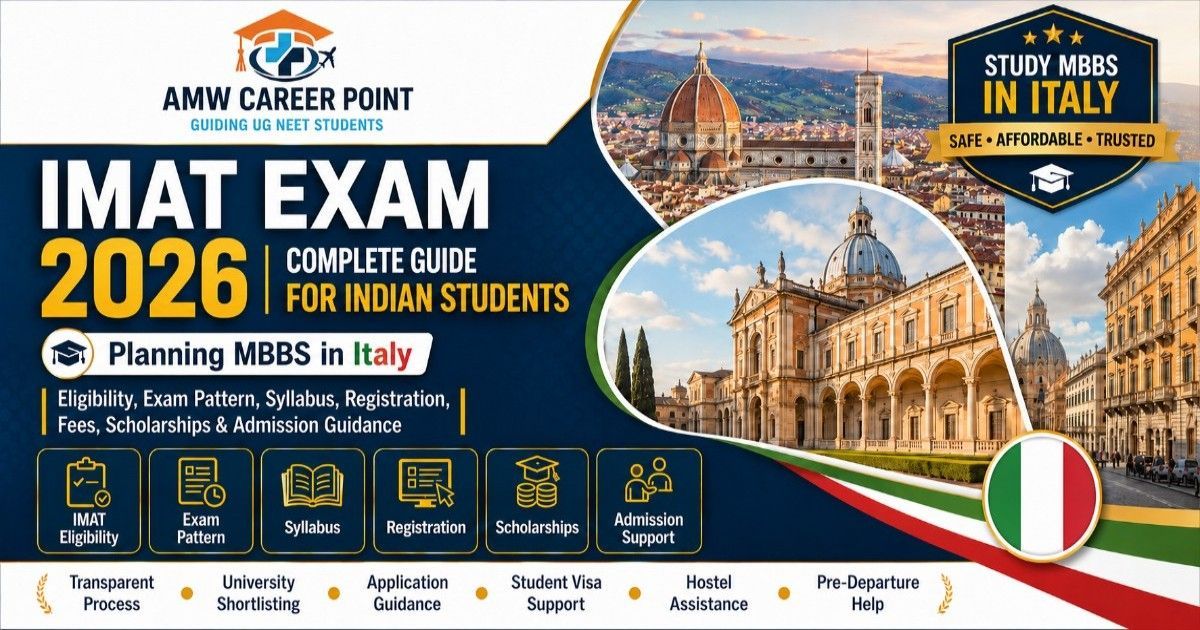
MBBS Abroad has quietly become one of the most credible medical-education destinations for Indian NEET aspirants, with a genuine public university system, English-taught programmes, tuition that can be a fraction of private MBBS fees in India, and a widely portable European medical degree. The gateway to all of it is a single exam: the IMAT Exam, short for the International Medical Admissions Test.
This guide covers the IMAT Exam 2026 end-to-end, what it is, who can take it, how it's structured, how to register, which universities accept it, what it actually costs once tuition, living expenses, and scholarships are netted out, and what studying medicine in Italy demands linguistically once you reach the wards. We have also corrected a few numbers that circulate widely but don't hold up against the official University and university sources, including exactly how many IMAT test centres actually exist in India (it is not the six commonly listed).
As with everything we publish, we would rather flag a number as provisional than round it up to look more impressive. Several IMAT 2026 specifications specify the exact registration window, and the final section-wise syllabus split has not been published by MUR (Italy's Ministry of University and Research) as of this guide's writing, though the exam date itself has been confirmed. We've marked every such figure clearly and will update this page the moment the official Bando (decree) is published.
What Is the IMAT Exam?
The IMAT Exam (International Medical Admissions Test) is the standardised, once-a-year entrance test that Italian public universities use to select international candidates for English-taught Medicine and Surgery, Dentistry, and Veterinary Medicine programmes. It was established in 2011 and, until 2023, was designed and delivered by Cambridge Assessment Admissions Testing on behalf of Italy's Ministry of University and Research (MUR). Since 2023, MUR has run the exam directly, which is why syllabus and format details have shifted slightly across recent cycles, a detail several older blogs still get wrong.
Unlike NEET-based admissions in India, Italian public medical schools do not consider your Class 12 board marks, conduct interviews, or ask for a personal statement to shortlist you. Your IMAT score alone determines whether you are offered a seat, provided you meet the basic eligibility conditions. This makes the exam unusually transparent: there is one number and one ranked list per university, with no subjective layer in between.
Full form: International Medical Admissions Test
Conducted by: Italy's Ministry of University and Research (MUR), via the Universitaly portal and Cineca
Held: once a year, simultaneously worldwide, at 11:00 AM Italian time
Used for: Medicine and Surgery (the large majority of seats), Dentistry (Sapienza Rome, Siena), and Veterinary Medicine (Bologna)
Open to: both EU and non-EU candidates, including Indian students, with separate EU and non-EU ranking pools at most universities
A simple way to picture the pathway: Class 12 (PCB) → IMAT → university offer based on rank → six-year Medicine and Surgery programme → 12-month internship → NMC licensing exam if you plan to practise in India.
Why Indian Students Consider IMAT Instead of Expensive Private MBBS in India
The factor that draws most families to MBBS in Italy is a straightforward cost comparison. A private medical seat in India, especially at a deemed university, can run into ₹70 lakh–₹1.5 crore over the course, often with a capitation or 'donation' component that families are quietly expected to arrange. Public Italian universities work on an entirely different, income-linked fee model.
Overview | Private MBBS in India | Public Medical University in Italy |
Total tuition (6 years) | ₹70 lakh – ₹1.5 crore+ | Roughly ₹9 lakh – ₹27 lakh (ISEE-dependent; see Section 17) |
Capitation/donation | Common, often undisclosed upfront | Not applicable fees are set by the ISEE bracket or a fixed non-EU rate |
Medium of instruction | English | English (for IMAT-based programmes); Italian required from year 3 clinical rotations |
Scholarships | Rare, limited | DSU regional scholarships can cover tuition, housing, meals and a stipend |
Degree type | MBBS | Single-cycle Laurea Magistrale in Medicina e Chirurgia NMC-equivalent to MBBS |
Expert Tip: Italian public universities calculate tuition using the ISEE (or ISEE Parificato for foreign families), essentially a means test. Two students at the same university in the same year can pay very different fees depending on their documented family income. Students who skip submitting the ISEE are charged the maximum bracket by default, so it is always worth completing it, even if you expect only a modest reduction. |
Benefits of Taking the IMAT Exam
English-taught Medicine and Surgery at genuine public universities, not private franchises
Public-university tuition, often reduced further through ISEE-based fee brackets
DSU regional scholarships covering tuition, housing, meals, and a cash stipend for eligible families
Erasmus+ exchange access during the degree
Exposure to European research and university-affiliated teaching hospitals
A Bologna Process-compliant EU degree with broad international portability
A transparent, single-score admission process with no interview or donation layer
Can Indian Students Appear for the IMAT Exam?
Yes. IMAT eligibility for Indian students is straightforward on paper, though a few conditions catch families out if they assume NEET and IMAT are interchangeable.
Requirement | Applies to Indian Students? |
12 years of schooling (10+2) with Physics, Chemistry, Biology | Yes, it is mandatory |
Valid Indian passport | Yes, it is mandatory; details must match the University registration exactly. |
NEET-UG qualifying score | Not required to sit the IMAT itself, but mandatory if you intend to return and practise in India (see Section 25) |
English proficiency certificate (IELTS/B2) | Not required to register or sit the exam; some universities request it at enrolment check, each university separately. |
Minimum age | No universal minimum beyond having completed Class 12; some universities set their own thresholds |
OCI / NRI status | Some universities treat cases on a case-by-case basis and apply different seat quotas for NRI/OCI applicants; verify with each institution. |
Indian applicants are classified as non-EU candidates. This matters more than it sounds: non-EU seats are a separate, smaller pool at every university, and unlike EU candidates, who benefit from a rolling national 'scrolling' system that keeps redistributing unfilled seats, most non-EU, non-resident applicants get only one shot at their first-choice university, with no fallback to a second preference if they miss the cut-off.
How Many Times Can You Take the IMAT Exam?
This is a genuinely under-covered question, and the honest answer is simple: there is no lifetime limit on IMAT attempts.
One sitting per admission cycle, the exam is held once a year
No cap on how many years in a row you can reappear
Each year's score is valid only for that year's application; scores do not carry over
Universities do not retain or consider a previous year's score during a later admission cycle
In practice, this means a student who narrowly misses their target university's cut-off can reappear the following September with a clean slate, no penalty, no reduced quota, and no need to disclose the previous attempt.
IMAT Exam Dates 2026
Confirmed vs. Provisional MUR confirmed the IMAT 2026 exam date as 30 September 2026 in an announcement issued in early July 2026, revising an initial date that had since been superseded, 8 October 2026. The registration window, however, had not been officially opened as of this guide's writing. The dates below combine the one official figure with realistic estimates based on the 2024 and 2025 cycles; treat anything not marked 'confirmed' as a planning estimate and verify on universitaly.it before making travel or document arrangements. |
Stage | Expected Timing (2026) |
Universitaly account creation | Open now, create early, well before registration opens. |
Non-EU pre-enrollment (university-specific) | April – July 2026 (some universities extend into August) |
IMAT registration window | Estimated late August – early September 2026 (based on the 2025 window of 26 Aug – 9 Sept) |
IMAT exam date | 30 September 2026 CONFIRMED by MUR |
Results | Estimated mid-to-late October 2026 (2025 results were released 13 October, 2025) |
Ranking / scorrimento (seat redistribution) | Rolling over several weeks to months post-results |
Enrollment deadline for offered seats | Typically, 4 business days from the offer for non-EU candidates |
Visa application window | Immediately after accepting an offer, start documentation in parallel; do not wait. |
Because the exact registration window keeps shifting by a few weeks each year, the single most useful habit for an Indian applicant is to bookmark the official Universitaly portal and check it weekly from May onward, rather than relying on any single date, including ours.
IMAT Registration Process (Step by Step)
IMAT registration happens exclusively through the Universitaly portal; no university accepts a direct, offline registration for the exam itself.
Create a Universitaly account well in advance (ideally by April–May 2026). Enter your name, date of birth, and passport number exactly as they appear on your passport; corrections later are difficult.
Complete non-EU pre-enrollment on Universitaly and, separately, any university-specific pre-evaluation the institution requires. This is a distinct step from IMAT registration itself.
Once MUR opens the registration window, log in and select your test center. For Indian applicants, this means choosing between New Delhi and Chennai (see Section 8) and doing so within the first hour after the window opens, as these centers fill up fast.
Select and rank your university preference(s). Non-EU non-resident candidates typically get only one effective choice, so treat this step as final rather than provisional.
Pay the exam fee of approximately €130 (₹11,700 at ₹90/EUR) online via the portal.
Watch for two separate confirmation emails: one to your Universitaly account confirming test center and slot, and one to the cardholder's email confirming payment. Follow up immediately if either is missing.
Download your admit card / QR code closer to the exam date and verify the test centre address, reporting time, and required ID.
Pro Tip Non-EU test centres in high-demand countries such as India, Pakistan, the UAE, and Turkey have historically filled within hours of the registration window opening. Have your Universitaly account, passport details, and payment card ready before the window opens; do not spend time browsing options once registration is live. |
IMAT Exam Centres in India
India has historically had two IMAT test centres: New Delhi and Chennai, both administered through British Council-affiliated venues. Students based in Mumbai, Bangalore, Kolkata, or Hyderabad must travel to one of these two cities to sit for the exam. |
City | Typical Venue (subject to yearly confirmation) |
New Delhi | Radisson Blu Hotel (Paschim Vihar) or The Suryaa (New Friends Colony) venue confirmed only on the admit card. |
Chennai | Ramada Plaza Chennai (Guindy) has been added to serve South Indian applicants |
Both centres are treated on a first-come, first-served basis during registration and have historically filled within hours. If neither slot is available by the time you register, the nearest realistic backup for many Indian applicants has been Dubai, worth keeping in mind as a contingency rather than a first choice.
IMAT Eligibility Criteria
Completed or currently completing 12 years of formal schooling (10+2), with Physics, Chemistry, and Biology as core subjects
A genuine, verifiable Class 12 certificate. Italian universities require a Declaration of Value (DoV) or the newer CIMEA Statement of Comparability to confirm your qualification is equivalent to an Italian high-school diploma
A valid passport at the time of registration and exam
For students who want the India-return option preserved: a qualifying NEET-UG score, even though NEET is not checked at the IMAT registration stage itself
No formal minimum IMAT score exists nationally; admission is purely rank-based against each university's available non-EU seats for that year.
Note A qualifying NEET score is not needed to sit the IMAT or to receive a university offer in Italy. It becomes essential later, when applying for the NMC Eligibility Certificate, that non-EU-qualified Indian students need the FMGE/NExT eligibility back home. Confirm this certificate before, not after, accepting an Italian offer. |
IMAT Exam Pattern
The IMAT exam pattern has remained broadly consistent since MUR took over administration in 2023, though small shifts in the section-wise question counts do occur year to year. Based on the most recent and internally consistent reporting available, the current structure is:
Section | Questions | Approx. Weightage |
Biology | 23 | Largest single section |
Chemistry | 15 | Second largest |
Physics & Mathematics (combined) | 13 | Application-based, formula-driven |
Logical Reasoning | 7 | Disproportionately rank-deciding |
General Knowledge | 2 | Low weightage does not overinvest prep time here |
Total | 60 | 100 minutes |
Duration: 100 minutes for all 60 questions
Marking: +1.5 for each correct answer, −0.4 for each incorrect answer, 0 for unanswered questions
Format: offline, pen-and-paper, OMR sheet, 5 options per question with one correct answer
The negative marking makes blind guessing a poor strategy: getting 40 right and 10 wrong nets 56 marks (60 − 4), while leaving genuinely uncertain questions blank protects your score better than random guessing does.
IMAT Syllabus
The IMAT syllabus draws heavily on Class 11–12 level Biology, Chemistry, Physics, and Mathematics, with an additional Logical Reasoning component that has no direct NEET equivalent.
Biology (23 questions, the highest-weightage section)
Cell structure, membranes, and organelles
Proteins, nucleic acids, carbohydrates, lipids
Cell division, respiration, photosynthesis, enzymes
Mendelian genetics, molecular biology, and the central dogma
Human physiology: nervous, endocrine, cardiovascular, respiratory, digestive, immune, and reproductive systems
Chemistry (15 questions)
Atomic structure, periodicity, bonding (ionic and covalent)
The mole concept, stoichiometry, gas laws
Acids and bases, oxidation-reduction
Organic chemistry basics: hydrocarbons, functional groups, isomerism
Physics & Mathematics (13 questions, combined)
Physics: kinematics, force, energy, pressure, electricity, simple harmonic motion
Mathematics: algebra, functions, probability, basic geometry and trigonometry
Logical Reasoning (7 questions) and General Knowledge (2 questions)
Critical thinking: identifying assumptions, drawing conclusions, spotting reasoning errors
Problem-solving: relevant selection, finding procedures, pattern identification
General knowledge: current affairs, geography, and international institutions with low weightage but easy marks if prepared lightly
Discrepancy Flag A meaningful minority of sources report a different split (for example, Logical Reasoning as high as 18–20 questions, or Physics and Mathematics reported as one evenly split 30-question 'scientific knowledge' block). This likely reflects older, pre-2023 Cambridge Assessment-era formats still circulating online. The breakdown above reflects the most recent and internally consistent reporting we could verify, but MUR had not published the official IMAT 2026 syllabus PDF as of this guide's writing. Always cross-check against that document once released. |
12. IMAT Marking Scheme
Correct answer: +1.5 points
Incorrect answer: −0.4 points
No attempt: 0 points
Worked example: a candidate who answers 45 questions, of which 38 are correct and 7 incorrect, and leaves 15 blank, scores (38 × 1.5) − (7 × 0.4) = 57 − 2.8 = 54.2. A candidate who instead guesses on all 60 and gets 30 right, 30 wrong scores (30 × 1.5) − (30 × 0.4) = 45 − 12 = 33, meaningfully lower, illustrating why selective attempting beats blind guessing under this scheme.
13. IMAT Score vs Admission Chances
There is no fixed national passing score; admission is entirely relative to how many non-EU seats a university has and how competitive that year's applicant pool is. As a rough, illustrative guide based on recent non-EU cycles for MBBS Abroad.
IMAT Score | Realistic Chances (Non-EU, Indicative) |
Below 40 | Low at most universities |
45 – 50 | Moderate realistic at lower-demand universities like Bari, Cagliari, Messina, in some years |
50 – 60 | Good news, the band most 2025 non-EU admits fell into mid-tier universities. |
60+ | Strong opens options at higher-demand universities such as Milan, Pavia, and Bologna. |
IMAT Cut-Off Trends (Recent Cycles)
For IMAT 2025, 13,495 candidates competed for 1,754 total seats (1,644 Medicine, 60 Dentistry, 50 Veterinary Medicine), a record field size. The table below shows the first-round 2025 cut-off scores from the combined EU/resident merit ranking, published by independent aggregators that cross-reference official university lists.
University | Seats | First-Round Cut-off (2025) |
Milan (Statale) | 55 | 66.2 |
Milan Bicocca | 30 | 64.6 |
Rome La Sapienza (Medicine) | 45 | 62.4 |
Bologna | 130 | 61.2 |
Pavia | 103 | 60.5 |
Naples Federico II | 25 | 60.2 |
Padua | 75 | 59.8 |
Turin | 70 | 59.5 |
Rome Tor Vergata | 60 | 58.5 |
Parma | 75 | 58.0 |
Marche Polytechnic (Ancona) | 20 | 57.8 |
Campania Vanvitelli (Naples) | 60 | 56.6 |
Bari | 69 | 56.5 |
Messina | 55 | 55.3 |
Cagliari | 80 | 54.8 |
Universities Accepting the IMAT Exam
As of the 2025/2026 academic year, 16 public Italian universities offer Medicine and Surgery entirely in English through IMAT-based admission, alongside two English-taught Dentistry programmes and one Veterinary Medicine programme. This list is the current, most reliable count of treat any blog citing a fixed number without a year attached with caution, since new campuses (such as Cagliari's 2024 English-track launch) are added periodically.
University | City | Programme |
Rome | Medicine and Surgery; Dentistry (English) | |
Bologna | Medicine and Surgery; Veterinary Medicine (English) | |
Milan | Medicine and Surgery | |
Milan / Bergamo | Medicine and Surgery | |
Pavia | Medicine and Surgery | |
Padua / Venice (from 2025/26) | Medicine and Surgery | |
Turin | Medicine and Surgery | |
Parma / Piacenza | Medicine and Surgery | |
Rome; also a Tirana, Albania campus | Medicine and Surgery | |
Naples | Medicine and Surgery | |
Naples | Medicine and Surgery | |
Bari | Medicine and Surgery | |
Messina | Medicine and Surgery | |
Catania | Medicine and Surgery | |
Cagliari | Medicine and Surgery (English track launched 2024) | |
Siena | Dentistry (English) | |
Marche Polytechnic University | Ancona | Medicine and Surgery / Technology |
Five private Italian universities, Humanitas, Vita-Salute San Raffaele, UniCamillus, Campus Bio-Medico, and Università Cattolica, also offer English-taught medicine. Still, most use their own entrance tests rather than the IMAT and charge substantially higher fixed fees. This guide focuses on the public, IMAT-based route, since that is what most Indian families researching affordable options are actually looking for.
Widely-Recommended Universities
University of Bologna
The world's oldest university (founded 1088), offering Medicine and Surgery in English with strong research infrastructure and one of the highest non-EU cut-offs on this list, is a reflection of high demand rather than a smaller seat count (130 seats in 2025, the largest allocation of any university on this list).
University of Pavia
A historic university town near Milan with one of the largest single non-EU intakes (103 seats in 2025) and consistently strong applicant interest, including a small reserved Marco Polo quota for Chinese students.
Sapienza University of Rome
One of Europe's largest universities, offering both Medicine and a separate English-taught Dentistry track, with degree-level fee flexibility including a flat non-EU rate option for students without a submitted ISEE.
University of Messina / University of Bari / University of Cagliari
Consistently among the more accessible non-EU cut-offs in recent cycles, and correspondingly, a common shortlist choice for students prioritising realistic admission odds over a specific city.
A Word of Caution Cut-off scores move meaningfully year to year based on applicant volume, not university quality. A lower cut-off in 2025 does not mean a lower-quality programme, and a university's ranking on prestige indices (such as Italy's Censis rankings) does not track neatly with its non-EU admission difficulty. Choose based on curriculum fit, city, and realistic score expectations together, not on brand name alone. |
MBBS in Italy Fees: Tuition Breakdown
Public Italian universities calculate tuition based on the ISEE (or ISEE Parificato, the equivalent for families whose income and assets are outside Italy). Students who do not submit this document are charged each university's maximum non-EU bracket.
Fee Component | Typical Range (Public University) | Approx. INR (₹90/EUR) |
Annual tuition with ISEE, lower-income bracket | €150 – €2,700/year | ₹13,500 – ₹2.43 lakh/year |
Annual tuition no ISEE submitted (maximum bracket) | €2,500 – €5,000/year | ₹2.25 lakh – ₹4.5 lakh/year |
Regional tax + stamp duty (fixed, all students) | €120 – €200/year | ₹10,800 – ₹18,000/year |
Total 6-year public tuition (typical, no-ISEE bracket) | €15,000 – €30,000 | ₹13.5 lakh – ₹27 lakh |
Private university annual tuition (Humanitas, San Raffaele, UniCamillus, etc.) | €18,000 – €23,500/year | ₹16.2 lakh – ₹21.15 lakh/year |
Once accommodation, food, insurance, and other living costs are added across all six years, independent cost breakdowns for the public route put the realistic all-in six-year total at roughly ₹54 lakh – ₹81 lakh, depending heavily on city choice (see Section 19) and ISEE eligibility broadly consistent with the ₹65–85 lakh estimate that appears on our own MBBS in Italy country page. Private-university students should expect a materially higher all-in figure, given that tuition alone can exceed ₹1.2 crore over six years, before accounting for living costs.
Scholarships for IMAT Students
The single most impactful scholarship for international students in Italy is the regional DSU (Diritto allo Studio Universitario), a need-based package rather than a merit-based competition. However, the second-year renewal requires passing a minimum number of credits.
Benefit | Approx. Value |
Full tuition waiver | Applies below the regional ISEE threshold (typically €13,560 – €14,000) |
Cash stipend (non-resident students) | €2,500 – €7,900/year, paid in two instalments |
Subsidised or free dormitory housing | Or a housing stipend if no dorm place is available |
University canteen (mensa) access | Free or heavily discounted daily meals |
Partial benefits (higher ISEE band, up to ~€25,000–30,000) | Reduced tuition; partial or no stipend |
MAECI government scholarships: More prestigious, competitive national scheme covering tuition, monthly stipend, and housing, applied through the Study in Italy portal
University-specific scholarships: Merit-based awards published on individual admissions pages (e.g., early-application tiers at some universities)
Regional textbook/device supplements: €100–300/year at some DSU agencies
Important Timing Note DSU is administered regionally (Tuscany, Lombardy, Lazio, Piedmont, Emilia-Romagna, and others), not nationally, and each region runs its own bando with its own deadline, commonly around September 30. It is also incompatible with some national scholarships (e.g., MAECI), so compare the total package value before choosing which to pursue. Apply for DSU as soon as your pre-enrollment is confirmed; do not wait until you physically arrive in Italy. |
Cost of Living in Italy
City | Est. Monthly Living Cost | Notes |
Milan | €1,200 – €1,600 | Most expensive; strongest career/internship market post-graduation |
Rome | €1,000 – €1,400 | High, but with a large international-student ecosystem |
Turin | €800 – €1,100 | Mid-range, strong industry links |
Bologna | €800 – €1,100 | Large student population keeps some costs (mensa, shared housing) competitive. |
Padua | €700 – €1,000 | More affordable than nearby Venice; strong academic reputation |
Pavia / Southern Italian cities (Bari, Messina, Cagliari, Catania) | €450 – €900 | Lowest cost tier; often paired with the more accessible non-EU cut-offs in Section 14 |
Over six years, the gap between a Milan-based and a southern-city-based budget can exceed ₹18–27 lakh (€20,000–30,000), often more than the tuition difference itself. City choice is therefore not a lifestyle detail; it is one of the largest levers on total programme cost.
IMAT Preparation Strategy: A 6-Month Plan
Months 1–2: Foundation
Cover the full Biology and Chemistry syllabus systematically. For Indian students with a NEET-track Class 11–12 background, this stage should move faster than for other international applicants, since core content overlaps substantially.
Months 3–4: Physics, Mathematics, and Logical Reasoning
Build Physics and Mathematics fluency (formula recall plus application, not derivation-heavy depth), and start Logical Reasoning practice early rather than late. Indian students consistently underestimate the impact of this section on final rank.
Month 5: Full-Length Mock Tests
Shift to timed, full-paper mocks under exam conditions. Review every wrong answer by topic, not just by score, so revision time in the final month is targeted rather than generic.
Month 6: Revision and Exam-Day Logistics
Final revision pass, lighter daily mocks, and separately lock in exam-day logistics: travel and accommodation for your test centre city, printed confirmation documents, passport, and a black ballpoint pen (no electronics of any kind, including a switched-off phone, are allowed; any are allowed; any can lead to disqualification).
Realistic Expectation Most counsellors and prep platforms converge on the same estimate: 4–6 months of genuinely focused preparation is sufficient to achieve a competitive score, particularly for students with a strong NEET-level foundation in Biology and Chemistry. The exam rewards conceptual speed and reasoning under time pressure more than depth of memorisation, a different skill from NEET's, even where the subject content overlaps. |
21. Recommended Preparation Resources
Resource Type | Best For | Notes |
NCERT Class 11–12 Biology & Chemistry | Foundational content overlaps with NEET | Strong base; IMAT questions are more application-focused than the NCERT alone tests |
IMAT-specific past papers (official, via MUR/University archives) | Format familiarity | The single highest-value resource question style differs meaningfully from NEET. |
A-Level or equivalent Physics/Maths reference material | Physics & Mathematics section | IMAT applied-numerical style suits A-Level-style problem sets well |
Dedicated Logical Reasoning practice sets | Logical Reasoning section | No NEET equivalent exists. Build this skill separately, starting early. |
Current-affairs digest / general knowledge flashcards | General Knowledge (2 questions) | Low weightage light, ongoing preparation is enough; don't overinvest |
Several dedicated IMAT prep platforms (IMAT Buddy, EnterMedSchool, WAU, ItaloStudy, among others) publish free past-paper archives and structured question banks genuinely useful, though commercial in nature, so treat their marketing claims about pass rates with the same scepticism you'd apply to any coaching institute.
IMAT vs NEET: A Direct Comparison
Factor | NEET-UG | IMAT |
Difficulty style | Memorisation-heavy, NCERT-anchored | Concept + speed + logical reasoning |
Subjects tested | Physics, Chemistry, Biology | Biology, Chemistry, Physics & Maths, Logical Reasoning, General Knowledge |
Eligibility to sit | Indian citizens / OCI meeting board criteria | Open globally to eligible 10+2 completers, EU and non-EU |
Purpose | Admission to MBBS seats in India (govt + private) | Admission to English-taught Medicine/Dentistry/Veterinary Medicine at Italian public universities |
Negative marking | −1 per wrong answer | −0.4 per wrong answer (less punishing, but still discourages blind guessing) |
Acceptance | India only | Italy (public universities); a qualifying NEET score is still required separately for India-return recognition |
Career path if returning to India | Direct, no further licensing exam needed beyond internship | Requires clearing FMGE/NExT after the Italian degree |
The honest framing: IMAT is not 'easier' than NEET in any general sense; it tests a different skill mix. Students strong in reasoning and comfortable with time pressure sometimes find IMAT more forgiving; students who rely heavily on memorised recall sometimes find the reverse.
Admission Process After the IMAT
IMAT results are published on Universitaly and, separately, by each university (approximately 3–4 weeks after the exam).
Each university publishes its own ranked list for candidates who selected it as their choice.
Non-EU non-resident candidates are admitted in descending score order until seats are filled. Remember, only your one selected university counts.
If offered a seat, you typically have a narrow window (often 4 business days) to accept and begin enrollment formalities.
Complete the Declaration of Value or CIMEA Statement of Comparability, if your chosen university requires it, alongside your academic transcripts.
Apply for the Type D national student visa.
Travel to Italy, complete university enrollment, and apply for your Permesso di Soggiorno (residence permit) within 8 working days of arrival.
Seats that go unfilled because admitted candidates decline or miss the enrollment deadline are redistributed through scorrimento (rolling reallocation), a process that primarily applies to the EU/resident ranking and, in practice, offers little to no benefit to non-EU, non-resident candidates who miss their first-choice cut-off.
Student Visa Process for Italy
Indian students enrolling in a full Medicine and Surgery program need the Type D national visa (Visto Nazionale per Motivi di Studio); the short-stay Type C visa does not cover a multi-year degree.
Pre-enrollment on Universitaly: Mandatory before applying for the visa; generates the summary document that consulates require
Academic documents: Original, HRD-attested, and apostilled (India's Hague Apostille Convention membership since 2023 has simplified this step); a Declaration of Value or CIMEA credential evaluation is often required
Proof of financial resources: Figures vary by consulate, but recent guidance points to roughly €594/month (~€7,128/year, about ₹6.4 lakh/year at ₹90/EUR); acceptable proof includes bank statements, fixed deposits, an education loan sanction letter, or a DSU scholarship award letter
Health insurance: Schengen-area coverage, commonly a minimum of €30,000
Proof of accommodation in Italy: Rental agreement, university housing confirmation, or a formal declaration of hospitality
Passport: Valid for at least 3 months beyond the intended stay, with blank pages
Visa fee: Approximately €50–€100
Processing can officially take up to 90 days, and longer if the consulate issues an 'advance notice for refusal' requesting additional documents. Apply at least 3 months before your intended departure, and treat any deadline the consulate publishes (recent cycles have referenced a late-November cutoff for the following intake) as firm rather than indicative.
After arriving in Italy, register your Permesso di Soggiorno within 8 working days. This is a separate, mandatory step from the visa itself and is what legalises your stay for the duration of your course.
Can IMAT Graduates Practise Medicine in India?
Yes, provided several specific NMC conditions are met and the returning graduate passes the relevant licensing exam. This is the single most consequential compliance section in this guide, so we're stating it plainly rather than burying it in reassuring language.
NMC Compliance Checklist Non-Negotiable 1. NEET-UG qualification before enrolling in Italy: A qualifying NEET score, valid for 3 years, is required for the India-return pathway, even though Italian universities do not check it. 2. NMC Eligibility Certificate obtained before confirming admission: Not after. Students who enrol without it have been denied FMGE/NExT eligibility, an outcome that cannot be retroactively reversed. 3. Minimum 54 months of theoretical and practical training plus a 12-month internship at the same Italian institution: Italy's standard 6-year Medicine and Surgery programme comfortably exceeds this, but the internship must be completed at the same university, not elsewhere. 4. English medium of instruction throughout: including clinical assessment, a subtlety worth flagging given Section 28's discussion of Italian-language clinical requirements. 5. FMGE or NExT clearance upon return to India: FMGE (conducted twice yearly by the National Board of Examinations in Medical Sciences, pass mark 50%) remains the current operative exam; it is expected to be phased out in favour of the National Exit Test (NExT) as NMC's reforms roll out, though the transition timeline has shifted before and should be checked against current NMC notifications closer to your graduation year. |
Once these conditions are met, Italy's Medicine and Surgery degree (LM-41) is recognised by the NMC, WHO, and, separately, the GMC for students considering the UK afterwards, since Italian medical education follows EU Directive 2005/36/EC. Global FMGE pass rates for foreign medical graduates as a category are frequently cited in the 15–20% range; we could not verify an Italy-specific pass-rate figure from a primary NMC or NBE source, so treat any such claim (including ones suggesting Italian graduates outperform this average) as anecdotal until an official figure is published.
Can IMAT Graduates Work Across Europe?
An Italian medical degree is generally recognised within the EU under European professional qualification frameworks, but graduates must still meet the licensing, language, and registration requirements of whichever country they want to practise in; recognition of the degree is not the same as an automatic right to practise.
Moving to Germany, France, Spain, Ireland, or the Netherlands typically requires local-language proficiency, registration with that country's national medical council, and sometimes supervised practice or additional assessment
Practising in the UK requires registration with the General Medical Council (GMC), typically via the PLAB route for non-UK graduates
Practising in the USA, Canada, or Australia requires passing their respective licensing exams (USMLE, MCCQE/NAC, AMC) and meeting residency requirements; an Italian degree does not shortcut these
Country | Additional Licensing Required | Local Language Needed |
Yes, state exam + Ordine dei Medici registration | Italian (C1 level, for full independent practice) | |
Yes | German | |
Yes | French | |
Yes | Spanish | |
Yes | English | |
Yes, GMC/PLAB | English | |
Yes, MCCQE/NAC | English/French | |
Yes, AMC | English | |
Yes, FMGE/NExT | English (with NMC-mandated internship in India) | |
USA | Yes, USMLE | English |
The realistic takeaway: Italy offers stronger EU-wide portability than most non-European MBBS destinations, but 'EU recognition' should never be taken to mean 'walk into any EU country and start practising.' Every destination, India included, layers its own licensing exam and language bar on top of the underlying degree recognition.
Career Opportunities After MBBS in Italy
Hospital practice within Italy, following the state exam and Ordine dei Medici registration
Postgraduate specialisation (residency) within Italy or elsewhere in the EU
Academic and research roles, particularly given Italy's participation in EU-funded research programmes (Horizon Europe, Erasmus+, Marie Curie fellowships)
Public health and international NGO roles, leveraging EU mobility
Pharma and biomedical industry roles
Return to India via FMGE/NExT, followed by NMC/State Medical Council registration and a mandatory Indian internship
The Italian Language Barrier
This is the section families most often misunderstand, so it deserves direct treatment rather than a passing mention. 'English-taught Medicine in Italy' means the first two to three years pre-clinical, classroom-based study are genuinely taught, examined, and assessed in English. It does not mean the entire six-year programme is Italian-free.
The Honest Disclosure From the third year onward, clinical rotations place students directly on hospital wards, and the large majority of patients in Italian public hospitals speak only Italian. Patient interviews, ward rounds, reading patient files, and day-to-day communication with nurses and attending physicians occur in Italian, regardless of the language in which your lectures were delivered. Universities require non-Italian-speaking students to reach a minimum CEFR B1–B2 level of Italian by the start of clinical years, and several universities, including the University of Milan Statale's International Medical School, are confirmed, published examples that make B2 a compulsory requirement to progress to the third year, with a formal end-of-course test. Most universities provide free or subsidised Italian language courses from year one specifically to build this level over two to three years, so this is a manageable, well-anticipated part of the programme rather than a surprise obstacle. It is real coursework and real assessed proficiency, not a token orientation module. |
A separate, smaller point of confusion: IMAT registration and the exam itself require no Italian whatsoever, and most universities accept a passing IMAT score as sufficient evidence of English proficiency for enrollment, without a separate IELTS/TOEFL certificate. Some universities and, separately, the visa process may still request a formal English certificate; check both your specific university's enrollment page and your consulate's checklist rather than assuming either exempts you.
For families weighing Italy specifically because a relative found a fully English-medium MBBS programme elsewhere (Georgia, several Central Asian destinations, or the Caribbean, for instance), it's worth being clear-eyed: Italy is not that kind of destination past year two or three. It rewards students genuinely willing to build conversational and clinical Italian alongside their medical coursework, a realistic, achievable commitment, not a formality to skim past.
Common Mistakes Students Make
Missing the IMAT or DSU registration windows because they assumed dates would resemble a rough estimate exactly, rather than checking Universitaly directly
Choosing a university purely on prestige or city appeal without checking the realistic non-EU cut-off history for that specific institution
Underestimating the Logical Reasoning section, which Indian students, used to NEET's science-only format, consistently under-prepare for
Skipping full-length timed mocks until too close to the exam, leaving no time to fix pacing issues
Ignoring DSU and other scholarship deadlines, which often fall well before the academic year starts and are entirely separate from university enrollment deadlines
Enrolling in an Italian medical programme without first confirming the NMC Eligibility Certificate is an irreversible mistake if discovered only after graduation
Assuming 'English-taught' means no Italian is needed at any point in the six-year programme
Conclusion
The IMAT Exam genuinely opens a credible, comparatively affordable route into medicine for Indian students who might otherwise be priced out of a private MBBS seat in India — but it rewards families who plan around verified facts rather than optimistic rounding. Confirm your target university's actual non-EU cut-off history, understand exactly what 'English-taught' does and doesn't cover past year two, secure your NMC Eligibility Certificate before enrolling anywhere, and build your scholarship and visa timelines around the real, University-specific deadlines rather than a generic blog's estimate — including this one, wherever we've flagged a figure as provisional.
If you're evaluating whether Italy is the right fit against other MBBS-abroad destinations, or want a second, independent check on a specific university's current cut-off, fees, or NMC compliance status before committing, AMW Career Point offers transparent, zero-commission guidance built on verified sources rather than sales targets.
Frequently Asked Questions
Q. Is the IMAT easier than NEET?
A. Not inherently, it tests a different mix of skills. NEET rewards memorisation and NCERT-level recall; IMAT rewards conceptual speed and logical reasoning under tighter time pressure. Students strong in reasoning sometimes find IMAT more comfortable; students who rely on rote recall sometimes find the reverse.
Q. Can I take the IMAT without first qualifying for NEET?
A. Yes, NEET is not checked at IMAT registration or by Italian universities. It becomes essential only if you intend to return to India and practise, since the NMC Eligibility Certificate and later FMGE/NExT eligibility depend on a qualifying NEET score obtained before enrolling in the foreign programme.
Q. How many attempts are allowed at the IMAT?
A. No lifetime limit. It is held once a year, and you may reappear in any subsequent year with no penalty for previous attempts.
Q. Is the IMAT conducted in India?
A. Yes, at two centres: New Delhi and Chennai
Q. What score is considered good for a non-EU applicant?
A. There's no fixed threshold; it depends entirely on your target university's seat count and applicant volume that year. As a rough planning band, scores in the 50s have historically opened options at several universities, while scores in the 60s have historically been competitive at higher-demand institutions.
Q. Can I study medicine in English throughout all six years in Italy?
A. Lectures and pre-clinical coursework, yes. Clinical rotations from year three onward require functional Italian for patient interaction.
Q. Are scholarships genuinely available for Indian students?
A. Yes, the DSU regional scholarship is need-based (not solely merit-based) and is explicitly open to international students, including from India, subject to an ISEE Parificato income assessment. See Section 18.
Q. Can I return to India and practise after graduating from a medical university in Italy?
A. Yes, provided you met the NMC's pre-conditions (qualifying NEET score, NMC Eligibility Certificate obtained before enrolling, minimum 54-month course plus 12-month internship at the same institution, English medium throughout) and subsequently clear FMGE or NExT. See Section 25.
Q. Can I specialise in another European country after graduating from Italy?
A. The degree itself is EU-portable, but specialisation (residency) placements are competitive and separately regulated in each country; Italy's own EU-directive-compliant curriculum makes this more straightforward than from many non-EU medical destinations, but it is not automatic.
Q. Do I need IELTS to register for the IMAT?
A. No. IELTS or any English certificate is not required to register for or sit the exam itself. Some universities require an English certificate at enrolment, and the visa process may also require one. Check both individually.
Q. Is there a fixed IMAT syllabus PDF I can rely on for 2026?
A. MUR had not published the official 2026 syllabus specification at the time of writing. The 2025 syllabus is the most reliable available reference and has remained broadly stable since 2023, but confirm against the official MUR Bando once released.