
Q1. When was the University of Siena founded?
+Its earliest documented reference dates to a podestà decree of 26 December 1240, making it one of the oldest universities in the world.
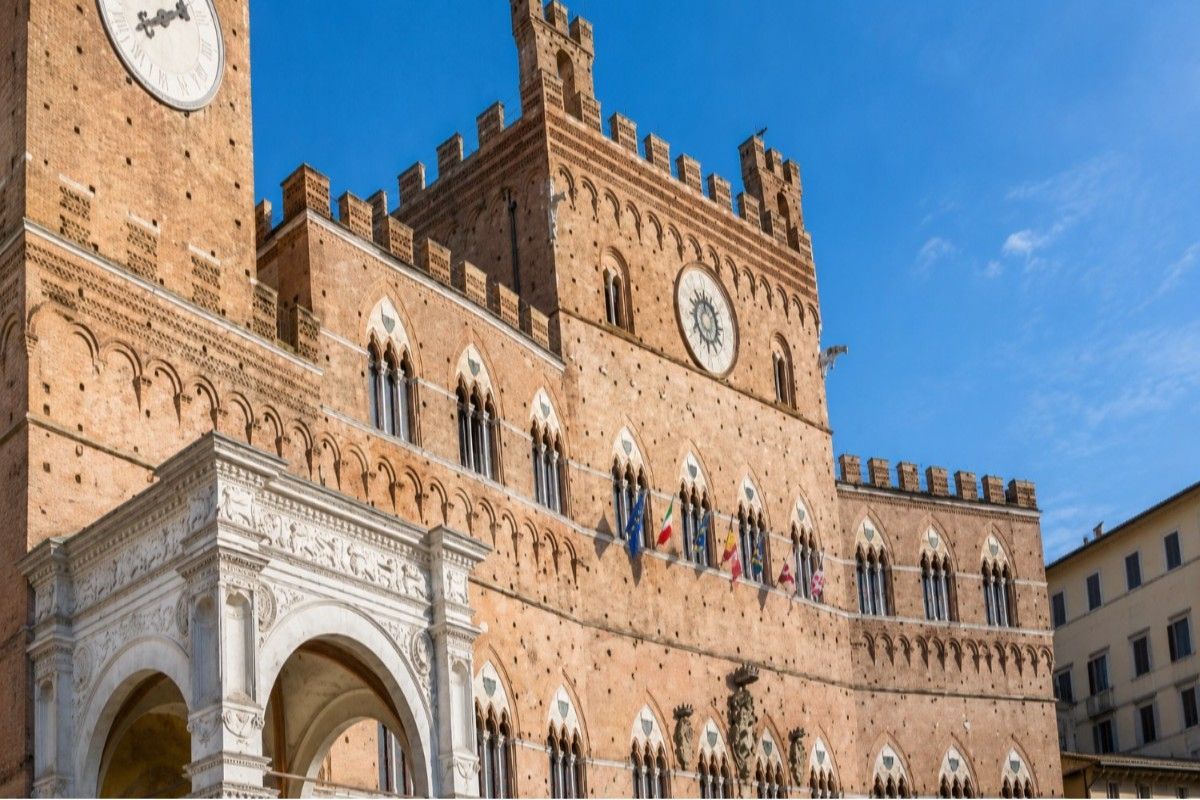
 Italy | Est. 1240
Italy | Italy's Ministry of University and Research | talian medium
Expert will call you within 2 hours
People mostly just call it UniSi for short. It is genuinely one of the oldest universities in the entire world, with its earliest documented reference tracing to a podestà decree dated 26 December 1240, a document that reveals a genuinely distinctive governance model. Unlike Bologna, where the university grew from student initiative, or Paris, where it developed under faculty administration, Siena's own university was built instead on direct organisation by the city itself. So, this university's founding structure reflects a real, documented, and genuinely different model of medieval university governance from its two more famous Italian and French counterparts.
Here is a fact most guides skip entirely. Medicine and Surgery, alongside Law, was among the university's very earliest historic faculties, and Siena's own fortunes as a university grew considerably in 1321, when large numbers of students transferred here directly from the University of Bologna. The Comune di Siena immediately recognised the university's potential as a major cultural and political asset, and deliberately allocated large sums of money to welcome these new students, granting them numerous privileges, tax exemptions, and franchises. On 16 August 1357, following sustained diplomatic effort by Siena's own governing council, the Studio senese was formally included among the universities of the Holy Roman Empire, through a diploma granted in Prague by Emperor Charles IV himself.
The university's history includes two genuinely dramatic interruptions worth knowing in full, since they are rarely mentioned in typical university guides. At one point, amid the political passions of Italy's Risorgimento unification movement, Tuscany's own Grand Duke, worried about the medical school's role in this unrest, closed the School of Medicine entirely, leaving only Law and Theology to survive. The university's fortunes only recovered after 1859, helped by city institutions and a series of legislative recognitions that restored fame to the Schools of Pharmacy and Obstetrics, and, through them, to the School of Medicine itself. Then, in 1892, Italy's own Minister of Public Instruction, Ferdinando Martini, actually proposed closing the entire university outright. A genuine popular uprising followed, including a general strike and direct intervention from the city's own institutions, forcing the minister to withdraw his proposal entirely.
The twentieth century brought steady, genuine growth. From roughly 400 students enrolled around the era of the two World Wars, the university has grown to nearly 20,000 students today. New faculties were added over time: Pharmacy in 1933, Mathematical, Physical, and Natural Sciences in 1962, Economics in 1966, Lettere e Filosofia in 1970, Engineering in 1992, and Political Sciences in 1997. In 1990, the university formally celebrated its 750th anniversary.
The Facoltà di Medicina e Chirurgia today operates as the Scuola di Medicina e Scienze della Salute, School of Medicine and Health Sciences, comprising departments of Medical Biotechnology, Molecular and Developmental Medicine, and Medical, Surgical, and Neuroscience Sciences. Medical students train across several distinct sites depending on their year of study. The Policlinico Santa Maria alle Scotte serves as the Faculty's main site overall, first-year students attend lectures at the Complesso Didattico del Laterino while their practicals and labs run at the Polo Scientifico di San Miniato, and second-year students shift entirely to San Miniato for both lectures and practical work, which also hosts a considerable share of examinations across all six years.
Medicina e Chirurgia at Siena runs as a six-year Single-Cycle Degree comprising 360 total credits, CFU, of which at least 60 must specifically be earned through professionalising activities aimed at developing genuine, specific clinical skills. Admission runs through Italy's national restricted-access system, with the test covering biology, chemistry, physics, and mathematics, and successful candidates must additionally hold English proficiency at a minimum of A2 level.
NEET remains a genuine requirement for Indian applicants here, exactly as it does for MBBS study in most other countries, and Indian graduates would still need to clear the FMGE or NExT exam to practise medicine back in India.
Siena itself is a genuinely well-preserved medieval Tuscan city, famous internationally for its Piazza del Campo and the Palio horse race held twice each summer, giving students a genuinely distinctive setting quite different from studying in one of Italy's larger, more modern cities. The city's own compact size means students genuinely benefit from a walkable, close-knit university town atmosphere, where academic life and everyday city life overlap considerably more than in a sprawling metropolis. This combination of deep historical character and manageable city scale is a real, distinctive feature of studying medicine at Siena specifically.
The university's own research strength extends well beyond teaching alone, with Siena hosting genuinely active research groups across molecular medicine, oncology, and neuroscience, reflecting the wider Scuola di Medicina e Scienze della Salute's own departmental structure. Students here benefit from training alongside faculty who are simultaneously engaged in ongoing research, giving them exposure to genuinely current medical developments throughout their six years of study, not solely established textbook knowledge alone.
Siena publishes genuinely specific, precise first-instalment figures, directly comparable across its own faculties, worth setting out exactly.
Cost Item | Amount | Notes |
First Instalment (Medicine, EU-regulation single-cycle courses) | EUR 609.00 | Applies specifically to Pharmacy, Chemistry and Pharmaceutical Technology, Medicine and Surgery, and remaining years of Dentistry |
First Instalment (science-area courses generally) | EUR 528.00 | For comparison, the standard rate for Siena's other scientific-area degree courses |
First Instalment (humanities-area courses generally) | EUR 406.00 | For comparison, the standard rate for Siena's humanities-area degree courses |
Regional Tax + Stamp Duty (included within first instalment structure) | EUR 140 (regional tax) + EUR 16 (stamp duty) | Standard charges applied across nearly all Italian public universities |
Second and Third Instalments | ISEE-based (second) and merit-based, tied to CFU credits earned by 31 October each year (third) | Consistent with the standard Italian public-university contribution model |
Total 6-Year Estimate | — | Genuinely dependent on individual ISEE and merit status; use Siena's own official fee simulator for a personalised estimate |
Note: no capitation fee is confirmed at any stage. Use Siena's own official tuition fee simulator (simulatore tasse) for a precise, personalised estimate.
Most lists mention Siena as just another ancient Italian university. However, they do not explain how genuinely turbulent its real history actually was, or how precisely its own Medicine-specific fee is published. The reason is simple. It is about real, documented survival against closure, and genuine fee transparency.
Siena is not like most other ancient Italian universities when it comes to its own history. In fact, its history includes two real, separately documented moments where the university's survival was genuinely at risk, a Risorgimento-era medical school closure, and an 1892 near-closure of the entire university, defeated only by a genuine popular uprising and general strike. Furthermore, this university's endurance rests on real, specific, dramatic history most competing guides simply don't mention.
The Medicine-specific fee also matters more than most guides let on. For example, most guides describing Italian medical school fees speak only in general, income-linked terms. Siena publishes an exact first-instalment figure of EUR 609.00 specifically for Medicine and related regulated health courses, directly comparable against its own published EUR 528.00 science-area rate and EUR 406.00 humanities-area rate. Moreover, applicants get a genuinely specific, official, three-way comparison here, not a vague generalisation.
One thing most other blogs miss is Siena's own genuinely distinctive credit-based progression system, known as the "blocchi." In addition to standard academic requirements, students need 70 CFU by a set deadline to avoid repeating Year 2, and 240 CFU to avoid repeating Year 5, both affecting progression into Years 3 and 6. Since falling behind carries real, specific financial consequences, applicants need to manage their credit accumulation carefully across the six years.
No hidden charges, no donation. The full picture of costs at MBBS in University of Siena Faculty of Medicine and Surgery.
Tuition Fee
EUR 609.00 first instalment (Medicine-specific); further instalments income and merit-based
€4,500 per year
Hostel Fee
€200 to €400 per month
€200 to €400 per month
Food & Meals
€270 per month
per month
Insurance
€15 to €20 per month
per month
Donation
No Donation
No hiddedn fee
Total Estimated Cost
Genuinely dependent on individual ISEE and merit status; use Siena's own fee simulator
6 year
25–35%
Average FMGE first-attempt pass rates for students from many overseas medical universities. Students from structured programs consistently score higher.
Students returning to India need to clear the FMGE/NExT exam. MBBS in University of Siena Faculty of Medicine and Surgery integrates exam-oriented coaching into the regular curriculum so students are prepared from day one.
A structured program that takes you from foundational sciences to clinical mastery.
● In addition, lectures run at the Complesso Didattico del Laterino, with practicals and labs at the Polo Scientifico di San Miniato
● First, Anatomy, Biochemistry, and foundational disciplines are covered, including credits specifically dedicated to the history of medicine and deontology
● Furthermore, both lectures and practical work run entirely at the Polo Scientifico di San Miniato
● Next, Physiology and Pathology build toward the diagnostic foundation needed for clinical training
● Moreover, this stage runs primarily through the Policlinico Santa Maria alle Scotte
● Then, Medicine, Surgery, and allied clinical subjects require a minimum 70-CFU threshold to progress into Year 3
● Also, graduates must pass Italy's Esame di Stato and register with the relevant professional body before practising
● Finally, no separate internship year is appended; clinical training runs throughout the six-year single-cycle degree itself
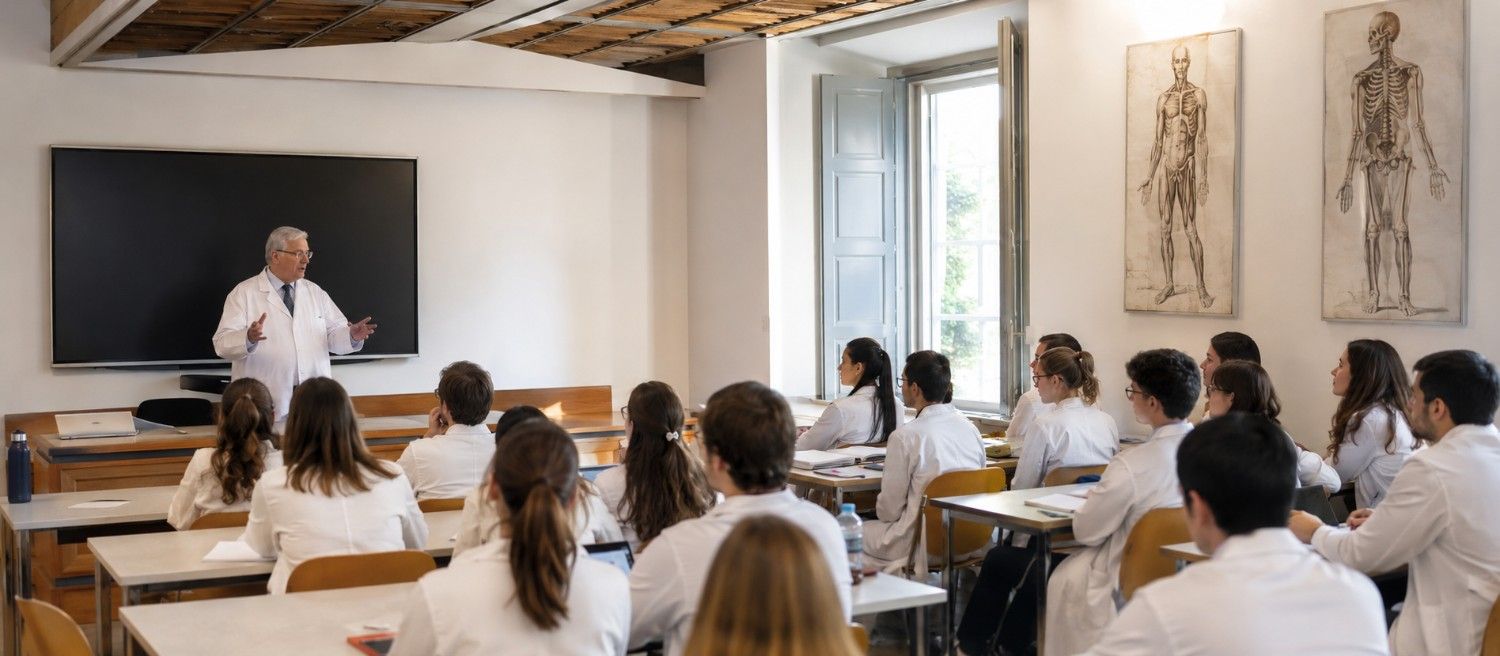
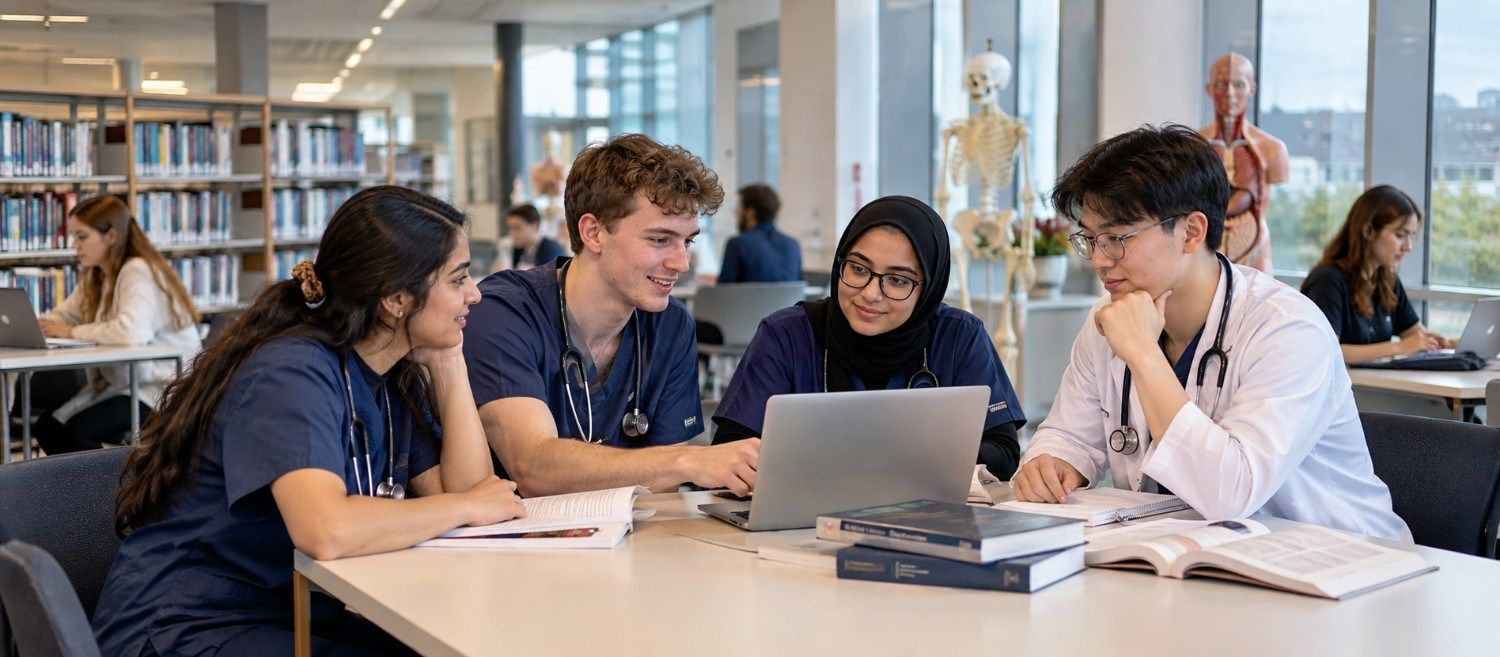
Furnished hostel rooms with Wi-Fi, laundry, 24/7 security, and Indian mess on or near campus.
Indian restaurants and mess facilities serving vegetarian and non-vegetarian home-style food daily.
Strong Indian community with cultural events, festival celebrations, and peer support groups.
Students get hands-on clinical training in government and private hospitals affiliated with the university.
Practical information for students planning to study at MBBS in University of Siena Faculty of Medicine and Surgery.
Prepare for all seasons. Thermal wear for winters, light clothing for summers. University provides heating in hostels.
Student visa processed with university invitation letter. Direct and connecting flights from major Indian cities.
Health insurance included in fees. Medical facility on campus plus city hospitals easily accessible.
Local SIM cards available. WhatsApp and video calls keep you connected with family back home.
Average monthly expenses of $150–$250 covering food, transport, and personal needs.
University library, online databases, and study groups. Seniors mentor juniors through academic challenges.
Our team guides you through every step — from application to arriving on campus.
Our Italy specialist explains the IMAT process, the income-based fee system, Bologna vs Rome vs other universities, and a total cost comparison with Hungary and Poland.
Our team registers you for IMAT (September test) and begins structured coaching. Biology, Chemistry, Physics, Maths, Critical Thinking. Begin preparation at least 6 months before the test.
Full Italian visa and IMAT application document set academic certificates, income documentation if applicable.
IMAT taken at designated test centres. We provide post-test analysis and guidance on university rankings.
Following IMAT ranking, the Italian university issues an admission confirmation. Our team can help with this process.
Full documentation submitted to the Italian Embassy or Consulate. Begin immediately after receiving the admission letter.
Our team advises qualifying families on the income-based fee reduction process.
Bologna /Rome orientation, accommodation, portico culture, Italian transport, Trenitalia app, banking, SIM card.
Our local team in Bologna (BLQ) or Rome (FCO) meets you and manages the first-week settlement.
We manage the Permesso application at the local Post Office within 8 days of arrival with our support, which is renewed annually.
Admission Helpline — Contact our counsellors for step-by-step assistance.
“The faculty here is incredibly supportive. The clinical training during hospital rotations has given me real confidence in patient care.”
“Affordable fees without compromising on quality. The campus facilities and hostel life made my transition abroad very smooth.”
“English medium instruction and WHO-recognized curriculum were the deciding factors for me. No regrets so far — excellent experience overall.”
“The university helped with everything from visa to accommodation. Hospital exposure from year three has been invaluable for my FMGE prep.”
“Just cleared my licensing exam on the first attempt. The structured coaching and mock exams during final year were a game-changer.”
“Safe campus, good food options, and a strong Indian student community. The teaching methodology is very practical and hands-on.”
Its earliest documented reference dates to a podestà decree of 26 December 1240, making it one of the oldest universities in the world.
Yes, genuinely twice under real threat: once during Italy's Risorgimento era, when the Grand Duke closed the School of Medicine specifically, and again in 1892, when a government minister proposed closing the entire university outright.
No, the entire programme runs in Italian, though A2-level English proficiency is required upon passing the admission test.
Yes, a valid, qualifying NEET score is required for Indian applicants, alongside meeting Italy's national medical admission requirements.
The first instalment for Medicine is a precisely published EUR 609.00, with the second instalment calculated on ISEE income and the third tied to academic merit; use Siena's own official fee simulator for a personalised total.
The Policlinico Santa Maria alle Scotte serves as the main clinical site, with earlier years also using the Complesso Didattico del Laterino and the Polo Scientifico di San Miniato.
It runs six years, comprising 360 total CFU, with no separate internship year, though the Esame di Stato follows graduation.
A credit-based progression requirement: students need 70 CFU by a set deadline to avoid repeating Year 2, and 240 CFU to avoid repeating Year 5, both affecting progression into Years 3 and 6.
Q9. How is Siena ranked?
Law, Pharmacy (1933), Sciences (1962), Economics (1966), Lettere e Filosofia (1970), Engineering (1992), and Political Sciences (1997), among others.

Our expert counsellors will guide you through the complete admission process — from documents to airport pickup.