
Q1. Does Trento have its own independent medical faculty?
+No. It's a joint programme with the University of Verona, formally coordinated through an interateneo Scuola di Medicina e Chirurgia.
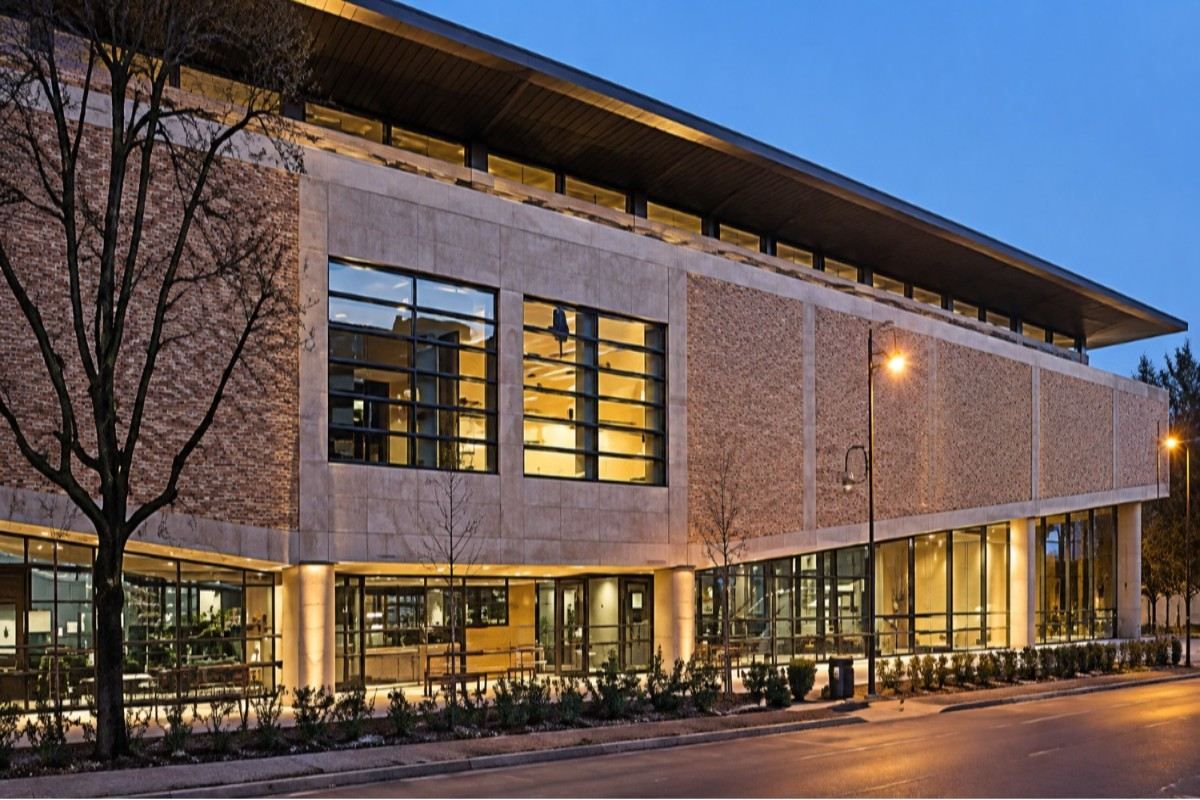
 Italy | Est. 2020
Italy | Recognised under Italian higher education law (MUR). A confirmed World Directory of Medical Schools listing could not be verified during research. | Entirely in Italian medium
Expert will call you within 2 hours
The University and What Makes It Different
Let's start with the one thing most guides get wrong about this university. Trento doesn't run its own independent medical faculty. What it actually has is a joint programme with the University of Verona, formally called the Scuola di Medicina e Chirurgia interateneo, with Trento acting as the administrative seat and Verona supplying much of the underlying medical teaching infrastructure. If you came here expecting a self-contained Trento medical school, that's not quite the shape of the thing.
The timeline matters here, and it's easy to get muddled. Teaching for the single-cycle Medicine and Surgery degree actually began back in 2020, with the health ministry authorising 60 places for that first cohort. The formal "Scuola" structure that coordinates the whole arrangement wasn't set up until four years later, on 28 March 2024, once both universities' academic senates had signed off. So the degree existed well before the coordinating body that now governs it did.
There's a genuinely nice payoff to that timeline, too. The first graduates, 28 of them, crossed the stage on 10 July 2026 at Trento's Palazzo Prodi, described locally as the first generation of doctors trained entirely on Trentino soil. Six years from launch to first graduating class, which tracks with how long the course actually takes.
Trento itself is an older university than its medical programme suggests, going back to 1962 as the Istituto Superiore di Scienze Sociali, founded by Bruno Kessler. It became the Libera Università di Trento in 1972 and picked up full state status in the 1982/83 academic year. Medicine, by comparison, is a genuinely recent addition to that longer institutional story.
The Trento Setting and How Teaching Is Actually Organised
On the Trento side, the academic home base is CISMed, the Centro Interdipartimentale di Scienze Mediche, set up by the university's Academic Senate in February 2021 and housed at Palazzo Consolati on Via S. Maria Maddalena. It pulls in expertise from CIBIO, Trento's cellular and computational biology centre, and from CIMeC, the university's well-regarded mind and brain research centre, which gives the programme a noticeably tech- and genomics-leaning flavour rather than a purely classical clinical one.
Clinical placements run through what used to be called APSS, the provincial health authority. As of 1 January 2026 that body was renamed ASUIT, Azienda Sanitaria Universitaria Integrata del Trentino, specifically to formalise the university-healthcare partnership on paper as well as in practice. Ospedale Santa Chiara in Trento is the anchor hospital within that system.
Trento the city is compact, Alpine, and genuinely pleasant to live in by Italian standards, though it's also one of the smaller settings on this list. That has real trade-offs. You're not getting the scale of a Naples or a Milan hospital network, but you are getting a tight-knit programme and a research culture that leans hard into biomedical technology, which suits a certain kind of student better than a traditional, sprawling university hospital would.
Rents have moved sharply here, worth flagging plainly. Regional reporting puts private-market student rents up roughly 73 percent over four years, with a shared single room now running 220 to 530 euros a month. University-run Opera Universitaria housing is cheaper, 220 euros for a single and 180 for a shared double, though it's means-tested.
Course Structure, Cost, and Practical Details
On the structural basics: this is the standard Italian single-cycle Laurea Magistrale in Medicina e Chirurgia, class LM-41, six years and 360 credits, the same national framework as everywhere else in Italy. Since a 2020 reform, the degree itself carries full qualifying status once you finish it. What that actually means in practice is a Tirocinio Pratico-Valutativo, worked into the final year or two of study rather than tacked on afterward, 300 hours split roughly evenly across medical, surgical, and general-medicine placements, the last of those specifically slotted into year six.
Admission for the 2025/26 intake and onward runs through Italy's new semestre filtro system: open enrolment into the first semester, no upfront entrance exam, then three national exams in chemistry and biochemistry, physics, and biology that rank you nationally for continuation. There's no English-taught or IMAT route here at all, and seats are limited to EU citizens and non-EU citizens already resident in Italy, 80 places for the coming year. Anyone hoping for an international, English-medium entry point specifically should look elsewhere on this list.
Tuition is the one area where a clean number genuinely isn't available for this specific programme. Trento's general, university-wide fee bands for EU students run roughly from 146 to 366 euros at the lower ISEE brackets up to around 2,384 euros at the top, but nothing found confirms those figures apply identically to medicine specifically, so treat them as a rough starting point rather than a confirmed cost and check directly with the university before assuming anything.
One honest note. Given the joint structure with Verona, anyone comparing Trento against a traditionally independent Italian medical school should understand that a fair amount of the academic weight sits with Verona's side. Not a criticism, plenty of joint programmes work this way, but "Trento medicine" and "a Trento-run faculty" aren't quite the same claim.
Quick Overview
Parameter | Details |
Founded | University founded 1962; medicine programme launched 2020 (60 places); formal interateneo Scuola established 28 March 2024 |
Institution Type | Public university; medicine run jointly with the University of Verona (interateneo) |
Location | Trento, Trentino-Alto Adige, Italy |
Programme | Laurea Magistrale a Ciclo Unico in Medicina e Chirurgia interateneo (LM-41) |
Duration | 6 years, 360 credits |
Medium of Instruction | Italian only; no English-taught track |
Admission Route | Semestre filtro (national reform, from AY 2025/26); 80 places, EU and Italy-resident non-EU only |
Teaching Hospital | Ospedale Santa Chiara, Trento, via ASUIT (formerly APSS) |
Fee Structure
Fee Component | Amount | Notes |
Tuition Fee (general university bands, not confirmed medicine-specific) | Roughly EUR 146 to 2,384 per year, ISEE-based | Not confirmed as medicine-specific; check directly with the university |
Living Costs (rent) | Approx. EUR 220 to 530 per month | Private-market rents rose roughly 73% over four years |
University Housing | EUR 180 to 220 per month | Opera Universitaria housing, means-tested, not guaranteed |
Total Annual Cost of Living | Approx. EUR 10,000 to 15,000+ | Estimate for an out-of-town student, rent included |
Total Cost | Best obtained from the university itself | Medicine-specific fee figures were not confirmed in research |
Why Trento's Medical School Deserves a Harder Look Than You've Given It
A Genuinely New Model for Italian Medical Education
Most comparison pages don't explain this clearly enough. Trento's programme isn't just administratively linked to Verona, it's described locally as the first inter-university medical school of its kind built under existing Italian regulation, a structure the rector has called a new way of doing academia.
A Tech-Leaning Curriculum Baked Into the Setup
Because CISMed pulls in CIBIO's computational biology strength and CIMeC's brain-research expertise, students get genomics and biomedical technology threaded through the curriculum in a way that isn't automatic at a more traditional Italian medical faculty.
Honest Assessment
Be clear-eyed about a few things. This is a joint programme, not an independently run Trento faculty, and a meaningful share of its academic weight sits with Verona. There's no English-taught route, seats are limited to EU and Italy-resident applicants, and medicine-specific tuition figures aren't cleanly published, so budgeting needs a direct check with the university. What you do get is a small, tightly-run programme in a genuinely pleasant Alpine city, leaning further into biomedical technology than most Italian alternatives, with a young but already-graduating track record.
No hidden charges, no donation. The full picture of costs at MBBS in University of Trento School of Medicine and Surgery.
Tuition Fee
€1,000 – €6,500
Roughly EUR 146 to 2,384 per year — Confirm directly with the university
Hostel Fee
Approx. EUR 220 to 530 per month
Approx. EUR 220 to 530 per month
Food & Meals
€150 to €280
per month
Insurance
€700 per year
per year
Donation
No Donation
No hidden fee
Total Estimated Cost
Best obtained from the university itself — Medicine-specific fee figures were not confirmed
6 year
25–35%
Average FMGE first-attempt pass rates for students from many overseas medical universities. Students from structured programs consistently score higher.
Students returning to India need to clear the FMGE/NExT exam. MBBS in University of Trento School of Medicine and Surgery integrates exam-oriented coaching into the regular curriculum so students are prepared from day one.
A structured program that takes you from foundational sciences to clinical mastery.
• Built jointly with the University of Verona's medical teaching structure, reflecting the interateneo arrangement.
• Foundation medical sciences coordinated through CISMed, drawing on CIBIO and CIMeC research strengths.
• The 300-hour Tirocinio Pratico-Valutativo runs across these final years, with the general-medicine placement specifically required in year six.
• Clinical training through ASUIT-affiliated hospitals, anchored by Ospedale Santa Chiara in Trento.
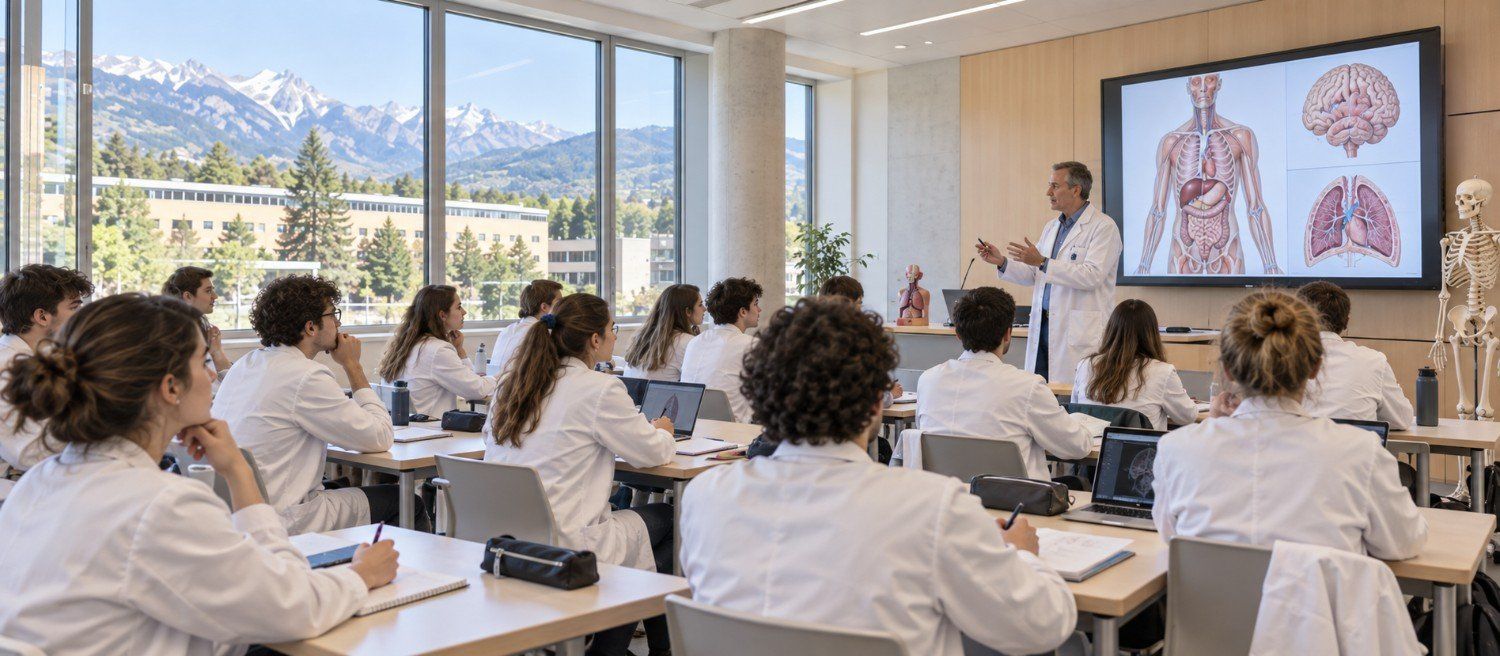
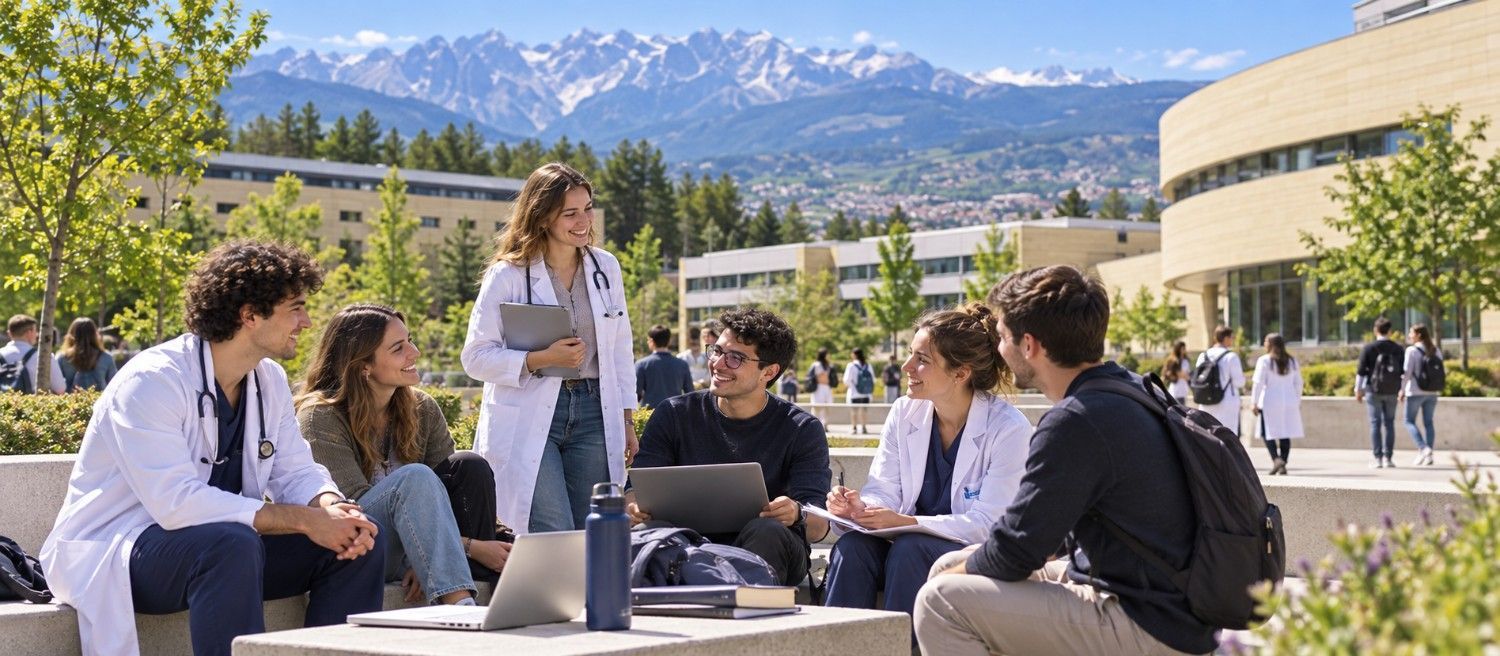
Furnished hostel rooms with Wi-Fi, laundry, 24/7 security, and Indian mess on or near campus.
Indian restaurants and mess facilities serving vegetarian and non-vegetarian home-style food daily.
Strong Indian community with cultural events, festival celebrations, and peer support groups.
Students get hands-on clinical training in government and private hospitals affiliated with the university.
Practical information for students planning to study at MBBS in University of Trento School of Medicine and Surgery.
Prepare for all seasons. Thermal wear for winters, light clothing for summers. University provides heating in hostels.
Student visa processed with university invitation letter. Direct and connecting flights from major Indian cities.
Health insurance included in fees. Medical facility on campus plus city hospitals easily accessible.
Local SIM cards available. WhatsApp and video calls keep you connected with family back home.
Average monthly expenses of $150–$250 covering food, transport, and personal needs.
University library, online databases, and study groups. Seniors mentor juniors through academic challenges.
Our team guides you through every step — from application to arriving on campus.
Our Italy specialist explains the IMAT process, the income-based fee system, Bologna vs Rome vs other universities, and a total cost comparison with Hungary and Poland.
Our team registers you for IMAT (September test) and begins structured coaching. Biology, Chemistry, Physics, Maths, Critical Thinking. Begin preparation at least 6 months before the test.
Full Italian visa and IMAT application document set academic certificates, income documentation if applicable.
IMAT taken at designated test centres. We provide post-test analysis and guidance on university rankings.
Following IMAT ranking, the Italian university issues an admission confirmation. Our team can help with this process.
Full documentation submitted to the Italian Embassy or Consulate. Begin immediately after receiving the admission letter.
Our team advises qualifying families on the income-based fee reduction process.
Bologna /Rome orientation, accommodation, portico culture, Italian transport, Trenitalia app, banking, SIM card.
Our local team in Bologna (BLQ) or Rome (FCO) meets you and manages the first-week settlement.
We manage the Permesso application at the local Post Office within 8 days of arrival with our support, which is renewed annually.
Admission Helpline — Contact our counsellors for step-by-step assistance.
“The faculty here is incredibly supportive. The clinical training during hospital rotations has given me real confidence in patient care.”
“Affordable fees without compromising on quality. The campus facilities and hostel life made my transition abroad very smooth.”
“English medium instruction and WHO-recognized curriculum were the deciding factors for me. No regrets so far — excellent experience overall.”
“The university helped with everything from visa to accommodation. Hospital exposure from year three has been invaluable for my FMGE prep.”
“Just cleared my licensing exam on the first attempt. The structured coaching and mock exams during final year were a game-changer.”
“Safe campus, good food options, and a strong Indian student community. The teaching methodology is very practical and hands-on.”
No. It's a joint programme with the University of Verona, formally coordinated through an interateneo Scuola di Medicina e Chirurgia.
Teaching began in 2020 with 60 places; the formal coordinating structure wasn't established until March 2024.
Yes, the first cohort of 28 students graduated in July 2026.
No. The entire programme runs in Italian, and there's no IMAT-based international route.
Through the national semestre filtro system since 2025/26: open enrolment, then three common exams determining national ranking.
EU citizens and non-EU citizens already resident in Italy; there's currently no route for non-EU applicants resident abroad.
Medicine-specific figures weren't confirmed in available sources; general university bands run roughly EUR 146 to 2,384 a year, but confirm directly with the university.
Through ASUIT (formerly APSS), anchored by Ospedale Santa Chiara in Trento.
No, not automatically. India's standard foreign-degree licensing route, including NExT, would still apply.
Public, operating under Italy's national higher education framework, jointly with the University of Verona.

Our expert counsellors will guide you through the complete admission process — from documents to airport pickup.