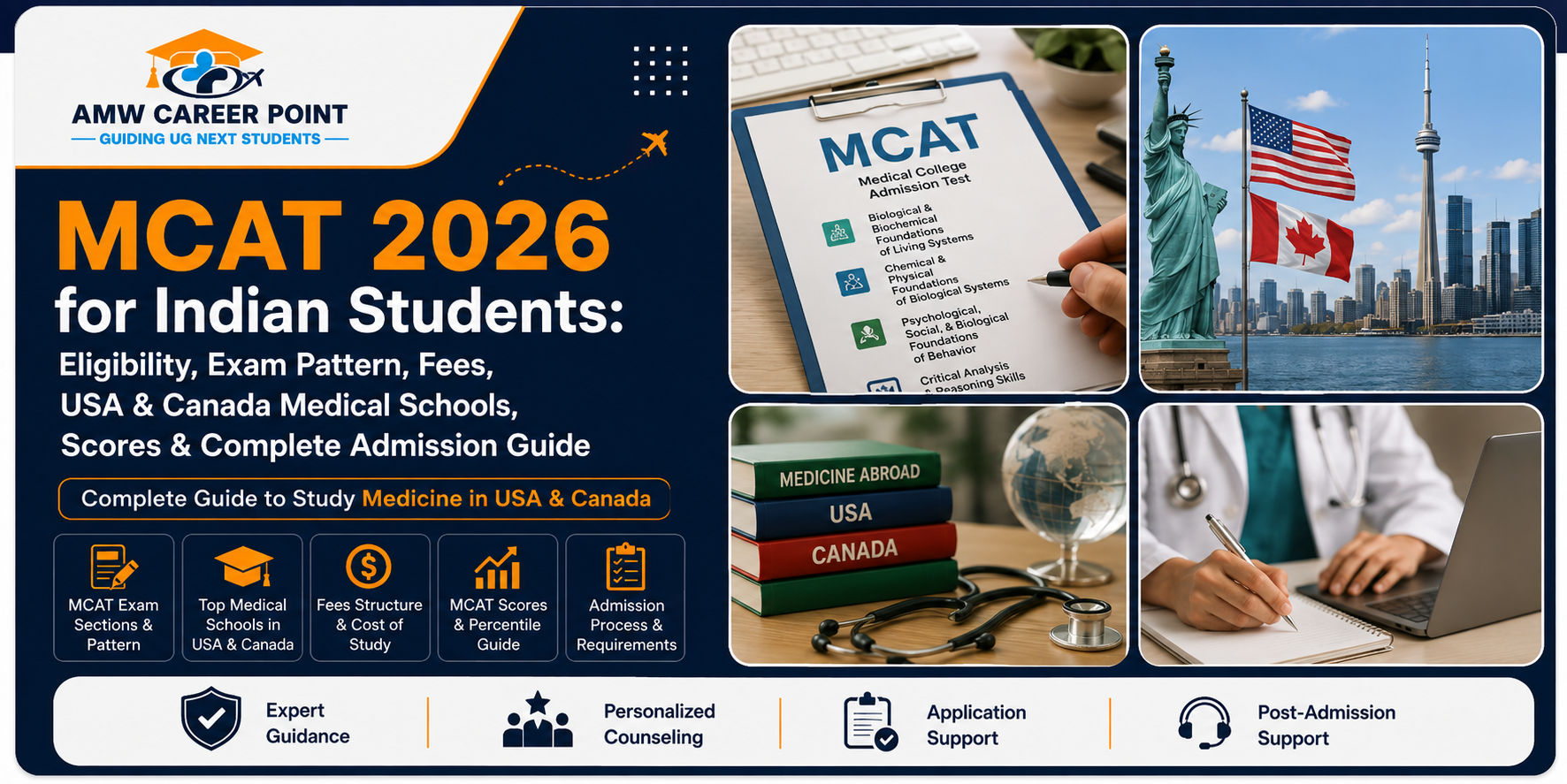
MCAT stands for Medical College Admission Test is a standardised, computer-based admissions exam developed and administered by the AAMC (Association of American Medical Colleges). It assesses knowledge of natural and social science concepts alongside critical thinking and scientific problem-solving skills considered necessary for beginning medical study and not simply how well you've memorised a fixed science syllabus.
Almost every MD- and DO-granting medical school in the United States, and most Canadian medical schools, use the MCAT as part of admissions. It differs from a traditional subject-only entrance exam (like NEET-UG) by weighting reasoning, reading comprehension, and applied scientific thinking as heavily as raw content knowledge.
Reality check: MCAT is an admission test and not a medical degree, and not a guarantee of admission to medical school. A strong score is one input among many that US and Canadian medical schools weigh.
Can Indian Students Take the MCAT in 2026?
Yes, an Indian student can take the MCAT but that's the easy part. The AAMC provides a dedicated pathway for international applicants and confirms that international applicants may apply to U.S. medical schools, though school policies and transcript requirements vary significantly. The real questions that determine whether this pathway actually works for you are:
Are you eligible to apply to your intended medical school specifically as an international applicant?
Does that school accept international applicants at all most don't (see the numbers below)?
Does it accept your previous academic qualifications, specifically an Indian bachelor's degree?
Have you completed the necessary prerequisite coursework that school requires?
How will your Indian academic record actually be assessed, given AMCAS's foreign-transcript policy (covered in detail below)?
MCAT Eligibility 2026 for Indian Students
Eligibility to take MCAT is not the same as eligibility for every medical school. This distinction matters throughout this entire guide. The AAMC's own MCAT eligibility criterion is broad and you must be planning to apply to a health-professions programme (medical, dental, veterinary, podiatric) that uses the MCAT, or hold special permission from AAMC otherwise. Current medical students and test-takers not intending to apply to health-professions schools cannot take the MCAT for other purposes.
Background | MCAT Test Eligibility | Notes |
Students planning to apply to medical school | Core MCAT eligibility group | Must intend genuine application to an MCAT-requiring programme |
Students with a completed bachelor's degree | Eligible | Most common profile for international applicants |
Students currently completing a bachelor's degree | Eligible | Common many take MCAT during their final undergraduate year |
Indian BSc students | Eligible to sit | Most common Indian applicant background |
BPharm students | Eligible to sit | School-specific coursework/eligibility still applies |
Biotechnology/Life Sciences graduates | Eligible to sit | Strong overlap with B/B section content |
Nursing graduates | Eligible to sit | School-specific policy on prior health-professional degrees varies |
Engineering graduates | Eligible to sit | Prerequisite science coursework gap needs realistic planning |
Other academic backgrounds (arts, commerce) | Eligible to sit | Prerequisite coursework becomes the central planning question |
Can You Study Medicine in the USA After Class 12?
Not directly this is the single biggest structural difference between the US system and India's direct-entry MBBS model. The traditional US pathway looks like this:
Class 12
Bachelor's/Pre-Med Education (typically 4 years)
Complete Required Prerequisites (school-specific science/humanities coursework)
MCAT
Medical School Application
MD/DO Programme (typically 4 years)
Residency (3–7 years depending on specialty)
Medical Licensure
There is no US equivalent of a direct-entry MBBS straight after Class 12. Even domestic American applicants complete a full bachelor's degree first the US model is inherently graduate-entry, which is exactly why an Indian bachelor's degree (rather than just Class 12 marks) is the realistic starting point for this pathway, not a shortcut around it.
What Is Pre-Med and Do Indian Students Need It?
Important: There is no single, compulsory "Pre-Med degree" required by every US medical school. "Pre-med" describes an academic pathway and mindset completing specific prerequisite coursework alongside any bachelor's degree not one fixed named degree programme.
Common prerequisite coursework that US and Canadian medical schools look for includes:
Biology (often with lab component)
General/Inorganic Chemistry (with lab)
Organic Chemistry (with lab)
Physics (with lab)
Biochemistry
Behavioural/Social Sciences (Psychology, Sociology) required or recommended at a growing number of schools
English/Writing coursework required at some schools
Exactly which of these are required, recommended, or unnecessary is entirely school-specific always check each shortlisted medical school's own prerequisite list rather than assuming a single universal checklist applies everywhere.
Can Indian Students Apply to U.S. Medical School With an Indian Bachelor's Degree?
This is one of the most misunderstood parts of the entire pathway, and deserves the most detailed treatment in this guide. The AAMC states plainly that AMCAS does not generally verify foreign coursework unless it was accepted by an accredited U.S., U.S. territorial, or Canadian postsecondary institution. In practice, this means:
Your Indian BSc/BPharm/other degree, on its own, may not automatically satisfy a US medical school's coursework verification process even though it's a completed, legitimate degree in India.
Many schools expect international applicants to complete at least some coursework sometimes a full additional degree at an accredited US or Canadian institution specifically so that grades and prerequisites can be verified through the normal AMCAS process.
School-specific policies vary enormously: Some medical schools evaluate foreign transcripts through a recognised credential-evaluation service; others require US/Canadian coursework outright; a few are more flexible than most. There is no universal rule.
This is precisely why "can Indian students get into US medical school" doesn't have a single answer and it depends entirely on which specific school, and how that school's admissions office chooses to treat foreign academic records.
Reality check: Do not assume an Indian bachelor's degree is automatically accepted everywhere. Many successful Indian applicants to US medical schools complete a second bachelor's degree, a post-baccalaureate pre-med programme, or at minimum a meaningful block of coursework at a US or Canadian institution specifically to build a verifiable AMCAS-compatible transcript before applying.
Complete MCAT-to-Medical-School Pathway for Indian Students
Step |
Decide whether USA or Canada is your target |
Check whether you meet medical-school academic requirements (including the transcript issue above) |
Complete prerequisite coursework ideally at a US/Canadian institution |
Research international-student-friendly medical schools specifically (not just any US medical school) |
Take the MCAT |
Build your application profile GPA, clinical experience, research, service, letters of recommendation |
Apply through the appropriate application system (AMCAS, AACOMAS, TMDSAS, or Canadian equivalents) |
Submit secondary applications to schools that request them |
Attend interviews (traditional panel or Multiple Mini Interview format) |
Receive an offer |
Arrange funding this is the single biggest practical constraint for most Indian applicants |
Apply for your student visa (F-1 for the US; study permit for Canada) |
Begin medical school |
Complete residency and licensing requirements |
MCAT 2026 Important Dates and Test Schedule
The 2026 MCAT testing cycle runs January through September 2026, across 31 official test dates in the US, Canada, and selected international locations and no MCAT testing is scheduled from October through December. Registration for all 2026 test dates opened on 21–23 October 2025, with January–June and July–September dates released together rather than in separate waves.
Period | Test Availability |
January 2026 | 4 test dates |
February 2026 | 1 test date (newly added) |
March–August 2026 | Multiple dates each month, typically 2–6 sessions |
September 2026 | Final test date: 12 September 2026 |
October–December 2026 | No MCAT testing |
Registration deadlines follow AAMC's tiered 60-day/30-day/10-day structure ahead of each date, governing your ability to change dates or locations and your eligible refund amount check the exact deadline for your chosen date directly on AAMC's scheduling system, since it varies by test-centre location.
Which MCAT Date Should Indian Students Choose?
Choosing a date is about more than convenience and it's about the relationship between four moving pieces:
Score release timing: results are typically released roughly 5–6 weeks after your test date.
AMCAS/application cycle timing: most US medical schools use rolling admissions, so submitting your primary application as early as the cycle allows (typically late May/June for the following year's intake) genuinely improves your odds with a late MCAT score can push your whole application timeline back.
Secondary applications and interviews: these follow your primary application submission, so a January–April MCAT date generally gives you the most application-cycle flexibility.
Your intended intake year: work backward from your target intake to your realistic application submission date, then backward again to a test date that leaves buffer for a possible retake.
Can Indian Students Take the MCAT From India?
Get this right: No, the MCAT is not currently administered in India, and this should not be presented as a minor inconvenience.
Indian candidates must travel to an international test centre. The AAMC's current international testing calendar lists test sites across roughly 14–18 countries excluding the US and Canada, including Australia, Hong Kong (China), France, Germany, Israel, Japan, Jordan, Lebanon, Qatar, Singapore, South Africa, Taiwan, Thailand, Turkey, and the UK — with most countries offering up to five test centres, while the US and Canada each have 30+ locations. Always confirm the live, current list directly on AAMC's official testing calendar before planning, since available countries and seat capacity change between registration cycles.
Nearest International MCAT Locations for Indian Students
For most Indian applicants, the practical nearest options are Thailand (Bangkok), Singapore, Qatar (Doha), and Malaysia (Kuala Lumpur) with Thailand and Doha typically cited as the closest by travel time, and Singapore among the fastest to fill up. Seats at these popular nearby centres are limited and allocated first-come, first-served, so register as early as your preparation timeline reasonably allows.
Reality check: Budget genuine travel logistics into your MCAT plan: flights, at least one night's accommodation, a valid passport (other Indian ID documents like Aadhaar or PAN are not accepted at the test centre), and a buffer day for travel disruption. This is a real cost and planning burden most competitor articles gloss over.
MCAT Registration 2026: Step-by-Step Process
Step | Details |
1. Create an AAMC account | Registration and payment both happen through your AAMC account. |
2. Confirm MCAT-accepted ID requirements | A valid, original passport is required at international test centres — no substitutes accepted. |
3. Choose your test date | Based on your application-cycle planning (see above). |
4. Choose your test location | Select your nearest available international centre — seats are limited, so check real-time availability. |
5. Complete registration | Enter personal, academic, and identification details accurately — they must match your ID exactly. |
6. Pay the required fees | Base registration plus the international testing fee (see Fees section below). |
7. Confirm your appointment | Save your confirmation and receipt for entry on test day. |
8. Understand rescheduling/cancellation deadlines | AAMC uses tiered 60-day/30-day/10-day windows — no changes are permitted within 10 days of your exam. |
MCAT Fees 2026 for Indian Students
Fee Component | 2026 Amount |
Standard Registration | US $355 |
International Testing Fee (testing outside US/Canada/US territories) | US $130 additional, non-refundable upon cancellation |
Fee Assistance Program (FAP) Registration | US $145, subject to eligibility (income-based; primarily aimed at US/Canadian applicants) |
Rescheduling 60+ days before exam | ≈ US $55 |
Rescheduling 30–59 days before exam | ≈ US $110 |
Rescheduling 10–29 days before exam | ≈ US $210 |
Rescheduling under 10 days before exam | Not permitted |
Cancellation refund (30+ days before exam) | Partial refund, approximately US $175 |
For most Indian applicants, realistic all-in MCAT cost — registration ($355) plus the international fee ($130), before travel — runs to roughly US $485, or about ₹41,000–₹47,000 depending on the exchange rate at payment time, plus flights and accommodation to your chosen test centre. Canadian applicants also pay applicable GST/HST on top.
MCAT 2026 Exam Pattern
Section | Full Name | Main Focus |
C/P | Chemical and Physical Foundations of Biological Systems | Chemistry, Physics, and Biological Systems |
CARS | Critical Analysis and Reasoning Skills | Reading and critical reasoning |
B/B | Biological and Biochemical Foundations of Living Systems | Biology and Biochemistry |
P/S | Psychological, Social, and Biological Foundations of Behavior | Psychology, Sociology, and Behaviour |
MCAT Exam Duration and Question Structure
The MCAT is a full 7.5-hour seated, computer-based test (including breaks and administrative time), with 230 questions total across the four scored sections — a mix of passage-based and standalone (discrete) questions. The AAMC has not announced any structural changes to this format for the 2026 testing year, so this remains consistent with recent cycles.
MCAT Syllabus 2026: Complete Subject-Wise Breakdown
Chemical and Physical Foundations of Biological Systems (C/P)
Covers General Chemistry, Organic Chemistry, Physics, Biochemistry, and how these apply to biological systems — testing applied problem-solving over isolated formula recall.
Critical Analysis and Reasoning Skills (CARS)
Important: CARS is not simply an English grammar test.
CARS draws from humanities and social-science passages and tests reading comprehension, argument analysis, and reasoning specifically your ability to work within the passage's own logic, without importing outside knowledge. This is the section many strong Indian science-background students underperform on, precisely because it rewards a different skill than content mastery.
Biological and Biochemical Foundations of Living Systems (B/B)
Covers Biology, Biochemistry, molecular biology, cell biology, organ systems, and genetics the section with the closest overlap to a typical Indian BSc/Biotechnology curriculum, though still tested through applied reasoning rather than pure recall.
Psychological, Social, and Biological Foundations of Behavior (P/S)
Covers Psychology, Sociology, and the biological/social/behavioural factors affecting health content that's often genuinely unfamiliar to students who've followed a traditional Indian science (PCB/PCM) curriculum, since Psychology and Sociology at this depth aren't standard Class 11–12 subjects in India. Budget real preparation time here rather than assuming your science background covers it.
Section | Major Areas | Skills Required | Best Preparation Method |
C/P | General & Organic Chemistry, Physics, Biochemistry applied to biological systems | Applied quantitative and conceptual reasoning | Practice problems requiring multi-step application, not formula memorisation |
CARS | Humanities and social-science passages, argument structure | Reading comprehension and reasoning strictly within the passage | Daily timed passage practice with structured review — avoid outside-knowledge assumptions |
B/B | Cell biology, genetics, physiology, biochemistry, molecular biology | Applying biological/biochemical concepts to novel scenarios | Concept-based revision paired with applied practice questions |
P/S | Psychology, Sociology, biological bases of behaviour | Often unfamiliar content for Indian PCB/PCM students — needs dedicated foundational study | Build from foundational concept review before attempting applied practice questions |
MCAT Scoring System Explained
Each of the four sections is scaled from 118 to 132, combining to a total score range of 472 to 528. There is no additional penalty for incorrect answers compared with unanswered questions — meaning strategic guessing on questions you can't solve in time is genuinely better than leaving them blank.
What Is a Good MCAT Score?
Score Range | General Interpretation |
520+ | Highly competitive range puts you in strong contention at top-tier US medical schools, domestic or international applicant pool |
515–519 | Strong range competitive at a wide range of MD programmes |
510–514 | Competitive depending on the specific school, GPA, and overall profile |
Below 510 | Requires strong school-specific analysis some DO and less selective MD programmes remain realistic; top-tier MD becomes increasingly unlikely without exceptional other credentials |
Reality check: These figures are not universal admission guarantees. Admissions committees also weigh GPA, coursework rigor, clinical exposure, research experience, community service, personal essays, letters of recommendation, interview performance, and critically for you international-applicant status, which materially changes your realistic odds regardless of MCAT score.
Is There an MCAT Cutoff?
There is no single universal MCAT cutoff for all US or Canadian medical schools. Each school publishes its own minimum (if any) and has a separate, typically higher, actual competitive range for matriculating students. Every school's current published minimum and competitive-profile data should be individually verified through the AAMC's MSAR (Medical School Admission Requirements) database before you build a target-school list.
How Long Is an MCAT Score Valid?
MCAT score validity is determined by individual medical schools and their specific application cycle policies, not by one universal AAMC-set expiry rule many schools accept scores from roughly the past 2–3 years, but this varies. Confirm directly with each shortlisted school rather than assuming a blanket validity period.
MCAT Results and Score Release
Scores are typically released approximately 5–6 weeks after your test date, delivered through your AAMC account, with the official 2026 calendar publishing exact score-release dates alongside each test date.
How Difficult Is the MCAT?
The MCAT's difficulty comes less from raw content depth and more from its combination of content breadth, passage-based reasoning under real time pressure, and the CARS section's demand for reasoning purely within unfamiliar passages — a genuinely different skill set from India's largely recall-based Physics/Chemistry/Biology entrance exams.
MCAT vs NEET
Factor | MCAT | NEET |
Main audience | Graduates/near-graduates applying to US/Canadian medical schools | Class 12 completers applying to Indian medical colleges |
Main purpose | US/Canadian medical school admission | Undergraduate medical admission in India |
Focus | Applied reasoning, passage-based science, critical reading (CARS) | Physics, Chemistry, Biology largely recall-based |
Format | 7.5-hour computer-based test, 230 questions across 4 sections | 3-hour pen-and-paper/computer test, largely MCQ recall |
Typical pathway | Medicine after a bachelor's degree | Medicine directly after Class 12 |
Neither exam is simply "harder" than the other they test fundamentally different skills. Students who prepare for MCAT the way they prepared for NEET (heavy memorisation) are frequently caught off guard by CARS and P/S specifically.
MCAT vs GAMSAT
Both are graduate-entry medical admissions tests, but MCAT is US/Canada-focused while GAMSAT is used primarily in Australia, the UK, and Ireland. MCAT has deeper, more extensive science content (four sections vs. GAMSAT's three) and no dedicated separate written-essay section, whereas GAMSAT includes a distinct Written Communication component. Several GAMSAT-using universities including Melbourne, ANU, Deakin, and Swansea accept MCAT as an alternative to GAMSAT specifically for international applicants. See our GAMSAT 2026 for Indian Students guide for the full comparison.
MCAT vs UCAT
UCAT is a direct-entry (undergraduate) UK/NZ/Australia admissions test with no science-content component it tests cognitive ability and situational judgement instead. MCAT, by contrast, is graduate-entry and heavily science-content-based. MCAT scores are typically not accepted by UK medical schools if the UK is your target, UCAT (or GAMSAT, at a limited set of schools) is the relevant test, not MCAT. See our UCAT 2026 for Indian Students guide.
MCAT vs ISAT
ISAT targets selected direct-entry international applicants at a narrower set of universities, with a different test structure and science emphasis than MCAT's four-section, US-focused format. See our ISAT 2026 for Indian Students guide for the detailed comparison.
All Major Medical Entrance Exams Compared
Exam | Main Target Student | Main Destination | Exam Focus | Medicine Pathway |
MCAT | Graduates/near-graduates | USA, some Canada | Heavy science content depth + CARS reasoning | Graduate entry (US model) |
Graduates/near-graduates | Australia, UK, Ireland | Reasoning + writing + sciences | Graduate entry | |
Class 12 completers | India | Physics, Chemistry, Biology (recall-based) | Direct entry | |
Class 12 completers/school-leavers | UK, NZ, Australia | Cognitive ability, situational judgement | Direct entry | |
Selected direct-entry applicants | Selected Australia/global universities | Science and reasoning, different format | Mostly direct entry |
U.S. Medical Schools for International Students
Reality check: As of the 2026–2027 admissions cycle, 41 accredited MD programmes and 24 DO campuses in the US accept international applicants — representing less than 36% of all MD and DO programmes nationwide. This is the single most important number in this entire guide: most US medical schools simply do not consider international applicants at all, regardless of MCAT score.
In the 2025 application cycle, 3,404 international applicants applied to MD-granting US programmes; 845 were accepted, and 755 ultimately matriculated — a matriculation rate of roughly 22%, or about 1 in 5. This is meaningfully more competitive than the odds facing domestic US applicants, and should shape how you approach both your school list and your expectations.
Some of the MD programmes with a confirmed history of considering international applicants include Boston University, Case Western Reserve University, Columbia University, and a defined further list of roughly 40 total — always verify current status directly through the AAMC's MSAR database (a paid subscription tool, but the single most authoritative source) before building your final school list, since a school's international-applicant policy can and does change between cycles.
Limited availability: most US medical schools prioritise domestic applicants due to public funding structures and state policy restrictions.
Educational requirements: many schools expect international applicants to complete substantial coursework — sometimes a full degree — at an accredited US institution, tying back to the AMCAS foreign-transcript issue covered earlier.
Visa and financial barriers: applicants must secure and maintain a student visa and demonstrate ability to cover the full cost of attendance, generally without access to US federal financial aid.
A note on public vs. private institutions: at public schools, international students typically pay significantly more than in-state (and often more than out-of-state) applicants; at private institutions, tuition is generally uniform across all applicant categories.
What Is AMCAS?
AMCAS (American Medical College Application Service) is the centralised primary application system most US MD programmes use. You submit one AMCAS application listing every MD school you're applying to, and AMCAS verifies and distributes your academic record, MCAT score, and application materials to each selected school.
AMCAS for Indian Students
This is the critical caveat: AMCAS does not verify foreign coursework or foreign transcripts — including translated or professionally evaluated Indian transcripts — unless that coursework was separately accepted for credit by an accredited US, US territorial, or Canadian postsecondary institution. If your coursework doesn't meet that bar, individual medical schools may still choose to evaluate your Indian transcript directly through their own process, but this is school-specific, not a guaranteed AMCAS-wide policy. Does AMCAS accept Indian transcripts? Not on its own — check each shortlisted school's specific foreign-transcript policy directly.
Secondary Applications
After your primary AMCAS application is verified, most schools that remain interested (roughly 90% of MD programmes send some form of secondary application) will request a secondary application — additional school-specific essays, usually with its own fee. Some schools screen applicants before sending a secondary; others send one to everyone who applies. Budget both the time and the additional cost for this stage.
Medical School Interviews
Interview formats vary by school — traditional one-on-one or panel interviews, or the Multiple Mini Interview (MMI) format involving several short stations assessing ethics, communication, professionalism, and judgment. For international applicants specifically, some schools conduct interviews remotely rather than requiring in-person travel to the US — confirm this directly, since travel costs for multiple US interviews can add up significantly.
MCAT and Medical School in Canada
2026 update: Canada has become meaningfully harder for international MCAT-based applicants heading into 2026, and this is a genuinely new development most existing MCAT articles have not caught up with.
Starting Fall 2026, Ontario is effectively barring international students from its medical schools through new legislation reserving at least 95% of medical school seats for Ontario residents and the remaining 5% for other Canadian residents — leaving no guaranteed seats for international applicants at any Ontario medical school (McMaster, Toronto, Ottawa, Queen's, Western, and others). Outside Ontario, international admission was already extremely limited before this change — McGill University's medical school, for example, offers up to only around 2 international seats out of an average of roughly 57 applicants for those spots, and other provinces generally allow only a small handful of international seats, if any.
Do not present Canada as an easy alternative to the US for international MCAT students. It was already more restrictive than the US before the Ontario change, and is now more restrictive still.
International students have always paid substantially higher tuition than Canadian citizens at Canadian medical schools, with domestic students benefiting from provincial subsidies of roughly CAD $5,000–$25,000/year that international students do not receive.
Quebec schools, including McGill and the University of Montreal, continue to accept a limited number of international students as of 2026 — this remains one of the more realistic (though still highly competitive) Canadian entry points.
MCAT Eligibility by Indian Degree Background
MCAT After BSc
BSc is the most common and best-understood Indian applicant profile for MCAT. Confirm your degree completion status, GPA conversion to the US 4.0 scale (school-specific methodology), and which prerequisite courses your specific target schools require beyond your existing BSc coursework.
MCAT After BPharm
BPharm graduates are MCAT-eligible; the central planning question is whether your specific target schools' prerequisite and foreign-transcript policies accept your BPharm coursework directly, or whether you'll need supplementary US/Canadian coursework first.
MCAT After BDS
BDS graduates are MCAT-eligible in principle. As with GAMSAT, individual US medical schools' policies on applicants with an existing dental/medical qualification vary — some evaluate this favourably as demonstrated commitment to healthcare, others assess case-by-case. Ask each shortlisted school directly rather than assuming either outcome.
MCAT for Nursing and Engineering Graduates
Both backgrounds are MCAT-eligible. Nursing graduates often have a genuine advantage in demonstrating clinical exposure and healthcare commitment during the wider application process. Engineering graduates typically face the largest prerequisite-coursework gap to close, particularly for Biology and Biochemistry content, and should plan preparation time accordingly.
Academic and Prerequisite Requirements: Summary Table
Indian Qualification | MCAT Eligible? | University Eligibility Depends On | Notes |
BSc | Yes | Prerequisite coursework and GPA conversion | Most common and best-understood Indian applicant background |
BPharm | Yes | School-specific coursework/foreign-transcript policy | Verify directly per shortlisted school |
BDS | Yes | School-specific policy on prior health-professional degrees | Ask specifically how each school treats an existing dental degree |
Biotechnology/Life Sciences | Yes | GPA conversion; generally strong B/B section overlap | Natural fit for MCAT science content |
Nursing | Yes | School-specific policy; clinical background often a genuine strength | Can strengthen the wider application profile |
Engineering | Yes | Largest prerequisite-coursework gap to close, especially Biology | Plan realistic additional coursework time |
Arts/Commerce/Humanities | Yes | Full prerequisite science coursework typically needed | CARS/P/S sections may be a relative strength |
English-Language Requirements
MCAT itself doesn't set a separate English-proficiency bar, but your target medical school and, separately, your US/Canadian student visa may each require IELTS/TOEFL scores independently. Keep university admission requirements, visa requirements, and (later) professional licensing English requirements as three distinct checks, not one — see our Language Requirements for MBBS Abroad guide for the fuller breakdown.
How to Prepare for MCAT 2026
6-Month Study Plan
A realistic default timeline for most Indian applicants, particularly those needing to rebuild P/S content from scratch: roughly the first 3 months on content review across all four sections (with heavier time on P/S and CARS if these are new to you), followed by 2 months of applied practice questions, and a final month of full-length timed practice exams under real test conditions.
Best MCAT Preparation Resources
Prioritise AAMC's own official practice materials — official full-length practice exams, section-specific question packs, and the AAMC Official Guide — since they're the closest available approximation of actual question style and difficulty. Third-party prep courses and question banks (Kaplan, Princeton Review, Blueprint, and others) can supplement but shouldn't replace official material, particularly for calibrating your actual scoring level before test day.
Should You Take Coaching?
Weigh self-study against structured coaching based on your existing science foundation (strong BSc/Biotech students may need less content-building support), your comfort with CARS-style reasoning (often the section where structured feedback helps most), and your discipline for consistent, unsupervised practice over a multi-month timeline.
Common Preparation Mistakes
Underestimating CARS and P/S because they don't resemble a traditional Indian science curriculum
Treating MCAT preparation like NEET preparation — heavy memorisation over applied reasoning practice
Not building a realistic full-length practice-test routine before test day
Choosing a test date before confirming your target schools' application cycle timeline
Registering without first checking test-centre travel logistics from India
Ignoring the prerequisite-coursework and foreign-transcript issue until late in the process
MCAT Retake Policy
Candidates can take the MCAT up to 3 times in a single testing year and up to 7 times in a lifetime, per current AAMC policy — but each attempt costs the full registration and international fees again, and most schools see your full score history, so treat retakes as a genuine cost and strategy decision, not a casual option.
MCAT Accommodations
AAMC offers testing accommodations for eligible candidates with documented disabilities, through a separate application process well ahead of your intended test date — this process can take significant time, so apply early if relevant to you.
What Happens After a Good MCAT Score?
MCAT Score
Academic Eligibility Check (GPA, coursework, foreign-transcript status)
University Application (AMCAS/AACOMAS/TMDSAS/Canadian systems)
GPA/Academic Assessment
Secondary Applications
Interview (traditional or MMI)
Offer
Funding and Visa
Medical School
MCAT + GPA + Profile: How Admissions Actually Work
A 520+ MCAT score does not guarantee admission. US medical school admissions weigh MCAT alongside GPA, prerequisite coursework, clinical experience (typically expected as hands-on patient-facing exposure, not just shadowing), research experience, community service, personal essays, letters of recommendation, interview performance, and — for you specifically — international-applicant status, which many schools weigh as an additional constraint given limited seats and funding structures.
Clinical Experience and Research
Most competitive US applicants — domestic and international alike — accumulate meaningful clinical exposure (volunteering, scribing, EMT work, or similar) and, often, research experience well before applying. International applicants without US-based healthcare-system access sometimes need to be creative here — clinical volunteering during a US-based coursework stint, or thoroughly documented Indian clinical/research experience translated clearly for a US admissions committee, are both realistic approaches.
Total Cost of Medical School in the USA and Canada
U.S. Medical School Fees
Median 2025–2026 tuition, fees, and health insurance at US MD programmes runs to a national average of roughly $53,000+ per year and can exceed $100,000/year at some private schools — international students, where accepted, are frequently charged at or above the highest applicable tuition tier (often the out-of-state or private rate, with no in-state option available to them). Across a full 4-year MD, total average cost runs to roughly $228,959 for domestic students at median pricing — expect meaningfully higher for most international students given the tuition tiers they're placed in.
Canadian Medical School Fees
International tuition at Canadian medical schools has always run substantially above domestic Canadian rates, and — following the Ontario changes outlined above — realistic international seat availability itself has now shrunk further, concentrated mainly in Quebec (McGill, University of Montreal) and a small number of seats elsewhere.
Application Costs Before You Even Enroll
Cost Item | 2026 Estimate |
MCAT registration + international fee | ≈ US $485 |
AMCAS primary application (first school + ~29 more, a typical 30-school list) | ≈ US $1,572 for 2026–2027 (first school ~$175–180, each additional ~$45–48) |
Secondary application fees (roughly 90% of MD programmes) | Typically $75–$150 per school — can add $1,000+ across a broad school list |
AACOMAS (if also applying DO) | $198 first school + $60 each additional |
TMDSAS (Texas public schools only) | Flat fee, ≈ $220–235 regardless of number of Texas schools |
Interview travel | Highly variable — can be reduced for international applicants where remote interviews are offered |
Reality check: The full application cycle alone — MCAT, primary application, secondaries, and some interview travel — commonly runs US $5,000–$10,000+ before you've paid a single dollar of tuition. Budget for this as a distinct, real cost stage, not an afterthought folded into your tuition planning.
Total Cost: Realistic Planning Range
For an international student completing a full 4-year US MD, budget realistically for ₹1.8–3.5+ Crore total (tuition, fees, health insurance, and living costs, at current exchange rates), before accounting for the application-cycle costs above and any supplementary US coursework needed to build an AMCAS-verifiable transcript. This is a dramatically larger financial commitment than most direct-entry MBBS-abroad destinations, and should be weighed accordingly.
Scholarships for International Medical Students
University scholarships: some exist but are limited and highly competitive for international applicants specifically.
Merit-based aid: occasionally available, but most institutional aid programmes are designed around US federal aid eligibility, which international students generally cannot access.
Partial tuition support: more realistic to plan around than full funding.
Education loans: the most realistic funding mechanism for most Indian families — plan around full self-funding through savings and loans rather than scholarship coverage.
Can Indian Students Get a Fully Funded Scholarship for US/Canadian Medical School?
Rarely, and it should not be the basis of your financial plan. International students at both US and Canadian medical schools are generally excluded from the federal loan and aid programmes domestic students rely on, and institutional aid specifically earmarked for international medical students is limited. Plan around full self-funding.
Financial Proof and Student Visa
Both US (F-1) and Canadian student visa processes require documented proof of ability to cover tuition and living costs for the relevant period, alongside your medical school offer/I-20 or equivalent enrolment confirmation. Requirements and exact documentation change; verify current rules directly through official US Department of State (for F-1) or Canadian IRCC sources at the time of your application, not from this or any other summary article.
Can You Work While Studying Medicine in the USA/Canada?
Do not plan your finances around part-time work funding your medical education. F-1 visa rules restrict off-campus work significantly, and a full-time MD/DO curriculum leaves little realistic room for substantial outside work regardless of visa permissions. Treat any on-campus or limited work as supplemental, never as a funding pillar.
How Long Is Medical School? MD vs MBBS vs DO
US medical school (MD or DO) is typically 4 years, followed by residency (3–7+ years depending on specialty) before independent licensed practice — a materially longer overall timeline than most direct-entry MBBS programmes once you count the preceding bachelor's degree.
MD vs MBBS
MD (US/Canada) and MBBS (India and most Commonwealth/European systems) are both first professional medical qualifications, differing mainly in entry structure (graduate-entry MD vs. typically direct-entry MBBS) and country-specific curriculum — neither is inherently a "higher" degree than the other; they're different systems reaching a broadly comparable professional endpoint.
MD vs DO
Both MD and DO graduates become fully licensed physicians in the US, completing equivalent residency and licensing pathways. DO programmes additionally include osteopathic manipulative medicine training and have historically had a somewhat higher rate of international-applicant acceptance among the schools that do accept international students — worth researching specifically if MD-only options feel especially narrow for your profile.
Career and Licensing Pathway
After MD/DO completion, US practice requires passing USMLE Steps and matching into a residency programme through NRMP (or CaRMS in Canada) — separate, demanding steps regardless of MCAT score or medical school reputation.
Can You Return to India After Completing an MD in the USA?
Yes, provided your US degree and training satisfy the NMC's FMGL Regulations, 2021, and you clear the FMGE (or NExT, once implemented) and obtain State Medical Council registration — this is a separate regulatory process from your US medical degree and US licensing, and should be verified specifically rather than assumed automatic simply because a US MD is a globally respected qualification.
MCAT vs Direct MBBS Abroad
If you haven't yet completed a bachelor's degree, or your core goal is simply becoming a practising doctor as efficiently as possible, direct-entry MBBS abroad — in destinations like Russia, Georgia, Kazakhstan, Poland, or others covered elsewhere on this site — is dramatically faster and less expensive than the MCAT-to-US-MD pathway, which realistically adds a 4-year bachelor's degree, a highly competitive international-applicant admissions process, and roughly 2–4x the total cost. MCAT genuinely makes sense as a primary strategy when you specifically want a US or Canadian medical degree and career — not simply as "the best possible pathway" in the abstract. See our Best Country for MBBS Abroad guide for the direct-entry comparison.
Is MCAT Worth It for Indian Students?
Advantages of MCAT for Indian Students
Access to the US/Canadian medical education and career system specifically, including its residency and specialisation depth
A genuinely globally respected qualification if you complete it
Reasoning-based assessment that rewards applied thinking, not just recall
A viable route for students who discover their interest in medicine after completing an unrelated bachelor's degree
Disadvantages and Challenges of MCAT
Fewer than 36% of US medical schools consider international applicants at all
Roughly 1-in-5 matriculation rate for international MD applicants who do apply
The AMCAS foreign-transcript issue often means additional US/Canadian coursework is needed before you're a genuinely competitive applicant
Total realistic cost of ₹1.8–3.5+ Crore, dramatically above most MBBS-abroad alternatives
No test centre in India, adding real travel cost and logistics
Canada has become meaningfully more restrictive for international students heading into 2026
A long overall timeline — bachelor's degree, then 4-year MD, then multi-year residency, before independent practice
MCAT May Be Worth It If:
You specifically want a US or Canadian medical career, not just "the best possible medical degree" in the abstract
You already have, or are completing, a bachelor's degree with a genuinely strong GPA
You can realistically fund ₹2–3.5+ Crore across the full pathway
You're prepared to potentially complete supplementary US/Canadian coursework to build a verifiable transcript
You've identified specific international-applicant-friendly schools, not just "US medical school" as a category
MCAT May Not Be the Best Route If:
You want the fastest or most cost-effective route to becoming a practising doctor
You haven't yet researched real international-applicant acceptance rates and costs
You're expecting a high MCAT score alone to overcome limited school options and international-applicant competition
A direct-entry MBBS-abroad pathway would better match your actual goals and constraints
MCAT 2026 Checklist for Indian Students
Bachelor's degree eligibility and GPA confirmed
US/Canada target decision made
International-applicant-friendly school shortlist built (via MSAR or equivalent)
Foreign-transcript/AMCAS verification issue researched for each shortlisted school
Prerequisite coursework gaps identified and a plan made to close them
MCAT test date chosen relative to your application-cycle timeline
AAMC account created
Registration completed, including the international fee
Test-centre travel logistics planned (passport, flights, accommodation)
MCAT preparation plan built, section-by-section
Official AAMC practice material reviewed
Clinical experience and/or research experience documented
Application system(s) identified (AMCAS/AACOMAS/TMDSAS/Canadian)
Full application-cycle budget prepared (MCAT + primary + secondaries + interviews)
Full tuition and living-cost budget prepared for your likely school tier
Scholarship options researched realistically
Visa requirements checked through official government sources
Common Mistakes Indian Students Make With MCAT
Assuming any US medical school will consider an international applicant — most won't
Assuming MCAT is the only requirement for US medical school admission
Assuming an Indian bachelor's degree is automatically accepted everywhere via AMCAS
Treating Canada as an easier alternative to the US for international MCAT students, especially post-2026 Ontario changes
Believing a 520+ MCAT score guarantees admission regardless of GPA, coursework, or international status
Registering for MCAT before confirming test-centre travel logistics from India
Underestimating CARS and P/S because they don't resemble the Indian science curriculum
Not researching the real total cost — tuition, application cycle, and living expenses — before committing
Confusing medical-school admission with the separate US residency/licensing process, and separately with India's own NMC/FMGE requirements if returning to India is part of the plan
Frequently Asked Questions
Q: What is MCAT?
A: The Medical College Admission Test is a standardised, computer-based admissions exam developed by the AAMC, used by most US MD/DO programmes and some Canadian medical schools.
Q: What is the full form of MCAT?
A: Medical College Admission Test.
Q: Can Indian students take the MCAT?
A: Yes, Indian citizenship doesn't itself prevent you from registering, provided you meet AAMC's eligibility criteria and intend to apply to an MCAT-requiring programme.
Q: Can I take MCAT after BSc in India?
A: Yes, BSc is the most common Indian applicant background for MCAT.
Q: Is MCAT accepted in India?
A: The test itself isn't administered in India — no test centre currently exists there — though the score, once earned, is used for admissions the same way regardless of where you sat the exam.
Q: Can I study medicine in the USA after Class 12?
A: Not directly — the US system requires a completed bachelor's degree before medical school; there's no US equivalent of India's direct-entry MBBS straight after Class 12.
Q: Do Indian students need a bachelor's degree for MCAT?
A: You need to have completed, or be currently completing, a bachelor's degree to realistically pursue the MCAT-to-medical-school pathway, even though MCAT registration itself doesn't demand a fully finished degree at the time of testing.
Q: Can Indian degree holders apply to US medical schools?
A: Yes, but AMCAS generally doesn't verify foreign coursework unless it was separately accepted by an accredited US, US territorial, or Canadian institution — many successful applicants complete supplementary US/Canadian coursework first.
Q: Can Indian students get admission in US medical schools?
A: Yes, but the odds are real and specific: only about 41 MD programmes and 24 DO campuses currently accept international applicants, and roughly 22% of international MD applicants who apply are ultimately matriculating.
Q: Which US medical schools accept international students?
A: Fewer than 70 of roughly 200+ MD/DO programmes nationwide, verified school-by-school through the AAMC's MSAR database — this list and each school's specific policy changes between cycles, so verify current status before applying.
Q: What is a good MCAT score for international students?
A: 520+ is highly competitive; 515–519 is strong; below that, admission odds narrow considerably, especially combined with the additional constraint of international-applicant status.
Q: Is MCAT harder than NEET?
A: They test fundamentally different skills — NEET is largely recall-based across Physics, Chemistry, and Biology, while MCAT emphasises applied reasoning, passage-based science, and critical reading (CARS).
Q: MCAT vs NEET — which should I take?
A: This depends entirely on your goal: NEET is for Indian medical college admission; MCAT is for US/Canadian medical school admission. They serve different pathways, not competing versions of the same exam.