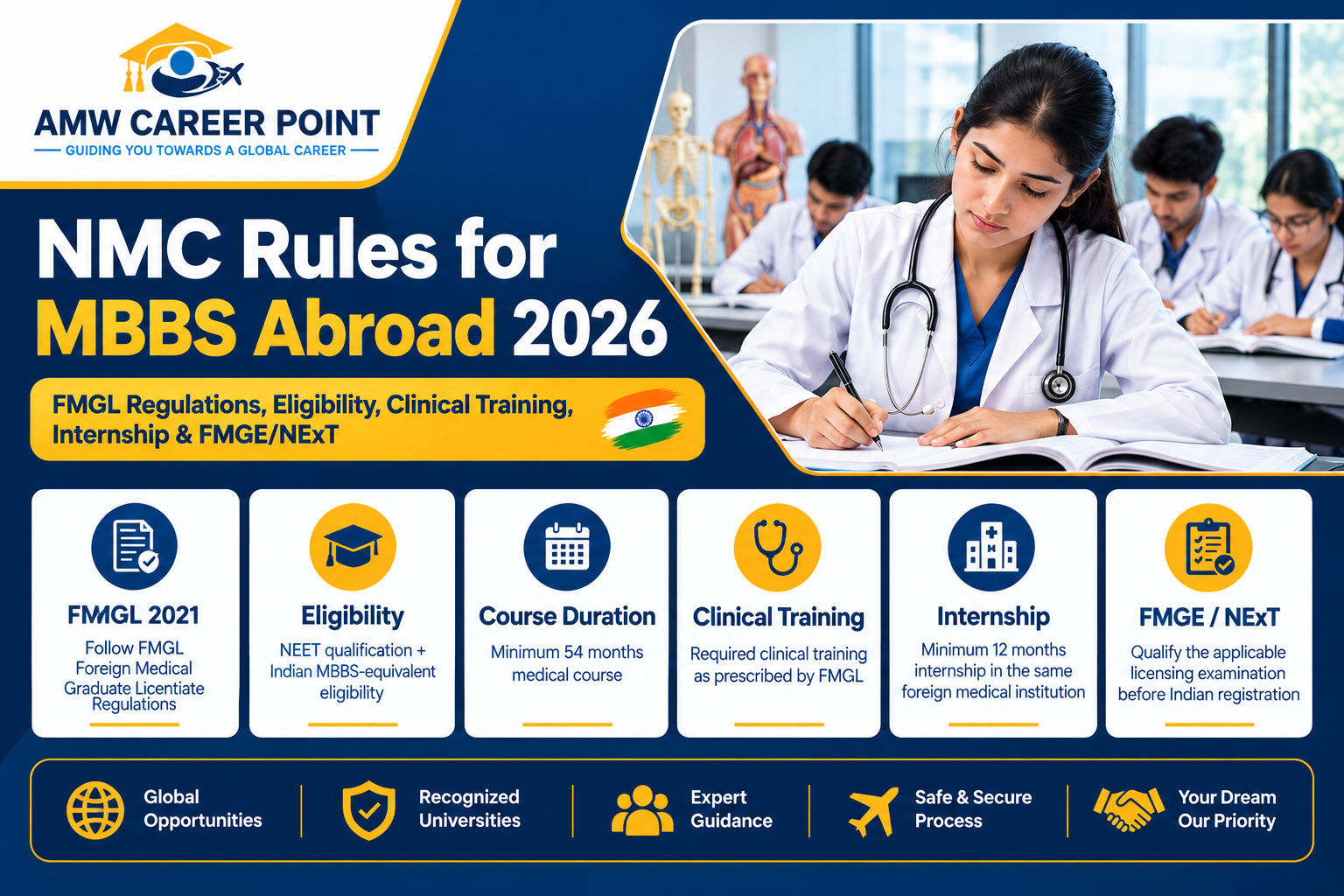
Most students planning MBBS abroad spend months comparing university campus photos, hostel videos, and rankings nobody can verify. That's the wrong first question. Before you shortlist a single university, you need to pick a country, because the country not the university decides almost everything that follows: the medical education system you'll sit inside for six years, the licensing pathway back to India, the language your patients will speak, your cost of living, the quality of your clinical exposure, the climate you'll live through nine months a year, how safe you'll be as a foreign student, and what your degree is actually worth when you land back in India and open the FMGE admit card.
A university can only work within the framework its country sets. A brilliant medical college in a country that doesn't allow foreign students hands-on hospital access can't give you clinical exposure no matter how good its faculty is. A university with a stunning campus in a country whose curriculum doesn't map onto Schedule I of the FMGL Regulations, 2021 can leave your degree unusable in India, regardless of ranking.
Reality check: Before you compare cost or rankings, verify that your target course structure duration, medium of instruction, internship location actually satisfies the current Foreign Medical Graduate Licentiate (FMGL) Regulations, 2021. The NMC does not publish an "approved country list" eligibility is decided course-by-course and university-by-university, not by country reputation. Cross-check every claim with nmc.org.in before you pay a rupee.
How We Ranked the Best Countries for MBBS Abroad
Every counselling website tells you their "top 5 countries." Almost none tell you how they decided. not going to rank countries emotionally, by which one pays the highest commission, or by which one is trending on Instagram this admission cycle. We use 12 evaluation parameters, and we score every country against all 12 before recommending anything.
Academic Quality: Faculty strength, labs, curriculum depth, and how closely the syllabus tracks India's CBME structure.
NMC Compliance: Whether the specific course (not just the country) satisfies FMGL 2021 duration, English medium, same-institution training, Schedule I subjects.
Global Recognition: WHO/WDOMS listing, WFME recognition, and whether the degree travels beyond India (US, UK, Gulf, Europe).
Clinical Exposure: Real, hands-on patient contact from the clinical years onward — not just lecture-hall theory.
Licensing Opportunities: Realistic pathways after graduation: FMGE/NExT in India, USMLE, PLAB, AMC, and how the curriculum supports each.
English Medium: Whether teaching is genuinely English throughout, including clinical rotations not just the first two pre-clinical years.
Local Language Requirement: How much of the local language you'll need to survive hospital rotations, daily life, and patient interviews.
Scholarships: Government, university, merit, and need-based aid genuinely available to Indian students, not just advertised.
Total Cost: Tuition plus hostel, food, insurance, visa, and flights over the full 5.5–6 years not the headline tuition number alone.
Safety: Crime rates, political stability, healthcare access, and documented experiences of the existing Indian student community.
Indian Student Community: Size and maturity of the existing community food access, mentorship, and support network.
Career Opportunities: What doors open after the degree — in India, in the host country, and in third countries.
Quick Comparison Table
This is the single most useful table on this page. Bookmark it. Figures are indicative 2026 ranges; always confirm exact numbers with the specific university before applying or go through the AMW College predictor tool for a better assessment of the university.
Country | Annual Tuition | Total Cost (6 yrs) | Duration | Medium | Local Language in Clinics | Best For |
Russia | ₹2.5–5L | ₹18–40L | 6 yrs | English* | Needed from Yr 3 | Value + established recognition |
Georgia | ₹4–6L | ₹20–35L | 6 yrs | English | Needed for patients | Balanced cost + FMGE track record |
Kazakhstan | ₹3–5L | ₹15–25L | 6 yrs | English* | Needed from Yr 3 | Low cost, modern infrastructure |
Uzbekistan | ₹2–4.5L | ₹15–25L | 6 yrs | English* | Needed from Yr 3 | Lowest cost tier, short flights |
Kyrgyzstan | ₹2–4L | ₹15–25L | 6 yrs | English* | Needed from Yr 3 | Cheapest total package |
Italy | ₹1–7L (income-based) | ₹15–45L | 6 yrs | English | Needed for clinics | EU degree, merit + DSU scholarships |
Romania | ₹5–7L | ₹35–50L | 6 yrs | English | Minimal in early yrs | EU degree, established programs |
Hungary | ₹9–12L | ₹55–75L | 6 yrs | English | Minimal in early yrs | EU degree, strong global standing |
Poland | ₹8–12L | ₹50–70L | 6 yrs | English | Needed for clinics | USMLE-oriented, EU degree |
China | ₹2.5–4.5L | ₹20–35L | 6 yrs | English (verify) | HSK-4 often required pre-internship | Budget + large, established programs |
Nepal | ₹4–6L | ₹35–55L | 5.5 yrs | English | Hindi/Nepali overlap helps | Proximity, curriculum closest to India |
Bangladesh | ₹3–5L | ₹18–32L | 5 yrs + 1 internship | English | Bengali helps but not mandatory | Strong FMGE track record, proximity |
*"English medium" in CIS countries typically means pre-clinical theory only. From the third year onward, clinical rotations happen in hospitals where the working language is Russian, Kazakh, Uzbek, or Kyrgyz verify this specifically for any university before enrolling.
Reality check: The NMC does not publish an approved-country list. Eligibility depends entirely on whether the specific university and specific course satisfy FMGL 2021 — a compliant university in an otherwise "risky" country beats a non-compliant one in a "safe" country, every time.
Part 3: Which Country Fits Your Budget?
This section recommends countries, not universities cause your budget bracket should narrow your country shortlist before you ever start comparing individual colleges.
Under ₹25 Lakhs
Consider: Kyrgyzstan, Uzbekistan, Kazakhstan, select Bangladesh universities.
This tier demands the tightest scrutiny of NMC compliance the lowest-fee universities are also where curriculum and English-medium shortcuts are most common. Verify Schedule I coverage and internship location before paying.
₹25–35 Lakhs
Consider: Georgia, Kazakhstan, mid-tier Russian universities, Bangladesh.
The most competitive bracket in the Indian MBBS-abroad market — the largest number of NMC-compliant, well-established options sit here.
₹35–50 Lakhs
Consider: Russia (established universities), Nepal, Romania (lower end).
You start getting access to universities with longer track records and larger existing batches of Indian graduates who've already been through FMGE.
₹50–75 Lakhs
Consider: Hungary, Poland, Romania (upper end).
This is EU-degree territory you're paying for Schengen-area recognition, WHO/WFME listing depth, and a curriculum built around USMLE/PLAB-style licensing exams as much as FMGE.
₹75 Lakhs+
Consider: Premium Italian public universities (private-quota seats), private European medical schools.
Above this point you're generally paying for brand and location rather than a proportionate jump in clinical training quality do the ROI math against Indian private colleges (₹60L–₹1.5Cr) rather than against cheaper MBBS-abroad options.
Part 4: Country-by-Country Analysis
Twelve countries, examined the same way each time: what you get, what you give up, what it actually costs, and who should and shouldn't choose it.
Russia
Russia remains the largest single destination for Indian MBBS aspirants, with decades of an established pipeline, large Indian student communities in most medical cities, and a subsidised fee structure under Russian Ministry of Health oversight that keeps tuition low relative to teaching quality.
Top Universities
Kazan Federal University
Bashkir State Medical University
Crimea Federal University
Volgograd State Medical University
Orenburg State Medical University
Advantages
Large, mature Indian student community in almost every medical city
Subsidised, government-regulated tuition keeps costs predictable
Long track record decades of FMGE-qualified graduates from top universities
Six-year structure with a full academic calendar and established clinical rotations
Disadvantages
Harsh winters (down to −20°C to −30°C in many cities) for six years
Clinical years require working knowledge of Russian for patient interaction
Geopolitical and travel-route uncertainty has periodically disrupted flight connectivity and banking channels for fee payments in recent years
Quality varies sharply by university reputation of the country doesn't guarantee reputation of the specific college
Factor | Detail |
Total Cost (6 yrs) | ₹18–40 Lakhs (tuition + hostel + living, 6 years) |
Climate | Continental — long, severe winters; short summers |
Language | Theory in English (pre-clinical); Russian required for clinical rotations and patient interaction |
Clinical Training | Strong in established universities with teaching-hospital affiliations; variable at newer/lower-tier colleges |
Internship | Compulsory 12-month internship at the same institution, per FMGL 2021 |
Who Should Choose Russia?
Students who want an established, cost-predictable pathway with a large existing support network, and who are prepared to build working Russian-language competence for their clinical years.
Reality check: Fee payment channels and flight routes to Russia have seen periodic disruption in recent years due to the geopolitical situation. Confirm current banking and travel arrangements directly with your shortlisted university before committing funds.
Georgia
Georgia has grown rapidly in popularity over the past decade, positioning itself as a European-adjacent option with genuinely English-taught programs, comparatively short flights from India, and, per NBEMS country-wise data, some of the stronger FMGE pass rates among CIS-adjacent destinations.
Top Universities
Tbilisi State Medical University
Ivane Javakhishvili Tbilisi State University
David Tvildiani Medical University
Batumi Shota Rustaveli State University
New Vision University
Advantages
Among the higher FMGE pass percentages recorded in recent NBEMS country-wise data
Genuinely English-medium at the more established universities, including clinical years
European Schengen-adjacent environment and lifestyle
Growing, increasingly well-organised Indian student community
Disadvantages
Tuition has risen as demand has grown; no longer the cheapest CIS option
Newer, lesser-known private universities vary widely in clinical-training quality — do not assume "Georgia" alone is a quality signal
Georgian language still helps significantly for patient interaction in public hospitals
Factor | Detail |
Total Cost (6 yrs) | ₹20–35 Lakhs (tuition + hostel + living, 6 years) |
Climate | Temperate four distinct seasons, milder winters than Russia/Central Asia |
Language | English medium at established universities; Georgian useful in clinical settings |
Clinical Training | Generally strong at longer-established universities with dedicated teaching hospitals |
Internship | Compulsory 12-month internship at the same institution, per FMGL 2021 |
Who Should Choose Georgia?
Students who want a European academic environment, are comfortable paying a moderate premium over Central Asia, and are prioritising a university with a proven FMGE track record over the absolute lowest sticker price.
Kazakhstan
Kazakhstan has positioned itself deliberately as a modern, mid-cost alternative to Russia investing visibly in clinical infrastructure, with several universities marketing NMC-compliant, WHO-recognised English-medium tracks specifically for the Indian market.
Top Universities
Kazakh National Medical University
Astana Medical University
Karaganda Medical University
South Kazakhstan Medical Academy
Advantages
Lower total cost than Russia with comparable or newer infrastructure at several universities
Modern campuses and labs at flagship institutions
Short flight connectivity from Delhi and major Indian cities
Growing but still manageable Indian student density (less crowded than Russia's top cities)
Disadvantages
Clinical rotations from year three onward require local language competence
Fewer decades of FMGE track record than Russia, so less historical pass-rate data per university
Quality gap between flagship and lesser-known universities is significant
Factor | Detail |
Total Cost (6 yrs) | ₹15–25 Lakhs (tuition + hostel + living, 6 years) |
Climate | Continental — cold winters, hot dry summers |
Language | Theory in English; Kazakh/Russian needed for clinical patient interaction |
Clinical Training | Improving steadily at flagship universities; verify hospital affiliation before enrolling |
Internship | Compulsory 12-month internship at the same institution, per FMGL 2021 |
Who Should Choose Kazakhstan?
Budget-conscious students who want newer infrastructure than older Russian universities and shorter flight times, and who are willing to build local-language competence for clinical years.
Uzbekistan
Uzbekistan sits at the lowest end of the total-cost spectrum and has expanded its English-medium MBBS offering aggressively for the Indian market in the last few years — but this is also the country where the NMC has issued the most pointed recent warnings about English-medium compliance.
Top Universities
Tashkent Medical Academy
Samarkand State Medical University
Bukhara State Medical Institute
Andijan State Medical Institute
Advantages
Among the lowest total costs of any NMC-relevant destination
Short flight times from India
Rapidly upgraded clinical labs and facilities in the last two admission cycles
Growing Indian student community
Disadvantages
NMC's own advisory in 2026 flagged specific Uzbek institutions for Indian students not receiving genuine hands-on clinical training due to English-medium gaps
Youngest track record of FMGE-qualified graduates among the popular CIS destinations — thinner historical data
Bilingual or partially local-language programs carry real NMC disqualification risk — this is not a theoretical warning
Factor | Detail |
Total Cost (6 yrs) | ₹15–25 Lakhs (tuition + hostel + living, 6 years) |
Climate | Continental — hot summers, cold winters |
Language | Advertised as English medium; verify actual clinical-year instruction language directly with the university and, ideally, with current Indian students there |
Clinical Training | Uneven — the NMC has specifically flagged clinical-exposure gaps at some institutions in 2026 |
Internship | Compulsory 12-month internship at the same institution, per FMGL 2021 |
Who Should Choose Uzbekistan?
Extremely budget-constrained students only — and only after independently verifying, university by university, that clinical-year instruction is genuinely in English. Do not take a university's marketing material as sufficient proof.
Reality check: The NMC's April 2026 advisory on Uzbekistan explicitly warned that Indian students at several institutions were not receiving adequate hands-on training because the actual medium of clinical instruction was not English. Do not shortlist a Uzbek university on cost alone — verify this specific point directly, in writing, before applying.
Kyrgyzstan
Kyrgyzstan offers the lowest total package cost among mainstream CIS destinations and has a long-running, sizeable Indian student community, but also carries a well-documented, specific NMC compliance risk around bilingual program structures.
Top Universities
Osh State Medical University
Jalalabad State Medical Institute
International School of Medicine, Kyrgyzstan
Kyrgyz State Medical Academy
Advantages
Cheapest total package among popular CIS destinations
Large, long-established Indian student community, particularly in Osh and Bishkek
Short flight connectivity from Delhi
Disadvantages
Several popular universities run genuinely bilingual programs (English + Russian/Kyrgyz) that carry a documented NMC disqualification risk if the curriculum doesn't demonstrate English-medium compliance on paper
Among the lower FMGE pass rates in recent NBEMS country-wise data compared to Georgia or Bangladesh
Clinical infrastructure varies significantly by university
Factor | Detail |
Total Cost (6 yrs) | ₹15–25 Lakhs (tuition + hostel + living, 6 years) |
Climate | Continental, mountainous — cold winters |
Language | Marketed as English medium; many programs are functionally bilingual — confirm curriculum documentation, not verbal assurance |
Clinical Training | Variable by university; verify hospital affiliations independently |
Internship | Compulsory 12-month internship at the same institution, per FMGL 2021 |
Who Should Choose Kyrgyzstan?
Students with the tightest possible budget who are willing to do rigorous, document-level due diligence on a specific university's English-medium compliance before enrolling.
Reality check: Bilingual-programme structures are the single most common reason Kyrgyzstan-trained graduates run into NMC registration trouble. Ask the university for the exact language breakdown of every year's curriculum in writing — not a brochure claim — before paying any fee.
Italy
Italy is the standout Western European option specifically because public universities charge income-linked tuition rather than a flat international-student rate — meaning the headline cost can be dramatically lower than Hungary, Poland, or Romania for eligible students, alongside genuine EU degree value.
Top Universities
University of Bologna
Sapienza University of Rome
University of Milan
University of Pavia
University of Padua
University of Bari
Tor Vergata University of Rome
Advantages
Public-university tuition is income-assessed (via the ISEE mechanism) and can run as low as a few hundred euros a year for eligible students — dramatically below other EU options
DSU regional scholarships can cover full tuition plus accommodation and a maintenance stipend for qualifying students
Genuine EU degree with strong WHO/WFME recognition and Schengen-area mobility
Entirely English-taught programs at 13+ public universities
Disadvantages
Admission is via the IMAT (International Medical Admissions Test) — a single, competitive, once-a-year exam (typically September) that determines every seat; there is no rolling admission safety net
Clinical rotations require functional Italian for patient interaction
Income-based fee assessment can push costs up significantly for higher-income families — this isn't a flat low fee for everyone
Popular public universities have very high IMAT cutoffs for the limited non-EU quota
Factor | Detail |
Total Cost (6 yrs) | ₹15–45 Lakhs depending on ISEE-assessed tuition tier and scholarship eligibility (6 years); private universities run higher, ₹75L+ |
Climate | Mediterranean to continental depending on region — generally milder than CIS destinations |
Language | English medium for instruction; Italian needed for clinical patient interaction |
Clinical Training | Strong at established public universities with major teaching hospitals |
Internship | Integrated into the 6-year (5+1) programme structure |
Who Should Choose Italy?
Academically strong students who can clear a competitive IMAT cutoff and want a genuine EU degree, and whose family income profile makes the ISEE-based fee assessment work in their favour.
Reality check: "Zero tuition" and "€150/year" headlines apply to the lowest ISEE income bracket and the specific university's fee table — not to every applicant automatically. Model your own likely tuition tier before assuming the lowest-published number applies to you.
Romania
Romania offers one of the more accessible EU entry points, with a long-running English-medium MBBS tradition (predating most CIS-country English programs) and moderate — not rock-bottom — costs.
Top Universities
Carol Davila University of Medicine, Bucharest
Iuliu Hațieganu University, Cluj-Napoca
Grigore T. Popa University, Iași
Victor Babeș University, Timișoara
Advantages
Established English-medium MBBS tradition going back further than most CIS programs
Genuine EU degree with Schengen-area mobility
Moderate local language requirement in early clinical years compared to some CIS countries
Disadvantages
Meaningfully more expensive than CIS destinations for a comparable or only moderately better clinical-training outcome
Admission and visa processing timelines can run longer than CIS or South Asian options
Romanian required for full clinical fluency in later years
Factor | Detail |
Total Cost (6 yrs) | ₹35–50 Lakhs (tuition + hostel + living, 6 years) |
Climate | Continental — cold winters, warm summers |
Language | English medium instruction; Romanian increasingly needed through clinical years |
Clinical Training | Strong at the older, established universities listed above |
Internship | Integrated into the 6-year programme structure |
Who Should Choose Romania?
Students who want EU-degree value, can afford the mid-to-upper budget tier, and prefer a longer-established English-medium program over a newer one.
Hungary
Hungary is one of the most internationally recognised EU medical-education destinations, with a decades-long history of teaching international students in English and strong outcomes for students later pursuing USMLE or European licensing rather than returning to India.
Top Universities
Semmelweis University, Budapest
University of Debrecen
University of Pécs
University of Szeged
Advantages
Among the most globally recognised EU medical universities on this list, with decades of international-student teaching experience
Strong curriculum alignment with USMLE and European licensing pathways
Well-established English-medium instruction across the full programme, not just pre-clinical years
Disadvantages
Among the highest total costs on this list
Highly competitive admission at the flagship universities (Semmelweis in particular)
Overkill on cost if your only goal is returning to India via FMGE — you're paying a premium for optionality you may not use
Factor | Detail |
Total Cost (6 yrs) | ₹55–75 Lakhs (tuition + hostel + living, 6 years) |
Climate | Continental — cold winters, warm summers |
Language | English medium throughout, including most clinical instruction; Hungarian helps for community-hospital patient contact |
Clinical Training | Strong — genuine, well-supervised hands-on clinical training |
Internship | Integrated into the 6-year programme structure |
Who Should Choose Hungary?
Students with a larger budget who are seriously weighing a European or US career path (not just an FMGE return route), where the university's international reputation and USMLE alignment justify the premium.
Poland
Poland has built a specific reputation as a USMLE-oriented EU destination, with several medical universities running English-medium divisions explicitly structured around US residency-matching outcomes for international students.
Top Universities
Medical University of Warsaw
Jagiellonian University Medical College, Kraków
Medical University of Gdańsk
Poznan University of Medical Sciences
Advantages
Curriculum and exam structure at several universities are explicitly built with USMLE preparation in mind
Genuine EU degree with strong WFME/WHO recognition
English-medium instruction is well-established, not a recent add-on
Disadvantages
High total cost relative to CIS or South Asian alternatives
If your goal is purely FMGE and returning to India, the USMLE-oriented curriculum design is a cost you're paying for but not using
Polish needed for full clinical-year patient interaction
Factor | Detail |
Total Cost (6 yrs) | ₹50–70 Lakhs (tuition + hostel + living, 6 years) |
Climate | Continental — cold winters, mild summers |
Language | English medium instruction; Polish needed in clinical settings |
Clinical Training | Strong, with structured hospital rotations |
Internship | Integrated into the 6-year programme structure |
Who Should Choose Poland?
Students who are specifically planning a US residency route via USMLE and want a curriculum designed around that outcome, not students whose only plan is FMGE.
China
China offers a large number of MOE-listed English-medium MBBS programs at comparatively low cost, with an established (if less discussed) pipeline of Indian graduates — but the details of visa entry, English-medium verification, and Mandarin requirements before the internship year demand more diligence than the marketing suggests.
Top Universities
China Medical University, Shenyang
Jilin University
Dalian Medical University
Nanjing Medical University
Central South University
Advantages
Among the lower total-cost options on this list, with modern infrastructure at flagship universities
Large number of MOE-listed universities offering English-medium tracks
Established, if lower-profile, Indian graduate pipeline
Disadvantages
HSK-4 level Mandarin proficiency is required before the internship year at most universities — a substantial, often underestimated commitment layered on top of the medical curriculum
Entry requires a long-term X1 student visa obtained before travel — there is no legitimate route via tourist visa conversion
English-medium listing status can and does change between admission cycles — verify a university's current MOE listing directly rather than relying on an agent's claim
Fewer, less detailed NBEMS country-wise pass-percentage breakdowns are publicly discussed compared to CIS or South Asian destinations, though recent data shows several thousand Chinese-university candidates appearing each FMGE cycle with pass rates roughly in line with the overall CIS average
Factor | Detail |
Total Cost (6 yrs) | ₹20–35 Lakhs (tuition + hostel + living, 6 years) |
Climate | Varies hugely by region — from subtropical south to continental north |
Language | English medium for instruction; HSK-4 Mandarin typically mandatory before internship |
Clinical Training | Strong at flagship, longer-established MOE-listed universities; verify hospital affiliation and current English-medium status independently |
Internship | Compulsory internship, generally requiring functional Mandarin for patient interaction by that stage |
Who Should Choose China?
Budget-conscious students who are genuinely willing to commit to reaching HSK-4 Mandarin proficiency during their pre-clinical years, and who independently verify a university's current MOE English-medium listing rather than trusting a brochure.
Reality check: Confirm your target university's MOE English-medium listing directly and recently — this status is not permanent, and enrolling at a university that has since lost English-medium authorisation is one of the biggest, least-publicised risks in the China MBBS pathway.
Nepal
Nepal's proximity to India, cultural familiarity, and a curriculum historically modelled closely on the Indian MBBS structure make it the most "low-friction" destination on this list — at a cost closer to mid-tier CIS options than to the ultra-budget end.
Top Universities
Kathmandu University School of Medical Sciences
Manipal College of Medical Sciences, Pokhara
P. Koirala Institute of Health Sciences
Nepal Medical College
Advantages
No real language barrier — Hindi is widely understood, and English medium is genuinely consistent throughout, including clinical years
Curriculum structure closely mirrors the Indian MBBS syllabus, which many students and FMGE-prep coaches consider an advantage at exam time
Shortest, cheapest travel from most of North India — flights, and in some cases road travel, are both viable
Cultural and dietary familiarity reduces adjustment time
Disadvantages
More expensive than the CIS budget tier for a broadly comparable clinical-training experience
Fewer total seats than the large CIS or Chinese universities — admission at the well-regarded institutions is competitive
Smaller pool of universities overall means less room to "shop around" within the country
Factor | Detail |
Total Cost (6 yrs) | ₹35–55 Lakhs (tuition + hostel + living, 5.5 years) |
Climate | Varies by altitude — temperate in the valleys, cooler in hill regions |
Language | English medium throughout; Hindi/Nepali overlap makes daily life and patient interaction easier than any other destination on this list |
Clinical Training | Strong — curriculum and hospital exposure structured close to Indian MBBS norms |
Internship | Compulsory internship built into the 5.5-year structure per FMGL 2021 |
Who Should Choose Nepal?
Students who prioritise proximity, cultural and linguistic comfort, and curriculum familiarity over squeezing out the absolute lowest possible fee.
Bangladesh
Bangladesh combines genuine affordability with one of the stronger FMGE pass-rate track records among popular MBBS-abroad destinations in recent NBEMS country-wise data, plus geographic and cultural proximity to eastern and northeastern India.
Top Universities
Chittagong Medical College
Dhaka Medical College
Sylhet MAG Osmani Medical College
Ad-din Women's Medical College
Jahurul Islam Medical College
Advantages
Among the stronger FMGE pass rates recorded in recent NBEMS country-wise data — behind Georgia but ahead of most CIS destinations
Genuinely affordable total cost
Close geographic and cultural proximity, particularly for students from eastern and northeastern India
English medium is well-established and consistently applied, including in clinical years at the reputed colleges
Disadvantages
Seat availability at the strongest, most established medical colleges is limited and competitive
Hostel and campus infrastructure varies significantly between top-tier and lesser-known colleges — this is not a uniformly high-infrastructure country
Visa and admission procedures can be more paperwork-intensive than some CIS alternatives
Factor | Detail |
Total Cost (6 yrs) | ₹18–32 Lakhs (tuition + hostel + living, 5 years academic + 1 year internship) |
Climate | Subtropical — hot, humid summers; monsoon season; mild winters |
Language | English medium instruction; Bengali helps but isn't mandatory for basic clinical interaction given cultural proximity |
Clinical Training | Strong at the established colleges listed above, with genuine hospital-based patient exposure |
Internship | Compulsory 12-month internship at the same institution, per FMGL 2021 |
Who Should Choose Bangladesh?
Cost-conscious students, particularly from eastern and northeastern India, who want one of the better FMGE track records on this list without paying Georgia-level fees.
Compare Countries on Every Important Factor
The country profiles above cover cost, language, and clinical training in depth. This section pulls together the remaining factors side by side.
Safety, Student Life & Practical Factors
Country | Safety | Indian Food Availability | Flight Connectivity | Visa Difficulty |
Generally safe in student areas; verify current advisories | Good in major student cities | Variable — periodic route disruptions | Moderate | |
Generally safe | Growing Indian food scene in Tbilisi/Batumi | Direct/short-layover flights from major Indian cities | Low–moderate | |
Generally safe | Moderate — improving with student demand | Short flights, growing connectivity | Low–moderate | |
Generally safe | Moderate | Short flights from India | Low–moderate | |
Generally safe in student cities | Good — large, established Indian community | Short flights from Delhi | Low | |
Generally safe, standard EU precautions | Available in major cities | Longer flights, multiple connections often needed | Moderate (Schengen visa process) | |
Generally safe | Limited outside capital | Longer flights via hub cities | Moderate | |
Generally safe | Available in Budapest | Longer flights via hub cities | Moderate | |
Generally safe | Limited outside major cities | Longer flights via hub cities | Moderate | |
Generally safe on campus; strict residence-permit compliance required | Limited outside large student hubs | Moderate — direct routes from some Indian cities | Moderate–high (X1 visa, HSK requirement) | |
Generally safe, culturally familiar | Excellent — closest to home food available | Very short flights, some road access | Low | |
Generally safe in established college towns | Good — culturally close cuisine | Very short flights from eastern India | Low–moderate |
Scholarships, Global Recognition & Licensing
Country | Scholarship Access | WHO/WDOMS-Type Global Listing | Realistic Licensing Pathways |
Russia | Limited government scholarships, competitive | Recognised | FMGE/NExT primarily |
Georgia | Some university merit awards | Recognised | FMGE/NExT; growing USMLE interest |
Kazakhstan | Limited | Recognised | FMGE/NExT primarily |
Uzbekistan | Limited | Recognised (verify per university) | FMGE/NExT primarily |
Kyrgyzstan | Limited | Recognised (verify per university) | FMGE/NExT primarily |
Italy | Strong — DSU regional scholarships, income-based fee waivers | Recognised (EU/WFME) | FMGE/NExT, EU practice, USMLE with extra prep |
Romania | Limited merit-based awards | Recognised (EU/WFME) | FMGE/NExT, EU practice |
Hungary | Some merit scholarships | Recognised (EU/WFME) | FMGE/NExT, strong USMLE/EU alignment |
Poland | Some merit scholarships | Recognised (EU/WFME) | FMGE/NExT, strong USMLE alignment |
China | Limited for MBBS track (more common for postgrad) | Recognised (verify per university/MOE listing) | FMGE/NExT primarily |
Nepal | Limited merit-based | Recognised | FMGE/NExT primarily |
Bangladesh | Limited merit-based | Recognised | FMGE/NExT primarily |
On licensing pathways beyond FMGE/NExT — USMLE (USA), PLAB (UK), and AMC (Australia) — eligibility always depends on meeting that country's own regulatory requirements in addition to your medical degree, and on your university's curriculum alignment. None of this is automatic, and none of it should be promised to you as guaranteed by a consultant. Treat every claim of "USMLE-ready curriculum" as a starting point for your own research, not a guarantee.
NMC Recognition & FMGL Requirements — What Actually Matters
This is the section that determines whether everything else in this guide is even relevant to you. In November 2021, the NMC replaced the old system of "approved university lists" with the Foreign Medical Graduate Licentiate (FMGL) Regulations, 2021 — a rules-based framework that applies to the course and institution, not the country as a whole. As of 2026, these remain the operative rules, with clarifications issued through the year rather than a wholesale rewrite.
NMC Recognition vs. WDOMS Listing
A university appearing in the World Directory of Medical Schools (WDOMS) or holding WHO recognition is a baseline signal of legitimacy — it is not the same as NMC compliance. WDOMS listing tells you the institution exists and teaches medicine to an internationally documented standard. It does not confirm that your specific course satisfies FMGL 2021's duration, language, and internship-location requirements. Always check both, separately.
The Core FMGL 2021 Requirements
Minimum duration: 54 months (4.5 years) of academic study plus a compulsory 12-month internship at the same foreign institution — a total of 5.5–6 years.
English medium: The entire course — theory and clinical training — must be taught in English. Bilingual or predominantly local-language programs risk disqualification, even if marketed as "English medium."
No split training: Students should not divide their academic study or internship between different countries or institutions.
NEET-UG qualification: Mandatory before taking admission abroad, and required to sit the FMGE/NExT on return.
Schedule I subject coverage: The curriculum must cover the mandatory subjects and be broadly commensurate with the MBBS course structure taught in India.
Internship registration: Only after completing the internship does the relevant State Medical Council (SMC) grant permanent registration — and SMCs independently verify duration, medium of instruction, and curriculum compliance before doing so.
What's New or Clarified in 2026
The FMGL Regulations themselves date to 2021 — 2026 has brought enforcement clarity, not a new rulebook. Two specific 2026 developments matter for anyone planning admission this cycle:
Online-training compensation rule (March 6, 2026): Students who completed any portion of their MBBS abroad through online classes — largely a COVID-era issue affecting students in Russia, Bangladesh, Nepal, Georgia, Kyrgyzstan, Kazakhstan, and Uzbekistan — must complete mandatory physical, on-site compensation training at their university before their clinical record is considered complete.
Uzbekistan English-medium advisory (April 1, 2026): The NMC's UGMEB issued a specific alert flagging that Indian students at several Uzbek institutions were not receiving adequate hands-on clinical training because instruction was not genuinely in English. This is the clearest recent example of the NMC naming a specific compliance gap rather than issuing generic guidance — treat it as current, not historical.
Reality check: None of this information should substitute for checking nmc.org.in directly before you finalise a university. Regulations, advisories, and country-specific alerts are updated through the year — what's accurate as this page is published may be superseded by the time you apply. Cross-check with an official source and, ideally, with recently graduated FMGE-qualified students from your shortlisted university.
FMGE/NExT Perspective — Teaching, Not Promising
Every counselling website you'll find promises high pass rates. We're going to do the opposite: show you the real numbers, and explain what actually predicts whether you clear the exam — because country-wide averages tell you almost nothing about your own odds.
The Real FMGE Numbers
FMGE pass rates have been consistently low and volatile across recent sessions — this is not a country-specific problem, it's the nature of the exam:
Session | Appeared | Passed | Pass % |
June 2025 | 36,039 | 6,707 | 18.61% |
December 2025 | 42,872 | 10,262 | 23.95% |
June 2026 | ~37,400 registered | ~4,635 | ~12.4% |
Roughly three out of every four foreign medical graduates who sit the FMGE do not clear it on a given attempt. That's the baseline reality of this exam — it applies regardless of which country you study in, and no consultant can honestly promise otherwise.
What the Country-Wise Data Actually Shows
Based on recent NBEMS country-wise breakdowns, pass percentages have skewed roughly as follows — treat these as directional, not exact, since NBEMS updates this data after each combined June+December cycle:
Georgia: ~35% — among the higher country-wise rates recorded in recent cycles.
Bangladesh: ~30–32% — consistently one of the stronger performers.
Nepal: Wide range (~30–70% depending on the specific college and cohort) — curriculum proximity to India's syllabus is the likely driver.
China: Roughly in line with the overall average — around 19% in recent large cohorts.
Russia, Kazakhstan, Uzbekistan, Kyrgyzstan: Wide variation by specific university; no single country-wide number tells the real story — a strong Russian university can outperform a weak Georgian one and vice versa.
What Actually Predicts Your FMGE Result
Country-wide averages are a weak predictor of individual outcomes. What correlates far more strongly with clearing the FMGE:
Genuine clinical exposure during your degree, not just theory — students who've actually examined patients consistently outperform those who haven't, regardless of country.
Curriculum alignment with Schedule I subjects and India's clinical case-mix — this is precisely why Nepal and Bangladesh often post stronger numbers despite modest infrastructure budgets.
Structured, early FMGE preparation — starting in your final academic year, not after you land back in India.
The specific university's track record, not the country's headline reputation.
Reality check: We're not going to quote you a country-wise pass percentage and let you assume it applies to your specific university. Ask any consultant — including us — for the FMGE pass data of the exact college you're considering, not the country average. If they can't or won't give you that, that's information too.
Part 8: Scholarships Around the World
Scholarship structures fall into five broad categories, and availability genuinely varies by country — don't assume every destination offers all five.
Government scholarships: Fully funded but highly competitive and limited in seat count — most common in Russia and select CIS bilateral programs.
University scholarships: Merit-based fee reductions offered directly by the institution, typically 10–25% from the second year onward for maintaining a strong academic record — common across CIS universities and some European ones.
Merit-based awards: Tied to entrance-exam performance (e.g., IMAT score bands in Italy) or first-year academic results.
Need-based awards: Income-assessed support — Italy's regional DSU scholarships (covering tuition, housing, and a maintenance stipend for qualifying students) are the strongest example of this on this list.
Regional/state-specific awards: Some Indian state governments and private trusts also offer education loans or partial support for MBBS abroad — check with your state education department separately from university-level scholarships.
Eligibility for all of these depends on documented academic performance, family income assessment (for need-based awards), and — for Italy specifically — your ISEE-equivalent income declaration. Verify current scholarship terms directly with the university's international office each admission cycle; terms change annually.
Career Opportunities After MBBS
Where you can eventually practice depends on a combination of your degree's country of origin, the licensing exam you clear, and that jurisdiction's own registration requirements — not on your MBBS alone.
Destination | Pathway |
India | FMGE/NExT (screening test) → State Medical Council permanent registration. The primary pathway for the large majority of MBBS-abroad graduates. |
USA | USMLE Steps 1, 2 CK, 2 CS (or current equivalent), then residency matching via ECFMG certification — a multi-year, separate process regardless of your MBBS country. |
UK | PLAB 1 and 2, or an approved alternative pathway, followed by GMC registration. |
Australia | AMC exams (or a recognised alternative pathway) followed by AHPRA registration. |
Germany / Europe (EU degree holders) | EU medical degrees (Italy, Romania, Hungary, Poland) generally allow practice-track registration within the EU/EEA, subject to language competency requirements (e.g., German C1 level) and each country's own medical council process. |
Middle East (GCC countries) | Generally requires DataFlow verification plus the relevant country's licensing exam (e.g., Saudi SMLE, DHA exam) — open to graduates from most NMC-relevant countries, subject to degree verification. |
The honest takeaway: an MBBS from any of the countries on this list keeps every one of these doors open in principle, but each door requires its own additional exam and years of further process. Don't choose a country because a consultant tells you it's "USMLE-friendly" without understanding that USMLE is a separate, demanding undertaking regardless of where your MBBS is from.
Student Life — What Daily Life Actually Looks Like
Beyond the safety/food/flight table in Part 5, two practical points deserve their own mention:
Part-time work: Most CIS and European student visas either prohibit part-time work outright or restrict it heavily (limited hours, specific permit requirements). Do not plan your budget around earning income during your MBBS — plan for the full cost upfront, and treat any part-time earning as a bonus, not a funding source.
Hostel vs. private accommodation: University hostels are cheaper and simpler for admission processing but vary widely in quality; private shared accommodation costs more but gives you more control, especially from the second or third year onward once you're familiar with the city.
Which Country Is Best Based on Your Goals?
Your Priority | Consider |
Lowest Budget | Kyrgyzstan, Uzbekistan (with rigorous English-medium verification) |
Highest Quality Education | Hungary, Italy (public university track), established Russian universities |
Best Clinical Exposure | Georgia (established universities), Nepal, Bangladesh |
Fastest Admission | CIS countries generally (Russia, Kazakhstan, Kyrgyzstan) — rolling intakes |
Easiest Admission | CIS countries and Bangladesh (moderate seat availability, no single high-stakes exam like IMAT) |
Scholarship Opportunities | Italy (DSU + ISEE-based fee reduction) |
Best for Future Practice in India | Georgia, Bangladesh, Nepal — strongest recent FMGE track records |
Best for Europe | Hungary, Poland, Italy, Romania — genuine EU degree and mobility |
Best for Research | Hungary, Italy — strongest university research infrastructure on this list |
Best English-Taught Options | Italy, Hungary, Poland, Nepal, Bangladesh — most consistent English-medium delivery through clinical years |
Hidden Costs Students Ignore
Tuition and hostel fees are the numbers every brochure leads with. These are the numbers that quietly add up on top:
Visa fees and renewals: Annual or periodic, and easy to underbudget across 5–6 years.
Health insurance: Often mandatory and billed separately from tuition.
Pre-departure medical tests: HIV, Hepatitis, and general fitness certificates required by most countries' visa processes.
Flights: Round trips over 5–6 years add up — budget ₹3–6 lakhs cumulatively, more for European destinations.
Winter clothing and gear: A real, recurring cost for Russia, Kazakhstan, Kyrgyzstan, Hungary, and Poland.
Local registration and residence permits: Mandatory in most countries within weeks of arrival, and renewed annually.
Emergency fund: For medical emergencies, unexpected travel, or family situations — don't leave this at zero.
Forex conversion costs and currency fluctuation: Fee amounts fixed in EUR, USD, or local currency can shift meaningfully against the rupee over a 5–6 year programme.
Books and study material: Including separate FMGE/NExT coaching in your final year — commonly ₹50,000–₹1,50,000.
Reality check: Ask any university or consultant for the complete cost breakdown — tuition, hostel, insurance, visa, and an estimated annual living cost — in writing, before you commit. If a quoted "total cost" figure doesn't explicitly include these line items, assume it's incomplete.
Common Mistakes While Choosing a Country
Choosing by fees only: The cheapest option is only a good deal if the course is NMC-compliant and delivers genuine clinical exposure — otherwise it's the most expensive mistake you can make.
Ignoring language: "English medium" claims deserve independent verification, specifically for the clinical years, not just the first two.
Ignoring FMGL compliance: A beautiful campus doesn't matter if your course duration, internship location, or curriculum doesn't satisfy FMGL 2021.
Trusting social media: Influencer content about a university is not due diligence — verify claims against official sources and, where possible, multiple independent current students.
Ignoring internship rules: Your internship must be completed at the same institution — check this specifically before enrolling anywhere.
Following friends blindly: A friend's good experience at a specific university doesn't transfer to a different university in the same country, or even a different intake year at the same one.
Not checking university-specific requirements: Country-level information is a starting point, not a substitute for verifying the exact university's current compliance status.
Country Recommendation by Student Persona
The Budget Student
Priority: lowest possible total cost, willing to do the extra due diligence.
Recommendation: Kyrgyzstan or Uzbekistan — after independently verifying English-medium compliance for your specific shortlisted university.
The Scholarship Student
Priority: reducing cost through merit or need-based aid rather than picking the cheapest headline fee.
Recommendation: Italy — the ISEE income-based system and DSU scholarships offer the strongest genuine aid on this list.
The Research Student
Priority: strong university research infrastructure and academic depth beyond the MBBS curriculum.
Recommendation: Hungary or Italy — established research programs and international faculty networks.
The Europe Career Student
Priority: EU mobility and a path toward practicing in Europe, not just India.
Recommendation: Hungary, Poland, or Italy — genuine EU degrees with Schengen-area registration pathways.
The India Return Student
Priority: maximising the realistic odds of clearing FMGE/NExT and returning to practice in India.
Recommendation: Georgia, Bangladesh, or Nepal — the strongest recent country-wise FMGE track records, provided you verify the specific university's own numbers.
Country Comparison Scorecard
Scores are out of 10, based on the 12 evaluation parameters from Part 1, condensed into the factors students weigh most heavily. This is our editorial assessment based on the research above — treat it as a starting framework, not a final verdict.
Parameter | Russia | Georgia | Italy | Kazakhstan | Uzbekistan | Romania | Hungary |
Education | 7 | 7 | 8 | 6 | 6 | 7 | 9 |
Cost | 7 | 6 | 7 | 8 | 9 | 5 | 3 |
Safety | 6 | 7 | 8 | 7 | 7 | 7 | 8 |
Clinical Exposure | 6 | 8 | 7 | 6 | 5 | 6 | 8 |
Scholarships | 4 | 4 | 8 | 3 | 3 | 4 | 5 |
English Medium | 5 | 7 | 8 | 5 | 5 | 7 | 9 |
Career/FMGE Track Record | 6 | 8 | 6 | 6 | 5 | 6 | 6 |
Student Life | 7 | 7 | 7 | 6 | 6 | 6 | 7 |
Overall Value | 6.5 | 7.5 | 7.5 | 6.5 | 6 | 6 | 6.5 |
Kyrgyzstan, Poland, China, Nepal, and Bangladesh are scored in depth in their individual country profiles in Part 4 — omitted here only to keep this table readable across a page width.
Final Verdict:
If you've read this far, you already know why every generic "Top 5 Countries for MBBS Abroad" listicle is selling you something simpler than the truth. The honest answer to "which country is best" is always a follow-up question:
What's your budget, realistically, including the hidden costs in Part 12 — not just tuition?
What's your career goal — return to India via FMGE, or keep options open for USMLE/PLAB/AMC and practice abroad?
How comfortable are you with a new language, knowing that "English medium" rarely means English-only in the clinical years?
What's your long-term licensing plan, given FMGE pass rates hover around 12–24% and vary meaningfully by university, not just country?
Does the specific university, not just the country, demonstrably satisfy FMGL 2021 in writing, not in a brochure?
Choose based on fit, verified against current NMC rules and your own risk tolerance — not based on which country a consultant's commission structure favours, or which country is trending this admission season. The students who clear FMGE and build real careers are, overwhelmingly, the ones who chose a compliant university with genuine clinical exposure over the cheapest sticker price or the flashiest campus video.
Frequently Asked Questions
Q: Which country is best for MBBS abroad?
A: There's no single best country — it depends on your budget, career goals, and risk tolerance. Georgia and Bangladesh currently show stronger FMGE track records; Kyrgyzstan and Uzbekistan are cheapest; Hungary and Italy offer the strongest EU-degree value. See Part 11 for a goal-based breakdown.
Q: Which country is cheapest for MBBS abroad?
A: Kyrgyzstan and Uzbekistan typically offer the lowest total 6-year cost (₹15–25 Lakhs), though this requires extra diligence on English-medium compliance.
Q: Which country offers the best scholarships?
A: Italy, through its income-assessed ISEE fee system and regional DSU scholarships, offers the strongest genuine financial aid among the countries covered here.
Q: Is Italy better than Russia for MBBS?
A: They serve different priorities. Italy offers EU-degree value and potentially very low income-assessed fees but requires clearing the competitive IMAT exam. Russia offers a larger, more established Indian student pipeline and predictable subsidised fees. Neither is universally "better" — match the choice to your budget and goals.
Q: Which country has the best English-medium programs?
A: Italy, Hungary, Poland, Nepal, and Bangladesh are generally the most consistent in delivering genuine English-medium instruction through the clinical years, not just pre-clinical theory.
Q: Which country is safest for Indian students?
A: Most countries on this list are reasonably safe for students who follow standard precautions. Nepal and Bangladesh offer the most cultural familiarity; Georgia and Italy are generally considered stable and welcoming to the international student community.
Q: Which country has the lowest living expenses?
A: Nepal, Bangladesh, and the CIS countries (Kyrgyzstan, Uzbekistan, Kazakhstan) generally have the lowest monthly living costs, often ₹15,000–₹25,000.
Q: Which country is best after NEET, if my score is on the lower side?
A: A lower NEET score doesn't disqualify you from MBBS abroad — NEET-UG qualification (not a high score) is the requirement for most destinations. Match your choice to budget and compliance factors rather than score-based ranking.
Q: Can I practice in India after studying MBBS abroad?
A: Yes, provided your degree and university satisfy FMGL 2021 requirements and you clear the FMGE (or NExT, once implemented) and obtain State Medical Council registration.
Q: Does the NMC approve countries or universities?
A: Neither, exactly. The NMC does not publish an approved-country or approved-university list. Compliance is assessed against the FMGL 2021 regulations for your specific course — duration, medium of instruction, internship structure, and curriculum content.
Q: Has NExT replaced FMGE yet?
A: As of 2026, no. FMGE remains the applicable licensing exam for foreign medical graduates. The NMC has confirmed NExT will eventually apply to FMGs as well, but no confirmed implementation date exists yet — monitor nmc.org.in directly.
Q: Is NEET mandatory for MBBS abroad?
A: Yes. A qualifying NEET-UG score is mandatory before taking admission abroad if you intend to practice in India, and is required to sit the FMGE/NExT afterward.
Q: What is the minimum course duration under FMGL 2021?
A: 54 months (4.5 years) of academic study plus a compulsory 12-month internship at the same institution — a total of 5.5–6 years depending on the country's exact structure.
Q: Can I split my internship between two countries or institutions?
A: No. FMGL 2021 requires internship to be completed at the same foreign institution where you studied — splitting it risks disqualification.
Q: Are bilingual MBBS programs in the CIS region valid for NMC registration?
A: This is high-risk territory. Programs that are only partially in English carry real disqualification risk under FMGL 2021's English-medium requirement. Verify the exact curriculum language breakdown in writing before enrolling.