Here's the single biggest misconception in MBBS-abroad research: students assume that if a university advertises an "English-medium MBBS," they will never need another language for the entire six years. That assumption is wrong often enough, and consequential enough when it's wrong, that it deserves a guide of its own.
The reality is more layered. In many countries, lectures genuinely are delivered in English from day one. But local languages become important or flatly mandatory the moment a student steps into a hospital ward, takes a patient's history, or sits a clinical exam. Some destinations require a formal English-proficiency test like IELTS or TOEFL at the admission stage; most of the popular budget destinations do not. And in a handful of countries, the honest answer is that the entire medical program is taught in the local language, with English support existing only at the margins.
This guide walks through all of it: English-language requirements at entry, local-language requirements during study and clinical training, a country-by-country breakdown covering twelve major destinations, IELTS and TOEFL in detail, CEFR proficiency levels explained, scholarships and language, and the myths that trip up more students than any single exam does.
Why Language Matters in Medical Education Abroad
The Difference Between Admission Language and Clinical Language
Most students research language requirements exactly once at the admission stage and then stop thinking about it. That's a mistake, because a medical degree is a six-year journey, and language demands shift meaningfully at each stage:
Admission
↓
Classroom Teaching
↓
Laboratory Work
↓
Clinical Posting
↓
Internship
↓
Hospital Communication
↓
Medical Licensing
The language that gets a student admitted (usually English, sometimes with no test at all) is frequently not the language that gets a patient's trust, takes an accurate history, or navigates hospital documentation during the clinical years. Treating "language requirement" as a single, one-time admission checkbox is the root cause of most of the confusion this guide exists to clear up.
Can You Complete MBBS Abroad Without Learning the Local Language?
The honest answer is genuinely split, and it's worth stating plainly rather than hedging:
YES, generally, for: classroom lectures, theory exams, and laboratory sessions in the pre-clinical years at most English-medium programs.
NO, generally, for: many hospitals (patient-facing wards frequently do not operate in English), direct patient communication, the internship year, and comfortable daily life outside campus.
The reason is straightforward: patients in Kazan, Tbilisi, Bologna, or Chengdu are not, as a rule, fluent in English. A university can teach anatomy and biochemistry in English indefinitely, but it cannot manufacture English-speaking patients for a student's clinical rotations. This is precisely why so many "English-medium" programs quietly build in local-language requirements from the second or third year onward not as an inconsistency, but as a practical necessity of clinical training.
Quick Country Comparison: Language Requirements at a Glance
This table is meant as a fast-reference starting point; each country is covered in full depth in Section 6. Requirements vary by individual university even within the same country, so always verify the specific institution's current admission page before applying.
Country | English Medium | IELTS/TOEFL at Admission | Local Language During MBBS | Local Language for Clinical Training |
Yes | Usually not required (Class 12 English marks generally accepted) | Russian commonly taught by the university, Year 1 | Yes, commonly needed for patient interaction | |
Yes | Usually not required | Georgian basics helpful, not always formal | Limited, varies by university and hospital | |
Yes | Usually not required | Uzbek/Russian basics helpful | Often encouraged, varies by hospital | |
Yes | Usually not required | Kazakh/Russian | Commonly useful, Russian widely spoken in hospitals | |
Yes | Usually not required | Russian/Kyrgyz | Commonly useful | |
Yes (selected public + private programs) | Not required for the English track itself | Italian | Yes, mandatory B1–B2 for clinical years at most universities | |
Very limited direct-entry English-medium options | Often required for the rare English tracks | German (B2/C1) | Essential German licensing (Approbation) requires it | |
Rare; almost all programs are French-medium | TOEFL/IELTS only for the limited English-taught tracks | French (B2/C1) | Essential French medical practice is French-language throughout | |
Yes, at MOE-listed universities | Usually not required | Mandarin (HSK) | Essential HSK-4 is now a graduation requirement even for English-medium programs. | |
Yes, English programs widely available | University-dependent | Romanian | Usually required during clinical years | |
Yes, English programs widely available | University-dependent | Hungarian (basics) | Clinical-communication benefit, increasingly expected | |
Yes, English programs widely available | University-dependent | Polish (basics) | Clinical-communication benefit, increasingly expected |
English-Medium MBBS: What Does It Really Mean?
"English-medium" is a genuinely accurate description of the first two to three years at most of the universities in this guide and a genuinely incomplete description of the full six-year journey. Here's the fuller picture of where English coverage typically starts to thin out:
Theory (English)
↓
Practicals (English)
↓
Hospital Exposure (Mixed)
↓
Patients (Local Language)
↓
Internship (Local Language)
↓
Local Communication (Local Language)
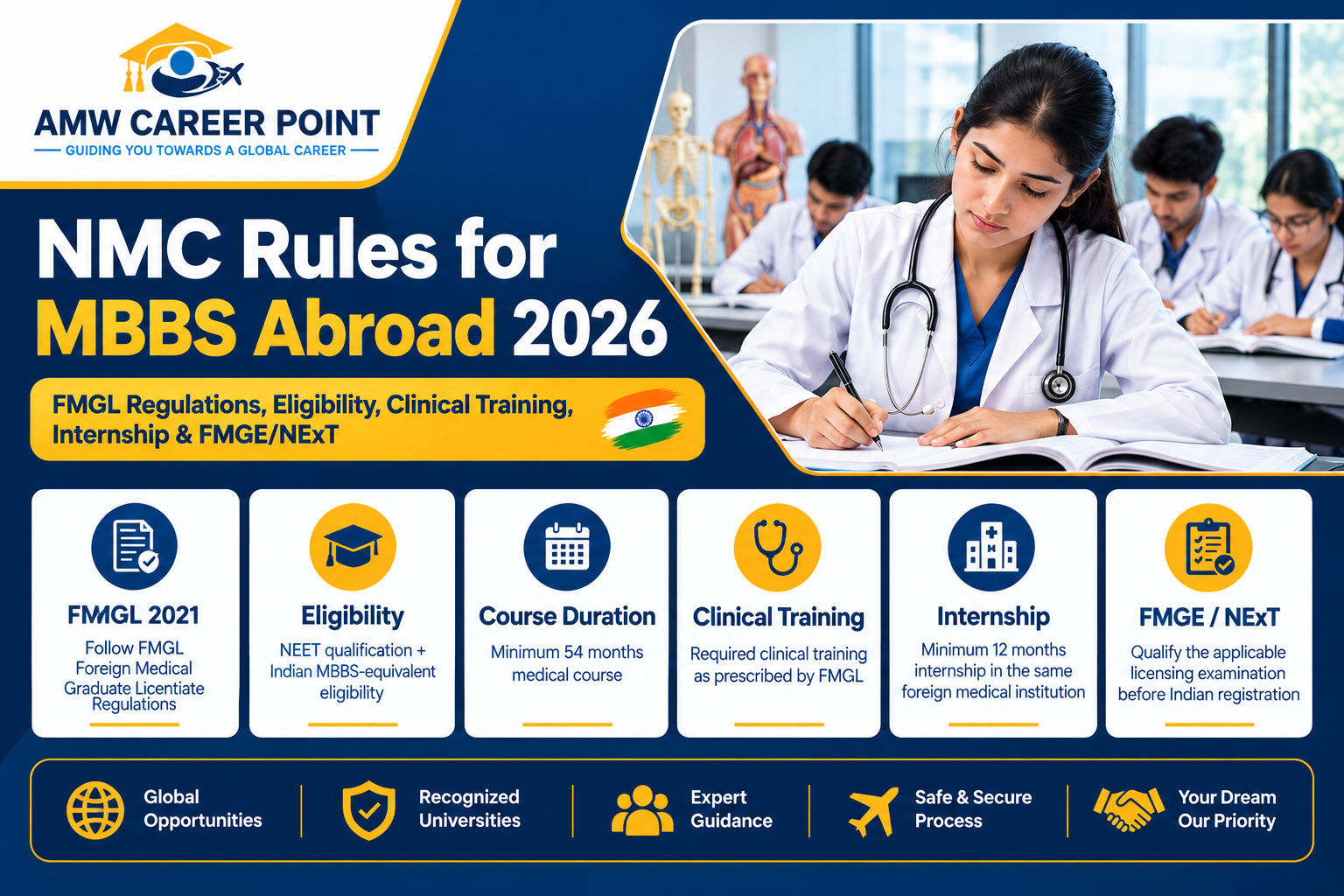
The National Medical Commission's own FMGL Regulations require that the entire foreign medical program be conducted in English for the degree to be eligible for FMGE/NExT registration in India. This is precisely why NMC's English-medium rule and a university's real-world local-language requirement are not in conflict. NMC cares about the language of instruction and assessment, while the local-language need arises from the practical reality of clinical training, which NMC's regulations don't (and can't) eliminate.
This is the single most important distinction in this entire guide: NMC's English-medium requirement is about instructional and assessment language for licensing eligibility. It has nothing to do with whether a student will need conversational or clinical local-language skills to function well during hospital rotations. A program can be 100% NMC-compliant on English medium and still require B1/B2 local-language proficiency for clinical progression; these are two separate, non-conflicting requirements, and confusing them is where most of the "my MBBS will be entirely in English" myth comes from. |
IELTS for MBBS Abroad
What Is IELTS?
The International English Language Testing System (IELTS) is the most widely recognised English-proficiency test globally, jointly managed by the British Council, IDP, and Cambridge Assessment English. It exists in two formats: Academic and General Training, and for university admission purposes, the Academic version is almost always the one required.
Academic vs. General
IELTS Academic tests reading and writing skills relevant to academic study (interpreting graphs, academic-style essays) and is what universities require for degree admission. IELTS General Training focuses on everyday and workplace English and is used for immigration and some vocational purposes; it is not accepted for medical-degree admission at any of the universities covered in this guide.
Countries and Universities That Actually Require IELTS
Contrary to what many students assume before researching this properly, IELTS is the exception rather than the rule across the most popular budget MBBS-abroad destinations. It is generally not required at most universities in Russia, Georgia, Kazakhstan, Uzbekistan, and Kyrgyzstan, where a student's Class 12 English marks are typically accepted as sufficient proof of proficiency. It is more commonly required, though still university-dependent, for the limited English-taught tracks in Germany and France, and occasionally requested by specific private universities in Italy or elsewhere as an additional (not universal) admission criterion.
Minimum Band Scores
Where IELTS is required, universities most commonly ask for an overall band of 6.0 to 6.5, occasionally with a minimum per-section score (commonly 5.5–6.0 in each of listening, reading, writing, and speaking) rather than accepting a strong overall average that masks one weak section.
Validity
IELTS scores are valid for two years from the test date. Applying with a score close to expiry is a genuine risk if the admission cycle is delayed, so it's worth timing the test to remain valid through the intended enrolment date, not just the application date.
Waivers and Who Can Skip IELTS
Most universities in the Central Asian and Russian markets offer an automatic waiver for students who studied their entire 10+2 in English medium (a category the large majority of Indian applicants fall into), accepting the Class 12 mark sheet as proof instead of a separate test. Always confirm this waiver in writing with the specific university rather than assuming it applies universally.
Preparation Tips
Start with a full-length practice test to identify your weakest section before committing to a study plan.
Writing Task 2 (the essay) is where Indian students most commonly lose marks by not practicing structured arguments within the 40-minute limit.
Book the test at least 6–8 weeks before your university's application deadline, to leave room for a retake if needed.
Common Mistakes
Assuming IELTS is universally required, and paying for and sitting the test when the target university would have accepted a Class 12 English-medium waiver instead.
Letting the score validity run out before the actual enrolment date, not just the application date.
Submitting a General Training score where Academic was required.
5. TOEFL for MBBS Abroad
Purpose
The Test of English as a Foreign Language (TOEFL), administered by ETS, is the other major English-proficiency benchmark accepted by universities globally, particularly common in North American-influenced admission systems and increasingly accepted as an IELTS alternative by European universities.
Accepted Countries and the Internet-Based Test (TOEFL iBT)
Most modern TOEFL administration is via the TOEFL iBT (Internet-Based Test), which is what universities currently reference when they list a TOEFL requirement. As with IELTS, TOEFL is generally not required at most Russian and Central Asian universities for Indian applicants, but is more commonly accepted (sometimes as one of several options alongside IELTS or Duolingo) at Italian, German, and French institutions offering limited English-taught tracks.
Minimum Scores
Where required, universities commonly ask for a TOEFL iBT score in the 80–90 range out of a possible 120, though this varies by institution and program.
IELTS vs. TOEFL: Which to Choose
Where a university accepts either, the choice usually comes down to test format preference: IELTS is a mix of paper-based and computer-based formats with a face-to-face speaking interview, while TOEFL iBT is fully computer-based, including a recorded (not live) speaking section. Students more comfortable speaking to a person than to a microphone often prefer IELTS; those who prefer a fully digital, self-paced format often prefer TOEFL. Neither is inherently "easier"; the better choice is the format that suits the student's own test-taking style.
University Acceptance
Always confirm whether a specific university accepts TOEFL as an IELTS substitute before booking either test; some accept both interchangeably, some prefer one over the other, and a meaningful number of budget-destination universities don't require either given the Class 12 English-medium waiver described in Section 4.
6. Country-Specific Language Requirements
This section covers the twelve destinations most commonly researched by Indian MBBS-abroad applicants, in the depth each genuinely requires.
Germany
MBBS in Germany is the clearest example in this guide of a country where the local language isn't a clinical add-on; it's close to the entire requirement. Direct-entry, fully English-medium MBBS-equivalent programs are very limited in Germany; the large majority of medical degree programs are taught in German from year one. Where limited English-medium or partial-English preparatory tracks exist, they are typically bridge programs rather than full six-year degrees. German proficiency requirements commonly cited for serious pathways sit at CEFR B2 to C1 level, which is a genuinely high bar, roughly two academic years of dedicated study for a student starting from zero. Clinical communication in German hospitals is conducted in German throughout, and Germany's Approbation (full medical license) process itself includes language-competency verification, alongside a medical-specific German exam (Fachsprachprüfung) for graduates whose primary qualification wasn't obtained in German. This makes Germany a longer-runway commitment than almost any other destination in this guide realistic only for students prepared to front-load one to two years primarily into German-language acquisition.
Italy
MBBS in Italy runs a genuine dual-track system: English-taught Medicine and Surgery is available at both public universities (via the IMAT entrance exam) and select private universities, with no separate English-proficiency test required for admission to this track. But Italian is not optional for the full degree; most public universities require mandatory CEFR B1-to-B2 Italian proficiency to begin clinical clerkships, typically from Year 2 or Year 3 onward (for example, Bologna requires B1 by Year 2; Milan Statale's International Medical School requires B2 by Year 3). Universities generally run their own in-house Italian courses (often through a university Language Center) with compulsory attendance and internal testing. Hospital rotations, patient interaction, and clinical documentation from the mid-program years onward operate in Italian, making this one of the more clearly documented "English gets you in, Italian gets you through" cases among all the countries covered here.
France
MBBS in France deserves a direct caution that a lot of MBBS-abroad content downplays: French medical education is overwhelmingly French-medium, with fluency requirements commonly cited at DELF/DALF B2-to-C1 level for the standard PASS/L, AS entry pathway. Limited English-taught options exist at a handful of institutions. Still, seats for non-EU international students across all French medical programs are capped extremely tightly (commonly cited around 8% of total admissions, with a roughly 2.6% acceptance rate for non-EU applicants), making this one of the most competitive and language-intensive pathways in this entire guide. There is also a compliance point worth stating plainly: NMC's FMGL framework requires the entire foreign medical program to be conducted in English for FMGE/NExT eligibility, and a predominantly French-medium degree is unlikely to satisfy that requirement, which is a serious consideration for any Indian student whose long-term goal includes practicing in India.
Russia
MBBS in Russia is one of the Most top-tier destination for medical universities to teach MBBS entirely in English, and the large majority do not require a separate IELTS or TOEFL score; a strong Class 12 English result is typically accepted as sufficient proof of proficiency. Where the confusion usually starts is with Russian itself: most universities teach basic-to-intermediate Russian during the first year specifically to prepare students for later clinical rotations, where hospital staff and patients are frequently not fluent in English. A smaller number of universities offer a fully Russian-medium track, which requires a mandatory one-year Russian-language preparatory course before the six-year MBBS itself begins, extending total duration to seven years. This preparatory-year model is also sometimes bundled, at extra cost (commonly USD 2,500–3,500), into otherwise "English-medium" packages, so it's worth explicitly confirming with any Russian university whether the quoted duration and fee already include a mandatory Russian prep year.
China
MBBS in China is currently the destination with the most significant, actively changing language requirement in this entire guide. It deserves the clearest possible statement: as of the 2026 intake, HSK Level 4 Mandarin proficiency has become a graduation requirement at MOE-listed universities even for fully English-medium Clinical Medicine (MBBS) programs, not merely a clinical-year nicety, but a Ministry of Education-mandated condition of receiving the final degree. Students who don't reach HSK-4 by the end of the program reportedly receive only a provisional degree until the requirement is met, which can extend the course beyond six years. HSK-4 requires roughly 600–700 hours of structured study, and is separate from the CSCA entrance requirements some universities also apply. There is also a distinct additional step for Indian students specifically: obtaining a Chinese Physician's License has been described as a prerequisite before Indian graduates from China can sit FMGE or NExT, a licensing-chain detail that's easy to miss amid the admission-stage marketing.
China's HSK requirement is a live example of why "English-medium" claims deserve real scrutiny rather than being taken at face value. Some sources still describe HSK as optional or clinical-benefit-only at MOE-listed universities; current 2026 reporting from multiple sources describes it as a mandatory graduation requirement. Given this is an area of active regulatory change, confirm the current HSK requirement directly with any shortlisted Chinese university's admissions office before enrolling, rather than relying on either the optimistic or the strict version circulating online. |
Georgia
English-medium Medicine is standard at Georgian universities, both public and (increasingly, given restrictions on new international intake at several public institutions) private. No separate English-proficiency test is generally required for admission. Georgian itself is not typically a formal academic requirement, but basic conversational Georgian is genuinely helpful for daily life and, depending on the specific university's hospital affiliations, for clinical exposure. The degree of local-language need for clinical training varies more by individual hospital partnership in Georgia than in more centralized systems like Russia's or Italy's.
Kazakhstan
English-medium instruction is standard, generally without a separate English-proficiency test requirement for Indian applicants. Russian remains widely spoken in Kazakh hospitals and everyday life, and Kazakh itself is the national language; most universities encourage (rather than formally mandate) basic Russian or Kazakh for clinical-year patient interaction, similar in spirit to Russia's own approach but generally less formalized as a first-year preparatory course.
Uzbekistan
English-medium teaching is standard at the universities Indian students commonly attend, again without a separate proficiency test in most cases. Uzbek is the national language, with Russian also widely spoken and useful, particularly in hospital settings. Basic proficiency in either is commonly "encouraged" by universities rather than formally mandated as a progression requirement, though clinical communication is genuinely smoother with at least conversational-level local language.
Kyrgyzstan
Similar to Kazakhstan and Uzbekistan: English-medium instruction with no separate proficiency test typically required, and Russian widely useful (often more so than Kyrgyz itself) for clinical communication and daily life, given Russian's continued role as a lingua franca across much of Kyrgyzstan's healthcare system.
Romania
English-taught Medicine programs are widely available at Romanian universities, with English-proficiency test requirements varying by institution rather than being uniform. Romanian itself typically becomes a genuine requirement during the clinical years, when hospital rotations and patient interaction shift toward the local language, a pattern consistent with Italy's model, though generally less formally codified with specific CEFR-level cutoffs at most Romanian universities.
Hungary
English-medium programs are well-established, particularly at Hungary's larger medical universities, with test requirements again varying by institution. Basic Hungarian is generally described as a clinical-communication benefit rather than a formal mandatory milestone. However, as with several countries in this guide, the gap between "beneficial" and "increasingly expected in practice" during actual hospital rotations is worth verifying directly with the specific university and its affiliated teaching hospitals.
Poland
English-taught Medicine programs are widely available, with test requirements varying by university. Basic Polish similarly functions as a clinical-communication benefit during patient interactions and hospital rotations rather than a universally mandatory academic milestone. However, the practical value of even conversational Polish during ward rounds is consistently noted across student accounts of the clinical years.
Local Language Requirements During Clinical Training
This is the stage most competing content on this topic stops short of covering in real depth, and it's arguably the stage that matters most, since it's where language ability translates directly into patient safety and quality of training, not just grades.
Talking to Patients
↓
Taking a History
↓
Reaching a Diagnosis
↓
Obtaining Informed Consent
↓
Handling Emergency Situations
↓
Writing a Prescription
↓
Hospital Documentation
Every one of these steps depends on functional communication, and in every country covered in this guide except a genuinely small number of fully international teaching hospitals, that communication happens in the local language, not English. A student who reaches Year 3 or 4 with only classroom-level local language will find their clinical training genuinely harder, not impossible, but harder in ways that affect both learning quality and, eventually, licensing-exam readiness (since FMGE and NExT still test clinical judgment that's best built through real, comprehensible patient interactions during training).
Do Medical Universities Teach the Local Language?
Yes, at the large majority of universities covered in this guide, this is one of the more reassuring, consistent facts across the entire MBBS-abroad landscape. Common components include:
Foundation classes: Typically starting in Year 1, introducing basic conversational structure and script/alphabet where relevant (Russian Cyrillic, for instance).
Dedicated language modules: Integrated into the academic timetable rather than treated as extracurricular, often for course credit.
Medical terminology components: Vocabulary specific to anatomy, symptoms, and common clinical phrases, introduced progressively as students approach clinical years.
Hospital vocabulary and role-play: Practical, scenario-based training (taking a history, explaining a procedure) rather than purely academic grammar instruction.
Conversation practice: Increasingly common through language-exchange programs or partnerships with local students.
Formal examinations: Particularly where a language milestone (like Italy's B1/B2 requirement) gates progression into clinical years; the university's own language center internally assesses these in most cases.
The practical implication: A student starting from zero local-language knowledge is rarely left to sink or swim. But "the university will teach it" is not the same as "it will happen automatically without effort." Students who treat these classes as optional extracurriculars, rather than as seriously as an academic subject, are the ones who arrive at clinical years underprepared.
Medical Language Proficiency Levels Explained (CEFR)
The Common European Framework of Reference for Languages (CEFR) is the standard scale referenced throughout this guide for German, Italian, and French requirements specifically, and it's worth understanding in plain terms rather than as an abstract label.
CEFR Level | Typical Description | Relevance to MBBS Abroad |
A1 | Basic phrases, introductions, simple everyday needs | Where most students start; insufficient for any clinical interaction |
A2 | Simple, routine exchanges on familiar topics | Adequate for basic daily life; still insufficient for clinical work |
B1 | Can handle most everyday situations and simple work-related topics | Minimum level required by some universities (e.g., Bologna) to begin clinical clerkships |
B2 | Can interact with a degree of fluency; understands complex text on concrete and abstract topics. | Commonly the real target level for clinical communication (e.g., Milan Statale, German/French pathways) |
C1 | Fluent, spontaneous expression; strong command of language for academic/professional use | Often the practical requirement for full German or French medical licensing pathways |
C2 | Near-native mastery | Rarely required for MBBS itself; occasionally relevant for competitive residency or specialization abroad. |
A useful rule of thumb: A1–A2 gets a student through daily life and basic social interaction; B1–B2 is where genuine clinical communication becomes realistic; C1–C2 is where a student can function with the fluency expected of a practicing professional, not just a proficient student.
Which Countries Let You Study MBBS Without IELTS or TOEFL?
For students specifically trying to avoid a separate English-proficiency test at the admission stage, the honest picture is that most popular budget destinations already don't require one for Indian applicants, provided the applicant's own 10+2 was in English medium.
Country | English Medium | IELTS | TOEFL | Interview Required? | Local Language Certificate Needed? |
Yes | Usually no | Usually no | Sometimes, university-specific | No, but Russian classes are commonly integrated | |
Yes | Usually no | Usually no | Sometimes | No | |
Yes | Usually no | Usually no | Sometimes | No | |
Yes | Usually no | Usually no | Sometimes | No | |
Yes | Usually no | Usually no | Sometimes | No | |
China (MOE-listed) | Yes | Usually no | Usually no | Sometimes | No at entry — but HSK-4 is a graduation requirement (see Section 6) |
Language Requirements for Scholarships
Language proficiency and scholarship eligibility are related, but not the same thing, and conflating them leads to two opposite mistakes: assuming a scholarship requires a language test it doesn't, or assuming language ability alone will secure funding it can't.
Government scholarships (e.g., Kazakhstan's Bolashak program, Italy's DSU and MAECI schemes) are primarily merit- and need-based; language proficiency can strengthen an application but is rarely, by itself, the deciding eligibility criterion.
University scholarships are typically tied to academic merit (12th-grade or entrance-score performance) rather than language test scores specifically.
Language-based scholarships do exist in some countries (particularly in Germany, where strong German proficiency can open access to DAAD-linked or university-specific funding). Still, these are the exception, not the rule, across the destinations in this guide.
Universities occasionally offer preparatory-course scholarships or fee reductions to offset the cost of mandatory local-language courses, though this varies significantly by institution.
The clarification worth internalizing: language proficiency may strengthen a scholarship application at the margins, but it is not automatically a scholarship requirement in most of these systems; merit and financial need typically carry far more weight.
How Language Requirements Affect Your Medical Career
Internship: local-language competence directly affects internship quality; a student who can genuinely communicate with patients gets far more out of a clinical placement than one working through a translator or a struggling colleague.
Licensing: some destinations (Germany's Approbation, France's Ordre des Médecins registration) build language competency verification directly into the local licensing process, meaning language ability isn't just an academic hurdle but a legal one for practicing in that country.
Residency: competitive residency programs, wherever pursued, favor candidates who can demonstrate strong clinical communication; language ability is part of what makes a residency application competitive, not incidental to it.
Research: participation in local research projects or clinical trials during the MBBS years is generally easier with functional local language, opening doors that remain closed to English-only students.
International mobility: strong proficiency in a widely spoken language (particularly German or French) can open career doors beyond the country of study, across the wider region where that language is used clinically.
Patient confidence: perhaps the most under-discussed factor is that patients are measurably more comfortable and more forthcoming with symptoms and history when spoken to in their own language, which directly affects diagnostic accuracy during training.
Common Myths About Language Requirements
Myth: "My entire MBBS will be in English."
Fact: Pre-clinical years commonly are. Clinical years, in most countries covered here, genuinely are not — local-language proficiency becomes a real, sometimes formally mandatory requirement from Year 2 or 3 onward.
Myth: "If I already know English, I don't need the local language."
Fact: Knowing English secures admission in most budget destinations; it does not equip a student to take a patient history in Russian, Italian, or Mandarin during clinical rotations.
Myth: "IELTS is compulsory everywhere."
Fact: It's the exception, not the rule, across Russia and Central Asia for Indian applicants with an English-medium 10+2 background; most of these universities accept the Class 12 mark sheet as sufficient proof instead.
Myth: "I can ignore the local language until internship."
Fact: By the time internship arrives, local-language demands are at their absolute peak — this is the single worst stage to be starting from zero. Universities that mandate a language milestone (like Italy's B1/B2 requirement) do so specifically because clinical years, not internship alone, already require it.
Myth: "My university will translate everything for me."
Fact: Universities teach the local language; they do not provide a permanent translator for six years of clinical training. Language classes are a resource for building proficiency, not a substitute for it.
Language Learning Timeline for MBBS Students
Before Admission: build basic conversational habits (apps, free resources)
↓
After Admission, Pre-Departure: start structured study of the target language's script/alphabet and core grammar
↓
First Year: attend every university-provided foundation language class seriously, treat it as a graded subject
↓
Clinical Years (Year 2–4): reach the university's required proficiency milestone (e.g., B1/B2) ahead of, not at, the deadline
↓
Internship (Final Year): consolidate medical-specific vocabulary and hospital documentation fluency
The realistic advice, consistent across every country covered in this guide, is to start early and treat language study as a parallel academic subject from Year 1, not a Year 2 emergency once clinical rotations are suddenly announced.
Free & Paid Resources to Learn Medical Languages
English: British Council's free online resources and IELTS/TOEFL official practice materials for students who do need to sit a formal test.
German: Goethe-Institut courses (in-person and online) remain the most widely recognized preparation route, alongside apps like Deutsche Welle's free "Nicos Weg" course.
Italian: University Language Centers (like Bologna's CLA) typically provide the primary, often free-to-enrolled-students route; the Dante Alighieri Society offers supplementary courses for students wanting a head start before departure.
French: Alliance Française centers (including branches in major Indian cities) and Campus France's own preparatory resources are the standard starting points.
Russian: Free resources like Russian for Free and Duolingo's Russian course are useful for basics; most universities' own first-year Russian modules carry the bulk of the real teaching load.
Mandarin: HSK's official practice test bank (available through Hanban/Chinese Testing International) is essential given HSK-4's now-mandatory status at MOE-listed universities; apps like HelloChinese and Pleco (for medical vocabulary lookup) are widely used supplements.
General medical vocabulary: University-provided "hospital phrasebooks" (common at Italian and Russian universities) and peer-shared vocabulary lists from senior students are consistently cited as more useful than generic language apps for clinical-specific terms.
Common Mistakes Students Make with Language Planning
Choosing a university purely because it's "IELTS-free," without checking whether that same university has a strict local-language milestone waiting in Year 2 or 3, trading one requirement for a bigger one later.
Treating the university's language classes as optional or low-priority in Year 1, then scrambling to reach a required proficiency level right before clinical rotations begin.
Assuming a country's language requirement is uniform across every university in it, when in reality it can vary significantly by institution; one Italian university's B1-by-Year-2 rule is not automatically another's rule.
Confusing NMC's English-medium instruction requirement (about licensing eligibility back in India) with a guarantee that no other language will be needed during the program itself; these are separate, unrelated requirements.
Booking IELTS or TOEFL preemptively, at real cost, for a university that would have accepted a Class 12 English-medium waiver instead always confirm the specific requirement in writing before paying for and sitting a test.
Underestimating how differently a language reads on paper versus how it's actually used in a hospital corridor, medical terminology and colloquial patient speech are both needed, and neither one alone is sufficient preparation.
Final Verdict: Choose Your Country Based on the Complete Language Journey, Not Just Admission
Admission language is only the opening chapter. The countries in this guide that look easiest at the application stage are Russia, Georgia, Kazakhstan, Uzbekistan, and Kyrgyzstan, which are the easiest specifically because they don't gate admission behind a formal English test, not because they eliminate local-language demands. Clinical communication is, in every single country covered here, a real and often formally structured requirement by the time patients enter the picture.
Before choosing a destination, verify the specific university's current language policy directly for admission, for progression into clinical years, and for graduation, since these three checkpoints can carry genuinely different requirements even within the same program. And weigh both your own comfort level with language learning and your long-term career goals: a student aiming to eventually practice internationally in a German- or French-speaking system has a very different calculus than one planning to return to India immediately after FMGE or NExT.
Question: Is IELTS compulsory for MBBS abroad?
Answer: No, not universally. Most universities in Russia, Georgia, Kazakhstan, Uzbekistan, and Kyrgyzstan do not require IELTS for Indian applicants with an English-medium 10+2 background. It is more commonly required for the limited English-taught tracks in Germany and France.
Question: Can I study MBBS abroad without TOEFL?
Answer: Yes, at the majority of popular budget destinations. TOEFL, like IELTS, is generally not required where a university accepts Class 12 English marks as sufficient proof of proficiency.
Question:Is German compulsory for MBBS in Germany?
Answer: For the overwhelming majority of German medical degree pathways, yes, direct-entry, fully English-medium six-year programs are very limited, and B2–C1 German proficiency is the realistic requirement for a genuine pathway.
Question: Do I need Italian for MBBS in Italy?
Answer: Not for admission to the English-taught track, but yes for progression into clinical years; most public universities require mandatory B1–B2 Italian by Year 2 or 3, despite this being downplayed by some marketing content.
Question: Is Russian compulsory for MBBS in Russia?
Answer: Not for admission to English-medium programs, but most universities teach basic Russian from Year 1 specifically to prepare students for clinical-year patient interaction, and a small number of universities offer fully Russian-medium tracks requiring a mandatory one-year language preparatory course.
Question: Which countries have the easiest language requirements for Indian students?
Answer: Russia, Georgia, Kazakhstan, Uzbekistan, and Kyrgyzstan generally have the lowest formal English-testing barriers at admission, though all still involve real local-language exposure during clinical years.
Question: Can universities teach me the local language after admission?
Answer: Yes, the large majority of universities in this guide provide structured language courses, commonly starting in Year 1 and often mandatory, well ahead of when clinical exposure begins.
Question: Is French compulsory for MBBS in France?
Answer: Yes, for almost all French medical degree pathways, B2 to C1 French proficiency is commonly required, and limited English-taught options exist only at a small number of institutions with very restricted non-EU intake.
Question: Is Mandarin compulsory for MBBS in China?
Answer: As of the 2026 intake, HSK Level 4 has been described as a mandatory graduation requirement even for English-medium MOE-listed programs, not merely a clinical-year benefit. Always verify the current requirement directly with the specific university, as this is an area of active change.
Question: What CEFR level is required for clinical training in Italy?
Answer: Commonly B1 by Year 2 at some universities (e.g., Bologna) and B2 by Year 3 at others (e.g., Milan Statale); the exact level and year vary by institution.
Question: Is there a scholarship specifically for learning the local language?
Answer: Occasionally, at the university level (some Italian and German universities subsidize or waive fees for mandatory in-house language courses), but this is not standard across all destinations and should be confirmed directly with the specific university.
Question: Do Central Asian universities require Kazakh, Kyrgyz, or Uzbek specifically, or is Russian more useful?
Answer: In practice, Russian is generally more widely useful for clinical communication across Kazakhstan, Kyrgyzstan, and Uzbekistan than the respective national languages, given Russian's continued role as a regional lingua franca in many hospital settings.
Question: Is Duolingo English Test accepted instead of IELTS/TOEFL?
Answer: Increasingly, some universities (more commonly in Italy and parts of Europe) accept Duolingo English Test scores as an alternative, but this is university-specific and should be confirmed directly rather than assumed.