The medical school at Exeter University has a unique birth certificate. While its very name has been present on graduates' diplomas only since 2013, the institution it was born from – Peninsula Medical School – was founded in 2000 as a partnership of Exeter, Plymouth, and NHS in Devon and Cornwall regions, while the very first fully independent graduating class at Exeter University was in July 2018. Thus, the partnership between the two institutions was dissolved amicably in 2013, after the joint school had grown beyond its bounds – Exeter opened its Medical School, Plymouth opened its own. Therefore, a prospectus which starts only from 2013 fails to give proper representation to the institution; in fact, the teaching tradition in the region dates back to the same 2000-2001 push which created Brighton and Sussex, Hull York, and Keele medical schools.
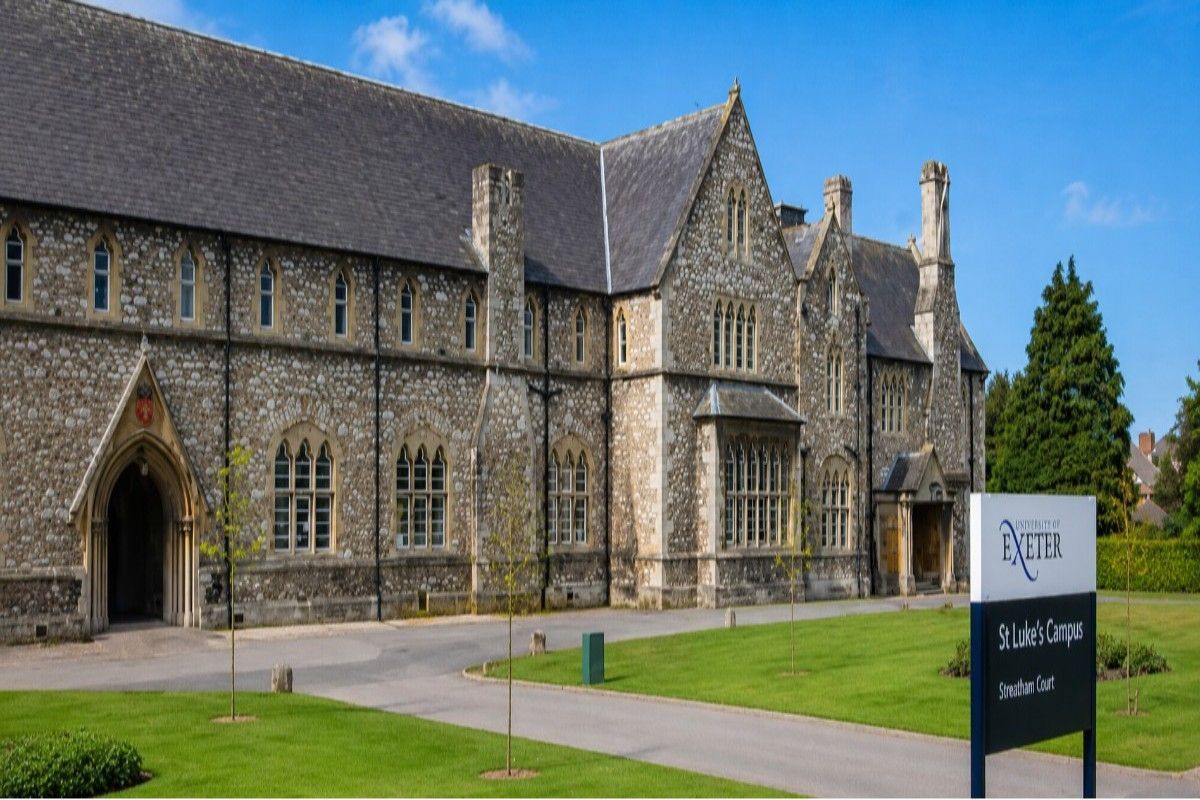
What this history has created is a curriculum based on the entire Peninsula region and not just a particular teaching hospital. The five-year BMBS programme starts at St Luke's Campus at Exeter and the first two years feature small group case-based learning and early placement into the clinic; normally, students meet their first patients in their first term. From year three onwards, teaching moves to Clinical Pathways rotations at NHS Trust sites in Devon and Cornwall regions, and all students have to spend a minimum of one year in the Knowledge Spa – a specially-built teaching facility attached to the Royal Cornwall Hospital in Truro. This relocation requirement is not a side note; it involves budgeting for two UK towns rather than just one, and it might be a good idea to know about it beforehand and not discover it in year three.
The final year – Preparation for Medical Practice – is a series of apprentice-style attachments to NHS hospitals and practices in the South West, along with a Student-Selected Elective module, which allows most students to work at a healthcare institution overseas before qualifying. Teaching relies on the Life Sciences Resource Centre for anatomy, imaging and prosections and the Clinical Skills Resource Centre for simulated ward and emergency teaching – both facilities date back to the times when the two universities were partnered and were mostly transferred intact in the 2013 split. Between years three and four, the top quartile of the students according to their internal assessment receive a guaranteed offer to intercalate to a Bachelor's or Master's year, while the second quartile compete for other spots.
Clearly, the immediate question of whether a candidate wants to attend a medical school named only a little over a decade ago becomes pertinent, given how London teaching hospitals and ancient universities of Scotland dominate the rankings. Exeter's counterargument is that the numbers already confirm that this is indeed a top institution: Complete University Guide of 2027 ranks Exeter among the ten best universities in the UK to study Medicine, despite being bettered by several considerably older institutions, and the university belongs to the Russell Group, which has a sufficient scientific base to allow for genuine research intercalation years rather than just an addition. The downside is scale and geography rather than education quality: a five-year programme which requires relocation within England mid-way, in a region with fewer major hospitals compared to London or the Midlands, for the sake of smaller, more practical cohort.
For Indian applicants, however, GMC accreditation and ranking among the UK medical schools do not mean that there is no need for extra paperwork to work in India afterwards. Citizens of India must still pass the Foreign Medical Graduate Examination in accordance with NMC rules before registering as a doctor in the country, and the NEET test is mandatory for any applicant who started his/her qualifying process after May 2018. This information is not unique to Exeter; it is true for every foreign medical degree, and the NMC revises its rules periodically. Thus, it might be a good idea to check the latest NMC rules directly rather than rely on general assurances that getting a UK medical degree allows bypassing Indian licensing entirely. In terms of Exeter University itself, selection is more complex than just school grades: it requires passing UCAT/GAMSAT and MMI interviews.
Exeter, the city, helps somewhat to soften this choice. It is a cathedral town with population of 140 thousand in Devonshire; in addition to being considered one of the better-value UK student cities, it has the beauty of Dartmoor, Jurassic Coast and Cornwall coastline within reach through public transport and/or trains, not requiring long weekend trips. Exeter University itself estimates living costs for a single student at £1,300-2,000 per month, including rent, and its Halls of Residence go for £146-342 per week, depending on room type and campus. All of that does not change the headline tuition fee; still, relative to medical school in central London, it is a significantly cheaper option for five years of studies once accommodation and daily costs are included.