
1. What makes the University of Nottingham School of Medicine unique?
+Founded in 1964, it was the first new medical school of 20th-century England, and its early research produced the MRI scan and a Nobel Prize.
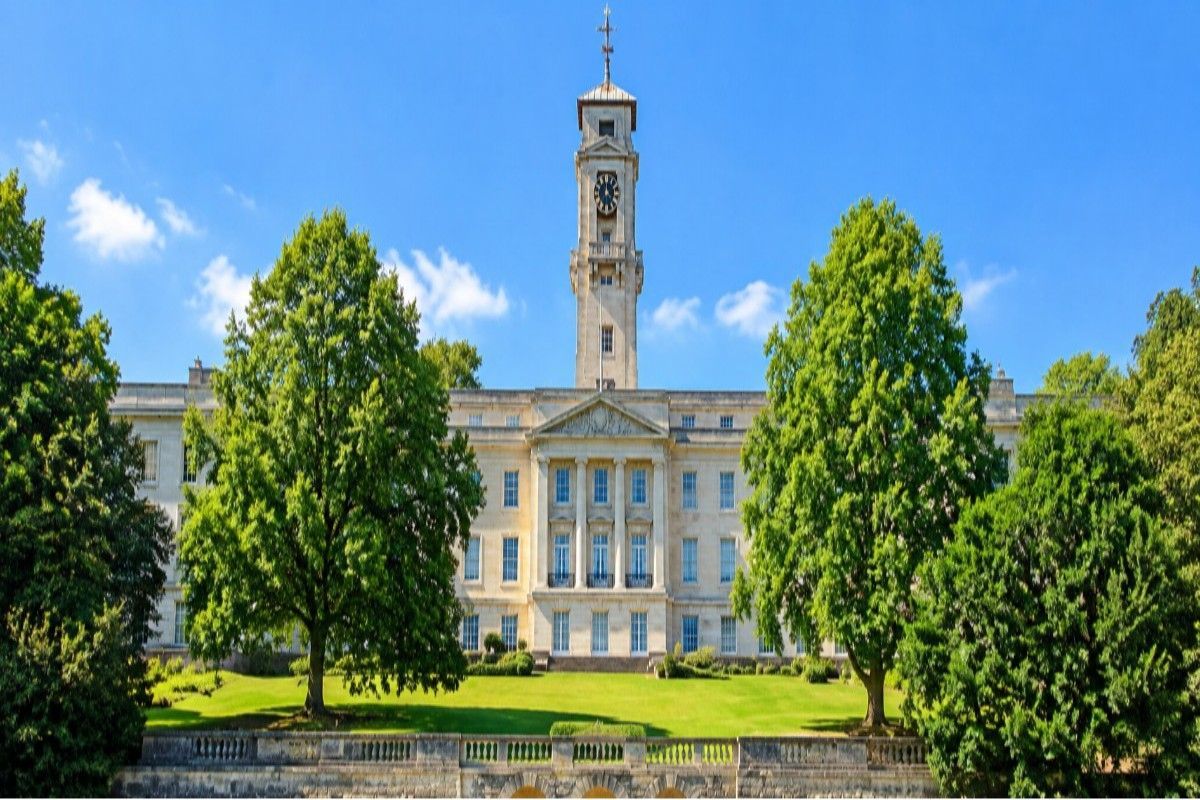
 Uk | Est. 1964
Uk | General Medical Council (GMC), United Kingdom | English medium
Expert will call you within 2 hours
UK medical schools rankings tend to reward age, so Nottingham comes as a surprise because this is the first medical school opened in England in the twentieth century. The idea of establishing Nottingham Medical School was officially announced in Parliament by the Minister of Health on 27 July 1964, and this decision was taken because of the real lack of doctors in the East Midlands after the war. Nottingham first batch of students started their learning process in October 1970 being 48 persons, with only six professors as founders. The learning process at the very beginning of the school took place in what the university archive shamelessly describes as 'cowsheds and a caravan' located behind the Portland Building on University Park.
From this improvised start came a discovery that is more than could be expected from a young medical school. Peter Mansfield, who was working in Physics department alongside with Nottingham Medical School since early 1970s, invented the technology of magnetic resonance imaging which earned him a part of the Nobel Prize in Physiology or Medicine in 2003. Currently MRI is one of the standard diagnosis tools which all Nottingham medical students should learn to interpret. Since then Nottingham Medical School grew slowly but steadily: the intake was increased from 48 in 1970 up to about 330 today, including a satellite group of graduate entry medical students, who study at another campus in Derby established in 2003. This way Nottingham got two teaching facilities in East Midlands instead of one crowded one.
The five-year BMBS programme (UCAS code A100) was recently redesigned. It is unusual for the medical school but Nottingham says that the programme was designed by collaboration with current students, teaching faculty and practising doctors, not imposed from above. The course is organized according to the spiral model based on three stages called 'Art of Medicine', 'Science of Medicine' and 'Practice of Medicine': Year 1 is dedicated to the development of consultation skills and basic knowledge about clinical medicine; in Year 2 students get deeper into the science and get additional one-day a week of placement in general practice; Years 3 to 5 shift the focus towards practical studies.
All students automatically receive an integrated Bachelor of Medical Sciences during this five-year period, and Nottingham doesn't provide an additional intercalation year because BSc-level studies are included into five years of studying rather than added to them.
Clinical placements take place in Nottingham University Hospitals NHS Trust, including Queen's Medical Centre, which is one of the biggest and busiest hospitals in the UK, Royal Derby Hospital, King's Mill Hospital, Chesterfield Royal Hospital and general practices in Nottinghamshire and Derbyshire. During Year 3, the students are placed for three ten-week placements in Medicine, Surgery and Integrated Specialties; in Year 4 they get four more placement blocks in different hospital specialties and in general practice; Year 5 provides placements in medicine, surgery, perioperative medicine and general practice in three six-week blocks followed by Assistantship block which involves working alongside with resident doctors.
The first question that arises is why anyone would prefer such a young medical school as Nottingham to Oxbridge or any of English Victorian medical schools, even taking into account the relatively high international fee (£47,000 a year). The reason lies in the fact that Nottingham Medical School was designed exactly for this: rather than designing a curriculum based on departmental boundaries, the school could create a system-based programme from the very beginning. Another point of interest is the ranking evidence that Nottingham has really fulfilled its founding ambition – Nottingham is ranked in the top 15 among the UK universities and in the top 100 in the world (QS World University Rankings by Subject 2026) in Medicine, and the ranking position of the school without an ancient history has been achieved purely because of the programme quality and research output.
Nevertheless, the cost of five years of studying in England cannot be erased. Nottingham itself is one of the most affordable UK university cities, it is clearly cheaper than London and noticeably cheaper than Leeds or Bristol on rental and living expenses, so that takes the edge off the figure of tuition fees which is going to become the sum of hundreds of thousands of pounds. So, the deal Nottingham offers to a family is a curriculum designed around teaching hospitals rather than the history of the institution in one of the cheapest university cities in the UK.
No hidden charges, no donation. The full picture of costs at MBBS in University of Nottingham School of Medicine.
Tuition Fee
Approximately GBP 47,000 (Approx. Rs. 61.34 lakh)
Approximately GBP 47,000 (Approx. Rs. 61.34 lakh)
Hostel Fee
Approx. Rs. 7.83 lakh-11.09 lakh
Approx. Rs. 7.83 lakh-11.09 lakh
Food & Meals
Approx. Rs. 2.35 lakh-3.13 lakh
per year
Insurance
Approx. Rs. 1.01 lakh
per year
Donation
no donation
no hidden fee
Total Estimated Cost
Approx. GBP 278,000-293,000 for the complete 5-year programme
5 year
25–35%
Average FMGE first-attempt pass rates for students from many overseas medical universities. Students from structured programs consistently score higher.
Students returning to India need to clear the FMGE/NExT exam. MBBS in University of Nottingham School of Medicine integrates exam-oriented coaching into the regular curriculum so students are prepared from day one.
A structured program that takes you from foundational sciences to clinical mastery.
• Physical examination and history-taking through real-world scenarios • Underpinning science for common presenting symptoms such as breathlessness, chest pain and abdominal pain • Reflective Practice module developing empathetic, patient-centred thinking
• Consultation and communication skills alongside introductory clinical knowledge
• Weekly exploration of presenting symptoms of increasing complexity • One day a week of primary care placement for early real-world patient exposure • Interprofessional Learning module on sustainable health goals, ethics, law and global health
• Clinically relevant physiology, anatomy, biochemistry and pharmacology across body systems
• A dedicated block on research skills and critical appraisal of medical literature • An Enrichment module allowing a self-selected clinical or non-clinical special interest
• Three ten-week clinical placement blocks covering Medicine, Surgery and Integrated Specialities (including Dermatology, Ophthalmology, ENT, Mental Health and Sexual Health)
• A Project Student Selected Module extending research or quality improvement work from Year 3 • Continued development of clinical reasoning across increasingly complex cases
• Four placement blocks in further hospital specialities and primary care, including Child Health, Women's Health and Long-Term Conditions
• An Assistantship placement working directly alongside resident doctors and the multidisciplinary team • A Transition to Practice module covering ward duties, out-of-hours responsibilities and key GMC procedures • An optional elective period of study in the UK or abroad
• Three six-week blocks revisiting Medicine, Surgery, Perioperative Medicine and Primary Care ahead of final assessments
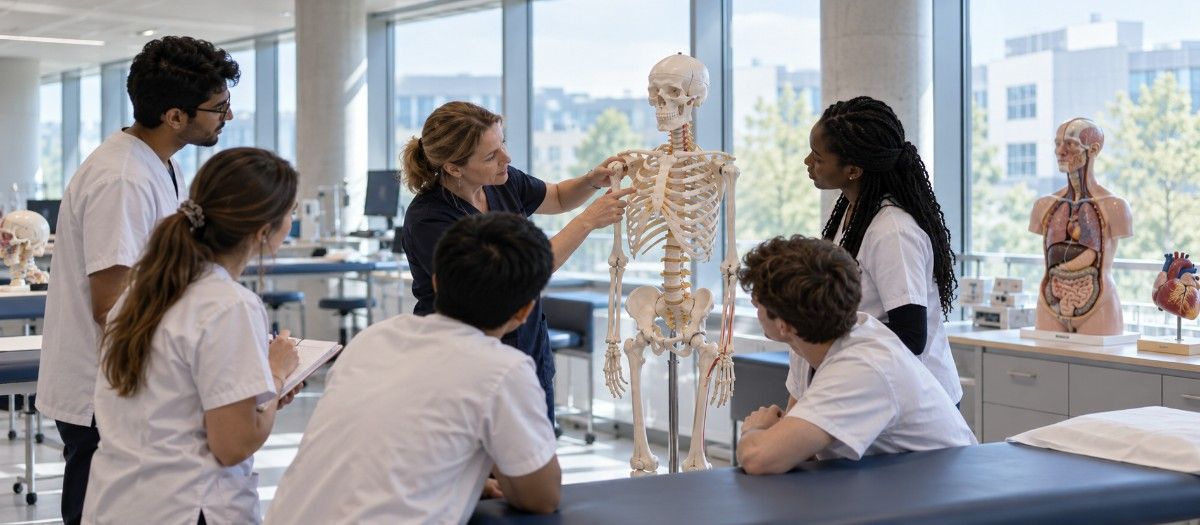
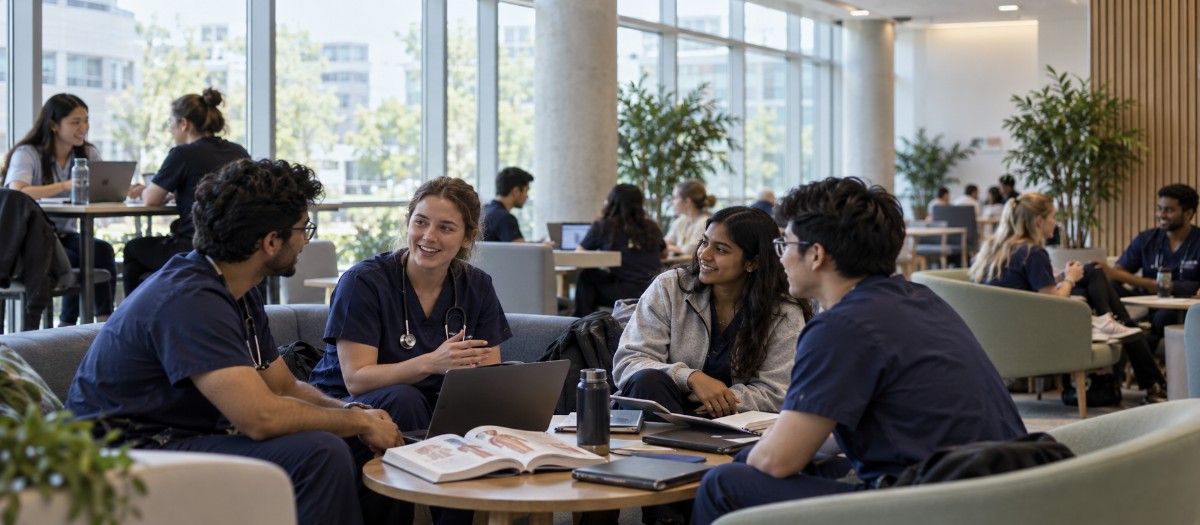
Furnished hostel rooms with Wi-Fi, laundry, 24/7 security, and Indian mess on or near campus.
Indian restaurants and mess facilities serving vegetarian and non-vegetarian home-style food daily.
Strong Indian community with cultural events, festival celebrations, and peer support groups.
Students get hands-on clinical training in government and private hospitals affiliated with the university.
Practical information for students planning to study at MBBS in University of Nottingham School of Medicine.
Prepare for all seasons. Thermal wear for winters, light clothing for summers. University provides heating in hostels.
Student visa processed with university invitation letter. Direct and connecting flights from major Indian cities.
Health insurance included in fees. Medical facility on campus plus city hospitals easily accessible.
Local SIM cards available. WhatsApp and video calls keep you connected with family back home.
Average monthly expenses of $150–$250 covering food, transport, and personal needs.
University library, online databases, and study groups. Seniors mentor juniors through academic challenges.
Our team guides you through every step — from application to arriving on campus.
Compare universities based on fees, city, UCAT requirements, and clinical exposure, starting 12–18 months before your intended entry, not the cycle you’re applying in.
Registration opens in May; the testing window runs July–September. Most successful applicants begin focused preparation 3–4 months ahead, alongside board exam preparation.
Book and complete IELTS, PTE, or TOEFL well ahead of the UCAS deadline, allowing time for a retake if needed.
Submit your application, including personal statement and up to 4 medicine choices, before the 15 October deadline.
Prepare for and attend interviews (MMI or Panel format) typically scheduled November through February.
Offers (conditional or unconditional) typically arrive through winter and spring; conditional offers require meeting stated academic and English-score conditions.
Once Class 12 results and any other conditions are confirmed, your university issues the Confirmation of Acceptance for Studies (CAS), which is required for your visa application.
Apply using your CAS reference number; arrange maintenance funds according to the 28-day rule well in advance rather than at the last minute.
Book flights, confirm accommodation, complete any on-arrival formalities during orientation week, open a local bank account, and begin building connections with your university’s Indian/South Asian student community.
Admission Helpline — Contact our counsellors for step-by-step assistance.
“The faculty here is incredibly supportive. The clinical training during hospital rotations has given me real confidence in patient care.”
“Affordable fees without compromising on quality. The campus facilities and hostel life made my transition abroad very smooth.”
“English medium instruction and WHO-recognized curriculum were the deciding factors for me. No regrets so far — excellent experience overall.”
“The university helped with everything from visa to accommodation. Hospital exposure from year three has been invaluable for my FMGE prep.”
“Just cleared my licensing exam on the first attempt. The structured coaching and mock exams during final year were a game-changer.”
“Safe campus, good food options, and a strong Indian student community. The teaching methodology is very practical and hands-on.”
Founded in 1964, it was the first new medical school of 20th-century England, and its early research produced the MRI scan and a Nobel Prize.
Yes. The entire five-year BMBS is delivered in English, and IELTS 7.5 overall with no element below 7.0 is required.
Yes. The BMBS is GMC-accredited and the school is listed in the World Directory of Medical Schools, supporting routes such as USMLE and PLAB.
No. An integrated Bachelor of Medical Sciences (BMedSci) is built into the five-year course, so a separate intercalation year is not offered.
Yes. Indian students seeking future recognition of a foreign medical qualification in India must hold a valid NEET qualification.
Applicants who score a Band 4 in the UCAT Situational Judgement Test are not considered for the BMBS course
Placements run through Nottingham University Hospitals NHS Trust and partner sites in Derbyshire from Year 2, expanding through Year 5.
Yes. Final-year students may undertake an optional elective placement in the UK or abroad to broaden clinical or research experience.
It follows three stages, the Art, Science and Practice of Medicine, using a spiral curriculum that revisits topics with increasing depth each year.
Applicants typically need academic transcripts, passport copies, UCAT and IELTS scores, a personal statement, and a UCAS reference.
Our expert counsellors will guide you through the complete admission process — from documents to airport pickup.