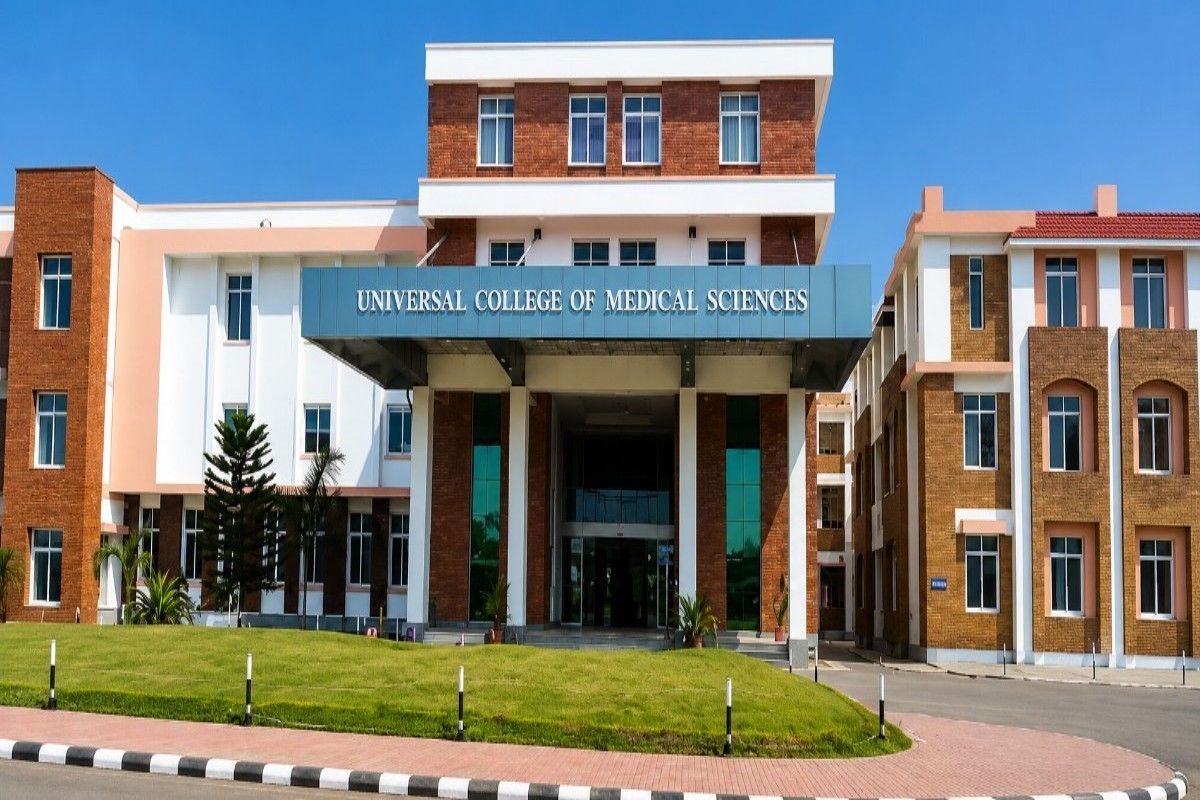
Most MBBS guides describe Birat Medical College in two sentences: private, Biratnagar, affiliated with Kathmandu University. That compressed summary misses the more interesting story. BMC started in 1991 as a single-bedded clinic set up by Dr Gyanendra Man Singh Karki, a gynaecologist who had completed his MD in the former Soviet Union, turned down opportunities abroad, and instead moved to Biratnagar in 1993 with a firm conviction that Nepal's healthcare should not be entirely centralised in Kathmandu. By 2000, that clinic had grown into a 50-bed Birat Nursing Home. By 2014, it had become an MBBS-granting institution, a formal extension campus of Kathmandu University's School of Medical Sciences. The founder's background in Obstetrics and Oncological Gynaecology explains why the teaching hospital runs oncology services that are rare at a 350-bed institution.
The Kathmandu University affiliation is the structural fact that every competitor guide acknowledges, but few explain properly. KU is Nepal's second national university, and the only one in the country explicitly modelled on Western research-university standards. The academic, examination, and teaching calendar at BMC is all directly supervised by KUSMS, which means the MBBS degree a student earns here carries the same KU academic stamp as degrees from the main KUSMS campus in Dhulikhel. BMC's finances and day-to-day operations are independent, but academic standards are not. That is a meaningful distinction from colleges where affiliation is nominal.
The location in Biratnagar deserves more attention than it typically gets. Biratnagar is the administrative and commercial capital of Morang District and the largest city in the Koshi Province, the second most populous province in Nepal. It sits close to the Indian border, with strong trade and transport links to Bihar and West Bengal. The Biratnagar Airport operates regular domestic flights to Kathmandu, and from there, Delhi is under two hours. Students from Bihar, UP, and West Bengal are often closer to Biratnagar than to most other MBBS destinations recommended by their consultants. That geographical proximity is not a trivial advantage when it comes to family visits, emergency travel, and the general mental health of a 17-year-old living away from home for the first time.
The teaching hospital has 350 beds and sees over 1,000 patients daily across 15 specialised departments. For a private medical college that launched in 2014, that patient volume is higher than many guides suggest. Because Biratnagar is the main medical referral point for the densely populated eastern Terai Morang, Sunsari, and Jhapa districts, which together have a population of over 3.5 million, the hospital draws high-acuity cases in general medicine, surgery, trauma, and obstetrics that a smaller city's college simply would not see. Clinical exposure at BMC directly reflects the health burden of eastern Nepal, meaning students rotating through the wards encounter the kinds of presentations that FMGE/NExT and real-world Indian practice both test.
The cost picture at BMC is honest and direct. The total MBBS course fee for Indian students is INR 52 lakh, payable in structured instalments. Add hostel (INR 1,80,000 per year for the first four years), food at the campus mess, and personal expenses; the total 5.5-year all-inclusive cost comes to INR 60–68 lakh. That is comparable to what IOM or other government colleges in Nepal cost overall and significantly lower than the cost of an Indian private medical college. There is no donation, no capitation fee, and the fee structure is published and fixed. For families who need to plan a medical education budget without surprise charges appearing mid-course, that transparency is worth more than it sounds.
Finally, the ISO 9001:2015 certification is worth mentioning because no competitor page explains what it actually means. ISO 9001 is a quality management system standard that requires documented processes, measurable performance metrics, and independent external auditing. A medical college that holds this certification has committed its administrative, academic, and clinical workflows to systematic review and continuous improvement, not just at accreditation time, but as a permanent operational standard. Very few Nepali medical colleges offer this, and BMC's certification signals how the institution is run internally, not just how it presents itself externally.