
Q1: Do I need to learn Romanian?
+No. The English-medium track runs entirely in English; lectures, exams, and clinical teaching. Basic conversational Romanian helps with daily life but is not an academic requirement.

 Romania | Est. 1875
Romania | NMC (India); verify at nmc.org.in; ARACIS; EU Directive 2005/36/EC; WDOMS listed; WHO recognised; ECFMG eligible; WFME compliant. | English (primary track for international students); French and Romanian also available. No language test required for En medium
Expert will call you within 2 hours
Grigore T. Popa University of Medicine and Pharmacy, widely known as UMF Iași, is one of the oldest and most established medical universities in Romania and the wider Eastern European region. Founded on 30 September 1879 as the Faculty of Medicine within the University of Iași, it went through significant institutional evolution over the following decades. In 1948, the Faculty of Medicine was joined with the School of Pharmacy and the School of Dental Medicine to form the Institute of Medicine and Pharmacy. In 1991, the institute was elevated to full university status and renamed in honour of the distinguished Romanian scientist and anatomist Grigore T. Popa, a figure closely identified with the Iași School of Functional Anatomy. Over 145 years of continuous operation have left their mark on the institution in ways that are hard to fully capture in a summary; through the depth of its faculty, its accumulated clinical infrastructure, and the sheer number of physicians it has trained for Romania and for the world.
The university sits in Iași, a city in the Moldavia region of northeastern Romania, with a population of roughly 350,000 and a long tradition as a cultural and academic centre. Iași is home to multiple universities and is considered one of Romania's most important student cities, offering an environment that is both intellectually active and considerably more affordable than Western European university towns. The cost of living is genuinely low by European standards, and the city itself has green spaces, a visible cultural life, and a student population that makes up a substantial share of its residents. For international students, particularly those coming from India, the city offers a practical and manageable environment to settle into for the duration of medical training.
UMF Iași's clinical training infrastructure is one of its defining advantages. The primary teaching hospital is St. Spiridon University Hospital, founded in 1757, making it the oldest hospital in the historical region of Moldavia and one of the largest in Romania. St. Spiridon is not simply an affiliated hospital in a logistical sense; it functions as a live tertiary care teaching environment where students rotate through real departments with real patient loads from the early clinical years. The university also affiliates with the Institute of Cardiovascular Diseases, the Neurosurgery Hospital, the Emergency Hospital for Children, C.I. Parhon Hospital, and a number of other specialised centres in Iași, giving students breadth of clinical exposure across medical and surgical disciplines. This network of teaching hospitals covering the Moldavia region provides the kind of clinical variety that smaller or newer institutions struggle to replicate.
Academically, UMF Iași is classified by Romania's Ministry of Education as a research-intensive university of advanced education. It is the only Romanian medical university that has been included in the Times Higher Education World University Rankings and is also listed in the Top 1501 Shanghai Rankings and the Top 25 U-Multirank Interdisciplinary Publications. The university hosts approximately 13,000 students from over 60 countries and has an academic staff of close to 1,000. This degree of international enrolment is not incidental; it reflects decades of deliberate internationalisation, particularly in the English-language and French-language streams of the medical programme, which have made UMF Iași one of the most internationally accessible medical schools in Eastern Europe.
The six-year MD programme at UMF Iași's Faculty of Medicine is available in three languages: Romanian, English, and French. For international students who do not speak Romanian, the English-medium track is the practical option and follows the same academic structure and clinical requirements as the Romanian programme. The curriculum runs across six full years, with the first three years covering biomedical and pre-clinical sciences and years four through six progressively integrating clinical training across the affiliated hospital network. The final portion of the programme includes a supervised internship component, which is a requirement for graduation. Importantly, the programme is fully compliant with the Bologna Process and the EU Professional Qualifications Directive 2005/36/EC, which means the degree carries recognition across all 27 EU member states. For Indian students, this EU recognition and the NMC-verified listing make UMF Iași one of the more straightforward European options in terms of international licensing pathway clarity.
For Indian students specifically, UMF Iași presents a combination of factors that is worth understanding properly rather than at the level of marketing. The tuition fees for the English-language track are approximately €8,500 per year for international students, making it one of the most cost-effective EU-member-state medical programmes available anywhere. Iași's living costs; accommodation, food, transport; run considerably lower than Bucharest, Warsaw, or Prague, let alone London or Dublin. The NEET qualification is mandatory for Indian students as per the National Medical Commission guidelines. The NMC recognises UMF Iași for NExT eligibility verification, and the EU-regulated degree opens pathways to practice in EU countries, ECFMG eligibility for the US, and GMC registration in the UK. None of these pathways are automatic or without further steps, but the structural foundation that UMF Iași's degree provides is one of the stronger starting points available in the affordable-European-medical-school category.
Romania is an EU member state and part of the Schengen Area, which has practical implications for students considering their post-graduation options in Europe. A Romanian medical degree recognised under EU Directive 2005/36/EC provides a clear legal basis for seeking registration in any EU country without having to sit additional licensing examinations, though each country has its own registration process and language requirements. UMF Iași has been producing internationally mobile physicians for decades, and a meaningful proportion of its graduates are working across Western Europe, the United States, Canada, and the Middle East. The university is a founding member of EduCare 5.0, a European University Alliance bringing together nine institutions focused on healthcare education innovation, and maintains research and academic partnerships across Europe, the Americas, Africa, and Asia.
No hidden charges, no donation. The full picture of costs at Universitatea de Medicină şi Farmacie Grigore T. Popa Facultatea de Medicină.
Tuition Fee
~€100–200 at enrolment — no donation or hidden fees
€8,500 / ~₹7.65 Lakh
Hostel Fee
€1,500 – €4,200 / ~₹1.35 – ₹3.78 Lakh
€1,500 – €4,200 / ~₹1.35 – ₹3.78 Lakh
Food & Meals
€1,200 – €2,400 / ~₹1.08 – ₹2.16 Lakh
per year
Insurance
€150 – €300
Per Year
Donation
NA
NA
Total Estimated Cost
€71,900 – €99,800 (Approx. ₹64.7 – ₹89.8 Lakh)
Total 6-Year Estimate
25–35%
Average FMGE first-attempt pass rates for students from many overseas medical universities. Students from structured programs consistently score higher.
Students returning to India need to clear the FMGE/NExT exam. Universitatea de Medicină şi Farmacie Grigore T. Popa Facultatea de Medicină integrates exam-oriented coaching into the regular curriculum so students are prepared from day one.
A structured program that takes you from foundational sciences to clinical mastery.
The structural and cellular foundations of medicine; with ethics embedded from semester one, not added as an afterthought.
Anatomy (with cadaveric dissection and histology), Biochemistry, Cell Biology & Genetics, Physiology I, Biophysics & Medical Informatics, Medical Ethics & History of Medicine.
Systems-level thinking takes hold here. Topographic anatomy carries surgical relevance, and the first concepts of disease-mechanism thinking arrive through pathophysiology.
Neuroanatomy, Topographic Anatomy, Physiology II (Systems), Microbiology & Immunology, Pathophysiology I, Genetics, Medical Psychology.
The bridge year. Semiology; reading signs and symptoms; is taught through structured patient encounters. Students begin supervised patient-facing activities. Pharmacology is framed around prescribing logic, not just theory.
Pharmacology I & II, General Pathology, Pathophysiology II, Semiology & Physical Examination, Epidemiology & Public Health, Evidence-Based Medicine, Research Methodology.
First full clinical year at St. Spiridon University Hospital and affiliated centres. Ward rounds, patient clerking, case presentations; real clinical reasoning under close faculty supervision.
Internal Medicine, General Surgery, Obstetrics & Gynaecology, Paediatrics, Radiology & Medical Imaging, Psychiatry & Neurology.
Wider speciality exposure across UMF Iași's hospital network, including primary care and community settings alongside hospital-based rotations. Dissertation research runs in parallel.
Internal Medicine II, Surgery II, ENT & Ophthalmology, Dermatology, Orthopaedics & Trauma, Emergency Medicine, Family & Community Medicine, Infectious Diseases.
Must be completed at UMF Iași-affiliated hospitals in Romania; cannot be transferred to India. Required before NExT eligibility.
Full-year internship across Internal Medicine, Surgery, Obstetrics & Gynaecology, Paediatrics, Psychiatry, Emergency Medicine, Community Medicine, and an Elective.

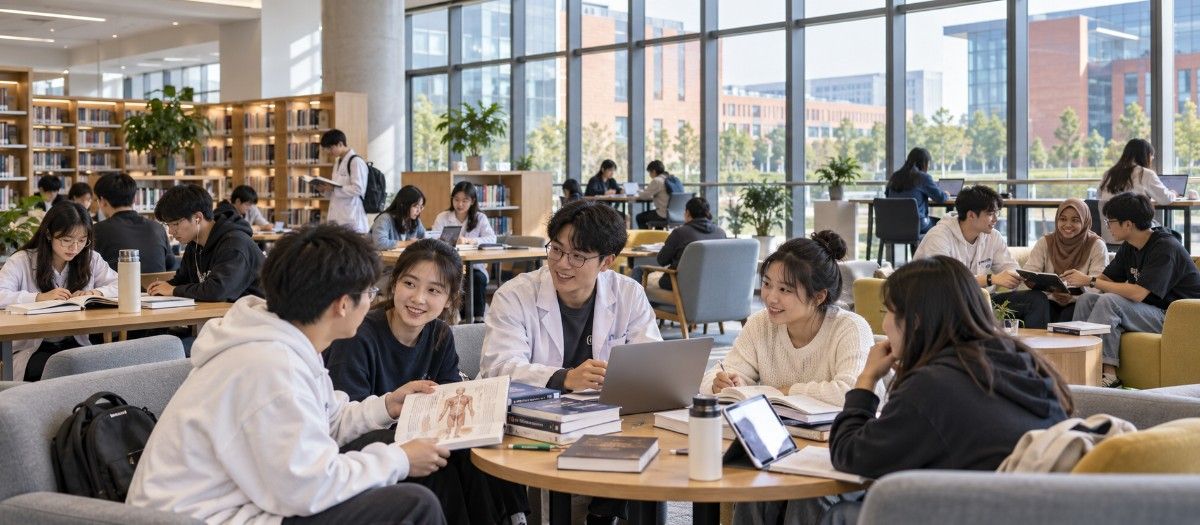
Furnished hostel rooms with Wi-Fi, laundry, 24/7 security, and Indian mess on or near campus.
Indian restaurants and mess facilities serving vegetarian and non-vegetarian home-style food daily.
Strong Indian community with cultural events, festival celebrations, and peer support groups.
Students get hands-on clinical training in government and private hospitals affiliated with the university.
Practical information for students planning to study at Universitatea de Medicină şi Farmacie Grigore T. Popa Facultatea de Medicină.
Prepare for all seasons. Thermal wear for winters, light clothing for summers. University provides heating in hostels.
Student visa processed with university invitation letter. Direct and connecting flights from major Indian cities.
Health insurance included in fees. Medical facility on campus plus city hospitals easily accessible.
Local SIM cards available. WhatsApp and video calls keep you connected with family back home.
Average monthly expenses of $150–$250 covering food, transport, and personal needs.
University library, online databases, and study groups. Seniors mentor juniors through academic challenges.
Our team guides you through every step — from application to arriving on campus.
Compare universities based on fees, city, and availability of non-EU seats, not just the cheapest option.
Submit the application, along with academic transcripts, to the university, either directly or through a registered admission partner.
The university's international admissions office verifies documents and publishes a merit-based ranking list.
Issued by the Romanian Ministry of Education after the university confirms your place on the ranking list.
Pay the first-year tuition fee (or the required deposit percentage) to confirm the seat.
Apply for the Type D student visa at the Romanian Embassy/Consulate in India; realistic processing time is 2–8 weeks.
Book travel and plan arrival dates ahead of the late-September start of the academic year.
In the final weeks, finalize documents, arrange winter clothing and travel/health insurance, book flights, arrange currency exchange, and confirm hostel allotment in writing.
Complete local registration (residence permit steps) with the relevant Romanian authorities within the required window after arrival; the university usually assists with this during orientation.
Open a local bank account, get a local SIM card, attend orientation sessions, get the class schedule, and begin building a grocery/cooking routine and connections with the Indian student community.
Admission Helpline — Contact our counsellors for step-by-step assistance.
“The faculty here is incredibly supportive. The clinical training during hospital rotations has given me real confidence in patient care.”
“Affordable fees without compromising on quality. The campus facilities and hostel life made my transition abroad very smooth.”
“English medium instruction and WHO-recognized curriculum were the deciding factors for me. No regrets so far — excellent experience overall.”
“The university helped with everything from visa to accommodation. Hospital exposure from year three has been invaluable for my FMGE prep.”
“Just cleared my licensing exam on the first attempt. The structured coaching and mock exams during final year were a game-changer.”
“Safe campus, good food options, and a strong Indian student community. The teaching methodology is very practical and hands-on.”
No. The English-medium track runs entirely in English; lectures, exams, and clinical teaching. Basic conversational Romanian helps with daily life but is not an academic requirement.
Yes. A valid NEET score is required for all Indian students under NMC guidelines.
St. Spiridon University Hospital; founded in 1757 and one of Romania's largest; is the primary teaching site. Students also rotate through the Institute of Cardiovascular Diseases, the Neurosurgery Hospital, the Emergency Children's Hospital, and other specialised Iași centres.
Yes, it is listed for NMC recognition. Always verify the current status at nmc.org.in before applying.
None. UMF Iași is a public institution; no donation fees, no capitation charges. Just a modest registration fee (~€100–200) at enrolment.
Yes. Year 6 must be completed at UMF Iași-affiliated hospitals in Romania and cannot be transferred to India; a requirement before sitting NExT.
Yes; 28 specialised laboratories, plus active research programmes in oncology, neuroscience, cardiology, and pharmacology.
Around 2,500 international students from 60+ countries, out of a total enrolment of approximately 13,000.
The supervised clinical internship (Year 6) must be completed at UMF Iași-affiliated hospitals in Romania. Per NMC guidelines, Indian students must complete the internship before appearing for NExT in India.
All-in estimated cost including tuition, accommodation, food, insurance, and personal expenses is approximately €72,000–100,000 (₹49–63 lakh) over six years. Iași's living costs are among the lowest in the EU.


Our expert counsellors will guide you through the complete admission process — from documents to airport pickup.