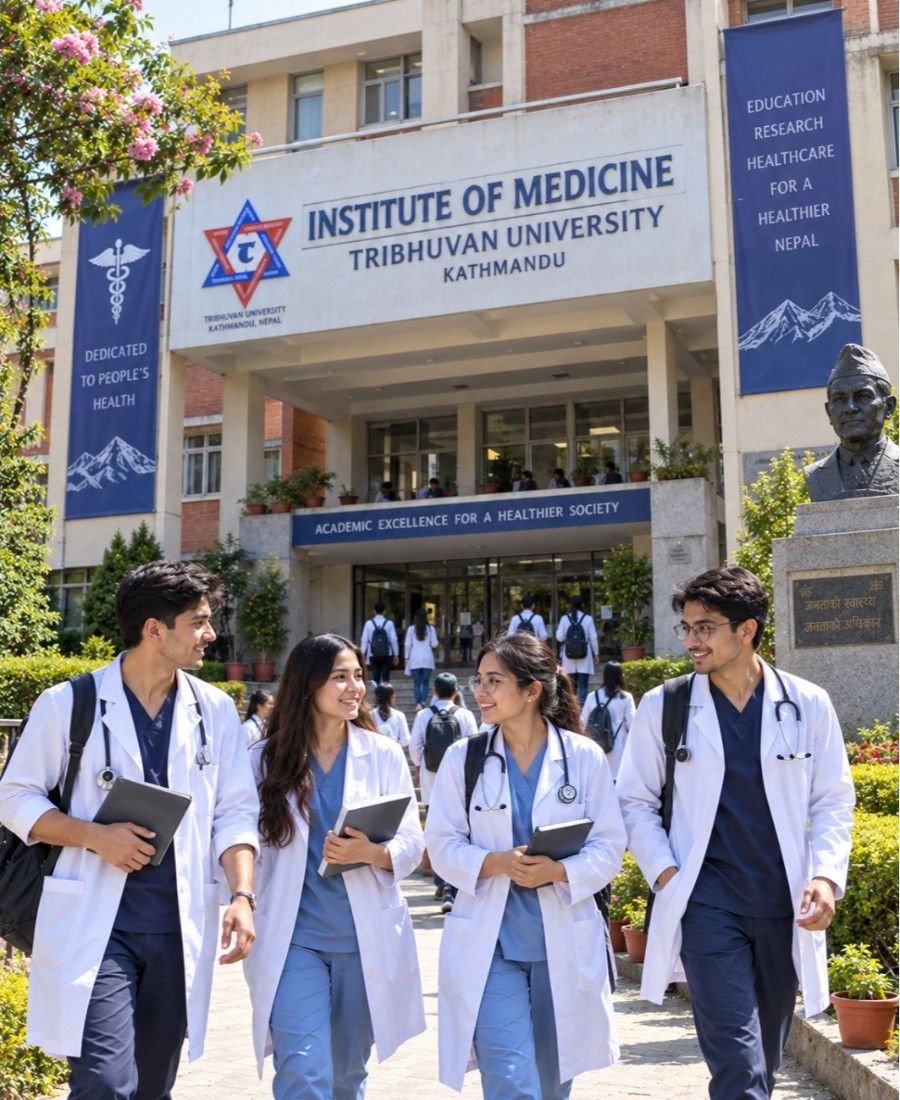
Most guides to MBBS in Nepal open with a ranking table and a fee comparison. This one starts in a more useful place with a fact that changes how you think about the Institute of Medicine (IOM). In 1978, when IOM launched Nepal's first MBBS programme with just 22 students, it did not design a standard curriculum and call it done. Instead, it built what was then one of the only community-oriented integrated MBBS programmes in South Asia. That design, in which public health, community medicine, and real field exposure were embedded in the curriculum from Year 1 rather than added as a final-year elective, remains the structural foundation of how IOM teaches medicine today. It matters because graduates who trained this way think differently about patients, populations, and clinical decision-making under resource constraints.
IOM was established in 1972 under Tribhuvan University by direct government mandate. The task was not just to build a medical school, it was to produce every category of health worker Nepal would need: from ANMs and community health workers to MBBS doctors, MD specialists, and doctoral researchers. Within its first decade, IOM had 12 campuses across the country. Today, it runs 7 constituent campuses, 1 central department, 15 affiliated colleges, and 3 tertiary-level teaching hospitals, and it conducts over 63 academic programmes from the undergraduate through to the DM/MCh and PhD levels. That is the scale of the institution. The Maharajgunj Medical Campus in northern Kathmandu, where the MBBS programme runs, is the largest of them all and sits on the same grounds as the Tribhuvan University Teaching Hospital.
The Tribhuvan University Teaching Hospital (TUTH) is what sets IOM apart clinically from most other MBBS destinations that Indian students compare it to. Completed in 1982 with direct support from the Japan International Cooperation Agency (JICA), TUTH now has 700 beds, provides super-speciality services, and draws patients from every corner of Nepal and from across the border from Bihar and UP. When you rotate through TUTH as an IOM student, you are not seeing a curated teaching case load. You are seeing the actual disease burden of a country, high-volume general medicine, trauma from mountain terrain and road accidents, infectious disease presentations that barely appear in Indian urban hospitals, obstetric emergencies, and cardiothoracic cases managed at the Manmohan Cardiothoracic Vascular and Transplant Centre next door. The BP Koirala Lions Centre for Ophthalmic Studies (BPKLCOS), also on campus, has treated over 1.5 million patients since 1996. These are not small affiliated hospitals. They are national referral centres.
For Indian students, the practical case for IOM is straightforward once you understand what it actually is. The language is not a barrier. English is the sole medium of instruction, and the cultural proximity between India and Nepal means the social adjustment is far gentler than any Central Asian or Eastern European destination. The flight from Delhi takes under 90 minutes. Students from Bihar, UP, West Bengal, and the Northeast, in particular, find the cultural and linguistic continuity reassuring. There is no adjustment period for food, festivals, or social norms, the way there is in Bishkek or Tashkent. Parents can visit on a long weekend. Students can go home for Holi and Diwali without burning a week of academic leave on travel.
That said, admission to IOM is genuinely competitive and works differently from most overseas MBBS programmes. Seats are allocated by Nepal's Medical Education Commission (MEC) through the MECEE-BL entrance examination, which comprises 200 MCQs covering Physics, Chemistry, Biology, and English. Indian students must also hold a valid NEET UG score. The cut-off rank for general category scholarship seats at Maharajgunj Medical Campus typically falls within the top 100–150 of all MECEE applicants, making IOM harder to get into than many overseas options that accept students on NEET qualifying marks alone. That competitive entry is also why IOM's clinical training and degree recognition carry more weight with postgraduate programmes in India than degrees from universities with open admissions.
Finally, the cost reality at IOM is important to state clearly. The total 5.5-year all-inclusive cost, including tuition, hostel, food, insurance, and local expenses, typically falls between INR 62 and 70 lakh. That is higher than the Kyrgyzstan or Uzbekistan options and lower than most Indian private colleges. What you are buying for that cost is a government medical school that has been running since 1972, a 700-bed tertiary hospital as your primary clinical site, and a degree that is recognised without qualification by the NMC in India, ECFMG in the USA, and the Medical Council of Nepal. For students and families who want the confidence of a proven institution without the financial weight of a domestic private college, IOM is the most logical choice in this part of South Asia.