The International University of Goražde (IUG) is a private higher education institution that was set up in 2014 in Goražde, a quiet town along the Drina River in eastern Bosnia and Herzegovina. Edina Brutus and Dr. Emir Duranović founded it with a fairly straightforward goal in mind: to finally bring university-level education to the Bosnian-Podrinje Canton, a region that, until then, had never had its own higher education institution. Being the first private university in this canton, IUG has grown quite a bit over the last decade, drawing in students from across Bosnia, the wider Balkans, the Middle East, and a handful of other international destinations. The university now runs four faculties, Health Sciences, Engineering, Economics, and Educational Sciences, which together cover roughly 18 academic programmes.
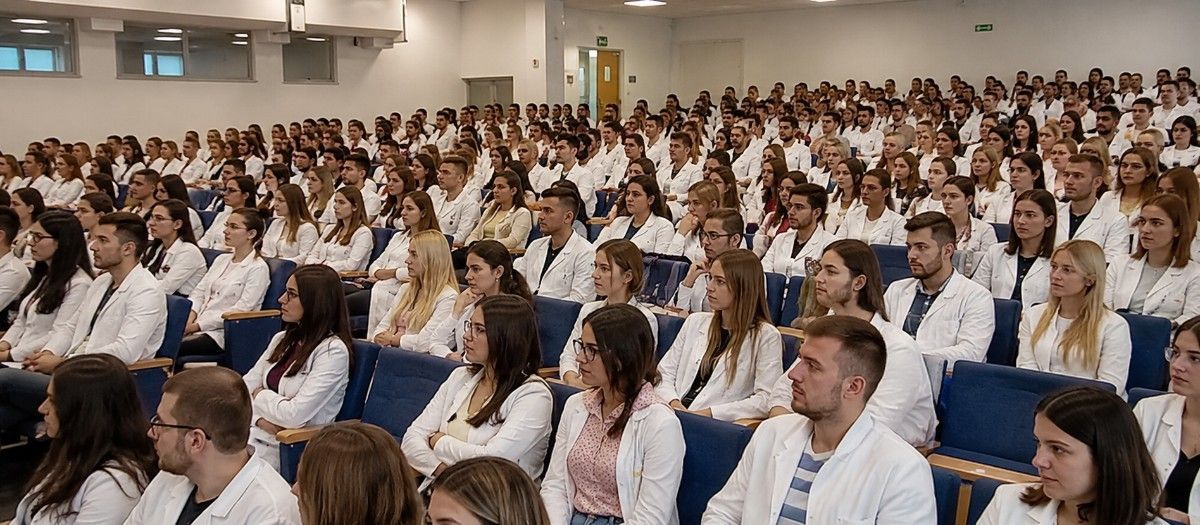
The Faculty of Health Sciences sits at the centre of the institution, offering undergraduate programmes in Medicine, Dentistry, and Pharmacy. For most of the international students who come here, especially those from India, it's really the six-year medical programme that puts IUG on the map. This curriculum runs for six years and splits naturally into two phases.
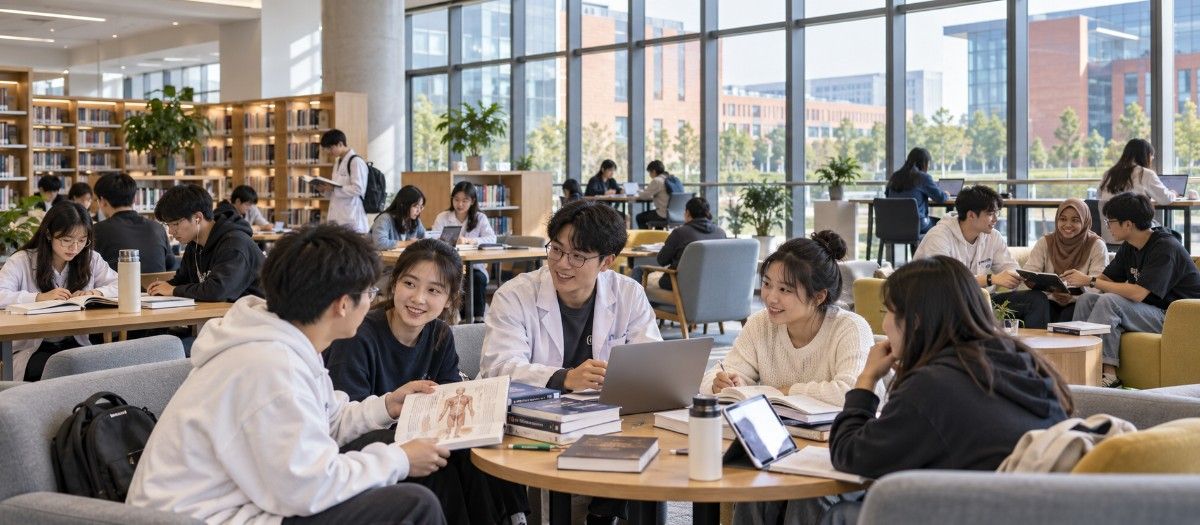
The first three years are pre-clinical through and through, built around the foundational sciences that any medical professional needs before they can start treating patients directly. This phase is centred on intensive coursework in Anatomy, Physiology, Biochemistry, Histology, Microbiology, Pharmacology, and Pathology. These subjects are demanding by nature, but they're taught in a structured way, so that by the time a student reaches the end of year three, they've built a solid scientific base strong enough to carry them through clinical training.
From years four through six, the focus shifts firmly into clinical rotations. Students start spending time in hospital departments, joining ward rounds, interacting directly with patients, presenting cases, and getting the kind of hands-on experience that turns textbook science into real medical practice. The whole programme follows the Bologna Process framework, which is the standard structure used across Bosnian higher education and keeps the university's degrees aligned with broader European academic norms.
One of the more practical perks of studying at IUG is that the full programme for international students runs in English. There's no Bosnian language requirement, no compulsory prep year, and no language exam to clear before classes begin. Students show up and start studying medicine in English from day one. This removes one of the biggest hurdles international students often run into at other European medical schools, where teaching happens in the local language and students end up losing an entire year just to basic communication skills. At IUG, that time goes straight into the core medical syllabus instead. Students who'd rather study in a different language also have the option of separate tracks taught in Bosnian and Turkish.
The campus itself is located at Ibrahima Čelika bb in Goražde. To back up the practical, research-oriented side of medical training, the Faculty of Health Sciences runs four dedicated science and health laboratories. These give students room to step outside the lecture hall and actually work with the material, running experiments, performing dissections, and building the manual and technical skills that simply can't be picked up from lectures alone. On top of that, the university has set up formal cooperation agreements with international healthcare institutions and companies, including hospitals in Germany and Austria for its nursing graduates, which shows that IUG is genuinely working to create career pathways for its students outside Bosnia as well.
Before deciding to relocate, it helps to understand what Goražde is actually like. It's a small, calm city with a population somewhere between 20,000 and 25,000, sitting about 80 kilometres from Sarajevo, the capital. It isn't a buzzing student metropolis, and it doesn't try to be one. What it offers instead is an environment that's genuinely affordable, safe, and easy to manage day to day. Living costs here are low even by Bosnian standards, with monthly expenses, rent, food, local transport, and the usual day-to-day spending, typically falling somewhere between USD 250 and USD 400. Most student housing comes through private rentals and shared apartments rather than big, purpose-built university dorms, which means students end up adapting to a more realistic, independent way of living fairly early on in their studies. On the financial side, Bosnia and Herzegovina uses the Bosnian Convertible Mark (BAM), which is pegged to the Euro at a fixed rate of around 1.96 BAM to 1 EUR. The country does hold official EU candidate status, though it isn't an EU member state yet.
For applicants from India, dealing with National Medical Commission (NMC) regulations is probably the single most important step before enrolling. IUG appears in the World Directory of Medical Schools (WDOMS), which covers the basic international eligibility requirement for graduates planning to sit the National Exit Test (NExT) in India, along with licensing routes like the USMLE in the US and PLAB in the UK. That said, it's important to understand that a WDOMS listing and actual NMC recognition are two completely separate things and shouldn't be mixed up. NMC recognition can be granted, paused, or pulled at any point depending on regulatory changes, so applicants need to check the current status directly on the official NMC website (nmc.org.in) before they apply. Don't assume anything here.
On top of that, qualifying for NEET-UG is compulsory for every Indian applicant, along with scoring at least 50% overall in Physics, Chemistry, and Biology at the 10+2 level. Indian students considering this programme should also get clear confirmation, before they enrol, on whether the internship completed in Bosnia during year six counts toward current NExT eligibility, or whether they'll need to complete a separate internship back in India afterward. This is something to confirm directly with the NMC rather than guess at.
As for the money side, annual tuition for international students runs roughly USD 4,500 to USD 6,000, which adds up to somewhere between USD 27,000 and USD 36,000 across the full six years. The university doesn't charge capitation fees or ask for donations. Combined with how cheap living in Goražde is, the total all-inclusive cost over six years makes this one of the more financially accessible European medical programmes available to Indian students.