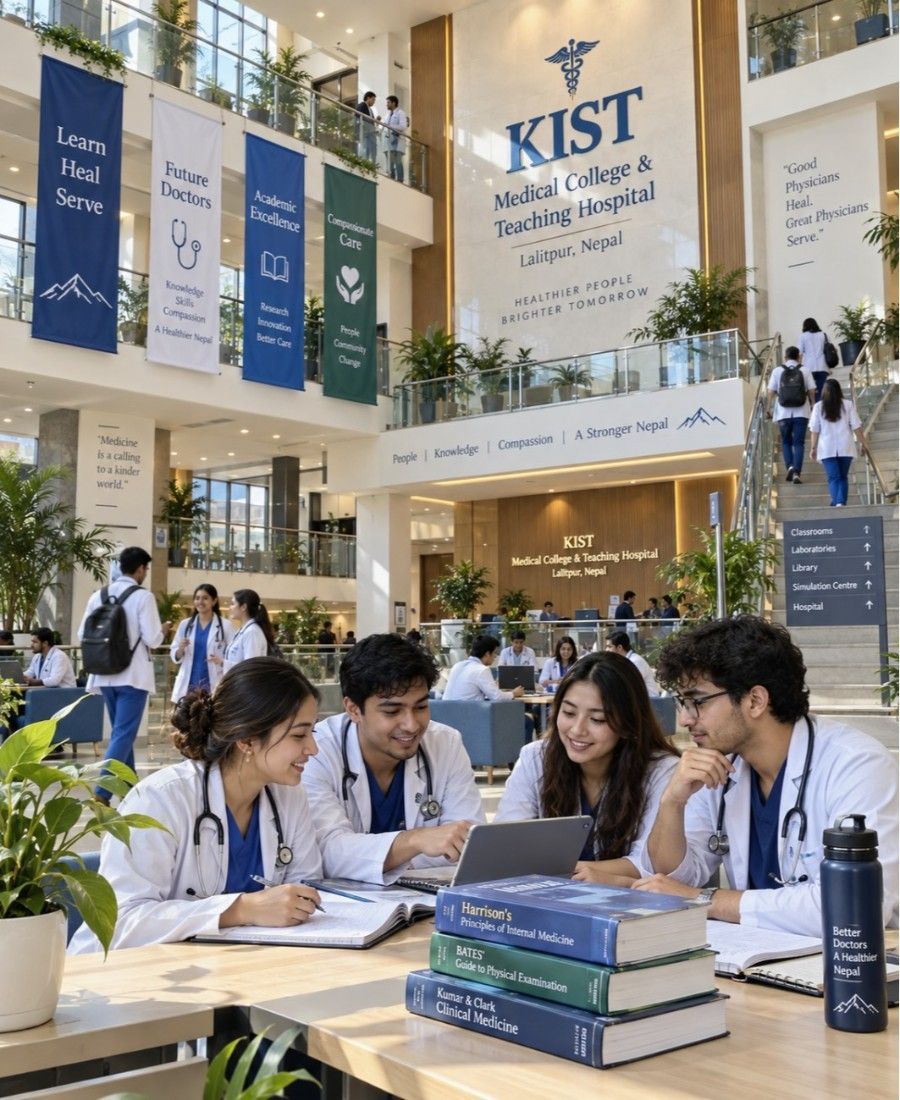
There is one fact about KIST Medical College that every other guide buries in a footnote, even though it matters more than the fee comparison table: KIST is the first private medical college in the Kathmandu Valley to be affiliated with a government university. That distinction, affiliated with the Institute of Medicine (IOM) under Tribhuvan University, not a private university, means that its MBBS degree carries the same academic authority as a TU constituent campus degree. That is not a small thing. Because when Indian licensing authorities, postgraduate admissions committees, and hospital HR departments look at a KIST degree, they see Tribhuvan University on the certificate, not just a private college name.
KIST was established in 2006 at Imadol, Lalitpur, about 300 metres from the Ring Road, close enough to central Kathmandu to be practically accessible, far enough from the city's main traffic corridors to give the campus a noticeably quieter and cleaner environment than most urban medical colleges in the valley. The college launched its MBBS programme in 2008, added BDS in 2011, and has since expanded to include BSc MLT, MD/MS across clinical and basic science disciplines, MDS in Prosthodontics and Orthodontics, DM/MCh programmes, and a Master of Public Health. By early 2023 (BS 2080), the college had produced 650 medical graduates and 151 dental graduates. Those are not projections; those are alums already in hospitals, clinics, and postgraduate programmes across Nepal, India, and abroad.
The teaching hospital is what makes the day-to-day clinical experience real. KIST's multi-speciality hospital runs 550 beds, with a separate dental hospital on the same campus. The hospital covers general medicine, surgery, orthopaedics, paediatrics, obstetrics and gynaecology, neurosurgery, cardiology, oncology, nephrology, burn and plastic surgery, and critical care. Organ transplant services run here. There is a 24/7 emergency line. The hospital is also the primary healthcare provider for the Imadol and Lalitpur area, which means the patient volume is driven by genuine community need rather than selective case referrals. For a student rotating from Year 3 onwards, that translates to real exposure across the full range of presentations that FMGE and NExT test.
The fee structure at KIST is one of the most straightforwardly published of any Nepali private medical college. As of the 2025–26 session, the total package for international students is INR 60,50,000, covering 54 months of tuition, hostel, and mess charges, payable in three instalments. That is the official figure published on KIST's own admissions page. No donation. No hidden charges. The total 5.5-year all-inclusive cost, including the internship year and miscellaneous living expenses, typically works out to INR 62–68 lakh. For a student comparing this against Indian private colleges charging INR 80–120 lakh for the same duration, KIST is genuinely competitive on price and meaningfully stronger on clinical exposure than many domestic options in that range.
First of all, for Indian students, KIST almost eliminates the problems of pursuing MBBS abroad. The medium of instruction at KIST is entirely English. There will be no necessity to know any Nepali. The food served in the college’s hostels is Indian food. Admission into the college mainly depends on NEET UG, with a cutoff point of 144 marks. The NMC eligibility certificate is mandatory, but in this respect, admission to KIST makes the process easier. In many ways, Kathmandu is much closer in cultural and logistical terms to the North Indian cities.
One thing that competing pages consistently miss is KIST's scholarship programme. KIST offers more than 250 annual scholarships. The Government of Nepal mandates that 10% of Nepali seats be awarded to qualifying students with full scholarships and need-based support. For an Indian student who enters with a strong NEET score and maintains academic performance, the scholarship pathway can meaningfully reduce the total cost over five years. That is a financial variable that deserves to be factored in at the shortlisting stage, not discovered after admission.