
Q1. Can international students, including those from India, apply to Koc's Medicine course?
+Yes. Koç is genuinely open to international applicants. NEET is required for Indian applicants.
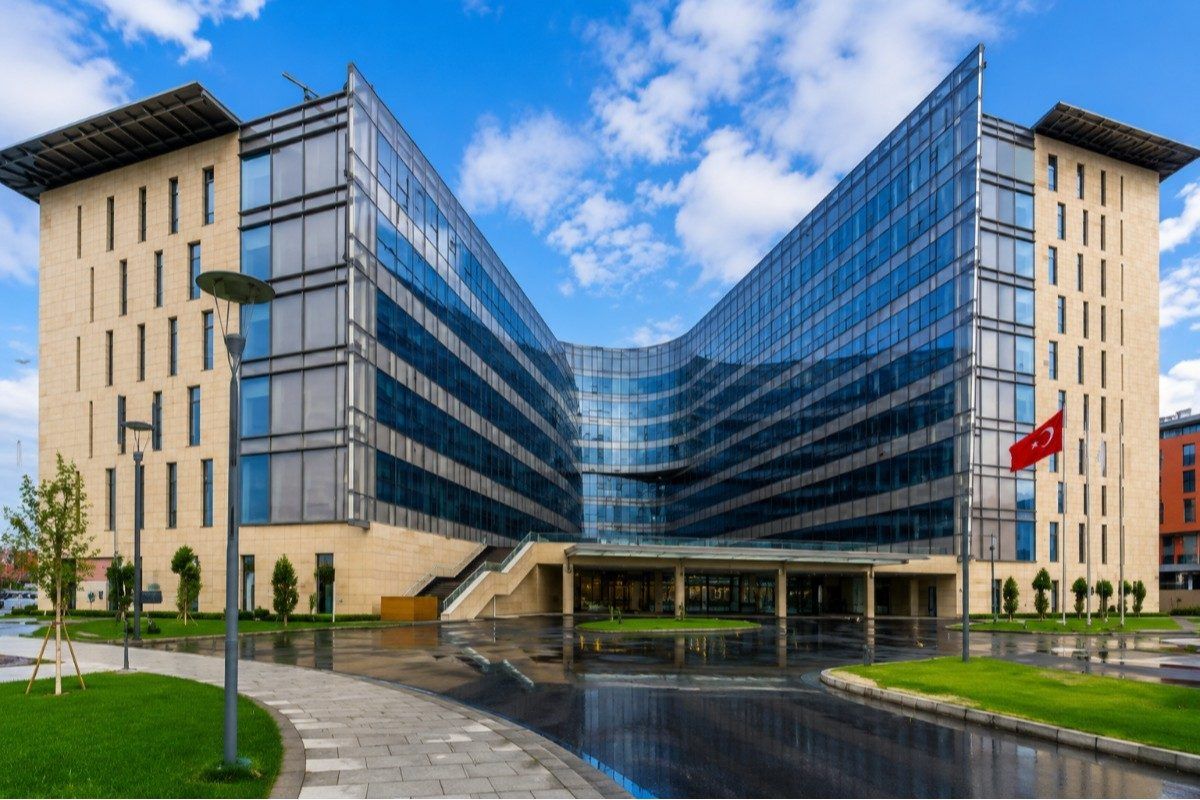
 Turkey | Est. 1993
Turkey | Turkey's Higher Education Council (YÖK); member of the European University Association (EUA) | English, with over 96% of all university classes taught in this language medium
Expert will call you within 2 hours
People mostly just call it KU for short. It is genuinely one of the youngest major universities covered in guides like this one, founded in 1993 by the Vehbi Koç Foundation, and it carries a specific, notable distinction. It is the first university in Turkey to bear a person's own last name. So, unlike centuries-old Turkish public universities with layered institutional histories, KU's identity traces to a single, deliberate act of philanthropic founding by one of Turkey's most prominent business families.
Here is a fact most guides skip entirely. KU did not start on its current, now well-known campus at all. It began providing instruction in temporary buildings in İstinye in 1993, before relocating to its current Rumeli Feneri campus, near Sarıyer on Istanbul's European side, in 2000. So, applicants researching KU's earliest history should understand its current, purpose-built campus is itself a later development, not the university's original home.
The School of Medicine specifically is a considerably more recent addition still, established in 2013, two decades after the wider university's own 1993 founding, with a stated aim of meeting the changing social needs created by technical and medical advances in the health system. KU today comprises Colleges of Social Sciences and Humanities, Administrative Sciences and Economics, Science, Engineering, Law, Nursing, and Medicine, offering 22 undergraduate, 31 graduate, and 16 PhD programmes to a student body of roughly 5,500, of whom around 6 percent are international students according to one detailed source.
A genuinely distinctive structural feature is KU's language of instruction. Over 96 percent of all classes are taught in English, with the only real exceptions found in the School of Law and School of Nursing. So, this university's English-medium commitment runs deeper and more consistently than at most comparable Turkish institutions. KU has climbed steadily in international rankings since its founding, at one point reported as ranked first in Turkey by both the Times Higher Education World University Rankings and QS World University Rankings in 2021, though rankings shift year to year and should be checked for the most current standing.
KU's Rumeli Feneri campus sits near Sarıyer, on Istanbul's European side, offering students modern facilities, a genuinely active range of student clubs and sports activities, and a self-contained, purpose-built campus environment distinct from the older, more urban campuses used by some of Istanbul's public universities. Clinical training runs through Koç University Hospital, the university's own affiliated teaching hospital, giving students a genuinely integrated relationship between their medical school and their primary clinical training site.
KU's MD Medicine programme runs six years, the standard length across Turkish medical education, leading to a Physician qualification equivalent to an MD or MBBS, taught entirely in English. Admission requirements for international applicants generally include standardised test scores, depending on the specific programme, English proficiency test results such as TOEFL or IELTS, academic transcripts, letters of recommendation, and a statement of purpose, with Medicine specifically likely to carry additional, programme-specific requirements beyond this general baseline.
Here is genuinely the most important, specific point worth understanding clearly before applying. KU's own materials strongly encourage most international undergraduate applicants to also apply to Turkey's national Türkiye Bursları, or Turkish Scholarships, programme, which offers 100 percent tuition waivers alongside dormitory accommodation, a monthly stipend, flights, and other benefits considerably more generous than KU's own merit-based scholarships for international students. However, this national scholarship programme specifically excludes Medicine and Law applicants. So, prospective Medicine students at KU cannot access this particular funding route, and instead must rely on KU's own comparatively less generous merit-based scholarship options.
NEET remains a genuine requirement for Indian applicants here, exactly as it does for most other MBBS-style destinations covered in guides like this one, and Indian graduates would still need to clear the FMGE or NExT exam to practise medicine back in India.
Independent sources also describe Koç as charging the highest tuition of any university in Turkey overall, a claim genuinely consistent with the confirmed USD 59,000 official Medicine rate. This is worth understanding clearly before applying, since it means Koç sits at a genuinely different price point from Turkey's public universities, several of which charge only a few thousand dollars a year for comparable Medicine programmes. The trade-off for this considerably higher cost is a genuinely small, close-knit student community, near-total English-medium instruction, and a purpose-built campus with modern facilities throughout, features that appeal strongly to some applicants and their families, even at this considerably higher price.
Istanbul's own scale and international connectivity also work in Koç's favour, since the city offers genuinely easy flight access from around the world, alongside a huge, culturally rich urban environment students can explore during their time away from the more self-contained Rumeli Feneri campus itself. Students at Koç genuinely benefit from this combination, a small, close, English-medium campus community set within one of the world's largest and most historically significant cities, a genuinely distinctive pairing not every university, in Turkey or elsewhere, can offer at this same scale.
KU genuinely publishes its own official, current international fee rate, a real point of confidence compared to universities where only third-party estimates exist. The figures below reflect this official rate, alongside older reported estimates for comparison.
Cost Item | Amount | Notes |
Tuition Fee (MD Medicine, official, 2025/26) | USD 59,000/year (TRY 2,520,000) | Confirmed directly on Koç University's own official 2025-2026 international fee page |
Total Tuition (6 years, based on above rate) | Approx. USD 354,000 | Estimate based on the current official rate held stable; actual costs will vary annually |
Tuition Fee (older reported estimates, for comparison) | Approx. USD 29,500-32,400/year | Reported by older third-party sources; the current official rate is considerably higher |
Turkish Scholarships Programme | Not available for Medicine or Law | This 100% tuition-waiver national scholarship specifically excludes these two fields |
Koç University's Own Merit Scholarships | Available, but less generous | The primary funding route available for Medicine applicants specifically |
Total 6-Year Estimate (Official Rate) | — | Approx. USD 354,000, tuition only, at the current 2025/26 official rate |
Note: no capitation fee and no donation is asked at any stage. This is genuinely one of the most expensive medical degrees covered in comparable Turkish university guides, reflecting Koç's private, foundation-university status.
Most lists mention Koç as just another private Turkish university. However, they do not explain how precisely its fee is documented, or how the country's biggest scholarship programme genuinely excludes Medicine. The reason is simple. It is about real transparency, and a real, important exclusion.
Koç is not like most other Turkish universities when it comes to fee transparency. In fact, it publishes its own current official rate directly, USD 59,000 for 2025/26, on its own International Student Recruitment page. Furthermore, this confirms a genuine, documented increase from the equivalent 2023-2024 rate of USD 38,700. As a result, applicants get a real, verified, currently confirmed figure here, rather than a guess pieced together from unrelated sources. Graduates prove this investment is real by training within one of Turkey's most highly ranked private universities.
The Turkish Scholarships exclusion also matters more than most guides let on. For example, many guides describing Turkish Scholarships opportunities present them as broadly available to international applicants. Koç's own materials are specific and direct here. This generous national scholarship programme explicitly excludes Medicine and Law. Moreover, this removes what would otherwise be the single most valuable funding route available to international applicants at this university.
One thing most other blogs miss is just how sharply Koç's own fees have risen recently. In addition to the already high current rate, the university's own fee climbed by more than USD 5,000 a year in just two admission cycles. Since this trend appears genuine and ongoing, applicants should plan for continued increases in future intakes too, not assume the current rate will hold steady.
No hidden charges, no donation. The full picture of costs at MBBS in Koc University School of Medicine.
Tuition Fee
USD 59,000
USD 59,000 PER YEAR
Hostel Fee
$3,916 to $12,673 per year
$3,916 to $12,673 per year
Food & Meals
$250 and $350 USD
per month
Insurance
$15 to $120 USD
per year
Donation
no donation
no hidden fee
Total Estimated Cost
Approx. USD 354,000
6 year
25–35%
Average FMGE first-attempt pass rates for students from many overseas medical universities. Students from structured programs consistently score higher.
Students returning to India need to clear the FMGE/NExT exam. MBBS in Koc University School of Medicine integrates exam-oriented coaching into the regular curriculum so students are prepared from day one.
A structured program that takes you from foundational sciences to clinical mastery.
● In addition, this stage benefits from the university's genuinely modern, purpose-built Rumeli Feneri campus facilities
● First, Anatomy, Physiology, and Biochemistry are taught entirely in English, consistent with KU's near-total English-medium model
● Furthermore, students benefit from a genuinely research-intensive teaching environment
● Next, Pathology, Microbiology, and Pharmacology are designed specifically for the changing demands of 21st-century healthcare
● Moreover, students benefit from a genuinely integrated relationship between the medical school and its own teaching hospital
● Then, Medicine, Surgery, and allied clinical subjects run through hands-on training at Koç University Hospital
● Also, Indian graduates would still need to clear the FMGE or NExT exam to practise medicine in India
● Finally, graduates receive a Physician qualification, equivalent to an MD or MBBS
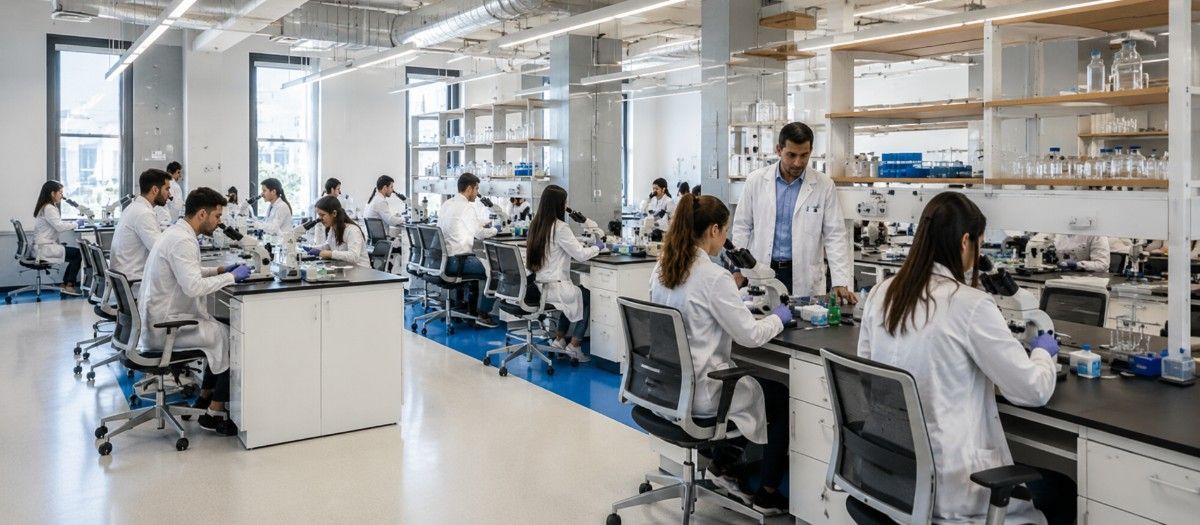
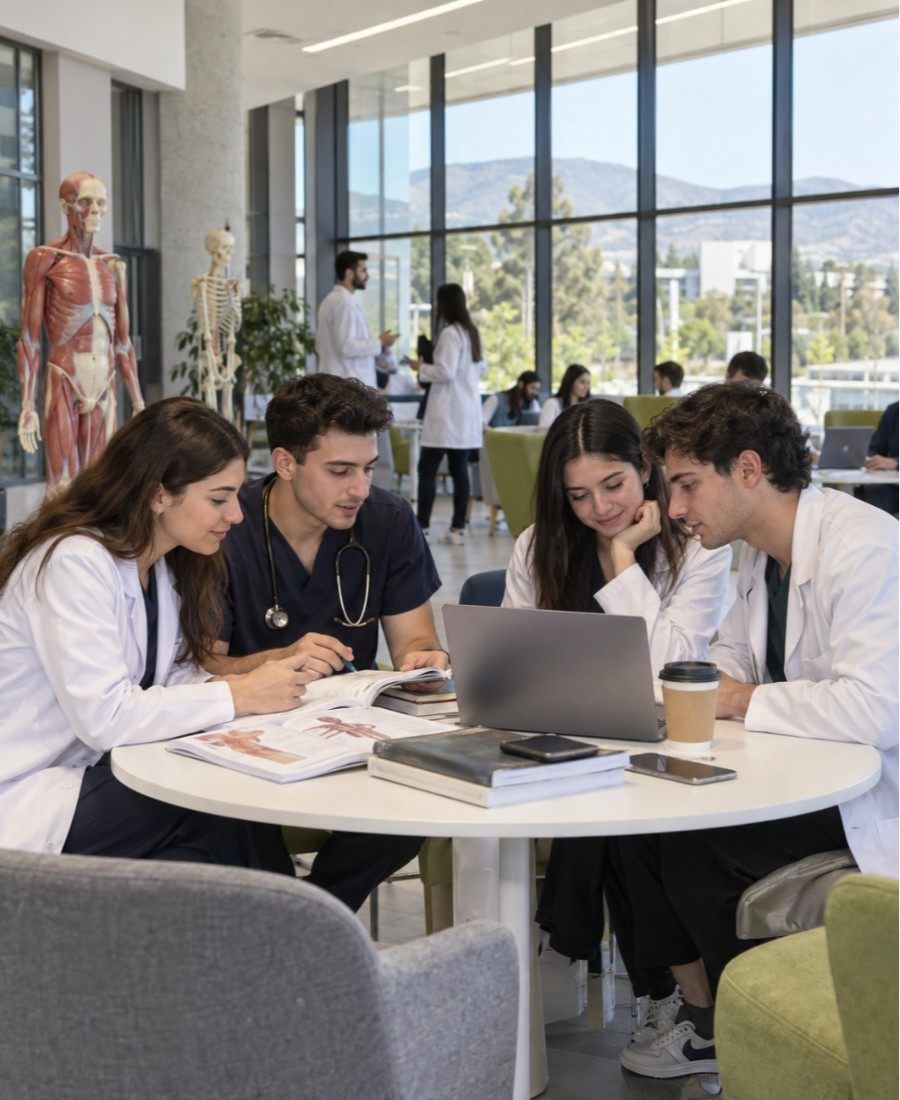
Furnished hostel rooms with Wi-Fi, laundry, 24/7 security, and Indian mess on or near campus.
Indian restaurants and mess facilities serving vegetarian and non-vegetarian home-style food daily.
Strong Indian community with cultural events, festival celebrations, and peer support groups.
Students get hands-on clinical training in government and private hospitals affiliated with the university.
Practical information for students planning to study at MBBS in Koc University School of Medicine.
Prepare for all seasons. Thermal wear for winters, light clothing for summers. University provides heating in hostels.
Student visa processed with university invitation letter. Direct and connecting flights from major Indian cities.
Health insurance included in fees. Medical facility on campus plus city hospitals easily accessible.
Local SIM cards available. WhatsApp and video calls keep you connected with family back home.
Average monthly expenses of $150–$250 covering food, transport, and personal needs.
University library, online databases, and study groups. Seniors mentor juniors through academic challenges.
Our team guides you through every step — from application to arriving on campus.
Share your NEET score, academic record, and budget. Our Turkey specialist provides an honest assessment comparing Turkey with Georgia, Armenia, and Russia and, within Turkey, identifies the right university based on NMC recognition status, clinical quality, preferred city, and total cost. NMC status verification is the first step for every Turkey recommendation.
AMW submits your application to the selected university with all required documents. Most Turkish private medical universities for English-medium programmes do not require a separate university entrance exam beyond NEET, though some require YÖS. AMW advises on this for each specific university. Offer letters are typically issued within 2–4 weeks.
AMW assists with your Turkish student visa application a straightforward process for Indian nationals. Required documents include a university acceptance letter, financial means documentation, health insurance, and a biometric appointment at the Turkish Embassy in India. Processing typically takes 3–6 weeks.
AMW coordinates travel planning and arranges airport pickup in Istanbul or Ankara. Our local Turkey representative handles hostel check-in, university registration, and city orientation. Support continues throughout the first month.
Admission Helpline — Contact our counsellors for step-by-step assistance.
“The faculty here is incredibly supportive. The clinical training during hospital rotations has given me real confidence in patient care.”
“Affordable fees without compromising on quality. The campus facilities and hostel life made my transition abroad very smooth.”
“English medium instruction and WHO-recognized curriculum were the deciding factors for me. No regrets so far — excellent experience overall.”
“The university helped with everything from visa to accommodation. Hospital exposure from year three has been invaluable for my FMGE prep.”
“Just cleared my licensing exam on the first attempt. The structured coaching and mock exams during final year were a game-changer.”
“Safe campus, good food options, and a strong Indian student community. The teaching methodology is very practical and hands-on.”
Yes. Koç is genuinely open to international applicants. NEET is required for Indian applicants.
Yes, a valid, qualifying NEET score is required for Indian applicants under NMC guidelines.
USD 59,000 a year for Fall 2025/2026 admits, officially confirmed on Koç University's own recruitment page, totalling approximately USD 354,000 across the full six years.
Yes, genuinely: the 2023-2024 official rate was USD 38,700, rising to USD 59,000 for 2025-2026.
No, the Türkiye Bursları (Turkish Scholarships) programme, offering 100% tuition waivers, specifically excludes Medicine and Law applicants.
Koç University Hospital, the university's own affiliated teaching hospital in Istanbul.
It runs six years, the standard length across Turkish medical education.
Yes, over 96% of all classes at Koç University, including Medicine, are taught in English.
It is the first university in Turkey to bear a person's own last name, founded by the Vehbi Koç Foundation.
It was reported as ranked 1st in Turkey by both the Times Higher Education and QS World University Rankings in 2021; current standings should be checked directly.
Our expert counsellors will guide you through the complete admission process — from documents to airport pickup.