
Q1. When was Tajik National University's Faculty of Medicine established?
+The wider university was founded on 21 March 1947; the Faculty of Medicine itself only began imparting medical education in 2012, a genuine 65-year gap.

 Tajikistan | Est. 1947
Tajikistan | Tajikistan's Ministry of Education; recognised by NMC (India), WHO, and WFME, per multiple sources | English medium
Expert will call you within 2 hours
People mostly just call it TNU for short. It was founded on 21 March 1947, in Dushanbe, established shortly after the Second World War specifically to meet a growing demand for highly educated professionals within the newly formed Tajik Soviet Socialist Republic. So, this university's own founding is tied to a specific, dated post-war moment in Central Asian history, not an arbitrary institutional creation.
Here is a fact most guides skip entirely, and it is genuinely important to understand clearly before applying. TNU is the largest university and the only national university anywhere in Tajikistan, a genuinely specific, verifiable institutional status rather than a general claim of prestige. However, the Faculty of Medicine's own history is considerably more recent than the wider university's 1947 founding. One detailed source specifically states the medical faculty only began imparting medical education in 2012, a genuine 65-year gap between the university's own founding and its medical faculty's own start. So, applicants should understand TNU's own deep institutional age and its medical faculty's own, considerably more recent founding as two separate facts.
TNU carries the Tajik name Donishgoҳi Milli Tojikiston, and operates under the motto "To learn, To Educate, To Enlighten." The university is affiliated with the International Association of Universities, IAU, the European University Association, EUA, and the World Health Organisation, WHO. TNU's current rector is Professor Nasriddinzoda Emomali Sayfiddin, a doctor of law, and the university's notable alumni include Murodali Alimardon, the former chairman of Tajikistan's own National Bank.
TNU's main campus sits near the Vatan cinema on Dushanbe's Rudaki Avenue, at Rudaki str. 17, spanning roughly 49 hectares, or about 121 acres, of urban campus space. The university teaches more than 22,661 students in total, supported by 2,299 academic staff and around 3,200 doctoral students, genuinely substantial figures for a single national university. TNU consistently holds the top national ranking within Tajikistan, though its global standing is reported somewhat differently across sources, at approximately 6,193rd globally by one ranking system and 7,992nd by another, a modest global position worth knowing honestly.
The Faculty of Medicine specifically comprises 19 departments, including Obstetrics and Gynaecology, Microbiology and Virology, Fundamentals of Medical Training and Life Safety, Morphology, and Therapeutic Dentistry, giving students access to a genuinely broad, specialised departmental structure within the medical faculty itself. More than 23,000 students are reported to be enrolled specifically within the Faculty of Medicine, a genuinely large cohort for a single faculty.
TNU's MBBS programme runs six years, comprising five years of academic study plus a compulsory one-year clinical internship, taught in English for international students, alongside Tajik and Russian used more broadly across the wider university. Admission requires completion of 10+2 with a minimum of 50 percent marks in PCB subjects for general-category applicants, or 40 percent for reserved categories, a qualifying NEET-UG score within the current or previous two years per NMC guidelines, and a minimum age of 17 by 31 December of the admission year, with no upper age limit.
NEET remains a genuine requirement for Indian applicants here, exactly as it does for MBBS study in most other countries, and Indian graduates would still need to clear the FMGE or NExT exam to practise medicine back in India.
Dushanbe itself, as Tajikistan's capital and largest city, offers TNU's students genuine access to the country's most developed infrastructure, alongside a genuinely rich cultural and historical setting quite different from studying at a smaller, more provincial university elsewhere in the country. Students benefit from TNU's central location within the city, close to major government institutions, businesses, and cultural landmarks, giving medical students real, practical exposure to the same urban environment where many of the country's leading healthcare institutions and government health bodies are also based.
TNU's own genuinely broad, multi-disciplinary character, spanning natural sciences, humanities, social sciences, and medicine all within one institution, gives medical students real opportunities to interact with a genuinely diverse student body studying entirely different fields, not just fellow medical students alone. This breadth, combined with the university's own status as Tajikistan's sole national university and its well-reconciled, genuinely transparent fee reporting, gives TNU a distinctive institutional character worth understanding fully before applying.
Fee figures here are reported with genuine consistency, and reconcile reasonably well across sources once the annual rate is compared against the reported total programme cost.
Cost Item | Amount | Notes |
Tuition Fee (reported) | USD 4,500/year | Reported by a detailed source specifically for the Faculty of Medicine |
Hostel Fee (reported) | USD 500/year | Reported by the same detailed source |
Total Tuition (6 years, based on above rate) | Approx. USD 27,000 | Estimate based on the reported annual rate held stable across the programme |
Total MBBS Programme Cost (alternate reported estimate) | USD 25,000-35,000 | Reported by a separate source as an all-inclusive total; broadly consistent with the annual rate above |
General Tajikistan Tuition Range (for context) | USD 3,000-5,000/year | A broader reference range reported for Tajikistan's medical universities generally |
Total 6-Year Estimate | — | Approx. USD 25,000-35,000, tuition and hostel combined; confirm current, exact figures directly |
Note: no capitation fee is confirmed at any stage. Confirm the university's own current, exact fee schedule directly before finalising a budget.
Most lists mention TNU as just another Tajikistan medical option. However, they do not explain its genuine status as the country's only national university, or the real gap between its own founding and its medical faculty's start. The reason is simple. It is about a specific, verifiable national distinction, and a genuine founding-order surprise.
TNU is not like most other Tajikistan universities when it comes to its own institutional status. In fact, it is genuinely the largest university and the only national university anywhere in the country. Furthermore, this is a specific, verifiable status, not a general claim of prestige. As a result, applicants get a genuinely more significant national institutional standing here than at most comparable Tajikistan medical schools.
The founding-order gap also matters more than most guides let on. For example, most rival pages assume a faculty's founding date matches its wider university's own founding. TNU's own Faculty of Medicine genuinely only began imparting medical education in 2012, a full 65 years after the wider university's own 1947 founding. Moreover, this faculty's own medical teaching tradition has a real, separately documented, considerably more recent origin story worth knowing distinctly.
One thing most other blogs miss is how well TNU's own reported fee figures actually reconcile once compared carefully. In addition to the specific USD 4,500 annual tuition figure, a separate source reports an all-inclusive six-year total of USD 25,000 to 35,000. Since these figures broadly agree once multiplied out across six years, applicants get a genuinely more reliable, cross-checked cost picture here than at some comparable universities with wildly conflicting figures.
No hidden charges, no donation. The full picture of costs at MBBS in Tajik National University Faculty of Medicine.
Tuition Fee
USD 4,500/year, plus USD 500/year
USD 4,500/year, approx. USD 27,000
Hostel Fee
USD 500/year
USD 500/year
Food & Meals
$100 to $150 (approx. ₹8,200 to ₹12,400) per month
per month
Insurance
approximately $100 to $200 USD per year (roughly ₹8,000 to ₹17,000 INR)
per year
Donation
No Donation
No Hideen fees
Total Estimated Cost
₹30 lakh to ₹35 lakh (approx. $25,000 to $30,000 USD)
6-year
25–35%
Average FMGE first-attempt pass rates for students from many overseas medical universities. Students from structured programs consistently score higher.
Students returning to India need to clear the FMGE/NExT exam. MBBS in Tajik National University Faculty of Medicine integrates exam-oriented coaching into the regular curriculum so students are prepared from day one.
A structured program that takes you from foundational sciences to clinical mastery.
● In addition, this stage draws on TNU's own well-equipped laboratories and library facilities
● First, Anatomy, Physiology, and Biochemistry build the pre-clinical base for the whole course
● Furthermore, this stage draws on the Faculty of Medicine's own 19 specialised departments
● Next, Microbiology and Virology, alongside Pharmacology, build the diagnostic foundation needed for clinical training
● Moreover, students benefit from Tajikistan's own multicultural environment, offering exposure to diverse medical cases
● Then, Medicine, Surgery, Obstetrics and Gynaecology, and allied clinical subjects run through hands-on hospital-based training
● Also, graduates can appear for licensing exams including FMGE (India), USMLE (USA), and PLAB (UK)
● Finally, a one-year internship follows the five years of academic study, matching the standard structure used across Tajikistan
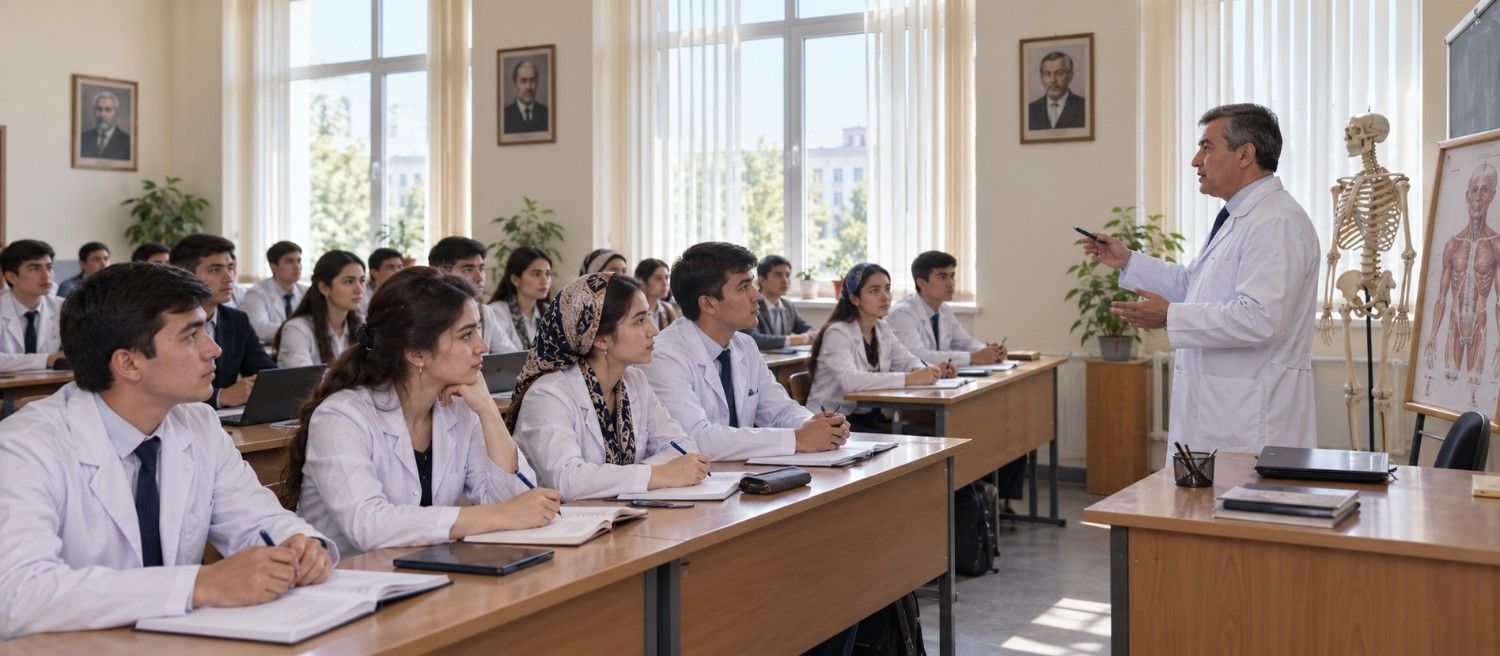
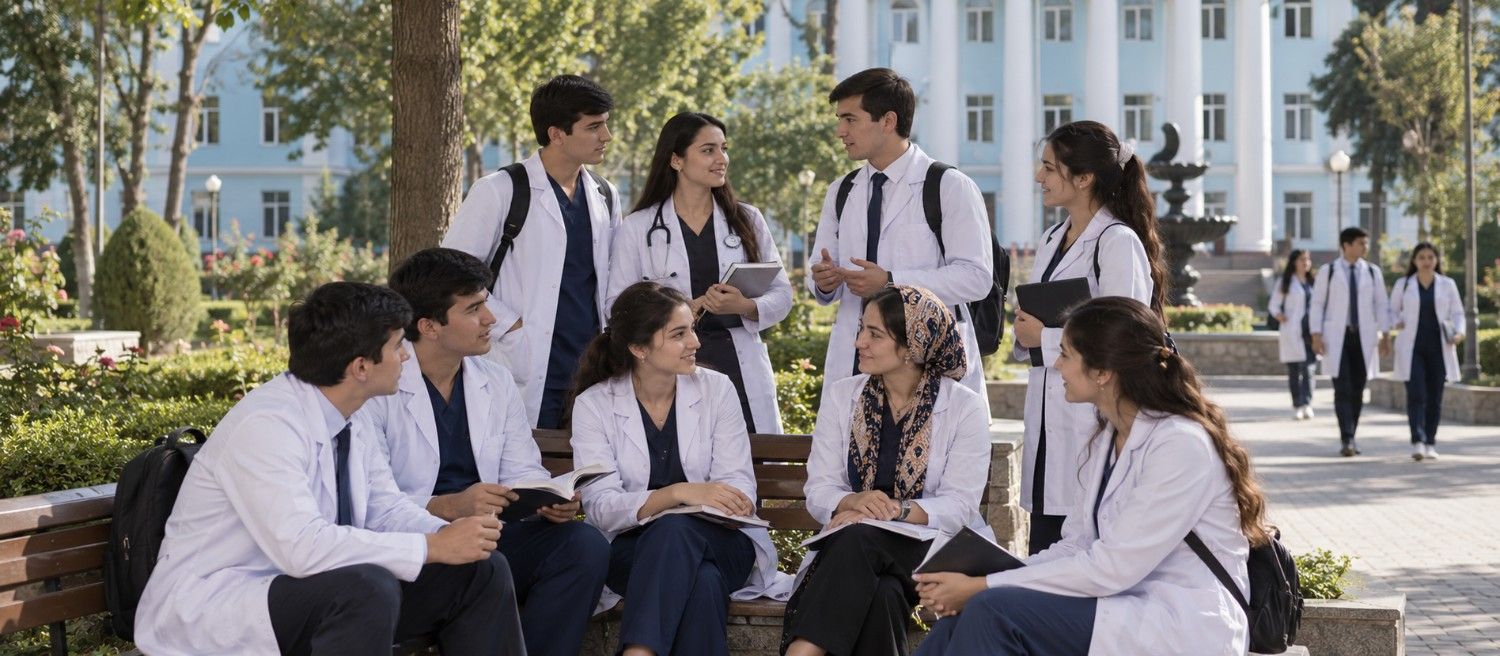
Furnished hostel rooms with Wi-Fi, laundry, 24/7 security, and Indian mess on or near campus.
Indian restaurants and mess facilities serving vegetarian and non-vegetarian home-style food daily.
Strong Indian community with cultural events, festival celebrations, and peer support groups.
Students get hands-on clinical training in government and private hospitals affiliated with the university.
Practical information for students planning to study at MBBS in Tajik National University Faculty of Medicine.
Prepare for all seasons. Thermal wear for winters, light clothing for summers. University provides heating in hostels.
Student visa processed with university invitation letter. Direct and connecting flights from major Indian cities.
Health insurance included in fees. Medical facility on campus plus city hospitals easily accessible.
Local SIM cards available. WhatsApp and video calls keep you connected with family back home.
Average monthly expenses of $150–$250 covering food, transport, and personal needs.
University library, online databases, and study groups. Seniors mentor juniors through academic challenges.
Our team guides you through every step — from application to arriving on campus.
Compare universities on fees, WDOMS status, hostel quality, and clinical exposure, not just the cheapest tuition on the page.
Submit the application along with 10+2 mark sheets and the NEET scorecard to the university, either directly or through an authorized admission partner.
The university's admissions office verifies your academic and identity documents.
Once the documents and initial fees are approved, the university issues the offer and subsequently the official invitation letter required for your visa.
Pay the initial or seat-confirmation fee to lock in your admission.
Apply for the student visa at the Embassy of Tajikistan or via the e-visa system; realistic processing time is 4–6 working days for standard cases.
Book your flight to Dushanbe. Somon Air's direct Delhi-Dushanbe route takes roughly 2.5 hours; book early given limited weekly frequency.
In the final weeks, finalize documents, pack proper winter clothing, arrange currency exchange (INR to TJS), and confirm hostel allotment in writing.
Complete university registration and on-arrival migration registration within the stipulated window; the university typically organizes this during orientation week.
Attend orientation, get your class schedule and hostel assignment, and begin building your routine around classes, meals, and the local Indian student community.
Admission Helpline — Contact our counsellors for step-by-step assistance.
“The faculty here is incredibly supportive. The clinical training during hospital rotations has given me real confidence in patient care.”
“Affordable fees without compromising on quality. The campus facilities and hostel life made my transition abroad very smooth.”
“English medium instruction and WHO-recognized curriculum were the deciding factors for me. No regrets so far — excellent experience overall.”
“The university helped with everything from visa to accommodation. Hospital exposure from year three has been invaluable for my FMGE prep.”
“Just cleared my licensing exam on the first attempt. The structured coaching and mock exams during final year were a game-changer.”
“Safe campus, good food options, and a strong Indian student community. The teaching methodology is very practical and hands-on.”
The wider university was founded on 21 March 1947; the Faculty of Medicine itself only began imparting medical education in 2012, a genuine 65-year gap.
Yes, it is genuinely the largest university and the only national university anywhere in Tajikistan, a specific, verifiable institutional status.
It runs six years: five years of academic study plus a compulsory one-year clinical internship.
Yes, English is used for international students, alongside Tajik and Russian used more broadly across the wider university.
Yes, a valid, qualifying NEET-UG score, within the current or previous 2 years, is required as per NMC guidelines.
Reported at approximately USD 4,500 a year plus a USD 500 hostel fee, totalling roughly USD 25,000 to 35,000 for the full six-year programme, per two broadly consistent sources.
Clinical training runs through hospital-based rotations, with students gaining exposure across Tajikistan's own multicultural patient population.
19 departments, including Obstetrics and Gynaecology, Microbiology and Virology, Morphology, and Therapeutic Dentistry.
Near the Vatan cinema on Dushanbe's Rudaki Avenue, at Rudaki str. 17, Tajikistan's capital city.
1st nationally within Tajikistan, with a reported global standing of approximately 6,193rd to 7,992nd, depending on the ranking system used.


Our expert counsellors will guide you through the complete admission process — from documents to airport pickup.