
Q1. When was Copenhagen's medical teaching founded?
+Medicine has been taught since the University of Copenhagen was founded in 1479; the current faculty structure dates from 2012.

 Denmark | Est. 1479
Denmark | A public faculty under Danish higher education law. Graduates who complete the cand.med. degree and the required clinical basic training (KBU) receive Autorisation, Denmark's licence to practise medicine, granted by the Danish Patient Safety Authority. | Danish runs through nearly all of the medical bachelor's and master's programme. A certified, strong level of Danish is medium
Expert will call you within 2 hours
Most people just call it KU, or the Copenhagen medical faculty. Its story is tied to the story of Denmark's oldest university itself. The University of Copenhagen was founded in 1479 under King Christian I, with papal approval, making it one of the oldest universities in Northern Europe still running today. Medicine was one of the original four faculties from day one, alongside Theology, Law, and Philosophy, so this faculty's roots go back well over five centuries.
Here is a fact most guides skip entirely. The faculty as it exists now, under the name Faculty of Health and Medical Sciences, is actually a fairly recent creation. In 1992, the old Faculty of Medicine merged with the Copenhagen School of Dentistry to form the Faculty of Health Sciences. Then in January 2012, that faculty absorbed the Faculty of Pharmaceutical Sciences and the veterinary arm of the Faculty of Life Sciences, and the combined body took its current name. So the medical teaching tradition is centuries old, but the administrative shell around it is only a few decades old.
Another detail worth knowing. This is one of the largest health and medical faculties in Europe by student numbers, running programmes not just in medicine but also dentistry, pharmacy, veterinary science, and public health, all under one faculty structure. That breadth is unusual compared with most single-purpose medical schools.
This is a public university, funded by the Danish state, sitting in the heart of Copenhagen, the country's capital. Clinical training runs mainly through Rigshospitalet, Denmark's largest hospital and a major Nordic referral centre, along with several other hospitals across the Capital Region, including Bispebjerg and Herlev.
The faculty's main teaching site is the Panum Building, on Blegdamsvej in central Copenhagen, close to Rigshospitalet itself, making the walk from lecture hall to hospital ward a short one. A newer landmark, the Maersk Tower, sits alongside it and houses much of the faculty's modern research space. Other parts of the wider faculty, particularly veterinary and some pharmaceutical teaching, sit on the Frederiksberg and Taastrup campuses, a bit further from the city centre.
Copenhagen itself is a compact, famously liveable capital, consistently ranked among the world's safest and happiest cities, with a strong cycling culture and an efficient, round-the-clock metro system.
Here is where this page needs to be direct with you. Medicine at Copenhagen is not an MBBS degree. It runs as a Bachelor of Science in Medicine, three years, followed by a Master's stage leading to the cand.med. degree, another three years. Six years total, and it is governed by Danish higher education law rather than any Bologna-style MBBS structure.
Teaching for the bachelor's stage runs almost entirely in Danish. A certified, strong level of Danish is expected before you can even apply, since there is no English-language route into the medical degree itself.
Admission does not run through the faculty directly. Places are limited nationwide, and applications go through Denmark's central portal, optagelse.dk. Two routes exist: Kvote 1, based purely on grade point average from a qualifying exam, and Kvote 2, which weighs other criteria such as work experience or supplementary tests. So getting a seat depends on a national quota system, not a single faculty's own admissions office.
On cost, there is genuinely good news for EU, EEA, and Swiss citizens. Denmark charges no tuition fees at its public universities for these students, and unlike some neighbouring countries, there is no separate semester contribution either. Non-EU/EEA students face tuition, though in practice the Danish-only bachelor's medical route is rarely a realistic option without an existing right of residence or a Danish-language qualifying exam.
Parameter | Details |
Founded | University founded 1479; medicine among the original faculties; current faculty name and structure formed in 2012 |
Institution Type | Public university, funded by the Danish state |
Location | Copenhagen (Panum Building, North Campus), with additional sites at Frederiksberg and Taastrup |
Bachelor of Science in Medicine + cand.med. (Candidatus Medicinae) | |
Duration | 3-year Bachelor's + 3-year Master's, 6 years total |
Medium of Instruction | Danish for the medical bachelor's and master's programme; certified strong Danish is required |
Centrally managed nationwide through optagelse.dk, via Kvote 1 or Kvote 2 | |
Teaching Hospital | Rigshospitalet, alongside Bispebjerg, Herlev, and other Capital Region hospitals |
Fee Component | Amount | Notes |
Tuition Fee (EU/EEA/Swiss) | None | Denmark charges no tuition for these students at public universities |
Tuition Fee (Non-EU/EEA) | Approx. EUR 14,000 to 17,000 per year | Applies mainly to eligible programmes; the Danish-taught medical bachelor's is rarely open to this group |
Semester Contribution | None | Unlike some other European systems, Danish public universities do not charge a separate semester fee |
Living Costs (rent) | Approx. EUR 700 to 1,000 per month | Copenhagen is one of the more expensive cities in Europe |
Food and Other Costs | Approx. EUR 300 to 450 per month | Groceries, transport, and leisure |
Health Coverage | No separate monthly premium | Free public healthcare once registered with a Danish CPR number and yellow health card |
Most rival pages never explain this properly. This faculty traces its teaching lineage back to 1479, when medicine was one of the four founding disciplines of the University of Copenhagen itself. Few medical faculties anywhere in Europe can point to a history that long and that continuous.
Many guides assume a faculty's name and structure have stayed fixed for centuries. This one has not. It was reshaped in 1992 through a merger with the dental school, and again in 2012 through a merger with pharmaceutical and veterinary sciences, giving today's faculty a genuinely wide academic footprint that goes well beyond human medicine alone.
Be clear about a few real points here. This is not a fee-paying, English-medium entry point into a medical degree. Danish fluency is required, certified, before you even begin the bachelor's programme. Seats depend on a competitive, nationwide Danish process, not a direct application to this faculty alone. So, who fits here best? Students who already have strong Danish, or a recognised right to study in Denmark on equal terms with Danish citizens, and who are comfortable with a high cost of living in one of Europe's priciest capitals. Students seeking a fast, English-only route into a medical degree should look elsewhere. Still, for those who meet the language and admission bar, Copenhagen offers free tuition, a centuries-old academic tradition, and direct access to one of the Nordic region's largest hospitals.
No hidden charges, no donation. The full picture of costs at MBBS In University of Copenhagen Faculty of Health and Medical Sciences.
Tuition Fee
$19,412
$19,412 per year
Hostel Fee
$5,590 – $9,318
$5,590 – $9,318 per year
Food & Meals
$2,795 – $3,727
per year
Insurance
$372
per year
Donation
Hidden Fees.
Hidden Fees.
Total Estimated Cost
$183,000 – $213,750
total 6 year
25–35%
Average FMGE first-attempt pass rates for students from many overseas medical universities. Students from structured programs consistently score higher.
Students returning to India need to clear the FMGE/NExT exam. MBBS In University of Copenhagen Faculty of Health and Medical Sciences integrates exam-oriented coaching into the regular curriculum so students are prepared from day one.
A structured program that takes you from foundational sciences to clinical mastery.
• Builds toward clinical reasoning before entering the master's stage.
• Covers Anatomy, Physiology, Biochemistry, and Cell Biology as core foundation subjects.
• Training runs largely through Rigshospitalet and partner hospitals in the Capital Region. • Concludes with a research-based master's thesis.
• Covers Internal Medicine, Surgery, Paediatrics, and related clinical specialities.
• Leads to Autorisation, Denmark's medical licence, issued by the Danish Patient Safety Authority.
• A 12-month period of supervised clinical rotations required for full practising rights.
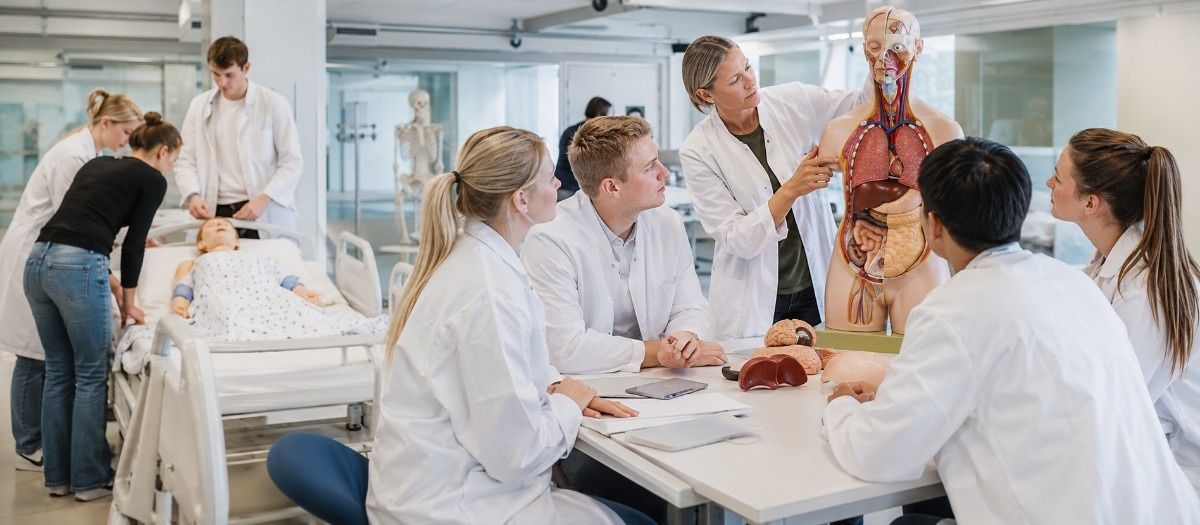
Furnished hostel rooms with Wi-Fi, laundry, 24/7 security, and Indian mess on or near campus.
Indian restaurants and mess facilities serving vegetarian and non-vegetarian home-style food daily.
Strong Indian community with cultural events, festival celebrations, and peer support groups.
Students get hands-on clinical training in government and private hospitals affiliated with the university.
Practical information for students planning to study at MBBS In University of Copenhagen Faculty of Health and Medical Sciences.
Prepare for all seasons. Thermal wear for winters, light clothing for summers. University provides heating in hostels.
Student visa processed with university invitation letter. Direct and connecting flights from major Indian cities.
Health insurance included in fees. Medical facility on campus plus city hospitals easily accessible.
Local SIM cards available. WhatsApp and video calls keep you connected with family back home.
Average monthly expenses of $150–$250 covering food, transport, and personal needs.
University library, online databases, and study groups. Seniors mentor juniors through academic challenges.
Our team guides you through every step — from application to arriving on campus.
Our Denmark specialist assesses academic profile, Danish language status, and career goals. Denmark is not formally recommended without this session.
We connect you with certified Danish language instructors. Preparation typically takes 18–24 months to achieve clinical-level proficiency.
Full Danish admission and residence permit document set prepared — transcripts, financial proof, language certification.
Our team manages your application through Denmark's centralised admissions system and university-specific portals.
: University admission letter is required immediately to begin residence permit application.
We submit the residence permit application to Udlændingestyrelsen (Danish Immigration Service) immediately after admission. Allow 1–3 months.
We advise on the fee structure and safe international transfer to the Danish university account.
Copenhagen or Aarhus orientation, student housing applications, cycling culture, banking, SIM cards, campus navigation
Admission Helpline — Contact our counsellors for step-by-step assistance.
“The faculty here is incredibly supportive. The clinical training during hospital rotations has given me real confidence in patient care.”
“Affordable fees without compromising on quality. The campus facilities and hostel life made my transition abroad very smooth.”
“English medium instruction and WHO-recognized curriculum were the deciding factors for me. No regrets so far — excellent experience overall.”
“The university helped with everything from visa to accommodation. Hospital exposure from year three has been invaluable for my FMGE prep.”
“Just cleared my licensing exam on the first attempt. The structured coaching and mock exams during final year were a game-changer.”
“Safe campus, good food options, and a strong Indian student community. The teaching methodology is very practical and hands-on.”
Medicine has been taught since the University of Copenhagen was founded in 1479; the current faculty structure dates from 2012.
A 3-year Bachelor's plus a 3-year Master's (cand.med.), six years in total.
No. The medical bachelor's and master's programme is taught almost entirely in Danish, and certified strong Danish is required beforehand.
No. Seats go through Denmark's centralised admission portal, optagelse.dk.
No tuition applies for EU/EEA/Swiss students, and there is no separate semester fee either.
Graduates receive the cand.med. degree and, after completing KBU, full Autorisation to practise.
Rigshospitalet, along with other hospitals across Copenhagen's Capital Region.
Not automatically. Indian graduates would still need to clear India's usual foreign-degree licensing route, such as NExT.
It is a public faculty, funded by the Danish state.
It combines a medical teaching tradition dating to 1479 with a faculty structure that was rebuilt twice in recent decades, in 1992 and again in 2012, folding in dentistry, pharmacy, and veterinary science along the way.


Our expert counsellors will guide you through the complete admission process — from documents to airport pickup.