The Faculty of Medicine at the University of Ostrava was established in 1993 and became the newest of all Czech Republic medical faculties. It is important to mention this because any promoter of Czech medicine in an international context will first say something about Charles University in Prague (founded 1348) or Masaryk University in Brno (founded 1919). But Ostrava is not like that. It is younger and leaner, with a more specialised faculty, created not as a copy of the Prague-Brno concept but as something new.
The first thing to note is the difference in the number of students. While Charles University Medical Faculty accepts 200+ Czech and another 100+ foreign students annually, the Ostrava faculty accepts only 60-80 students for its entire medicine program. And it is intentional. The faculty has chosen to maintain a 1:18 teacher-student ratio and decided that it is not possible in the case of large classes. You will have to choose between bigger and noisier Prague or Brno, and smaller but more comfortable and intimate Ostrava. In case you prefer the second option, it is worth knowing that there is a possibility to have a good relationship with teachers, small classes, and to be known by the professors.
The Simulation Centre in Ostrava distinguishes this university from other educational institutions. SIMLEK, one of the best simulation centres in the Czech Republic, enables students to practice on full-body manikins, VR systems, and task trainers before seeing a real patient. While some older European faculties still use textbooks and live observation, in Ostrava, the simulation centre is integrated into the curriculum already from the first year of studies. This approach is typical of modern Danish, Dutch and Swiss medical schools, while in some countries education is still based mostly on ward training.
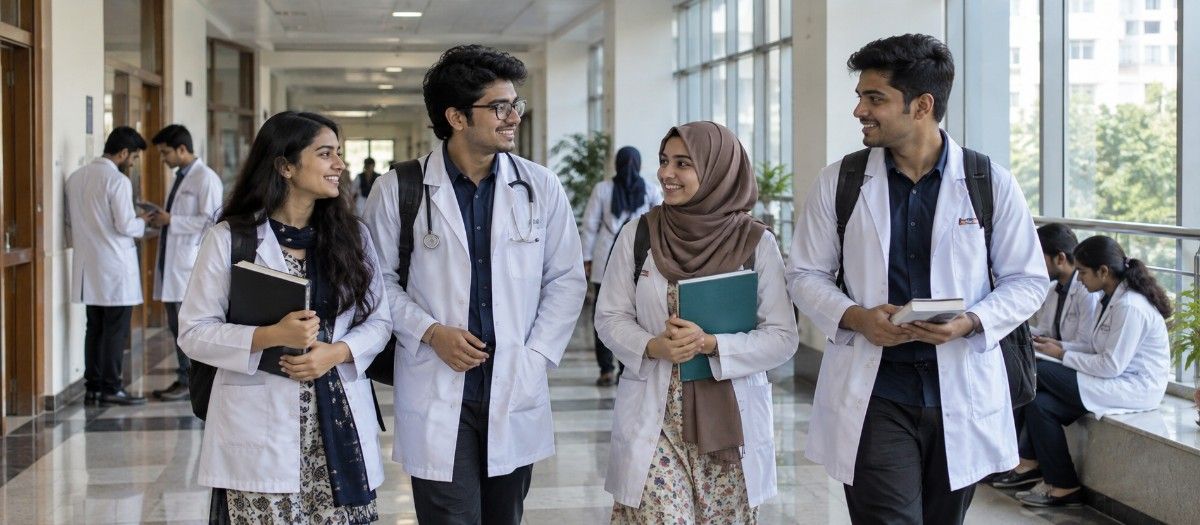
The program is in English. While the Czech medical system operates in Czech and there are national examinations in Czech, the six-year study program at the Ostrava Faculty is entirely in English. It is significant because all local and EU students, as well as Indian, Asian, and African students from around the world, will learn together, and there will be no separate program for international students. It is worth noting that you must learn Czech to practice your skills in the Czech Republic; it is not included in the program.
The University of Ostrava is located in Ostrava, not in Prague or Brno. Ostrava is an industrial city in Moravia that has a real population and is not pretending to be attractive to tourists. Here, rents and food prices are lower, there is less noise than in capital cities and more focus on work. For some people, it is the reason to come to this place. For others, it is a disadvantage. Ostrava is a quieter, more working city than the more lively and colourful Brno.
CLINICAL TRAINING NETWORK includes University Hospital Ostrava, one of the largest regional teaching hospitals with about 1300 beds. This hospital is active, but not too busy, and you will receive responsibilities earlier than in big complexes in Prague, where foreign students often feel like observers. Ostrava offers the opportunity to undertake clinical placements in years 4-6 in medicine, surgery, paediatrics, obstetrics, and psychiatry, with clinical responsibilities.
The cost structure makes this school competitive. Annual tuition is approximately €8,500 to €9,500, which is the average price for an English-taught medicine program in Central Europe. It is cheaper than Austrian and German programs, but more expensive than Polish and Hungarian ones. However, the cost of living in Ostrava is much lower than in Prague and Brno; therefore, your expenses will be lower. The total price for a six-year period, including tuition fees, accommodation, books, and living costs, is €200,000 to €240,000.