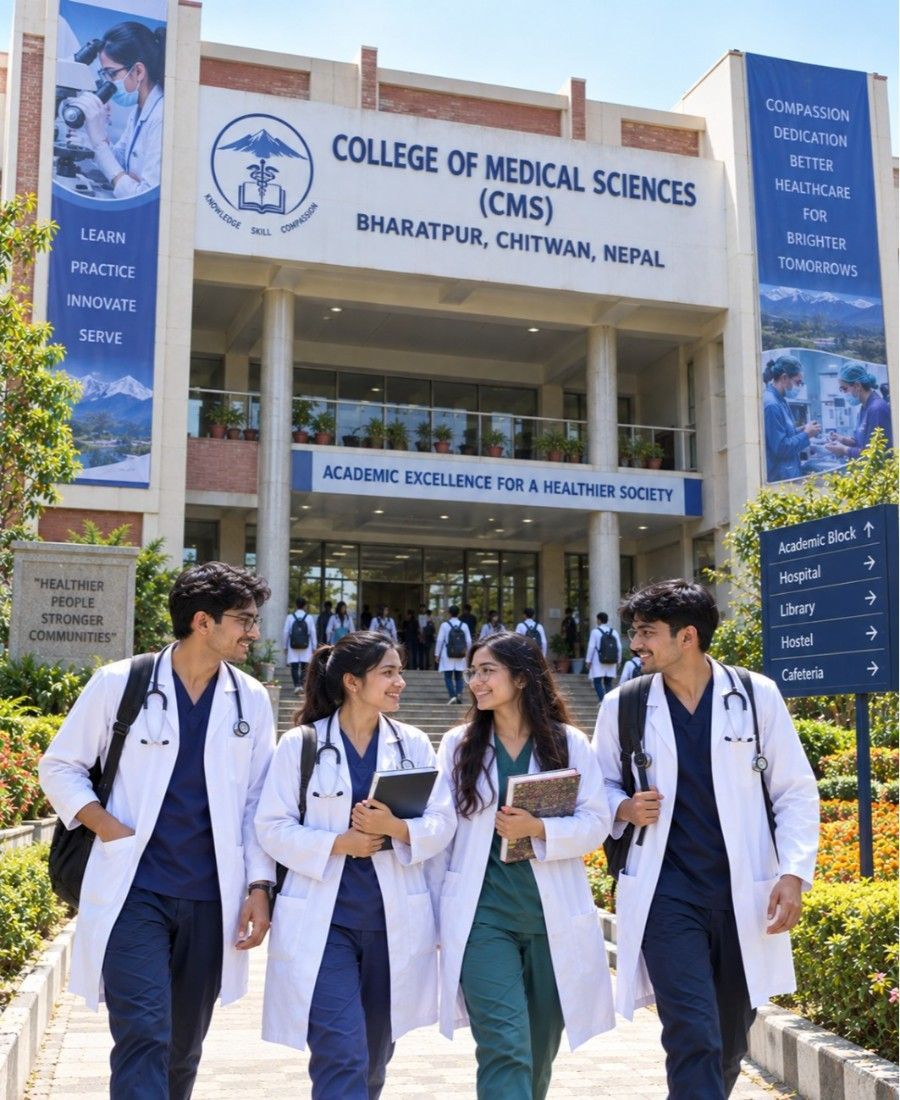
Here is a fact almost no guide mentions about the College of Medical Sciences in Bharatpur. On 11 April 2015, CMS performed the first successful kidney transplantation ever conducted outside the Kathmandu Valley. That is not a statistic about ranking or fees. It is a statement about what kind of hospital this college runs. A 1050-bed tertiary care facility that carries out organ transplants, hosts the largest ICU and OT complex in the Chitwan region, and draws patients from across Central Nepal is not a college-attached ward. It is the primary healthcare anchor for an entire geographic region, and CMS medical students rotate through it.
CMS started in 1993 when the International Society for Medical Education Pvt. Ltd. (ISME Pvt. Ltd.) signed an agreement with the Government of Nepal to build Nepal's first private medical college. The first batch of MBBS students was admitted in 1996. Since then, CMS has been the institution against which all other private medical colleges in Nepal are benchmarked. It was the first private college in Nepal to start all postgraduate MD/MS courses, the first to launch DM and MCh super-speciality programmes (from 2009), and the first to admit 150 students in a single MBBS batch, as recommended by Kathmandu University. These are firsts that came from institutional investment and regulatory confidence, not from marketing claims.
The Kathmandu University affiliation is important to understand properly, because most guides mention it as a credential. KU is Nepal's top ranked private university, and it sets the curriculum standards, examination framework, and faculty qualification requirements that CMS operates under. That means the MBBS degree from CMS is not self-certified; it is externally validated by a university with its own national standing, accreditation processes, and quality oversight of affiliated colleges. For postgraduate admissions in India, external validation by an independent university is a stronger signal than self-accreditation.
The curriculum at CMS uses a horizontally and vertically integrated design with a strong emphasis on Problem-Based Learning (PBL). This is not standard across Nepal's medical colleges. PBL means that instead of passive lectures followed by a final exam, students work through clinical cases in small groups, developing reasoning and diagnostic thinking from Year 2 onwards. The direct result of this for Indian students is that FMGE and NExT preparation is not a separate exercise bolted onto the end of the degree; it is built into the way the curriculum is taught. Students who have been trained to reason through clinical cases rather than memorise lecture notes perform better in reasoning-heavy licensing exams.
Bharatpur is a different kind of MBBS city from Kathmandu. It is Nepal's fourth-largest city, sits on the Mahendra National Highway along the Narayani River, and is connected to India by three major road routes. Gorakhpur in UP is 240 km away. Raxual in Bihar is 126 km. Kakarvitta, the crossing point for students from West Bengal, Sikkim, and the Northeast, gives access from New Jalpaiguri and Siliguri. The Bharatpur domestic airport is a 5-minute walk from the college campus. For students who want to go home frequently or have parents who want to visit, the geography of CMS is more convenient than Kathmandu itself.
The international connections at CMS are also rarely reported. The college has formal liaisons with the Royal College of Physicians of Edinburgh and AFRIMS (Armed Forces Research Institute of Medical Sciences) in Bangkok, Thailand. It collaborates with BP Koirala Institute of Health Sciences in Dharan and BP Koirala Memorial Cancer Hospital. These are not listed for credentialing purposes; they reflect active research and training partnerships that provide CMS faculty and students with access to case material, training protocols, and academic exchange that smaller colleges in Nepal lack.
For Indian students, the most practical advantage of CMS is the combination of things it removes from the decision. No visa is required; Indian citizens enter Nepal freely. There is no language barrier; English is the medium of instruction, and Hindi is widely understood throughout Bharatpur. There is no cultural dislocation. Festivals, food, and family dynamics are close enough to northern India that the adjustment period is minimal. And there is no question about degree recognition. GMC UK, NMC India, Nepal Medical Council, WHO, and FAIMER all recognise the CMS degree. What you are choosing is a medical college, not an overseas adventure, and CMS is the most established private option in Nepal for making that choice straightforward.