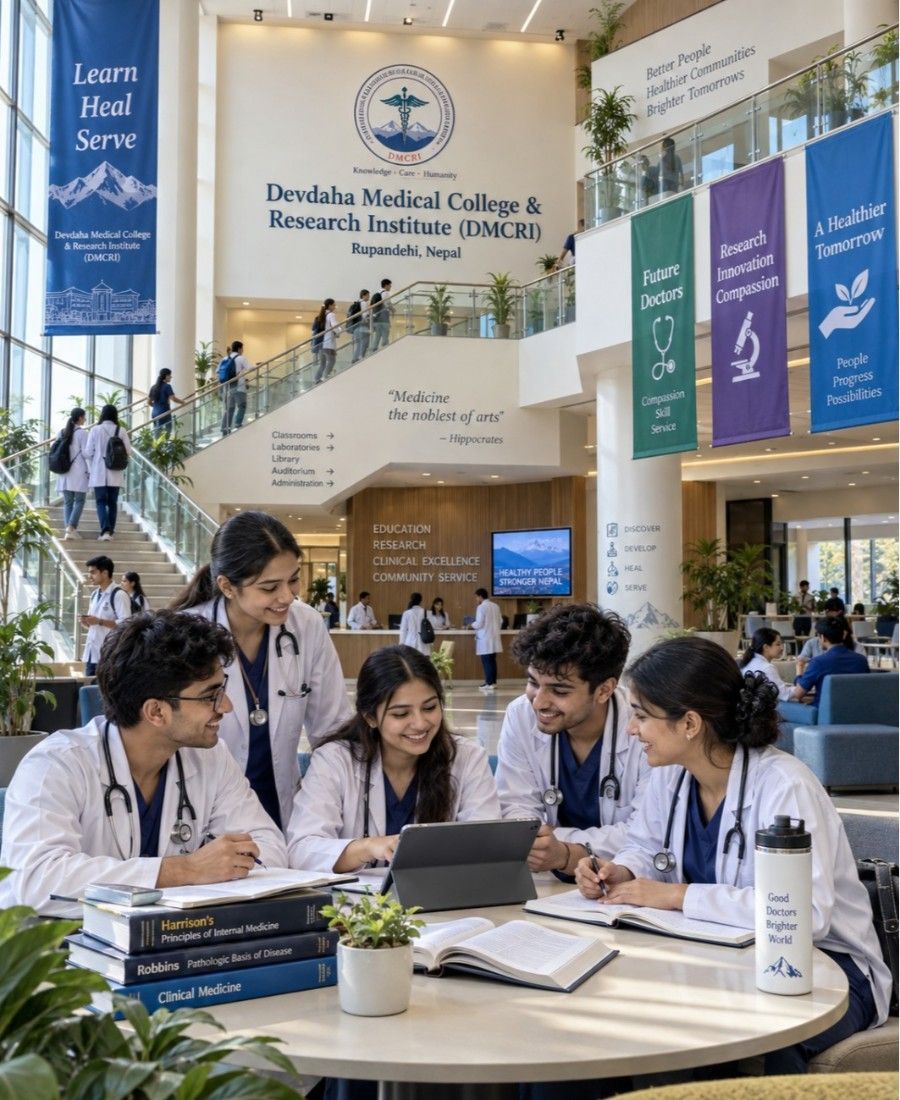
Devdaha Medical College & Research Institute is not the most talked-about medical college in Nepal. But for Indian students who know what to look for, it checks nearly every box without the price tag of a metro-based institution and without the cultural shock of studying six time zones away.
DMCRI was founded in 2006 and is located in Bhaluhi-8, Devdaha, in the Rupandehi District of western Nepal, about 7 kilometres east of Lumbini, the birthplace of Gautam Buddha, and roughly 15 kilometres from Butwal, the major commercial hub of that region. The MBBS programme began in 2014 and is affiliated with Kathmandu University (KU), one of Nepal's two principal medical degree-granting universities. Unlike many institutions that cycle through different affiliations over the years, DMCRI has consistently maintained its affiliation with Kathmandu University, which matters because KU-affiliated colleges follow a structured, internationally benchmarked curriculum directly aligned with NMC's CBME framework.
The teaching hospital is what sets DMCRI apart from smaller Nepali medical colleges at a similar price point. The Devdaha Teaching Hospital is a multispecialty institution with 450+ beds, currently expanding beyond 500, and is the primary tertiary referral centre for Rupandehi District and several neighbouring districts. That means the hospital sees a genuine cross-section of the regional disease burden: general medicine, trauma from the highways and mountain roads, high-risk obstetric cases from underserved communities, and paediatric emergencies. The hospital operates a 1.5T cardiovascular MRI, CT Scan, Mammography, Endoscopy, and ECHO services, alongside ICU, CCU, NICU, and PICU units. For a student rotating in Year 3 onwards, this is not a walk-through ward. It is a functional tertiary care hospital with real caseloads.
Because DMCRI's curriculum is integrated, meaning basic and clinical sciences overlap rather than sitting in separate pre-clinical and clinical silos, students begin engaging with hospital cases earlier than the standard structure would allow. Problem-based learning sessions, small-group teaching, and community visits are built into the schedule from Year 1. The medical education department runs this as a deliberate design feature, not an occasional addition. That integrated structure is also part of why DMCRI graduates tend to perform reasonably in FMGE/NExT, since the examination tests integrated clinical reasoning rather than compartmentalised subject knowledge.
The location is a practical advantage that most guides understate. Devdaha is 7 km from Lumbini and sits along the East-West Highway, Nepal's main arterial road connecting the eastern and western Terai. Gautam Buddha International Airport in Bhairahawa is approximately 20–25 km away. It has flights to Kathmandu (under an hour), with Delhi, Mumbai, Kolkata, and other Indian cities all under two hours away. Better still, Indian students do not need a visa to travel to Nepal. The India-Nepal open border treaty means Indian nationals can travel with just an Aadhaar card, Voter ID, or passport — no student visa, no visa extension costs, no embassy queues. For a student who wants to go home for a long weekend, that matters in a way that a visa-required destination cannot match.
The cost at DMCRI falls in the middle range among private Nepali medical colleges. The annual tuition is approximately USD 4,500–5,500, and the total 5.5-year all-inclusive cost, including tuition, hostel, food, insurance, and incidental expenses, is typically around INR 60–68 lakh. That is higher than Kyrgyzstan or Uzbekistan options, and lower than most Indian private colleges. For families comparing DMCRI to a domestic private medical seat, the total cost difference is often INR 40–70 lakh, at which point the clinical exposure, NMC recognition, and cultural proximity are not trade-offs. They are the same or better.