
Q1. When was the Universität Augsburg medical faculty founded?
+Its model programme was approved in 2018, and the first students began in winter semester 2019/20.

 Germany | Est. 1970
Germany | Recognised by the Free State of Bavaria; the Humanmedizin Modellstudiengang follows Germany's nationally standardised medical licensing framework | German medium
Expert will call you within 2 hours
People mostly just call it Uni Augsburg for short. The wider university opened in 1970 as a Reformuniversität, a purpose-built reform university, at a time when Augsburg, despite being one of Bavaria's oldest cities, had no university of its own. So, this makes the university itself a genuinely modern institution, even though it sits in a city with a history stretching back over two thousand years.
Medicine is a genuinely recent addition to this university, and the story behind it is worth knowing in some detail. In February 2009, Bavaria's then Minister-President, Horst Seehofer, wrote a short, three-exclamation-mark note, "Die Uniklinik kommt!!!", meaning "The university clinic is coming!!!", into the Golden Book of the City of Augsburg. That handwritten line is widely credited as the real starting point for everything that followed. So, unlike faculties that simply appear in an administrative announcement, this one traces back to a specific, documented, almost casual moment that later became official policy.
The broader national context matters too. Back in 1961, West Germany's Wissenschaftsrat, the country's central science policy advisory body, had already identified a need for ten new medical training institutions nationally, including seven new Medical Academies. So, Augsburg's eventual medical faculty responds to a genuinely old, documented national planning gap, not a purely local ambition decades later.
Here's a fact most guides skip entirely. The Augsburg hospital's own central building, opened back in 1982, was reportedly designed from the very beginning with the possibility of a future university hospital in mind. So, decades before the Medizinische Fakultät actually existed, the city's own hospital infrastructure was already, in a sense, built toward that eventual purpose.
The faculty's formal creation followed a clear, documented timeline. It was founded on 1 December 2016. On 1 January 2019, the previously municipal Klinikum Augsburg was formally transferred into the ownership of the Free State of Bavaria, becoming the Universitätsklinikum Augsburg, marked with its own ceremony on 9 January 2019. Students first arrived at the new faculty in the 2018/19 winter semester, though initially only in the Medical Informatics bachelor's programme; Humanmedizin itself only began teaching students a year later, in the 2019/20 winter semester, once the faculty's first teaching building had opened that October. So, medicine here is barely half a decade older than the faculty's formal founding date suggests.
Humanmedizin isn't the only programme at this faculty either. The Medizinische Fakultät also offers Medical Informatics at bachelor's and master's level, jointly with the Faculty of Applied Computer Science, and added a Midwifery Science bachelor's programme from the 2023/24 winter semester, run in cooperation with Universitätsklinikum Augsburg. So, medicine sits within a genuinely broader, still-expanding health sciences faculty, not a single, standalone medical degree.
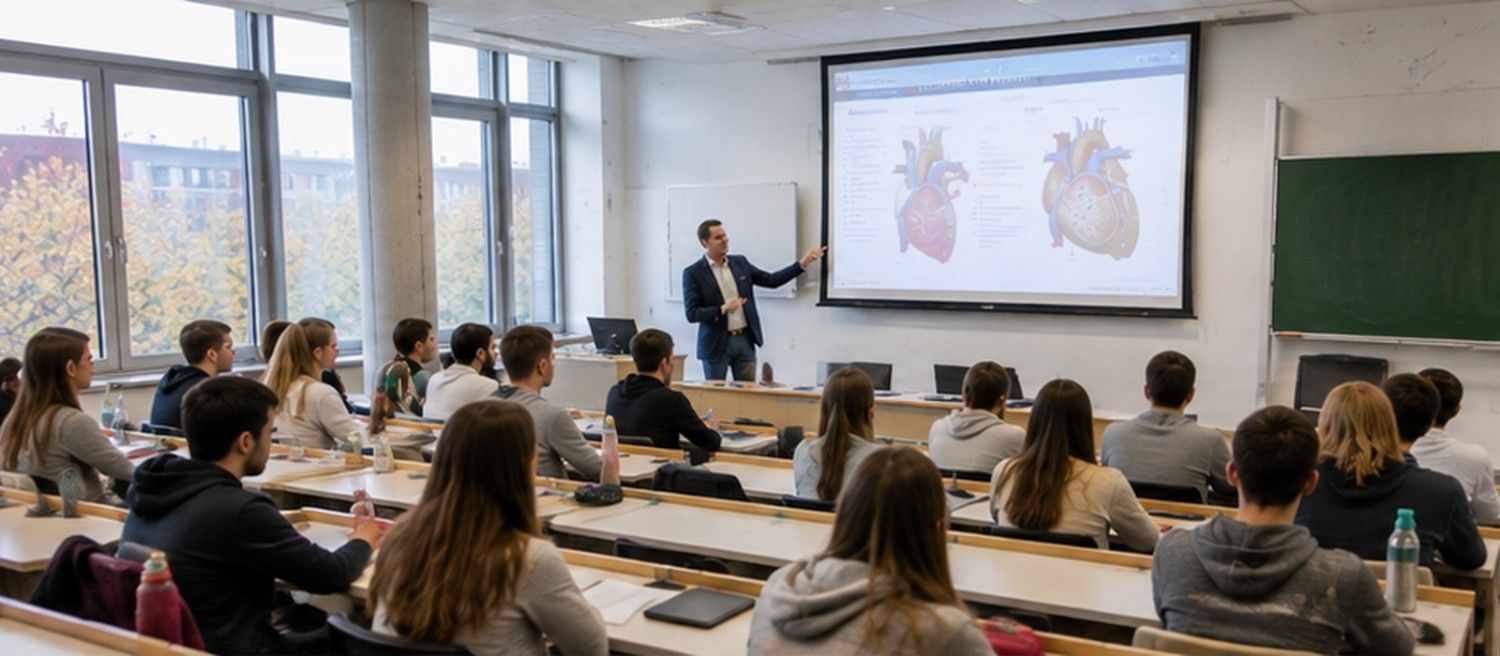
One especially distinctive detail concerns how the medical curriculum itself is taught. Augsburg runs its Humanmedizin degree as a Modellstudiengang, a specially approved model curriculum, described as the first of its kind in the whole of Bavaria. Rather than splitting study into the traditional separate preclinical and clinical stages, Augsburg's curriculum integrates basic-science and clinical content together from early on, deliberately avoids large lecture-hall teaching in favour of problem-based, seminar-style, and small-group instruction, while still preserving clear subject boundaries between disciplines. So, students here experience patient contact and practical clinical exposure considerably earlier than in many traditional German medical programmes.
The Medizinische Fakultät sits within the University of Augsburg, based in Augsburg, one of Bavaria's oldest cities, roughly 60 kilometres northwest of Munich. Because the faculty is so new, its early teaching actually took place in a converted former children's hospital building in Augsburg, extensively renovated to include seminar rooms, small-group teaching spaces, practical and microscopy laboratories, an interprofessional training centre with simulation and observation rooms, and even a temporary medical library. A permanent Medical Campus has since been built directly south of the university hospital, including a dedicated teaching building and an Institute for Theoretical Medicine. So, students here have watched their own faculty's physical campus grow from a repurposed building into purpose-built facilities within just a few years.
Clinical training runs through the Universitätsklinikum Augsburg, a hospital with around 1,700 beds, ranking among Bavaria's largest, and standing as the only Maximalversorger hospital, Germany's highest tier of hospital care provision, in the entire Swabia administrative region, an area home to roughly two million people. A second clinical partner, the Bezirkskrankenhaus Augsburg, a district-run psychiatric hospital, also contributes to student training. So, the clinical backbone here is a genuinely large, regionally essential hospital, not a smaller teaching-only facility.
Research infrastructure in Augsburg actually predates the medical faculty itself. UNIKA-T, the Universitäres Zentrum für Gesundheitswissenschaften am Klinikum Augsburg, was founded in 2011 as a joint research network bringing together Klinikum Augsburg, the University of Augsburg, the Technical University of Munich, and LMU Munich, with a focus on health care operations, health information management, environmental medicine, and epidemiology. So, by the time the Medizinische Fakultät itself was founded in 2016, a genuine, multi-institution research collaboration had already been running in Augsburg for five years.
The faculty has also deliberately prioritised general medicine, Allgemeinmedizin, from the very start, with its own dedicated professorship and a supporting network of local practices that help teach students directly. So, community-based, general-practice training is built into the programme's design, rather than added on as an afterthought.
Augsburg runs Humanmedizin as a Modellstudiengang rather than the traditional Regelstudiengang used at most German medical faculties, with a standard study period of roughly six years, concluding with a Staatsexamen, Germany's state medical examination, and opening the path to Approbation, the medical licence needed to practise.
Admission for Medicine at the University of Augsburg runs entirely through Germany's national system. Applicants cannot apply directly to the university for a place in Humanmedizin; instead, the process runs through the Stiftung für Hochschulzulassung, accessed via Hochschulstart.de. Places are allocated across three national quotas: the Abiturbestenquote, based on the best school-leaving grades, taking 30 percent of places, the Zusätzliche Eignungsquote, an additional aptitude quota, taking 10 percent, and the Auswahlverfahren der Hochschulen, the universities' own selection procedure, taking the remaining 60 percent.
Fee figures here are refreshingly simple. Bavaria charges no general tuition fees, and the University of Augsburg has not opted to introduce a separate fee for non-EU students, unlike at least one other major Bavarian university that has already begun charging one, and another that plans to from 2027. The only regular charge is a semester contribution, currently running at around EUR 177, which includes a regional semester transport ticket priced at roughly EUR 92 to 97.
Parameter | Details |
Established | University founded 1970; Medizinische Fakultät founded 1 December 2016; Humanmedizin teaching began Winter Semester 2019/20 |
Institution Type | Public, state-run university |
Location | Augsburg, Bavaria, Germany |
Programme | Human Medicine (Modellstudiengang), leading to a Staatsexamen |
Duration | Approx. 6 years, following an integrated model curriculum rather than the classic Vorklinik/Klinik split |
Medium of Instruction | German |
Foreign Quota Note | No SAARC-style quota; places are allocated nationally via Hochschulstart.de rather than by the university directly |
Teaching Hospital | Universitätsklinikum Augsburg, the only Maximalversorger hospital in the Swabia region |
Fee Component | Amount | Notes |
Tuition Fee | None | Bavaria charges no general tuition fees |
Non-EU Student Fee | None | The university has not opted to introduce this, unlike some other Bavarian institutions |
Semester Contribution | Approx. EUR 177 per semester | Includes a semester public transport ticket of approx. EUR 92 to 97 |
Living Costs | Not separately confirmed by the university | Augsburg generally runs cheaper than Munich |
Approx. Total Programme Cost | Roughly EUR 2,100 to 2,200 over 6 years (semester fees only) | Estimate only; confirm the current rate directly with the university |
Most rival pages describe new medical faculties as simply smaller or younger versions of older ones. Augsburg is genuinely structurally different: it runs the first Modellstudiengang in the whole of Bavaria, integrating basic-science and clinical teaching together, avoiding large lecture halls, and giving students early, sustained patient contact. So, the curriculum itself represents a real, documented departure from the traditional German medical teaching model, not just a newer building housing an old-style course.
Most guides describe a faculty's founding purely through committee decisions and legislation. Augsburg's origin genuinely traces back to a specific, handwritten line in the city's own Golden Book, written by Bavaria's Minister-President in 2009, a full seven years before the faculty formally existed. So, there's a real, documented, almost personal moment behind this faculty's creation, not just a policy paper.
Be upfront about a few real limits here. The whole programme runs in German, so applicants without strong German language skills will struggle from the outset. Admission runs entirely through Germany's national Hochschulstart system rather than the university directly, so applicants need to track the national portal's quotas and deadlines. As one of Germany's youngest medical faculties, Augsburg doesn't yet carry the multi-generational graduate track record of the country's oldest medical schools.
So, who fits here best? Students comfortable studying entirely in German, and drawn to a genuinely modern, integrated Modellstudiengang with early clinical exposure, fit well. Students interested in a faculty still visibly building its own campus and research identity fit well too. However, anyone hoping for an English-taught path should look elsewhere, since none exists here. Still, the zero-tuition structure and the faculty's distinctive curriculum design are genuine, well-documented strengths.
Established Year: University founded 1970; Medizinische Fakultät founded 1 December 2016; Humanmedizin teaching began 2019
No hidden charges, no donation. The full picture of costs at MBBS in Faculty of Medicine University of Augsburg.
Tuition Fee
(approx. €363.90 or ₹39,984 annually)
Approx. EUR 177 per semester
Hostel Fee
€200 to €400 per month,
€200 to €400 per month €3,600 to €6,000 per year
Food & Meals
€200 to €300 per month
per month
Insurance
~€1,680 – €1,800 per year
PER YEAR
Donation
No Donation
No Hideen fess
Total Estimated Cost
Confirm directly with the university — Living costs form the bulk of total spending, not tuition
6 year
25–35%
Average FMGE first-attempt pass rates for students from many overseas medical universities. Students from structured programs consistently score higher.
Students returning to India need to clear the FMGE/NExT exam. MBBS in Faculty of Medicine University of Augsburg integrates exam-oriented coaching into the regular curriculum so students are prepared from day one.
A structured program that takes you from foundational sciences to clinical mastery.
Runs largely through problem-based, seminar-style, and small-group teaching instead of large lecture halls
Covers Anatomy, Physiology, and Biochemistry alongside early clinical concepts, rather than as an isolated preclinical block.
Draws on the faculty's Interprofessional Training Centre for simulation-based skills practice.
Introduces sustained patient contact earlier than many traditional Regelstudiengang programmes.
Runs largely through the Universitätsklinikum Augsburg, the region's only Maximalversorger hospital.
Covers Internal Medicine, Surgery, and allied clinical subjects, while preserving clear subject boundaries within the integrated structure
Draws on both Universitätsklinikum Augsburg and the Bezirkskrankenhaus Augsburg for varied clinical exposure
A dedicated final period spent largely in hospital settings, applying clinical skills under supervision
Graduates need the Approbation, Germany's medical licence, before they can practise independently
The programme concludes with the Staatsexamen, Germany's state medical examination

Furnished hostel rooms with Wi-Fi, laundry, 24/7 security, and Indian mess on or near campus.
Indian restaurants and mess facilities serving vegetarian and non-vegetarian home-style food daily.
Strong Indian community with cultural events, festival celebrations, and peer support groups.
Students get hands-on clinical training in government and private hospitals affiliated with the university.
Practical information for students planning to study at MBBS in Faculty of Medicine University of Augsburg.
Prepare for all seasons. Thermal wear for winters, light clothing for summers. University provides heating in hostels.
Student visa processed with university invitation letter. Direct and connecting flights from major Indian cities.
Health insurance included in fees. Medical facility on campus plus city hospitals easily accessible.
Local SIM cards available. WhatsApp and video calls keep you connected with family back home.
Average monthly expenses of $150–$250 covering food, transport, and personal needs.
University library, online databases, and study groups. Seniors mentor juniors through academic challenges.
Our team guides you through every step — from application to arriving on campus.
Begin German lessons as early as possible, ideally alongside Class 11–12, targeting B1 within 12 months and progressing toward the required B2–C1 level.
Submit Class 10, 12, and any higher-education transcripts for verification. Processing typically takes 3–5 weeks; apply early, since this gates every subsequent step.
portal and apply to the correct track, the M-Kurs for medical aspirants, at your shortlisted Studienkolleg institutions.
Complete the roughly 10–12 month M-Kurs program covering Biology, Chemistry, Physics, and German, then pass the Feststellungsprüfung (FSP), the qualifying exam for university entry.
Submit applications to your shortlisted universities. Uni-assist fees run €75 for the first program and €30 for each additional program in the same semester.
University decisions follow Uni-assist’s document evaluation and forwarding; final admission is always the university’s own decision.
Deposit €11,904 into a blocked account (via Fintiba, Expatrio, or a similar provider) and arrange either public (€140–€160/month) or private health insurance; both are mandatory prerequisites for the visa stage.
Submit your visa application at the German consulate in India (Delhi, Mumbai, Bengaluru, or Chennai), with your admission letter, APS certificate, language proficiency proof, blocked account confirmation, and insurance proof. Realistic processing time is 6–12 weeks.
Bring originals of every document submitted digitally. Be prepared to discuss your study plans, financial arrangements, and reasons for choosing Germany.
Book travel around your intake date (October for Winter, April for Summer), and complete formal university enrollment on arrival. Medical study then begins with the Pre-Clinical phase.
Admission Helpline — Contact our counsellors for step-by-step assistance.
“The faculty here is incredibly supportive. The clinical training during hospital rotations has given me real confidence in patient care.”
“Affordable fees without compromising on quality. The campus facilities and hostel life made my transition abroad very smooth.”
“English medium instruction and WHO-recognized curriculum were the deciding factors for me. No regrets so far — excellent experience overall.”
“The university helped with everything from visa to accommodation. Hospital exposure from year three has been invaluable for my FMGE prep.”
“Just cleared my licensing exam on the first attempt. The structured coaching and mock exams during final year were a game-changer.”
“Safe campus, good food options, and a strong Indian student community. The teaching methodology is very practical and hands-on.”
Its model programme was approved in 2018, and the first students began in winter semester 2019/20.
Approximately six years in total, including the practical year.
No. Humanmedizin is taught almost entirely in German, and a certified strong German level is required beforehand.
No. Seats go through Germany's centralised admission body, Stiftung für Hochschulzulassung.
No tuition applies at Bavaria's public universities, though a semester contribution is required.
Graduates receive a state medical examination pass and, after registration, the Approbation, Germany's medical practice licence.
Universitätsklinikum Augsburg (UKA), converted from the city's Klinikum Augsburg in 2019.
Not automatically. Indian graduates would still need to clear India's usual foreign-degree licensing route, such as NExT.
It is a public faculty, run by the Free State of Bavaria.
It runs an integrated Modellstudiengang rather than the traditional preclinical-clinical split most German medical schools still follow.


Our expert counsellors will guide you through the complete admission process — from documents to airport pickup.