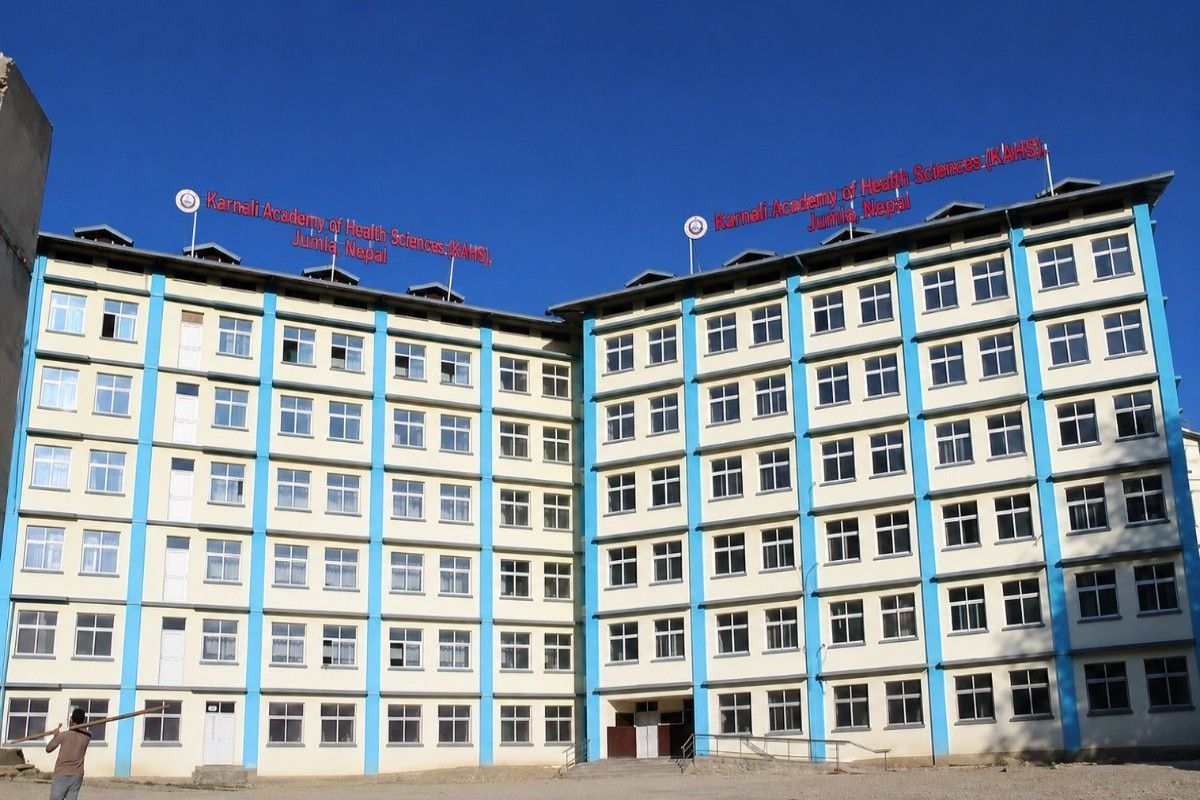
There is a version of medical education that most Indian students have never been told about. Not the one in Bishkek, Almaty, or Manila, where the clinical years take place in large city hospitals treating urban disease patterns. And not the private college in Pune with its INR 1.2 crore fee tag. Karnali Academy of Health Sciences (KAHS), in Jumla, is something entirely different. It is a government institution, established by an Act of the Nepalese Parliament on 20 October 2011, created specifically to address a problem that most medical universities do not even try to address: the near-total absence of trained doctors in Nepal's most remote and underserved region.
Jumla sits at 2,300 metres above sea level in Karnali Province, in the mid-western hills of Nepal. The surrounding districts, Humla, Dolpa, Kalikot, Mugu, Bajura, Bajhang, and Achham, are among the most geographically isolated in all of South Asia. Rara Lake, Nepal's largest lake, is less than 40 kilometres to the north. Shey Phoksundo National Park, a UNESCO-nominated site, borders the region to the west. The Karnali River, Nepal's longest river, flows through it. From a student's perspective, Jumla is not an urban campus. It is a high-altitude, mountain-flanked town where the daily reality of healthcare is radically different from that of a Kathmandu teaching hospital. And that difference is precisely what makes KAHS clinically valuable.
KAHS was built by upgrading the existing Karnali Zonal Hospital. That is the most important fact about it. The teaching hospital is not a newly constructed annexe to an academic building; it is a functioning referral hospital for a vast region with limited access to any secondary or tertiary care. Patients walk in from Humla, travel by bus from Kalikot, and are flown in from Dolpa on emergency transfers. The 300-bed hospital handles Internal Medicine, Surgery, Obstetrics & Gynaecology, Paediatrics, Orthopaedics, Psychiatry, ENT, Radiology, and ICU-level emergencies. Because the nearest alternative tertiary centre is in Surkhet or Kathmandu, hours away, the doctors here manage cases independently that urban hospitals would immediately escalate to specialists. So do the students who rotate through it.
The result of training in that environment is a specific kind of clinical competence. Students who graduate from KAHS are, almost by necessity, more comfortable with clinical decision-making under resource constraints than most of their peers from urban campuses. They have seen high-altitude illness presentations, malnutrition-related complications, infectious disease cases from mountain communities, and obstetric emergencies without the backup of a specialist just two floors up. That experience does not just help in FMGE preparation, though it does that too. It builds the kind of clinical reasoning that community medicine, rural posting, and NRHM positions specifically look for in graduates. If you want to become a doctor who can actually function in rural India, training at KAHS is one of the best preparations available anywhere in the region.
For Indian students, KAHS's practical profile is straightforward. The MBBS programme runs entirely in English, with no Nepali language requirement. Culturally, Karnali Province has strong historical and linguistic connections to the Kumaon and Garhwal regions of Uttarakhand. Students from UP, Uttarakhand, Bihar, and Himachal Pradesh find the social environment familiar in ways that no Central Asian destination can match. The flight route is Delhi to Kathmandu (under 90 minutes on Air India or IndiGo), followed by a domestic flight from Tribhuvan Airport to Jumla Airport on Tara Air or Summit Air, which takes around 50 minutes. Total travel time from Delhi to the KAHS campus is typically under 5 hours. Parents visit. Students go home. The logistics work.
The fee structure is among the most competitive at government-backed Nepali medical colleges. The total 5.5-year all-inclusive cost of tuition, hostel, food, and insurance typically ranges from INR 40 to 46 lakh. For context, that is significantly lower than IOM Tribhuvan and substantially lower than any NMC-recognised Indian private medical college. The government-regulated fee structure means there are no donations, no capitation fees, and no mid-course fee revisions without parliamentary approval. That regulatory protection is something private colleges in Nepal or abroad cannot offer. What students get for that cost is a government institution, a functioning 300-bed tertiary hospital, a 4:1 to 5:1 student-faculty ratio, and 20 MBBS seats per cohort, one of the smallest class sizes of any NMC-recognised medical programme anywhere.
Finally, the 45% seat reservation system at KAHS warrants an explanation, as no other guide explains it clearly. By law, 45% of MBBS seats at KAHS are reserved for students from the nine designated backward districts of Karnali Province: Jumla, Humla, Dolpa, Kalikot, Mugu, Jajarkot, Bajura, Bajhang, and Achham. The remaining seats are filled through MECEE-BL merit, including international and Indian students. That reservation system is why KAHS takes community medicine seriously in a structural, not aspirational, way. The students sitting beside you in clinical rounds include people from communities where their own relatives cannot access a doctor. The peer environment created is unlike that of any other medical school in the region.