2026 MBBS Admissions Open — Limited Seats!

Book Free Counselling →
Kimyo International University — School of Medicine, Tashkent, Uzbekistan image
UzbekistanUzbekistan | Est. 2018

Kimyo International University — School of Medicine, Tashkent, Uzbekistan

Uzbekistan | Listed in WDOMS (World Directory of Medical Schools); recognised by NMC India, WHO, FAIMER, and UNESCO. International programme accreditation from KAZSEE and IQAA; listed in the European EQAR database. Graduates are eligible for FMGE/NExT (India), USMLE (USA), | 100% English medium. No Uzbek, Russian, IELTS, or TOEFL required for Indian or international MBBS applicants. medium

Year 1: USD 4,000 (₹3.44 lakh approx.) | Years 2–6: USD 3,500/year (₹3.02 lakh approx.). Total 6-year tuition: approx. USD 21,500 (₹18.5 lak
Annual Fees
6 years: 5 years of structured academics and clinical training + 1-year compulsory internship. Fully aligned with NMC 2021 guidelines.
Duration
No
Donation
USD 600/year (approx. ₹52,000). Separate hostels for male and female students. Fully furnished rooms (single, double, triple sharing).
Hostel / yr
AMW

Get Free Counselling

Expert will call you within 2 hours

100% Free - No spam - Verified counsellors only

Why students choose
Kimyo International University — School of Medicine, Tashkent, Uzbekistan

Most foreign medical universities are built around a single idea: take the government curriculum, teach it in English, and collect fees from international students. Kimyo International University School of Medicine (KIUSOM) was built around a different idea entirely. Founded in 2018 as the first private higher education institution in Uzbekistan, it came into existence through an intergovernmental agreement between South Korea and Uzbekistan — a partnership with Yeoju University that shaped not just the branding but also the institution's academic DNA. The Korean influence is not cosmetic. It runs through the curriculum design, the teaching methodology, the research culture, and the institutional standards that KIUT has held itself to since day one.

The university is located in Tashkent, Uzbekistan’s capital and largest city, home to more than 3 million people. For international students — particularly those coming from India, Pakistan, Bangladesh, and across Africa — Tashkent offers something that many Central Asian study destinations don’t: a functioning metropolitan city with reliable infrastructure, accessible transport, an established international student community, and a cost of living that runs at Rs 10,000 to Rs 15,000 per month. For a six-year medical programme, the location matters as much as the curriculum, and Tashkent consistently earns high marks on both counts from students already there.

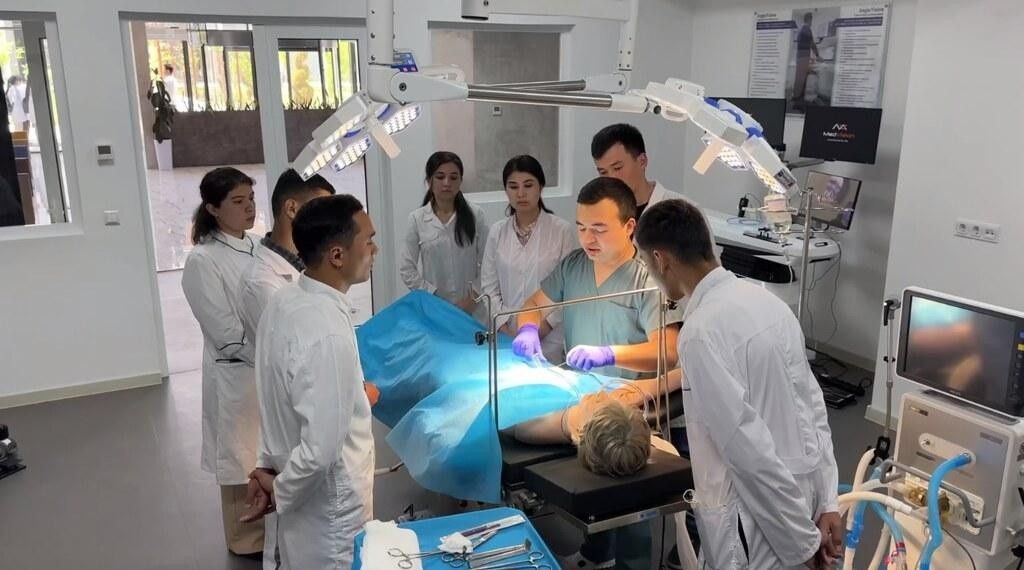
KIUSOM runs its MBBS programme entirely in English across six years: five years of structured academic and clinical training, followed by a mandatory one-year internship. The curriculum is USMLE-aligned, which is not the standard approach for Uzbekistan-based medical institutions — most stick to Soviet-era frameworks with an English overlay. Building toward USMLE standards from the first year means graduates leave with a knowledge base that translates directly into the most competitive licensing markets worldwide, not just in India. The School of Medicine maintains clinical training partnerships with Tashkent’s top multi-speciality hospitals, and structured ward rotations begin from Year 4, with FMGE/NExT coaching integrated into the academic schedule from Year 3.

Academically, KIUT holds a position that no other private institution in Uzbekistan can claim. It was the first non-state university in the country to receive international accreditation from KAZSEE and IQAA agencies, and it is listed in the European EQAR database — the same register used to verify educational quality across European higher education systems. The university holds a QS EECA regional rank of 101–150, a Times Higher Education BRICS rank of 151–200, and its Medicine programme ranks 451–500 globally in subject-level assessments. Faculty come from South Korea, the United States, the United Kingdom, Germany, France, Italy, Japan, and Malaysia, as well as experienced Uzbek clinicians. It currently maintains active partnerships with more than 50 overseas universities.

Recognition spans the jurisdictions that matter most for international students. KIUSOM is listed in WDOMS (World Directory of Medical Schools), recognised by India’s National Medical Commission, approved by WHO, recognised by FAIMER, and accredited by UNESCO. Indian graduates are eligible to sit for FMGE/NExT. The USMLE and PLAB pathways are also open. For a private university that has existed for under a decade, that stack of recognitions is genuinely unusual — and it reflects the deliberate, standard-driven approach KIUT took from its founding rather than arriving at recognition as an afterthought.

Established2018 — First private higher education institution in Uzbekistan; founded via Uzbek–South Korean intergovernmental agreement with Yeoju UniversityDuration6 Years: 5 years structured academics + 1-year compulsory internship; NMC 2021 compliantCurriculumUSMLE-aligned; Korean pedagogical framework; research publishing requirement from Year 3 for scholarship eligibilityRankingsQS EECA 101–150 | THE BRICS 151–200 | Medicine subject 451–500 globallyAnnual TuitionYear 1: USD 4,000 | Years 2–6: USD 3,500/yr | Total 6-year: ~USD 21,500 (₹18.5 lakh approx.)HostelUSD 600/yr; separate male/female blocks; furnished rooms; Wi-Fi; 24/7 CCTV; Indian mess; self-cooking allowedRecognitionNMC India, WHO, FAIMER, UNESCO, WDOMS; KAZSEE & IQAA international accreditation; listed in European EQAR databaseLicensing ExamsFMGE/NExT (India) | USMLE Steps (USA) | PLAB (UK)Language100% English medium; no Uzbek/Russian required; no IELTS/TOEFL required for MBBS applicantsFMGE/NExT CoachingIntegrated into curriculum from Year 3; Indian faculty support; dedicated NExT coaching cell; no additional costFacultyInternational faculty from South Korea, USA, UK, Germany, France, Italy, Japan, Malaysia; 50+ overseas university partnershipsLiving CostRs 10,000–15,000/month; 20–30% lower than European cities; Tashkent metro, malls, direct flights to India

Quick Facts

LocationUzbekistan
Duration6 years: 5 years of structured academics and clinical training + 1-year compulsory internship. Fully aligned with NMC 2021 guidelines.
Medium100% English medium. No Uzbek, Russian, IELTS, or TOEFL required for Indian or international MBBS applicants.
RankingQS EECA: 101–150 | Times Higher Education BRICS: 151–200 | Medicine subject ranking: 451–500 globally—first private Uzbek university to receive accreditation for an international
AccreditationListed in WDOMS (World Directory of Medical Schools); recognised by NMC India, WHO, FAIMER, and UNESCO. International programme accreditation from KAZSEE and IQAA; listed in the European EQAR database. Graduates are eligible for FMGE/NExT (India), USMLE (USA),
EligibilityFor Indian students pursuing MBBS at Kimyo International University School of Medicine: • Class 12 (10+2) completed with Physics, Chemistry, and Biology as core subjects • Minimum 50% aggregate marks in PCB for General category; 40% for SC/ST/OBC per NMC norms • NEET UG qualification is mandatory for Indian students intending to practise medicine in India • Minimum age of 17 years as on December 31 of the admission year • Valid passport; no IELTS or TOEFL required for MBBS admission • NEET score should not be older than 3 years at the time of admission • No gap years required; clean academic record preferred but not an absolute bar for international applicants • Non-Indian international students are not required to clear NEET; local academic criteria apply per their home country’s medical council requirements
Recognition
Listed in WDOMS (World Directory of Medical Schools) by WHO — the globally accepted directory used by all major licensing bodies to verify international MBBS degree validityRecognised by India’s National Medical Commission (NMC) — graduates are eligible to sit FMGE and NExT licensing examinations to practise medicine in IndiaRecognised by FAIMER (Foundation for Advancement of International Medical Education and Research) — a globally trusted validator of international medical programmesAccredited by UNESCO — recognition that extends KIUT’s degree credibility into international educational systems beyond just medical licensing bodiesFirst private university in Uzbekistan to receive international programme accreditation from KAZSEE and IQAA; listed in the European EQAR database — no other Uzbek private medicaDegree accepted for USMLE (USA) and PLAB (UK) examination eligibility; graduates may pursue postgraduate residency in the United States upon completing Steps 1, 2, and 3Licensed by the Ministry of Higher Education, Science and Innovation of Uzbekistan; institutional partnerships with 50+ universities across South Korea, Europe, and the Americas

Complete, transparent
cost breakdown

No hidden charges, no donation. The full picture of costs at Kimyo International University — School of Medicine, Tashkent, Uzbekistan.

Tuition Fee

Year 1: USD 4,000 (₹3.44 lakh approx.) | Years 2–6: USD 3,500/year (₹3.02 lakh approx.). Total 6-year tuition: approx. USD 21,500 (₹18.5 lak

USD 4,000 ₹3.44 lakh, year 2-6 USD 3,500/yr ₹3.02 lakh/yr

Hostel Fee

USD 600/year (approx. ₹52,000). Separate hostels for male and female students. Fully furnished rooms (single, double, triple sharing).

USD 600/yr ₹52,000 approx.

Food & Meals

USD 100–150/month ₹8,600–12,900/month

month

Insurance

Contact Us

/year

Donation

No Donation

No donation

Total Estimated Cost

USD 24,000–25,800 ₹18.5–19.4 lakh

Contact us

25–35%

Average FMGE first-attempt pass rates for students from many overseas medical universities. Students from structured programs consistently score higher.

Built to help you
clear licensing exams

Students returning to India need to clear the FMGE/NExT exam. Kimyo International University — School of Medicine, Tashkent, Uzbekistan integrates exam-oriented coaching into the regular curriculum so students are prepared from day one.

Regular mock tests and practice exams throughout the program
Faculty-guided FMGE preparation sessions every semester
Study material aligned with NMC/NExT syllabus
Clinical postings designed to strengthen practical knowledge

6-Year MD curriculum,
year by year

A structured program that takes you from foundational sciences to clinical mastery.

Year 1

Foundation of Medical Sciences

Medical Latin, History of Medicine, and clinical ethics modules lay the intellectual and professional framework students carry into ward rotations; introductory digital anatomy tools and simulation equipment are used from the first semester — not held back for later years

Key subjects: Human Anatomy, Medical Biochemistry, Histology, Biophysics, and Cell Biology taught through KIUT’s advanced science laboratories; Korean-influenced pedagogy emphasises visual learning, structured group sessions, and frequent formative assessments from semester one

Campus Image

What life actually
looks like on the ground

🏠

Campus Accommodation

Furnished hostel rooms with Wi-Fi, laundry, 24/7 security, and Indian mess on or near campus.

🍛

Food & Dining

Indian restaurants and mess facilities serving vegetarian and non-vegetarian home-style food daily.

🤝

Indian Student Community

Strong Indian community with cultural events, festival celebrations, and peer support groups.

Hospital access in
Uzbekistan’s capital

Students get hands-on clinical training in government and private hospitals affiliated with the university.

Yr 3
Clinical rotations start
10+
Affiliated hospitals
Uzbekistan
City-based training
1 Yr
Full internship

What a first-time student
actually needs to know

Practical information for students planning to study at Kimyo International University — School of Medicine, Tashkent, Uzbekistan.

❄️

Weather & Packing

Prepare for all seasons. Thermal wear for winters, light clothing for summers. University provides heating in hostels.

✈️

Travel & Visa

Student visa processed with university invitation letter. Direct and connecting flights from major Indian cities.

🏥

Health & Insurance

Health insurance included in fees. Medical facility on campus plus city hospitals easily accessible.

📱

Communication

Local SIM cards available. WhatsApp and video calls keep you connected with family back home.

💰

Monthly Budget

Average monthly expenses of $150–$250 covering food, transport, and personal needs.

📚

Study Resources

University library, online databases, and study groups. Seniors mentor juniors through academic challenges.

Admission in 10 steps

Our team guides you through every step — from application to arriving on campus.

01
1

🤝 Free Counselling

Uzbekistan specialist gives honest overview. TSMA vs SamSMU, FMGE outcomes, cost vs Kazakhstan and Russia, cultural and climate briefing.

02
2

📋 Document Collection

Our team provides the Uzbekistan-specific checklist. All documents verified before university submission.

03
3

📨 University Application

Direct submission to TSMA or SamSMU. Offer letter typically within 7–14 days.

04
4

📄 Offer Letter & Fee Deposit

Our team receives offer, explains terms, manages initial fee payment.

05
5

🌐 e-Visa Application

our team assists with Uzbekistan e-visa (e-visa.uz) processed within 3 working days, $20 USD.

06
6

🎒 Pre-Departure Briefing

Tashkent / Samarkand orientation accommodation, transport, migration card process, currency, Indian community contacts, and first-week logistics.

07
7

✈️ Travel to Uzbekistan

Our team advises on routing to Tashkent International Airport (TAS) or Samarkand Airport (SKD). Confirms arrival with local team.

08
8

🛬 Airport Pickup

Our local Uzbekistan team meets you immediately on arrival.

09
9

🪪 Migration Card Registration (ASAP)

Our team registers your migration card within 3 days of arrival which is strictly managed, no delays.

10
10

🏠 Hostel & University Registration + Residence Permit

Hostel check-in, university registration, and student residence permit filing all handled by our local team within your first two weeks.

Admission Helpline — Contact our counsellors for step-by-step assistance.

What our students
actually say

The faculty here is incredibly supportive. The clinical training during hospital rotations has given me real confidence in patient care.

PS
Priya Sharma
3rd Year Student

Affordable fees without compromising on quality. The campus facilities and hostel life made my transition abroad very smooth.

RP
Rahul Patel
5th Year Student

English medium instruction and WHO-recognized curriculum were the deciding factors for me. No regrets so far — excellent experience overall.

AG
Ananya Gupta
2nd Year Student

The university helped with everything from visa to accommodation. Hospital exposure from year three has been invaluable for my FMGE prep.

VS
Vikram Singh
4th Year Student

Just cleared my licensing exam on the first attempt. The structured coaching and mock exams during final year were a game-changer.

SR
Sneha Reddy
6th Year Student

Safe campus, good food options, and a strong Indian student community. The teaching methodology is very practical and hands-on.

AM
Arjun Mehta
3rd Year Student

Honest answers to
the real questions

Q1. Is Kimyo International University School of Medicine actually NMC and WHO recognised — or is it still 'in process'?

+

A. KIUT is listed in the World Directory of Medical Schools (WDOMS) and recognised by NMC, WHO, and FAIMER. That means Indian graduates are eligible to sit the NExT exam. Still, always verify the WDOMS listing yourself at wdoms.org before you commit — counsellors sometimes conflate 'applied for' with 'approved'.

Q2. What is the realistic total cost of six years at KIUT — not just year one?

+

A. Year one tuition is $4,000. Years two through six are $3,500 each — totalling $21,500 in tuition alone. Factor in hostel ($100–$150/month), food, travel, and visa renewals, and a grounded six-year estimate comes to $28,000-$34,000. Most sites conveniently stop at the first-year number.

Q3. Is NEET mandatory for getting a seat at KIUT?

+

A. NEET is not required for KIUT admission. The university evaluates 12th-grade PCB scores and runs its own entrance interview. That said, if you want to practice medicine in India afterwards, NEET qualification feeds into your NMC compliance chain for NExT — so skipping NEET entirely still has downstream consequences.

Q4. KIUT was previously Yeoju Technical Institute — does that name change affect my degree's validity?

+

A. No. KIUT was formally renamed in 2022 and operates on a valid state license from the Republic of Uzbekistan. The rebrand doesn't affect degree recognition. What matters is the current WDOMS listing under 'Kimyo International University' — that's what NMC and licensing bodies look at, not the old name.

Q5. When does clinical training actually start — year one or only in the later years?

+

A. Classroom clinical exposure begins early, but structured hospital rotations at affiliated hospitals in Tashkent formally kick in from year four onward. Years one to three cover preclinical sciences — anatomy, physiology, biochemistry — with case-based learning woven in. Don't let anyone tell you it's 'fully clinical from day one' — that's a selling point, not an accurate description.

Q6. Is English really the medium of instruction, or do I need Uzbek and Russian too?

+

A. The MBBS program is fully English-medium — lectures, exams, textbooks, everything. Uzbek and Russian are not needed to pass your courses. In practice, though, hospital wards are staffed in Uzbek and Russian, so students who pick up basic conversational phrases handle clinical rotations noticeably better. The university doesn't tell you this upfront.

Q7. What makes KIUT different from the other dozen-odd medical universities in Uzbekistan?

+

A. KIUT is one of the very few private universities in Uzbekistan with KAZSEE and IQAA international accreditation, placing it in the European EQAR database — a credential most state universities here don't hold. Its QS EECA ranking (101–150) and THE BRICS ranking (151–200) are also independently verified. That's a different weight class from unranked institutions.

Q8. What are the hostel conditions actually like for Indian students?

+

A. KIUT's hostels have separate wings for male and female students, resident wardens, Wi-Fi, heating, and study desks. Single, double, and triple-sharing options exist. Indian meals are available on campus, which genuinely matters for students adjusting to Tashkent winters. The campus sits close enough that daily commuting isn't an issue for most students.

Q9. Can a KIUT MBBS graduate practice in countries other than India?

+

A. Yes. WDOMS listing makes you eligible to attempt licensing exams in most countries. For the US, that means USMLE Steps 1–3. For the UK, PLAB 1 and 2. For India, NExT. What consultants often skip: your residency match success in the US or UK depends far more on your scores than on your institution's name — start planning that early.

Q10. What programs does KIUT offer beyond MBBS — is it strictly a medical school?

+

A. KIUT is a full multi-disciplinary university. Beyond MBBS, the School of Medicine covers Dentistry, Nursing, Pharmacy, and Pediatrics. Across the broader university, there are 38 undergraduate and 22 graduate programs spanning Engineering, Business, Education, and Arts — plus 29 PhD programs. If allied health is on your radar, KIUT is worth exploring beyond just the MBBS track.

Let's get you into
Kimyo International University — School of Medicine, Tashkent, Uzbekistan

Our expert counsellors will guide you through the complete admission process — from documents to airport pickup.