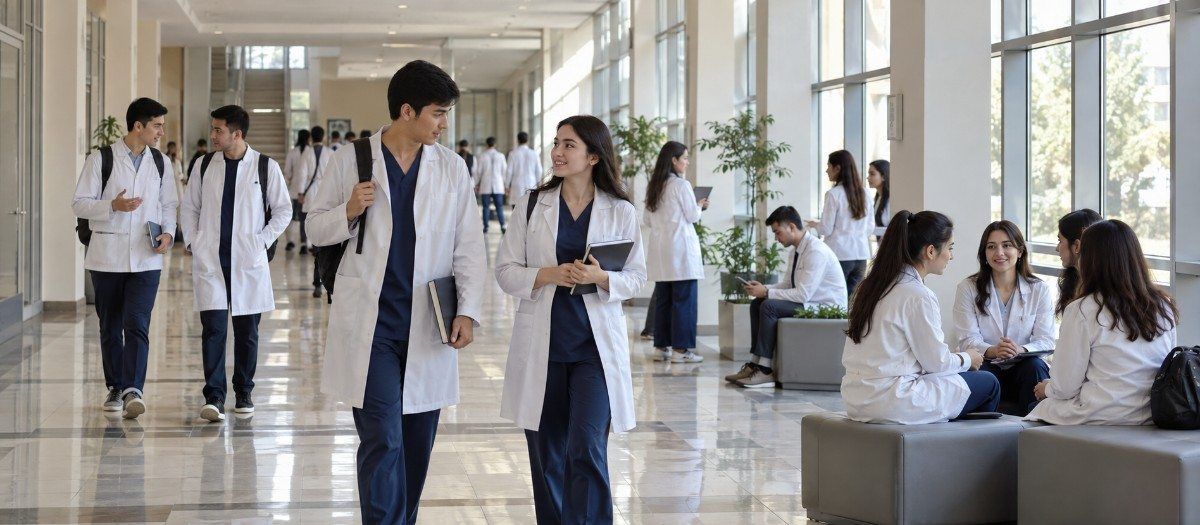
Tashkent Medical Academy, known in Uzbek as Toshkent Tibbiyot Akademiyasi, is the oldest and most well-established public medical university in Uzbekistan, located in the heart of Tashkent, Central Asia's largest capital city. It traces its roots back to 1920, when the Faculty of Medicine at Turkestan State University first opened its doors. Over the century since, it has grown through two major institutional mergers, first into the First and Second Tashkent State Medical Institutes, and then in 2005 by Presidential Decree into what it is today: a single, unified Academy with six faculties, 52 departments, its own Multidisciplinary Clinic, and an Interuniversity Research Scientific Laboratory one of very few medical universities in the entire Central Asian region to have all of that under one roof.
What makes TMA genuinely different from most other medical universities that Indian students consider is its size and depth. With over 46,000 total students and a faculty of 803 — including 97 full professors, 3 academicians of national distinction, 183 docents, and 176 Doctors of Sciences — this is not a small private college that opened a few years ago to chase the international MBBS market. It is a century-old research institution whose medical graduates have been practising across the world for generations. The Academy operates its own Multidisciplinary Clinic alongside affiliations with 20+ hospitals in Tashkent, meaning clinical exposure is not a distant Year 4 promise — structured patient contact begins progressively from Year 3, with real wards, real cases, and real consultants.
The city itself is a significant part of the proposition. Tashkent is a modern, safe capital with a Numbeo Safety Index score above 73/100 — higher than many Indian cities and most European study destinations. The city has a well-developed metro system, international-standard hospitals, functioning supermarkets stocked with familiar products, and a growing Indian diaspora community that makes the cultural transition far smoother than students typically expect. The climate runs cold in winter (averaging around 0°C) and warm in summer (28–30°C), but TMA's campus buildings are fully climate-controlled, and students adapt quickly.
For Indian students specifically, TMA covers the practical bases well. The entire MBBS programme is conducted in English, with no Uzbek or Russian requirements. Indian mess facilities are available near the campus hostels. NEET qualification is the primary admission requirement, with no IELTS or TOEFL needed. The Academy's NMC and WHO recognition means graduates can sit FMGE/NExT in India, USMLE in the US, and PLAB in the UK — and with MoUs signed with several Indian hospitals, including BLK Super Speciality Hospital in Delhi, students have a real pathway to do elective rotations back home before they graduate.
The one thing most competitor pages do not clearly state is this: TMA was recently upgraded and rebranded as Tashkent State Medical University (TSMU) following its merger with the Tashkent Pediatric Institute and the Tashkent Dental Institute. This is an institutional expansion, not a name change for marketing purposes — it signals that the government of Uzbekistan is actively investing in making this the country's flagship medical institution, with upgraded labs, new research facilities, and a broader clinical network. Students admitted under TMA will graduate under the expanded TSMU structure, which only strengthens the value of their degree.