The Faculty of Medicine at Vrije Universiteit Amsterdam trains doctors under the joint Amsterdam UMC banner. It sits on the university's Zuidas campus in the south of Amsterdam, next to the VUmc hospital location. Since 2018, VUmc and AMC have merged their clinical work into Amsterdam UMC, so VU medical students share hospitals and research groups with UvA students. But VU keeps its own Geneeskunde degree, its own admissions, and its own teaching style.
Vrije Universiteit was founded in 1880 by the theologian Abraham Kuyper. The name means Free University, marking its origin as an institution independent of both the state and the established church. It has grown into a broad research university with about 30,000 students. The medical faculty opened later and now sits inside the top 150 in most world rankings for medicine. Its teaching hospital, VUmc, has been part of the Dutch academic hospital network since 1966.
The medical degree follows the standard Dutch structure: a three-year Bachelor of Medicine followed by a three-year Master of Medicine, six years in total. The final award is arts (physician), the same title issued by every Dutch medical faculty. VU is known for a strongly integrated curriculum. Basic science, clinical skills, and communication training run together from the first weeks rather than sitting in separate blocks.
As with every Dutch medical school, the programme is taught in Dutch. This is not a soft rule. Lectures, tutor groups, patient contact, and exams are all in Dutch. Applicants must show NT2 Programme II or hold a Dutch VWO diploma. Anyone applying from India or another non-EU country typically spends a year or more building Dutch fluency before they can even apply. VU does not offer an English-taught medical doctor track.
Selection also runs through the national numerus fixus. VU admits roughly 350 Bachelor students each year. Its decentralised selection scores candidates on prior academic marks, motivation, extracurricular record, and a written test or interview. A very small number of seats sit open for non-EU applicants. This makes VU a hard choice for the standard international MBBS pathway, but a solid one for students set on the Netherlands.
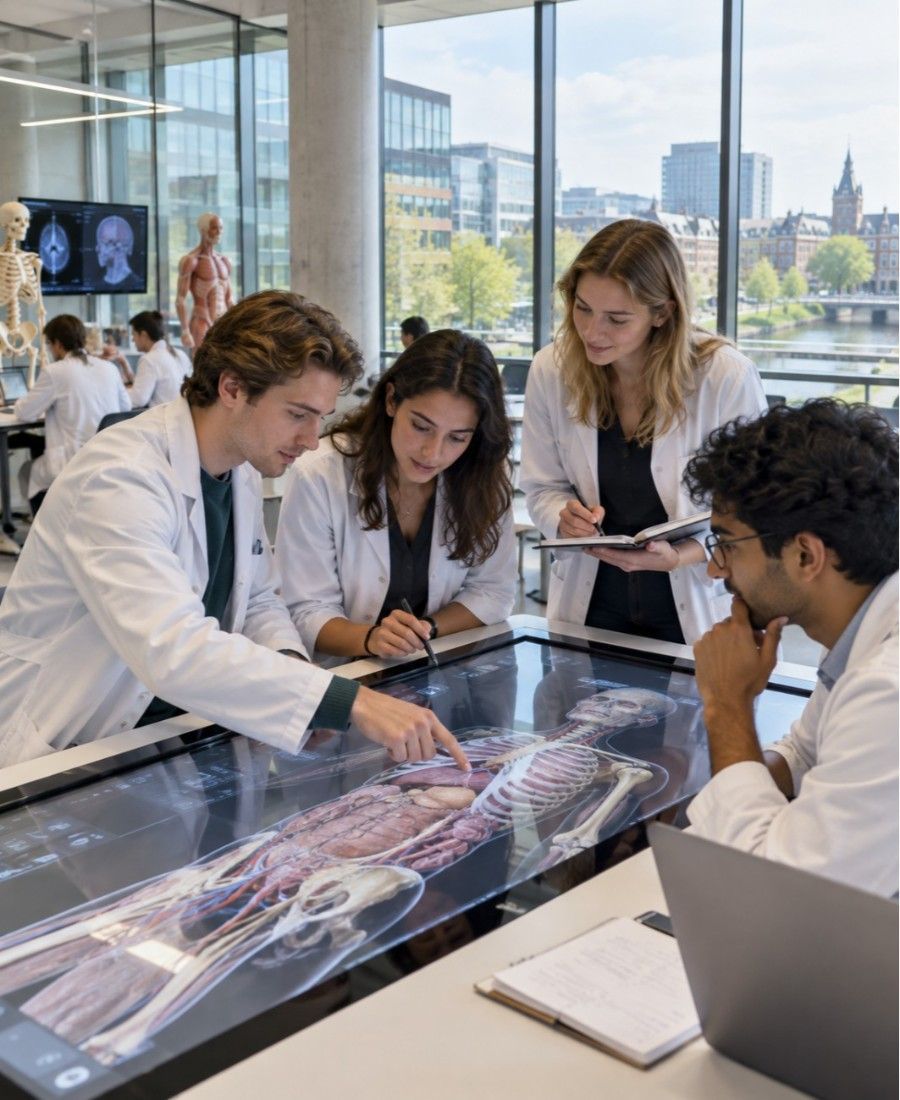
Teaching at VU leans on themed blocks, small group work, and a strong dose of skills-lab practice. Students meet patients from year one, either in general practice settings or through structured hospital visits. Anatomy work uses cadaveric dissection paired with 3D imaging. The programme has a clear focus on scientific reasoning; VU wants graduates who think like clinicians and researchers at the same time.
Clinical training happens across Amsterdam UMC and a wide ring of regional partner hospitals. VUmc handles complex care in oncology, neurology, cardiothoracic surgery, and paediatrics. Regional hospitals give students exposure to community medicine and higher patient volume. Master's students rotate through internal medicine, surgery, obstetrics and gynaecology, paediatrics, general practice, psychiatry, and emergency medicine. Sub-specialty electives round out the final year.
Research at VU has a clear identity. The faculty is strong in neuroscience, oncology, mental health, movement sciences, and public health. VU also runs one of the largest neuroscience research groups in Europe. Medical students can take a research honours track alongside the standard degree. This adds an extra research project and often opens the door to a PhD later.
Amsterdam is one of the easiest European capitals for a student to settle into. Public transport is straightforward, cycling is the default, and English works fine in daily life even though the medical course itself does not. Student housing in the city is tight and expensive, so anyone joining VU should start the housing search the moment admission is confirmed. VU also partners with providers to help international students find rooms.
On registration, graduates receive the title arts and can register with the BIG register. This lets them practise as a basisarts (junior doctor) in the Netherlands. Specialty training follows through a national matching system. Recognition across the EU is smooth under Directive 2005/36/EC. For Indian graduates, the return path runs through NMC rules for FMGE or NExT; these do change, so check current rules before enrolling.
The Zuidas campus gives VU a modern feel. Glass buildings, open study spaces, and clinical simulation rooms sit beside the VUmc hospital. The location is well linked to the rest of Amsterdam by train, metro, and tram. Students can live in the city centre and commute in under 30 minutes. This urban setting suits students who want a capital-city experience.
VU is very much about the human side of care. The curriculum includes ethics, communication and social context. Students learn how to take histories, deliver bad news and work in teams. These skills are assessed by the practical examnations & clinical placements. The aim is to make doctors who are technically good and with the people.
Student life includes active medical associations, study committees, and research groups. These groups host talks, workshops, and social events. Also, they help students to find internships, electives, and mentors. Many VU students join research projects early, which strengthens their CV for residency or PhD applications later.
Career paths for VU graduates are similar to those at other Dutch medical faculties. Most start as junior doctors in the Dutch system. Some move into research, public health, or medical management. The VU neuroscience and oncology strengths create extra openings in those fields. International graduates must verify licensing rules in their home country before leaving the Netherlands.
The neuroscience focus is a particular draw. VU's Amsterdam Neuroscience network brings together neurologists, psychiatrists, and basic researchers. Students interested in the brain can join rotations and projects in this area. The same applies to oncology, where VUmc's cancer centre links clinical care with laboratory research. These strengths make VU a hub for students drawn to those specialties.
VU also supports students who want an international outlook. The university has exchange agreements with medical schools across Europe and beyond. Some students do electives abroad in their final year. This broadens their clinical view and helps them compare health systems. Still, the core degree stays firmly in Dutch and in the Netherlands.
The VU culture is often described as personal and ambitious. Class sizes are moderate, and tutor groups are small enough for real discussion. Staff are accessible, and students are encouraged to ask questions. This atmosphere suits students who want to be active learners rather than passive listeners. Also, it builds the teamwork skills which are needed in modern healthcare.
The application timeline follows the national numerus fixus schedule. Candidates register in Studielink, prepare a portfolio, and may face a written test or interview. Deadlines are fixed in January for the September intake. Prospective students should review the VU Geneeskunde admissions page each year for the latest requirements and any changes to the selection format.
VU sits well for students who want a European medical degree from an urban, research-heavy university with a strong clinical base. Its unique features are the integrated block curriculum, the neuroscience research focus, and the direct link into Amsterdam UMC. It is not a shortcut into medicine; the Dutch-language rule and tight non-EU quota mean careful long-term planning. But for a candidate who commits to that plan, VU is one of the most respected medical faculties in the country.