Q1. Is Albert Ludwig University of Freiburg a public university?
+A: Yes. It is one of Germany's oldest and most respected public universities.

 Germany | Est. 1457
Germany | Recognised by the Ministry of Science, Research and the Arts of Baden-Württemberg | German medium
Expert will call you within 2 hours
Albert Ludwig University of Freiburg – Faculty of Medicine is one of Germany's oldest and most prestigious medical schools. Located in Freiburg im Breisgau, Germany, the faculty is internationally recognised for excellence in medical education, biomedical research, clinical innovation, and patient-centred healthcare. It combines centuries of academic tradition with modern scientific advancement to prepare future physicians and medical researchers.
Founded in 1457, Albert Ludwig University of Freiburg is among Germany's oldest universities. Its Faculty of Medicine has built a strong international reputation through outstanding teaching, cutting-edge biomedical research, and extensive clinical training provided in partnership with the University Medical Center Freiburg, one of Germany's leading university hospitals.
The medical programme follows the German medical education system regulated by the German Medical Licensing Regulations (Approbationsordnung für Ärzte). Students complete comprehensive training in biomedical sciences, clinical medicine, scientific research, communication skills, public health, ethics, and evidence-based medical practice before qualifying for professional medical licensing.
Students begin their studies with foundational medical sciences including anatomy, histology, embryology, physiology, biochemistry, molecular biology, genetics, microbiology, immunology, pathology, pharmacology, neuroscience, behavioural sciences, epidemiology, medical ethics, and public health. These disciplines establish the scientific knowledge required for advanced clinical education.
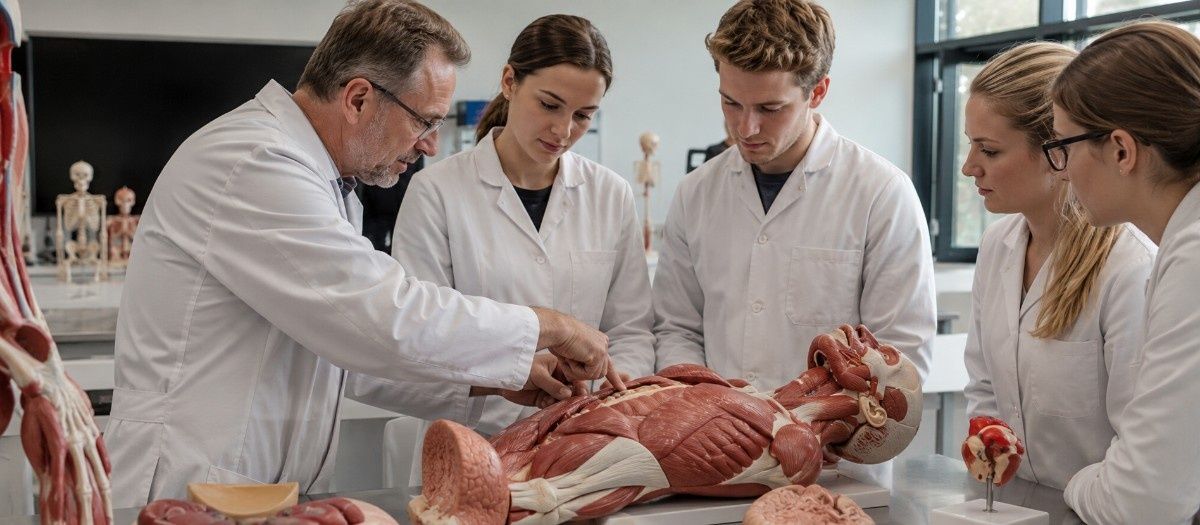
Teaching combines lectures, anatomy dissections, laboratory sessions, simulation-based education, clinical skills workshops, problem-based learning, case discussions, digital learning platforms, seminars, and small-group practical instruction. Students progressively strengthen analytical thinking, communication skills, professionalism, teamwork, and evidence-based clinical reasoning.
The curriculum places strong emphasis on translational medicine by connecting biomedical research with clinical practice. Students learn how scientific discoveries contribute to improved diagnosis, treatment, and patient outcomes while developing critical research skills.
Clinical education is delivered primarily through University Medical Center Freiburg, one of Germany's largest academic hospitals. Students gradually transition from classroom learning to supervised patient care while working alongside experienced physicians, surgeons, and researchers.
Clinical rotations include internal medicine, general surgery, paediatrics, obstetrics and gynaecology, psychiatry, cardiology, neurology, orthopaedics, emergency medicine, anaesthesiology, dermatology, ophthalmology, ENT, radiology, oncology, nephrology, endocrinology, respiratory medicine, gastroenterology, infectious diseases, geriatrics, rehabilitation medicine, intensive care, and family medicine.
Students participate in ward rounds, outpatient consultations, operating theatres, emergency departments, multidisciplinary meetings, diagnostic investigations, and supervised patient management. Clinical responsibilities gradually increase throughout the programme to prepare students for independent clinical practice.
Simulation-based education strengthens practical learning through advanced clinical skills centres equipped with patient simulators, emergency medicine laboratories, procedural skills facilities, surgical simulation equipment, consultation rooms, and digital healthcare technologies. Students develop confidence before treating patients in clinical settings.
Biomedical research is a major strength of the faculty. Students have opportunities to participate in internationally recognised research involving oncology, neuroscience, immunology, molecular medicine, genetics, cardiovascular medicine, regenerative medicine, stem cell research, infectious diseases, transplantation medicine, pharmacology, epidemiology, and precision medicine.
The Faculty of Medicine collaborates with research institutes, university hospitals, biotechnology companies, healthcare organisations, and international academic institutions throughout Europe and beyond. These collaborations support scientific innovation, international mobility, and multidisciplinary medical research.
Students also study healthcare leadership, patient safety, healthcare quality improvement, evidence-based medicine, medical ethics, healthcare law, digital medicine, public health, and interprofessional collaboration throughout their education.
Educational facilities include anatomy laboratories, biomedical research centres, simulation facilities, clinical skills laboratories, digital learning environments, specialised research institutes, advanced medical libraries, and University Medical Center Freiburg equipped with state-of-the-art healthcare technologies.
Student life includes scientific societies, medical associations, research groups, cultural activities, sports facilities, international exchange programmes, volunteering opportunities, and leadership initiatives. Comprehensive academic and personal support services contribute to student success.
International students benefit from academic advising, mentoring, language support, digital learning resources, research opportunities, career counselling, and exchange programmes through partnerships with universities across Europe and worldwide.
Graduates pursue residency training, specialist medical practice, biomedical research, academic medicine, healthcare administration, biotechnology, pharmaceutical research, public health, and international medical careers according to national licensing regulations.
Today, Albert Ludwig University of Freiburg continues to rank among Germany's leading medical institutions through excellence in education, scientific discovery, clinical innovation, and world-class patient care.
No hidden charges, no donation. The full picture of costs at MBBS In Albert Ludwig University of Freiburg Faculty of Medicine.
Tuition Fee
€3,000/year (Non-EU international students pay €1,500 per semester plus a semester contribution of approximately €190 per semester.)
€1,500 Per Semester ₹1,35,000 Per Semester
Hostel Fee
Approximately €3,600–6,000/year (Student accommodation generally ranges from €300–500/month
€250–€600 per month ₹27,550.75 INR to ₹66,097.38 INR
Food & Meals
Approx. USD 5,500/year Approx. Rs. 4.7 lakh
per year
Insurance
Approx. USD 1,500/year Approx. Rs. 1.3 lakh
per year
Donation
No Donation
No Hidden Fees
Total Estimated Cost
€66,000 to €96,000 (approx. ₹60 lakh to ₹88 lakh)
total 6 year
25–35%
Average FMGE first-attempt pass rates for students from many overseas medical universities. Students from structured programs consistently score higher.
Students returning to India need to clear the FMGE/NExT exam. MBBS In Albert Ludwig University of Freiburg Faculty of Medicine integrates exam-oriented coaching into the regular curriculum so students are prepared from day one.
A structured program that takes you from foundational sciences to clinical mastery.
• Anatomy dissections, laboratory practicals, simulation-based learning, communication training, problem-based learning, digital education, and early patient contact. • Students complete the First State Examination (Physikum) after the pre-clinical phase.
• Human anatomy, histology, embryology, physiology, biochemistry, molecular biology, genetics, microbiology, immunology, medical psychology, sociology, medical ethics, behavioural sciences, and scientific methodology.
• Students complete supervised clinical rotations through University Medical Center Freiburg while participating in ward rounds, outpatient consultations, emergency departments, operating theatres, multidisciplinary meetings, diagnostic procedures, and patient management. • Scientific research, evidence-based medicine, healthcare leadership, patient safety, medical ethics, public health, and digital healthcare remain integrated throughout clinical education
• Internal medicine, general surgery, paediatrics, obstetrics and gynaecology, psychiatry, cardiology, neurology, orthopaedics, emergency medicine, anaesthesiology, dermatology, ophthalmology, ENT, radiology, oncology, nephrology, endocrinology, respiratory medicine, gastroenterology, infectious diseases, geriatrics, rehabilitation medicine, family medicine, and community healthcare.
• Students complete rotations in Internal Medicine, General Surgery, and one elective specialty while actively participating in patient care under physician supervision. • The programme concludes with the Second State Examination, leading to eligibility for medical licensure in Germany.
• The final year consists of full-time supervised clinical training.

Furnished hostel rooms with Wi-Fi, laundry, 24/7 security, and Indian mess on or near campus.
Indian restaurants and mess facilities serving vegetarian and non-vegetarian home-style food daily.
Strong Indian community with cultural events, festival celebrations, and peer support groups.
Students get hands-on clinical training in government and private hospitals affiliated with the university.
Practical information for students planning to study at MBBS In Albert Ludwig University of Freiburg Faculty of Medicine.
Prepare for all seasons. Thermal wear for winters, light clothing for summers. University provides heating in hostels.
Student visa processed with university invitation letter. Direct and connecting flights from major Indian cities.
Health insurance included in fees. Medical facility on campus plus city hospitals easily accessible.
Local SIM cards available. WhatsApp and video calls keep you connected with family back home.
Average monthly expenses of $150–$250 covering food, transport, and personal needs.
University library, online databases, and study groups. Seniors mentor juniors through academic challenges.
Our team guides you through every step — from application to arriving on campus.
Begin German lessons as early as possible, ideally alongside Class 11–12, targeting B1 within 12 months and progressing toward the required B2–C1 level.
Submit Class 10, 12, and any higher-education transcripts for verification. Processing typically takes 3–5 weeks; apply early, since this gates every subsequent step.
portal and apply to the correct track, the M-Kurs for medical aspirants, at your shortlisted Studienkolleg institutions.
Complete the roughly 10–12 month M-Kurs program covering Biology, Chemistry, Physics, and German, then pass the Feststellungsprüfung (FSP), the qualifying exam for university entry.
Submit applications to your shortlisted universities. Uni-assist fees run €75 for the first program and €30 for each additional program in the same semester.
University decisions follow Uni-assist’s document evaluation and forwarding; final admission is always the university’s own decision.
Deposit €11,904 into a blocked account (via Fintiba, Expatrio, or a similar provider) and arrange either public (€140–€160/month) or private health insurance; both are mandatory prerequisites for the visa stage.
Submit your visa application at the German consulate in India (Delhi, Mumbai, Bengaluru, or Chennai), with your admission letter, APS certificate, language proficiency proof, blocked account confirmation, and insurance proof. Realistic processing time is 6–12 weeks.
Bring originals of every document submitted digitally. Be prepared to discuss your study plans, financial arrangements, and reasons for choosing Germany.
Book travel around your intake date (October for Winter, April for Summer), and complete formal university enrollment on arrival. Medical study then begins with the Pre-Clinical phase.
Admission Helpline — Contact our counsellors for step-by-step assistance.
“The faculty here is incredibly supportive. The clinical training during hospital rotations has given me real confidence in patient care.”
“Affordable fees without compromising on quality. The campus facilities and hostel life made my transition abroad very smooth.”
“English medium instruction and WHO-recognized curriculum were the deciding factors for me. No regrets so far — excellent experience overall.”
“The university helped with everything from visa to accommodation. Hospital exposure from year three has been invaluable for my FMGE prep.”
“Just cleared my licensing exam on the first attempt. The structured coaching and mock exams during final year were a game-changer.”
“Safe campus, good food options, and a strong Indian student community. The teaching methodology is very practical and hands-on.”
A: Yes. It is one of Germany's oldest and most respected public universities.
A: The Medicine programme is taught in German.
A: Students receive supervised clinical education through University Medical Center Freiburg and affiliated healthcare institutions.
A: Yes. Students receive early clinical exposure and complete extensive clinical rotations followed by a full Practical Year.
A: Students have access to anatomy laboratories, biomedical research laboratories, simulation centres, clinical skills laboratories, digital learning platforms, and University Medical Center Freiburg.
A: Yes. Students actively participate in biomedical research, scientific publications, clinical innovation, and interdisciplinary research projects.
A: Yes. Student residences and private accommodation options are available throughout Freiburg.
A: Graduates may pursue residency training, specialist medical practice, biomedical research, academic medicine, healthcare administration, biotechnology, pharmaceutical research, public health, and international medical careers.
A: Yes. Graduates may be eligible for international licensing pathways after meeting the eligibility requirements of the respective licensing authorities.
A: Applicants typically submit academic transcripts, proof of secondary education, German language proficiency certificates, passport copies, health insurance documentation, and other admission documents required by the university.



Our expert counsellors will guide you through the complete admission process — from documents to airport pickup.