
Q1. Is DMC the same as Dhaka National Medical College?
+No. DMC is a government public college. DNMC is a private college. They are completely different institutions.

 Bangladesh | Est. 1946
Bangladesh | Listed by NMC India, WHO, WDOMS, and BMDC; the WDOMS listing has been continuously maintained since 1953. | English is the sole medium of instruction at Dhaka Medical College for all local and international MBBS students. medium
Expert will call you within 2 hours
The First Medical College of Independent Bangladesh
Dhaka Medical College was founded on 10 July 1946. It was set up during British colonial rule, just one year before the partition of India. The founding principal was Major WJ Virgin of the Indian Medical Service. So, this college predates Bangladesh itself by 25 years. When Bangladesh won independence in 1971, DMC was already a fully functioning medical institution. It became the anchor of the new country's healthcare system from Day 1.
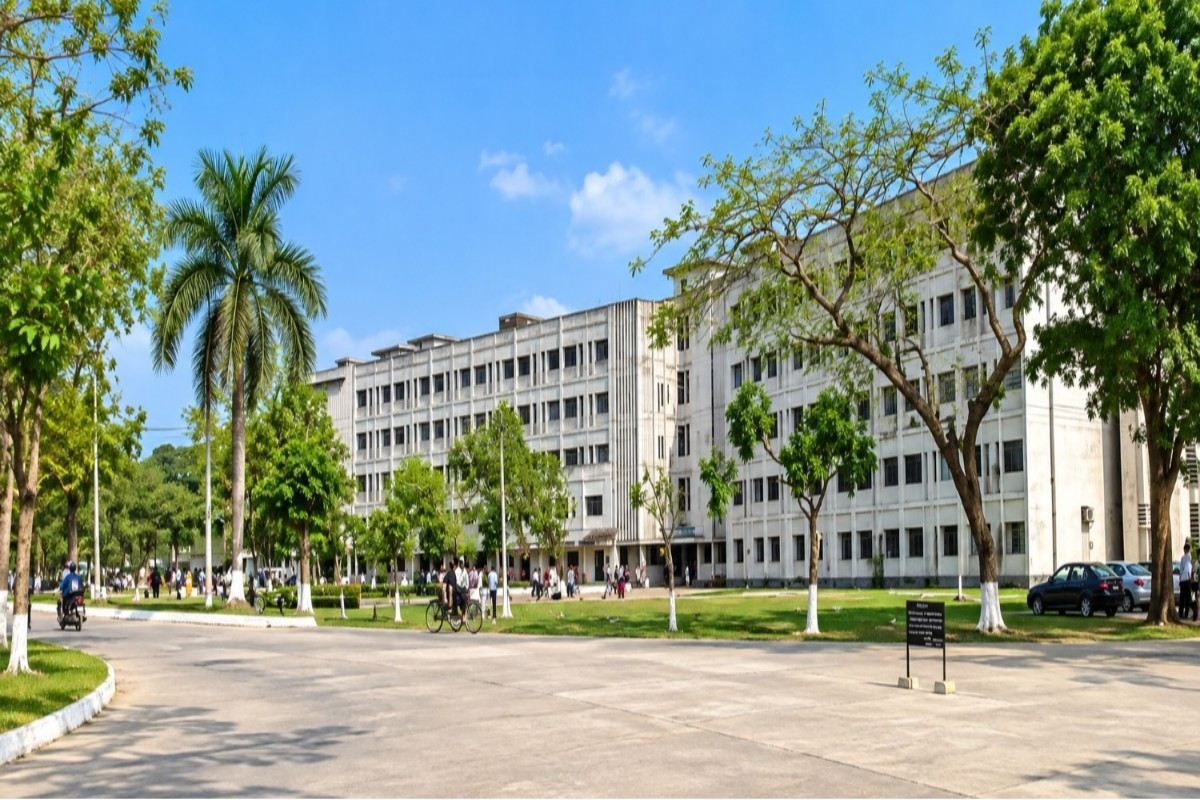
The campus is located in Bakshibazar in central Dhaka. It occupies a site that was once the Victoria Park area of colonial Dhaka. Moreover, Dhaka Medical College Hospital, the attached teaching hospital, has over 2,600 beds. It is the largest hospital in Bangladesh by bed count. Furthermore, it is also the busiest hospital in the country. On average, more than 7,000 outpatients attend every single day. So, students here do not just rotate through a teaching hospital. They work in what is effectively Bangladesh's national referral centre.
That scale of clinical exposure is something no private college in Bangladesh and very few in South Asia can match. Private hospitals in Dhaka are well-equipped. But the volume, variety, and complexity of cases at DMC Hospital are in a different category entirely.
The Liberation War and Dhaka Medical College
Now here is something almost no Indian blog has ever written about. During the Bangladesh Liberation War of 1971, Dhaka Medical College Hospital played a direct and critical role. When Pakistani forces launched Operation Searchlight on 25 March 1971, one of the most brutal crackdowns in modern South Asian history, DMC doctors and staff treated the wounded under occupation. The hospital became a place where lives were saved at enormous personal risk to the medical staff.
Moreover, after liberation in December 1971, DMC was one of the first institutions the new government of Bangladesh looked to for rebuilding the national healthcare system. So, the college is not just historically significant. It’s embedded in the very origin story of Bangladesh itself. Such an identity gives the university a unique culture which any new private university cannot recreate.
The students' strike in Bangladesh in July 2024, called the Quota Reform Movement, was mainly organised by students from public universities, including DMC. The protests led to the resignation of Prime Minister Sheikh Hasina's government. DMC students and doctors were directly involved. So, the college has a current political and social significance that goes beyond its academic profile.
Government College: What That Means Practically
DMC is a government college. It is funded by the Bangladesh government and regulated by BMDC. Seats for international students, including Indian students, are allocated by the DGHS (the Directorate General of Health Services of Bangladesh). So, admission is not directly through the college. It goes through a formal government process.
This matters in two ways. First, the fee is significantly lower than that of private colleges. Foreign student tuition at DMC is around USD 5,000 per year, compared to USD 8,000-11,000 at most private colleges in Dhaka. Secondly, the application procedure for DGHS is much more formalised and competitive. One cannot simply make a seat reservation through an agent. So, plan the paperwork well in advance.
For Indian students, the proximity to India is a practical advantage too. Dhaka is under 2 hours by air from Kolkata. Moreover, Benapole and Petrapole are connected by road and rail, and the Bandhan Express runs between Kolkata and Dhaka. So, travelling home during breaks is easy and relatively cheap. Furthermore, Bengali is mutually intelligible with Bengali spoken in West Bengal and Tripura. Even for non-Bengali Indians, the cultural familiarity with South Asian life makes adjustment easier than in Russia, China, or Eastern Europe.
Quick Overview
Parameter | Details |
Established | 10 July 1946, First Medical College in What Is Now Bangladesh |
Location | Bakshibazar in Central Dhaka, 7 km from Hazrat Shahjalal International Airport |
University Type | Government Public Medical College, under the Ministry of Health, Bangladesh |
Teaching Hospital | Dhaka Medical College Hospital, 2,600+ Beds, Largest Hospital in Bangladesh |
OPD Volume | 7,000+ Outpatients Per Day, Busiest Hospital and Highest Case Volume in Bangladesh |
Course Duration | 5 Years MBBS + 1 Year Internship (Total 6 Years) |
Admission Process | Through DGHS Bangladesh, Not Direct College Admission, Government Allocated Seats |
Annual Tuition Fee | Approx. USD 5,000 | INR 4.2 Lakhs/Year (Foreign Students, Government Rate) |
Fee Structure
Fee Component | Per Year (Approx.) | 6-Year Total (Approx.) |
Tuition Fee (Foreign) | USD 5,000 | INR 4.2 Lakhs | INR 25.2 Lakhs (6 Years) |
Hostel Fee | USD 600–800 | INR 50,000–67,200/Year | INR 3–4 Lakhs |
Food and Meals | INR 48,000–72,000/Year (Indian Mess Available in Dhaka) | INR 2.9–4.3 Lakhs |
Visa and Misc. | INR 40,000–60,000/Year | INR 2.4–3.6 Lakhs |
Donation | NIL | NIL |
Total Estimated | — | INR 30–38 Lakhs (All Inclusive, 6 Years) |
Why Dhaka Medical College Deserves a Harder Look Than You've Given It
2,600 Beds and 7,000 OPD Patients Per Day
Most pages about Bangladesh MBBS focus on private colleges. But that misses the most important institution in the country. So here is why DMC is in a different category.
First, the 2,600-bed hospital is not just a number. At most private Dhaka colleges, the teaching hospital has 500 to 1,000 beds. At DMC, it is 2,600. Moreover, more than 7,000 outpatients attend every day. The emergency ward runs 24 hours. The trauma centre handles road accidents, burns, poisoning, and serious cardiac cases from across Bangladesh. Students here rotate through a hospital that sees the full complexity of national medicine, not just the cases a private hospital selects.
Second, the Liberation War connection gives DMC a cultural depth that private colleges cannot claim. The college was functioning before Bangladesh existed. The hospital treated the wounded during the 1971 war. Its doctors helped rebuild the country's healthcare system after independence. That history is real, and it shapes how faculty and senior staff think about medicine. There is a sense of mission here that goes beyond curriculum outcomes.
Third, the government college structure means the fees are genuinely lower. International students pay around USD 5,000 per year. Most private colleges in Dhaka charge USD 8,000 to 11,000 for the same 5-year MBBS. As a result, the total 6-year cost at DMC is around INR 30-38 lakhs. That is significantly below the INR 40-55 lakh range for most private options in Dhaka.
Kolkata Connection, Bengali Language, and Honest Admission Reality
Also, the geographic advantage is real and underreported. Dhaka is under 2 hours from Kolkata by air. The Bandhan Express train runs between the two cities. Moreover, Benapole-Petrapole is the busiest land border crossing between India and Bangladesh. So, students from West Bengal, Bihar, Jharkhand, and the northeast can travel home easily.
Furthermore, Bengali in Bangladesh and Bengali in West Bengal are mutually intelligible. In the wards, most patients speak Bengali. So Indian students from Bengal feel linguistically at home from Week 1. Even non-Bengali Indian students adapt quickly because the cultural environment is South Asian in all the ways that matter: food, social norms, climate, and daily life.
Finally, the honest admission picture. DMC is highly competitive. The DGHS seat allocation process is formal and merit-based. There is no way for the agents to secure a seat for you. You require documents, the equivalence certificate, and cooperation from the Bangladesh embassy. So, start early, get your documents in order, and do not rely on informal channels. But for students who go through the process correctly, DMC offers the most clinically rich MBBS experience in Bangladesh at the most government-subsidised rate.
No hidden charges, no donation. The full picture of costs at MBBS In Dhaka Medical College.
Tuition Fee
Foreign student tuition is around USD 5,000 per year (around INR 4.2 lakhs), a government-subsidised rate that is the lowest in Dhaka.
USD 5,000 per year, government rate for foreign students
Hostel Fee
USD 600 to 800 per year; hostel on or near DMC campus in central Dhaka.
USD 600 to 800 per year, hostel on or near DMC campus in central Dhaka
Food & Meals
INR 48,000 to 72,000
per year
Insurance
USD120 to 360
per year
Donation
No donation
No capitation fee
Total Estimated Cost
INR 30 to 38 lakhs
6 years all inclusive
25–35%
Average FMGE first-attempt pass rates for students from many overseas medical universities. Students from structured programs consistently score higher.
Students returning to India need to clear the FMGE/NExT exam. MBBS In Dhaka Medical College integrates exam-oriented coaching into the regular curriculum so students are prepared from day one.
A structured program that takes you from foundational sciences to clinical mastery.
The first Professional MBBS examination is held at the end of Phase 1 under the University of Dhaka
Anatomy, Physiology, and Biochemistry form the full pre-clinical base in Phase 1
The Second Professional MBBS examination is held at the end of Phase 2 by the University of Dhaka
Pathology, Microbiology, Pharmacology, and Forensic Medicine are taught in Phase 2
Hospital ward rotations at the 2,600-bed DMC Hospital run fully during this phase
Medicine, Surgery, Obstetrics and Gynaecology form the core clinical subjects in Phase 3
Final Professional MBBS examination is the qualifying exam; FMGE and NExT coaching runs here
Paediatrics, Community Medicine, ENT, Ophthalmology, Psychiatry, and Orthopaedics run here
Community medicine rural posting and emergency rotations complete the internship year
Full 12-month internship covers all major departments at DMC Hospital and affiliated centres

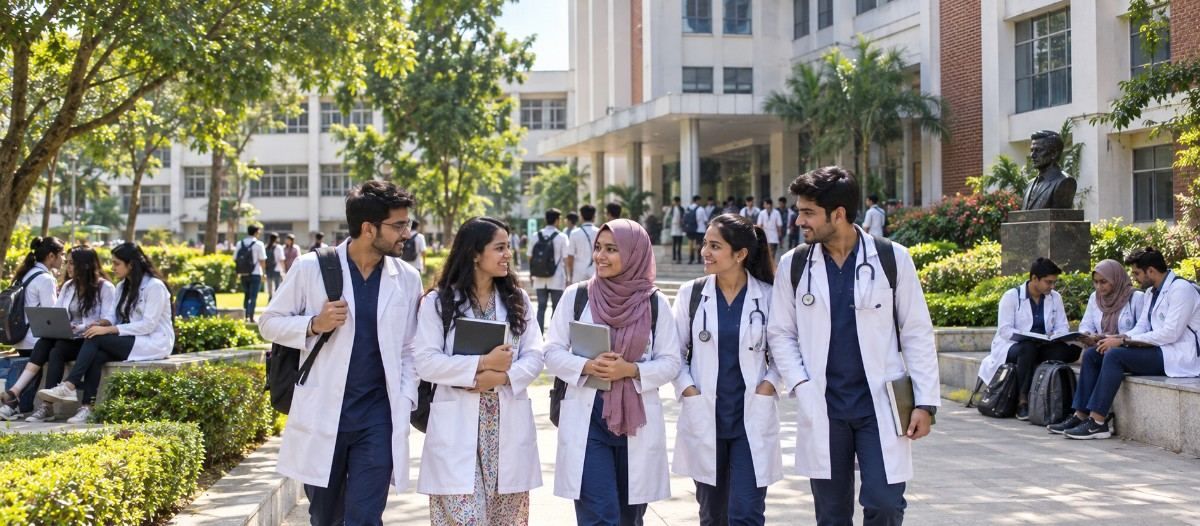
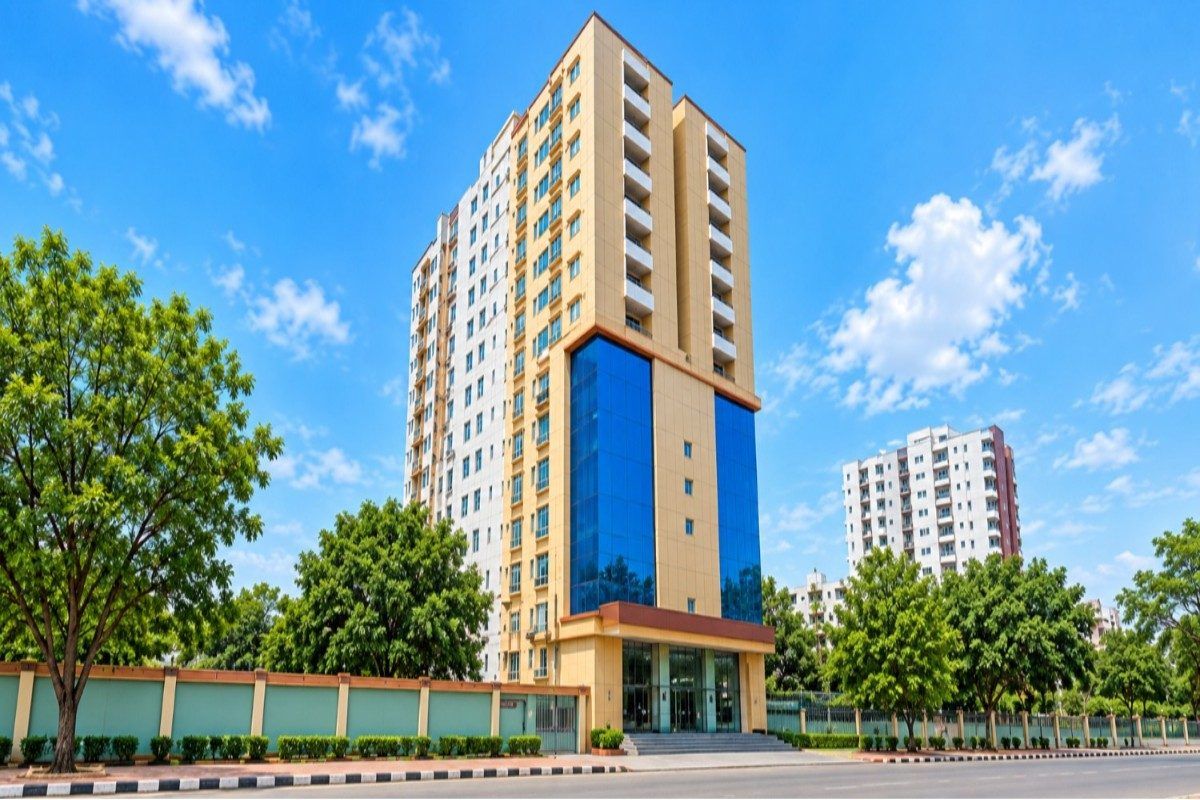
Furnished hostel rooms with Wi-Fi, laundry, 24/7 security, and Indian mess on or near campus.
Indian restaurants and mess facilities serving vegetarian and non-vegetarian home-style food daily.
Strong Indian community with cultural events, festival celebrations, and peer support groups.
Students get hands-on clinical training in government and private hospitals affiliated with the university.
Practical information for students planning to study at MBBS In Dhaka Medical College.
Prepare for all seasons. Thermal wear for winters, light clothing for summers. University provides heating in hostels.
Student visa processed with university invitation letter. Direct and connecting flights from major Indian cities.
Health insurance included in fees. Medical facility on campus plus city hospitals easily accessible.
Local SIM cards available. WhatsApp and video calls keep you connected with family back home.
Average monthly expenses of $150–$250 covering food, transport, and personal needs.
University library, online databases, and study groups. Seniors mentor juniors through academic challenges.
Our team guides you through every step — from application to arriving on campus.
DGME publishes the foreign-student MBBS/BDS admission circular for the upcoming session, usually around November, separately for SAARC/non-SAARC applicants and government/private colleges.
• Confirm your PCB percentage/GPA and NEET status against the circular's stated minimums. • Gather passport, academic transcripts, NEET scorecard, birth certificate, medical fitness certificate, and other listed documents, with mandatory two-step attestation.
• Shortlist government and/or private colleges based on budget, GPA/NEET strength, and location preference, comparing on recognition status and FMGE track record, not just the lowest fee. • Register on DGME's foreign-student portal, fill in details, and upload documents.
Pay the standard equivalence-certification fee (commonly around USD 100) via bank transfer (TT/SWIFT), not cash.
DGME evaluates your academic equivalence against Bangladeshi grading standards.
• Based on merit, quota category (SAARC/non-SAARC/reserved), and seat availability. • Receive a formal offer/admission letter from the allocated college.
Pay the first-installment tuition and hostel fee, per the college's own schedule.
• Apply at the Bangladesh High Commission/Mission with the admission letter and financial proof; realistic processing time varies by season. • In the final weeks, finalize documents, arrange travel/health insurance, book flights, and confirm hostel allotment in writing.
Fly to Bangladesh and complete airport formalities; many colleges arrange airport pickup for new students on specified reporting dates.
Complete physical document verification and hostel allotment at the college, and register with the Indian High Commission in Dhaka shortly after arrival, an important, non-optional step for consular support.
Admission Helpline — Contact our counsellors for step-by-step assistance.
“The faculty here is incredibly supportive. The clinical training during hospital rotations has given me real confidence in patient care.”
“Affordable fees without compromising on quality. The campus facilities and hostel life made my transition abroad very smooth.”
“English medium instruction and WHO-recognized curriculum were the deciding factors for me. No regrets so far — excellent experience overall.”
“The university helped with everything from visa to accommodation. Hospital exposure from year three has been invaluable for my FMGE prep.”
“Just cleared my licensing exam on the first attempt. The structured coaching and mock exams during final year were a game-changer.”
“Safe campus, good food options, and a strong Indian student community. The teaching methodology is very practical and hands-on.”
No. DMC is a government public college. DNMC is a private college. They are completely different institutions.
Yes. The accreditation bodies which recognise this institution are NMC India, WHO, WDOMS, BMDC, and FAIMER.
Around INR 30 to 38 lakhs for 6 years. Government tuition is only around USD 5,000 per year.
Yes. NEET is compulsory according to NMC India. No other entrance exam is available for Indian students.
DMC admission is through DGHS Bangladesh. It is a government procedure, not an application to the college.
Over 2,600 beds. More than 7,000 outpatients attend every day. It is the largest hospital in Bangladesh.
Under 2 hours by air. The Bandhan Express train also connects Kolkata and Dhaka directly.
Yes. Full English medium. No IELTS or TOEFL needed. Bengali helps in the wards but is not required.
A certificate from the Bangladesh Embassy in India certifying that your class 12 is eligible for the Bangladesh MBBS.
12-month rotating internship at DMC Hospital and affiliated centres. Covers all major clinical departments.
Our expert counsellors will guide you through the complete admission process — from documents to airport pickup.