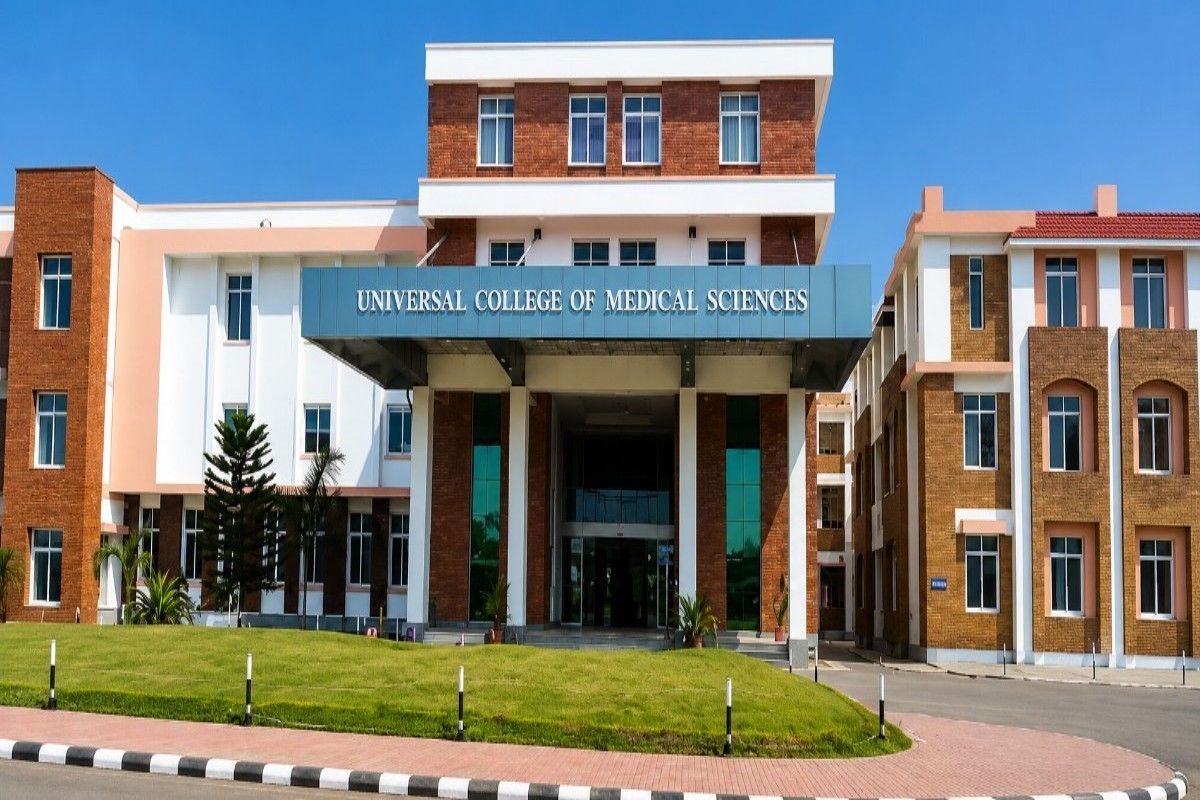
Walk into Kathmandu Medical College's Teaching Hospital in Sinamangal, and the first thing you notice is the location. The hospital sits just inside Kathmandu's ring road, about ten minutes from Tribhuvan International Airport. Ambulances roll in from the city and from the mountains, so the emergency department, where KMC students rotate from Year 3, handles everything from road trauma to high-altitude illness in a single shift. That is not a detail you find in most MBBS guides in Nepal, but it tells you more about the clinical training environment than any ranking table does.
KMC was established in 1997 as a private medical college under the auspices of Kathmandu University. It operates from two campuses: the basic science years are held at Duwakot in Bhaktapur, and the clinical years are held at Sinamangal in central Kathmandu. The teaching hospital KMCTH has grown to over 900 beds, with ICUs for Neonatal, Surgical, Medical, and Cardiac patients; advanced imaging (CT, MRI, Digital X-ray); modern operation theatres; and dedicated departments for Cardiology, Neurology, Nephrology with dialysis units, and Oncology. Since June 2002, KMCTH has been listed in the WHO's World Directory of Medical Schools, well before most MBBS abroad options currently being marketed to Indian students.
What most competitor pages mention and then quickly skip is the Kathmandu University affiliation. That matters more than it sounds. KU is not the government-run Tribhuvan University; it is a smaller, more selective autonomous university that models its academic structure on European and North American universities, uses a semester-based credit system, and runs Kathmandu University School of Medical Sciences (KUSOM) as its own medical faculty. KMC, as KU's permanently affiliated medical college, follows KU's curriculum standards and examination system. That alignment with a more internationally oriented university gives KMC graduates a degree that is structured differently and, in many ways, more recognisably than TU-affiliated degrees for international postgraduate applications.
Then there is the TUFH membership. KMC is an Associate Member of the Network Towards Unity for Health, headquartered in Ghent, Belgium, a global network of community-oriented medical schools. That membership is the reason KMC graduates became eligible from August 2012 to apply for a California Postgraduate Training Authorisation Letter (PTAL) and a Physicians and Surgeons Certificate in California. No guide to KMC explains clearly what this means. It means that for students who eventually want to practise in California, one of the most competitive and highest-paying medical markets in the United States, KMC's TUFH membership provides a pathway not available to graduates from institutions outside this network.
For Indian students, KMC works well on the practical checklist. English is the only medium of instruction. NEET qualification plus MECEE-BL is required for admission. The cultural distance from India is minimal. Nepali and Hindi share vocabulary, the festivals overlap almost completely, and the food at the campus mess caters to both North and South Indian preferences. The flight from Delhi is under 90 minutes, and Sinamangal is close enough to the airport that the taxi ride from the terminal to the college takes about as long as clearing immigration. Parents can visit on a long weekend without burning annual leave.
One thing worth saying directly about cost: KMC is not the cheapest option in Nepal. The total 5.5-year all-inclusive cost of around INR 55–60 lakh is higher than IOM Tribhuvan University (which is government-subsidised) and Central Asian options like Kyrgyzstan and Uzbekistan. However, what you are buying at KMC is a 900-bed multispecialty teaching hospital three minutes from a major international airport, a degree under Kathmandu University's semester system, the GMC UK recognition that makes the PLAB pathway clean, and the California PTAL eligibility that no other Nepali college currently offers. For students with serious ambitions in the UK or California, that package costs more than a Bishkek option and is worth every rupee of the difference.