People mostly just call it NpMC for short. It is a government medical college, established on 30 August 2018, affiliated with Rajshahi Medical University. Here is genuinely one of the most specific, well-documented founding sequences covered in guides like this one. On 26 August 2018, Bangladesh's own government approved four new medical colleges together in a single decision, including Nilphamari Medical College, a real, specific, dated example of a genuinely coordinated national rollout of new government medical colleges. Although this initial batch approval came on 26 August, Nilphamari Medical College itself received its own full, formal approval a few days later, on 30 August 2018.
A genuinely specific, dated administrative sequence followed. On 22 September 2018, Associate Professor Md. Robiul Islam Shah, transferred specifically from Khulna Medical College, was appointed as the college's own founding principal. Admission for the first batch of students then began on 15 October 2018, with a genuinely small founding cohort of 48 students admitted during the 2018-2019 academic session.
This pattern of several new Bangladeshi government medical colleges being approved and launched together within the same short window genuinely parallels what has been documented at other comparably young institutions covered in this whole series, including Naogaon Medical College and Netrokona Medical College, both of which began teaching their own first cohorts on the exact same date, 10 January 2019, suggesting a real, sustained, multi-phase national government initiative to expand medical education access across Bangladesh's own districts during this specific period.
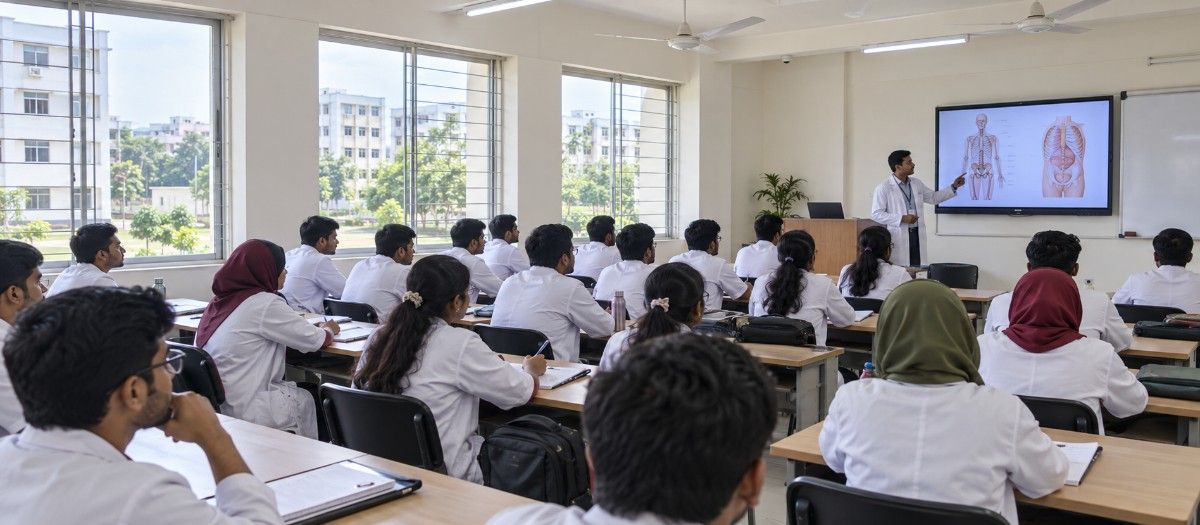
NpMC is currently led by Professor Dr. Jimma Hossain, supported by more than 52 academic staff, teaching a current student body of more than 289. The college is associated with the 250-bed Adhunik Sadar Hospital in Nilphamari, its own named clinical training facility. Teaching runs in English, and the college offers a five-year MBBS programme, followed by a compulsory one-year internship, with the awarded degree recognised by the Bangladesh Medical and Dental Council.
Nilphamari itself sits within Rangpur Division, in Bangladesh's own northern region. NEET remains a genuine requirement for Indian applicants pursuing MBBS study at Bangladeshi medical colleges generally, and Indian graduates would still need to clear the FMGE or NExT exam to practise medicine back in India, though applicants should confirm NpMC's own specific current international admission process directly, given how limited detailed, NpMC-specific admission information currently is.
Nilphamari district itself carries a genuinely deep local educational history separate from the medical college's own considerably more recent founding. Nilphamari Government College, established on 16 May 1958, now teaches more than 14,800 students across undergraduate, postgraduate, and higher secondary levels, reflecting a real, substantial local commitment to education stretching back six decades before NpMC's own 2018 arrival.
Given how genuinely young NpMC still is, and given the real, specific documentation available around its own batch-approval history, prospective applicants get a considerably more concrete, honest picture here than the generic "established in [year]" framing many comparable Bangladeshi medical colleges rely on. This genuine specificity, combined with the real, practical need to confirm current tuition and admission details directly, gives NpMC a distinctive institutional profile worth understanding fully before applying.
Fee figures here represent a genuine information gap worth being upfront about, since a specific, confirmed NpMC-only tuition rate was not found across the sources reviewed; reasonable, clearly labelled estimates are provided below, drawn from the well-established pattern seen at comparably young, similarly affiliated Bangladeshi government medical colleges.
Cost Item | Amount | Notes |
Tuition Fee (estimated, based on comparable Bangladeshi government medical colleges) | Approx. USD 4,000-5,000/year | Not separately confirmed for NpMC specifically; estimated from the reported rates at Naogaon Medical College, a comparably young college affiliated with the same Rajshahi Medical University |
Hostel/Accommodation Fee (estimated) | Approx. USD 500-1,000/year | Not separately confirmed for NpMC specifically; estimated from the same comparable pattern |
Additional Fees (estimated) | Exam fees, lab charges, library fees | Standard, separate itemised charges reported at comparable Bangladeshi government medical colleges |
Health Insurance (estimated) | Approx. USD 100-200/year | Not separately itemised for NpMC specifically; a general estimate for international student health coverage in Bangladesh |
Food/Meal Expenses (estimated) | Approx. USD 80-150/month | A general estimate for food costs in a smaller Bangladeshi district town |
Total 6-Year Estimate (tuition + hostel, low end) | Approx. USD 27,000-36,000 | A combined estimate based on the ranges above; genuinely approximate, and should be confirmed directly with NpMC |
Note: as a government medical college, request NpMC's own current, official, itemised fee schedule directly before making any financial commitment; the figures above are genuinely estimated from a comparable institution's own reported rates, not confirmed directly for NpMC.
Why NpMC Deserves a Harder Look, and a More Careful One
Most lists mention Nilphamari Medical College only briefly among Bangladesh's newer government medical colleges. However, they do not explain its own genuinely specific, documented batch-approval history, or the real naming overlap risk with a separate, considerably older institution. The reason is simple. It is about a real, dated national rollout pattern most guides skip entirely, and a genuine naming overlap worth understanding directly.
NpMC is not like most other Bangladeshi medical colleges when it comes to how precisely its own approval history can be documented. In fact, Wikipedia's own account specifically confirms that four new medical colleges, including NpMC, were approved together by Bangladesh's government on 26 August 2018, a real, specific, dated batch decision. Furthermore, this genuine, documented coordination directly parallels the exact-date launch pattern found at Naogaon and Netrokona Medical Colleges, strengthening the case that this reflects a real, sustained national government initiative rather than a series of unrelated coincidences.
The college's own specific founding administrative sequence also matters more than most guides let on. For example, most guides describing a Bangladeshi medical college's founding present only a single date. NpMC's own history specifically includes a 26 August batch approval, a 30 August full approval, a 22 September principal appointment, and a 15 October first-admission date, each individually confirmed. Moreover, this level of granular, dated detail is genuinely rarer than at most comparable Bangladeshi government medical colleges covered in this whole series.
One thing most other blogs miss is the specific detail of NpMC's own founding principal, transferred directly from Khulna Medical College. In addition to standard due diligence, this real, named administrative transfer reflects how Bangladesh's own government drew on existing, established institutions to help launch new ones. Since this is a genuine, specific detail rather than a vague claim of "experienced leadership," applicants get a genuinely more concrete picture of NpMC's own founding here.